

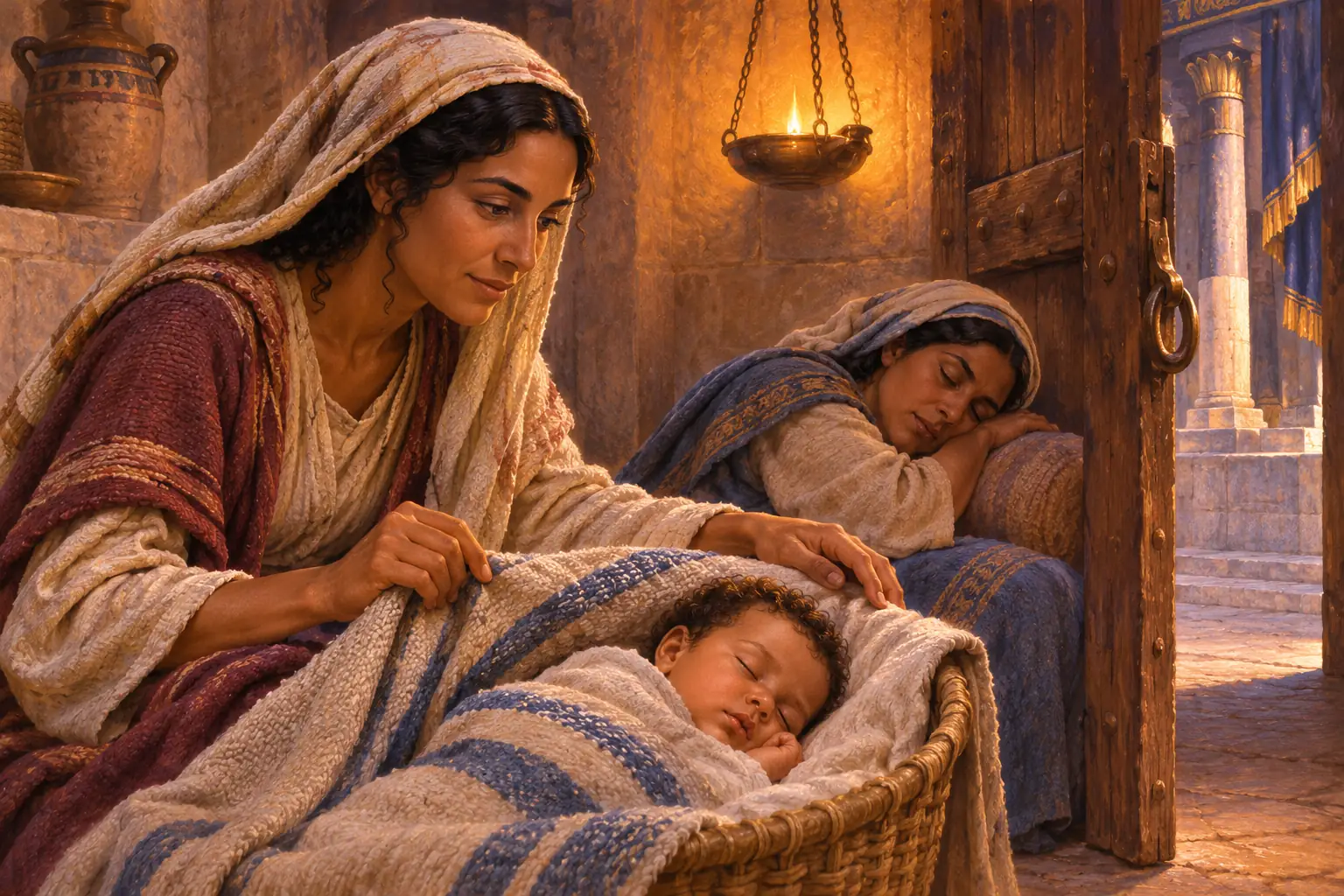
How can protecting a child embody covenant faithfulness amid destructive royal power?
Study overview
The throne is occupied, but the promise is hunted. Counsel becomes a trap; kinship becomes a battlefield. Then one woman carries a child through a doorway. Behind the temple walls, a future still breathes.
Passage: 2 Chronicles 22:1–12 Controlling metaphor: A child sheltered behind the temple door Heart-question: When corrupt leadership threatens the next generation, where can covenant hope survive, and what courage does preservation require?
Introduction: The Door No One Must Notice
Sometimes a community survives because someone quietly protects a vulnerable person. A teacher defends a student; a caregiver shelters a child while powerful people fight for position.
Second Chronicles 22 contrasts destructive influence and courageous protection. Ahaziah follows ruinous advisers; Athaliah attacks the royal family. Jehoshabeath rescues an endangered child without an army, through courage and a safe place.
This text is about a kingdom threatened with extinction becoming a hidden place of covenant preservation. The Chronicler directs attention through terrible violence toward a surviving child. What must God's people protect when power has forgotten its purpose?
Historical and Literary Context: The Lamp Needs Shelter
Chapter 21 ends with Jehoram's dishonored death, yet God promises not to destroy David's house because of the covenant and the continuing lamp (2 Chr 21:7; 2 Sam 7:12–16). Chapter 22 brings that lamp close to extinction. Ahaziah inherits a compromised household; his death enables Athaliah's seizure of power.
The Chronicler writes for a community acquainted with ruined monarchy and restored temple worship. How can David's promise endure under a usurper? The heir is hidden in the house of God (22:12). The temple, usually protected by Davidic rulers, now shelters the Davidic future (Sailhamer 1983).
The fuller events appear in 2 Kings 8:25–11:3. Chronicles shortens the northern political history to emphasize Judah's disastrous alliances and the preservation of David's line (Japhet 1993; Klein 2012). Textual difficulty: Some Hebrew copies of 22:2 give Ahaziah's age as forty-two, while 2 Kings 8:26 gives twenty-two. Jehoram died at forty (2 Chr 21:20); many scholars therefore recognize a copying problem. The difference should not be concealed.
Walking Through the Text
When the Youngest Son Inherits a Wounded Crown (22:1–2)
Jerusalem's inhabitants establish Ahaziah, Jehoram's youngest son, as king. Raiders accompanying the Arabians had killed the older sons (21:16–17; 22:1). The dynasty has lost princes, property, and stability.
Ahaziah reigns only one year. The account names Athaliah, connected to Omri's dynasty, as the new king's mother (22:2). The crown passes to a son, but advisers shape its direction.
The Chronicler's concern is not the youth of the king alone. The question is whose voice shapes the crown.
When Advice Becomes a Road Toward Destruction (22:3–4)
Ahaziah walks in the ways of Ahab's house. Athaliah counsels the king toward evil; other members of Ahab's household become advisers after Jehoram's death. The narrator twice stresses counsel and then supplies the verdict: their advice leads to Ahaziah's ruin (22:3–4).
The repeated language exposes a desire for security through influence without submission to God. Practical-sounding advice can value access above righteousness.
The passage judges named individuals, not women in leadership. Another woman soon acts courageously (22:11). Faithfulness, not gender, is the distinction.
When a Political Visit Becomes a Fatal Crossing (22:5–6)
Following the advisers, Ahaziah joins Joram, son of Ahab, in war against Hazael of Aram at Ramoth-gilead. Joram is wounded and returns to Jezreel. Ahaziah visits the wounded king (22:5–6).
The concern is the wider allegiance drawing Judah into Ahab's orbit. Jehoshaphat had earlier survived a nearly fatal partnership with Ahab (18:1–34). Now another Davidic king repeats the dangerous pattern.
A good-looking action cannot redeem a corrupt allegiance. Godly judgment asks not only whether an isolated action appears kind, but also whether the larger partnership is faithful.
When Judgment Finds the King Among His Allies (22:7–9)
The narrator declares that Ahaziah's downfall through this visit came from God (22:7). Jehu, commissioned against Ahab's dynasty, encounters Judah's princes and relatives attending Ahaziah, and kills them. Ahaziah is captured while hiding in Samaria and is put to death (22:7–9).
Divine judgment does not excuse every act of political killing. 2 Kings 9:27–28 presents Ahaziah's final movements differently; Chronicles selects details serving the account of Judah's dynastic crisis. The two narratives should not be forced into an invented precise itinerary.
Ahaziah receives burial because people remember Jehoshaphat, who sought the Lord wholeheartedly (22:9). An honored memory survives even when the descendant's choices betray that memory. Yet the royal household now has no one able to exercise kingship. The question of David's lamp becomes urgent.
When the Palace Turns Against Its Own Children (22:10)
Seeing that Ahaziah has died, Athaliah seeks to destroy the royal offspring of Judah (22:10). Children and relatives become obstacles to an ambitious ruler.
The violence reverses the vocation of kingship. Authority intended to protect the covenant people becomes a threat to the vulnerable. The next verse interrupts the destruction with an exception.
A palace can be filled with guards and still become unsafe. True security begins when those entrusted with authority refuse to sacrifice people for power.
When a Hidden Child Keeps the Promise Alive (22:11–12)
Jehoshabeath, daughter of Jehoram and sister of Ahaziah, takes Joash, Ahaziah's young son, from among the children marked for death. Jehoshabeath hides the boy with his nurse in a bedroom. As the wife of Jehoiada the priest, Jehoshabeath can also protect Joash within the temple community (22:11).
No spectacular rescue appears: preservation comes through a courageous relative, a caregiver, a priestly household, and the house of God. Joash remains hidden there six years, while Athaliah rules the land (22:12).
Here the narrative's deepest reversal emerges: the Davidic kings were called to care for the temple; now the temple shelters the Davidic heir (Sailhamer 1983). The child preserves hope, yet six years of hiding show that deliverance remains incomplete.
Theological Reflection: Hope Behind the Door
God's Covenant Outlasts the Failure of Its Guardians
God's promise to David is not dependent on Ahaziah's wisdom or Jehoram's character (2 Sam 7:12–16; 2 Chr 21:7). The survival of Joash illustrates the continuation of that promise, not divine approval of every Davidic ruler. Postexilic hope needs no romanticized monarchy.
Counsel Shapes the Future of a Community
The vocabulary of counsel in 22:3–5 is a warning. Leaders can surround themselves with respected names while becoming resistant to God's ways (Ps 1:1–3; Prov 12:15). Test advice by truth, justice, and protection—not prestige.
The House of God Must Be a Refuge, Not a Palace Annex
Jehoshabeath and Jehoiada offer protection when the throne becomes dangerous (22:11–12). The temple becomes a site of practical mercy. Worship and justice meet at a child's bedside; sacred space serves covenant life rather than decorating royal power. Churches must never conceal abuse. Safe refuge requires safeguarding and accountability.
The Hidden Heir Points Beyond a Fragile Dynasty
Joash is a real child who must be protected; later chapters show that Joash himself will not be a flawless savior (2 Chr 24:17–22). The story awaits the faithful Son of David (Luke 1:32–33). Jesus also faces royal hostility in childhood (Matt 2:13–18), without making the two accounts identical. The hope rests finally in Christ's faithful reign, not in the innocence or excellence of every human successor.
Life Application: Keep the Door Open to the Vulnerable
- Examine the voices around leadership. Ask whether advisers can disagree freely and whether Scripture, evidence, and the concerns of ordinary people shape decisions (22:3–4).
- Review dangerous partnerships. Refuse alliances that demand silence about injustice, even when political access or funding looks attractive (22:5–7).
- Protect children before institutional reputation. Establish safeguarding procedures, independent reporting, and immediate practical support when harm is threatened (22:10–11).
- Honor quiet protectors. Recognize caregivers, teachers, relatives, and volunteers whose faithful work seldom reaches the platform (22:11).
- Make worship spaces genuinely safe. Train trusted teams, supervise ministry responsibly, and cooperate with lawful protection systems; secrecy must never shield an abuser (22:11–12).
- Practice covenant memory without nostalgia. Remember Jehoshaphat's seeking of God while naming the failure of later rulers honestly (22:9; 21:7).
- Persevere through long seasons of uncertainty. Build sustainable care and patient community support when protection must continue for years rather than days (22:12).
Reflection Questions
- Whose counsel currently determines the direction of the family, church, or institution?
- Which partnership offers influence but quietly requires the surrender of conviction?
- Which vulnerable child or person needs protection rather than speeches about protection?
- Does the worshiping community offer safe, accountable refuge—or merely defend its reputation?
- What faithful action can preserve hope today even if public change remains six years away?
Response Prayer
God of David's lasting lamp, look upon houses darkened by fear. Expose counsel that leads toward ruin. Restrain power that turns against children and neighbors. Give Your people the courage of Jehoshabeath, the patient care of an unnamed nurse, and the integrity needed to make the house of worship a refuge. Teach us to protect the vulnerable without hiding wrongdoing. Guard the small beginnings of renewal when the throne seems captured and the door must remain quietly watched. Through Jesus Christ, the faithful Son of David, keep covenant hope alive and make our obedience courageous. Amen.
Window into What Comes Next
The story pauses outside a hidden room. Athaliah holds the throne; Joash remains alive inside God's house. Second Chronicles 23 will show Jehoiada gathering priests, Levites, and courageous allies to bring the concealed heir into the light. Will the house that protected the child also become the place where covenant leadership is restored?
Annotated Bibliography
- Dillard, Raymond B. 2 Chronicles. Word Biblical Commentary 15. Waco, TX: Word Books, 1987. Examines the dynastic crisis and the theological weight of the survival of Joash.
- Hill, Andrew E. 1 & 2 Chronicles. NIV Application Commentary. Grand Rapids: Zondervan, 2003. Connects faithful leadership, destructive counsel, and covenant preservation with contemporary application.
- Japhet, Sara. I & II Chronicles: A Commentary. Old Testament Library. Louisville: Westminster John Knox, 1993. Illuminates the Chronicler's selection and shaping of the parallel traditions in Kings.
- Klein, Ralph W. 2 Chronicles: A Commentary. Hermeneia. Minneapolis: Fortress, 2012. Provides close attention to literary detail, historical questions, and textual variation.
- Sailhamer, John. First and Second Chronicles. Everyman's Bible Commentary. Chicago: Moody Press, 1983. Highlights the striking reversal in which the temple protects the Davidic promise.
- Williamson, H. G. M. 1 and 2 Chronicles. New Century Bible Commentary. Grand Rapids: Eerdmans, 1982. Places the preservation of David's line within the Chronicler's postexilic hope.
Be the first to leave a comment.