

How can renewed leadership place the crown under God’s word?
Study overview
Six years behind a guarded door; one kingdom beneath a stolen crown. Then courage gathers at the gates, and an old promise steps into daylight. The child receives a crown; the people must recover a covenant.
Passage: 2 Chronicles 23:1–21 Controlling metaphor: The temple door opening for the hidden heir Heart-question: What does faithful renewal require when the rightful promise has survived, but worship and public leadership have been captured by fear?
Introduction: When the Door Must Open
Protection and restoration are not the same task. A family may shelter a child from violence; eventually the child needs justice. A congregation may preserve faith through trouble; eventually preservation must become public faithfulness.
For six years, Joash remained hidden in God's house while Athaliah ruled Judah (2 Chr 22:12). In chapter 23, the priest Jehoiada moves from safeguarding the child to rebuilding the public life of the covenant. The opening phrase is decisive: Jehoiada “took courage” (23:1).
This text is about a promise preserved in secret becoming public covenant renewal through courageous, ordered worship. The heart-question reaches beyond a change of ruler: What must be repaired when a community finally opens the door to a new beginning?
Historical and Literary Context: A Temple Keeping David's Lamp
Athaliah's seizure of power threatened the line promised to David (2 Sam 7:12–16; 2 Chr 21:7; 22:10–12). The hidden Joash embodied a vulnerable continuity. Yet the Chronicler does not portray the palace rescuing the temple. For a time, the temple rescues the Davidic future (Sailhamer 1983).
The parallel in 2 Kings 11:4–20 emphasizes military arrangements. Chronicles highlights the Levites, priests, Sabbath service rotations, temple boundaries, singers, and the orders of David (23:2, 4–8, 13, 18–19). The Chronicler portrays government restored under covenant worship (Japhet 1993; Klein 2012).
For postexilic readers without a Davidic monarch, the story nurtures hope without nostalgia. The promise was not dead; the community's task was to seek God faithfully around the house of worship.
Walking Through the Text
When Courage Calls the Scattered Together (23:1–3)
In the seventh year, Jehoiada makes a covenant with five named commanders of hundreds (23:1). The names matter: renewal requires accountable people. The commanders travel through Judah, gathering Levites from the towns and heads of Israelite families to Jerusalem (23:2).
The assembly meets in the house of God and covenants with the king. Jehoiada announces the surviving royal son, appealing to what the Lord said concerning David's descendants (23:3). The priest does not invent a new claim to power; Jehoiada recalls an older promise.
The desire is security through faithful belonging, not mere survival under a usurper. Courage first takes the form of gathering the community around God's word.
When the Gates Are Guarded with Holy Care (23:4–7)
Jehoiada assigns groups of priests and Levites to guard the temple gates, the royal house, and the Gate of the Foundation. The people remain in the temple courts (23:4–5). Entry into the inner sanctuary remains restricted to those authorized for sacred service (23:6).
The Levites must surround Joash with weapons (23:7). These are emergency arrangements in an ancient royal crisis, not a standing command for Christians to defend religion by violence. The contrast is between Athaliah's destructive power and coordinated protection.
Holiness is not disorder. The doorway that sheltered Joash now requires safety and accountability.
When David's Weapons Stand Beside God's Testimony (23:8–11)
The Levites and all Judah follow Jehoiada's instructions. Even Sabbath rotation matters: the outgoing and incoming groups both remain, strengthening protection (23:8). Jehoiada distributes spears and shields associated with David, kept in God's house (23:9).
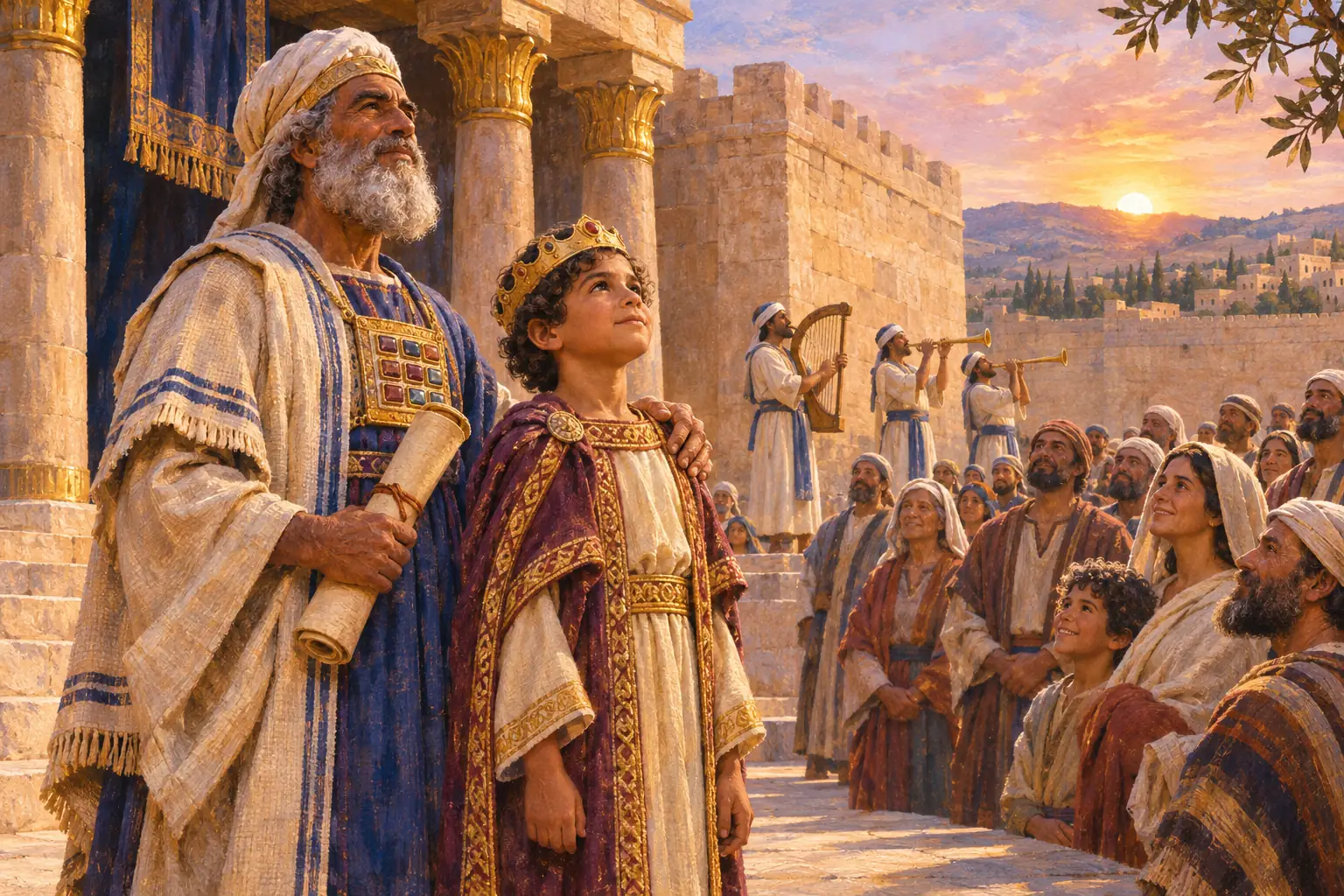
The placement is striking. Davidic weapons surround the altar, but the king also receives the testimony when Joash is crowned and anointed (23:10–11). The testimony may be a covenant document or instruction for kingship; its form is debated (cf. Deut 17:18–20). The theological point is unmistakable: the crown stands under God's word, not above it.
The people acclaim Joash. The promise steps into daylight, but a crown cannot repair worship.
When the Usurper Calls Renewal Treason (23:12–15)
Athaliah hears the people's noise and enters the temple. Joash stands in the appointed royal place; commanders and trumpeters surround the king; singers with instruments lead public praise (23:12–13). Athaliah tears royal clothing and cries, “Treason! Treason!” (23:13).
The irony is deliberate: the ruler who seized the throne denounces the restoration of David's heir. Jehoiada orders Athaliah removed from the sacred precincts. Athaliah is killed at the Horse Gate near the palace (23:14–15).
The account reports political and religious violence, including a death sentence. The narrative does not authorize Christian vigilantism or religious persecution. The church's Lord rejects the sword as the way to advance his kingdom (Matt 26:52; John 18:36). Moral seriousness requires naming the bloodshed, not polishing it away.
When the Covenant Reaches Beyond the Crown (23:16–19)
Jehoiada establishes a covenant involving the priest, the people, and the king, so that they may be the Lord's people (23:16). That is the chapter's center. The goal is not merely a different person on the throne; belonging to the Lord must shape public life.
The people demolish Baal's sanctuary, break its images, and kill Mattan, Baal's priest (23:17). These acts belong to an ancient covenant kingdom, not to Christian models of worship.
Jehoiada then restores temple oversight through priests and Levites according to Moses' Law and David's arrangements, with offerings, joy, and song (23:18). Gatekeepers guard the sanctuary's purity (23:19). The Chronicler lingers over ordinary worship structures because renewal needs more than one triumphant day.
When the Procession Returns to the Throne (23:20–21)
Commanders, dignitaries, leaders, and all the people escort Joash from the temple through the Upper Gate to the palace. Joash sits on the royal throne (23:20). The movement reverses the earlier crisis: the house that guarded the heir now sends the heir into public responsibility.
The people rejoice, and the city is quiet (23:21). The quiet follows Athaliah's execution; the narrative does not erase that moral weight. Nevertheless, the final image is not the sword but a community emerging from fear into ordered public life.
The door has opened. The greater question is whether the heart of the kingdom will stay open to God.
Theological Reflection: A Throne Under the Word
God's Promise Survives Through Ordinary Courage
David's lamp is not preserved through the brilliance of kings. Jehoshabeath's earlier rescue, Jehoiada's courage, and the faithful coordination of priests, Levites, and people carry the promise forward (2 Chr 21:7; 22:11–12; 23:1–3). The God of covenant memory works through people prepared to act.
True Renewal Places Power Under Covenant Responsibility
The king is crowned with the testimony (23:11), then included in the covenant that the people shall belong to the Lord (23:16). Kingship is accountable to divine instruction, recalling Deuteronomy 17:18–20. Leadership that claims God's favor while escaping correction contradicts this scene.
Worship Is a Public Practice, Not a Palace Decoration
Chronicles emphasizes Sabbath shifts, Levitical service, singers, sacrifices, and gatekeepers (23:8, 13, 18–19). Renewal needs practices that cultivate holiness and joy. Yet ancient purity regulations must not become an excuse for excluding vulnerable people from Christian care (Isa 56:6–7; Mark 11:17).
The True Son of David Builds a Greater House
Joash survives to wear the crown, but 2 Chronicles 24 will reveal the fragility of Joash's later faithfulness. The story longs for the faithful Son of David, ruling without coercion (Luke 1:32–33). Jesus speaks of the temple through the sign of his own death and resurrection (John 2:19–22); God's people become a dwelling built in Christ (Eph 2:19–22). The promise finds its lasting foundation beyond any palace.
Life Application: Open the Doors to Faithful Renewal
- Turn quiet protection into accountable reform. After safeguarding someone in danger, establish lasting systems of safety, care, and independent reporting (22:11–12; 23:1–3).
- Build courageous teams rather than heroic personalities. Invite trustworthy members, including overlooked worship workers, to share responsibility and test decisions (23:1–2).
- Place leadership under Scripture and review. Make finances, authority, safeguarding, and discipline transparent; give leaders a genuine path to receive correction (23:11, 16).
- Prepare carefully without glorifying force. Plan safe gatherings and lawful responses to threats; reject intimidation and religious violence (23:4–7, 14–15).
- Restore the weekly work of worship. Support teaching, music, prayer, hospitality, and careful stewardship beyond special ceremonies (23:18–19).
- Name destructive loyalties without targeting people. Repent of idols such as status, money, or political access, while protecting freedom of conscience (23:16–17).
- Measure peace by justice and care. Ask whether children, workers, and those without influence can live safely—not merely whether public conflict has stopped (23:20–21).
Reflection Questions
- What promise or responsibility has the community protected privately but hesitated to practice publicly?
- Whose courage, often unnoticed, has kept faith and compassion alive?
- Does the community's leadership stand under God's word and meaningful accountability?
- Which neglected structures of worship, safety, or justice need rebuilding now?
- Is the apparent peace of the community rooted in trust and righteousness, or only in the silence of fearful people?
Response Prayer
God of David's enduring promise, open the doors fear has kept closed. Give courage like Jehoiada's, care like Jehoshabeath's, and faithfulness like those who guarded the child. Let every crown bow beneath Your word. Restore the altar of prayer, the labor of teaching, the welcome of the gate, and the song of the congregation. Keep us from confusing Your kingdom with the violence of earthly thrones. Protect the vulnerable, correct the powerful, and teach us to seek peace through truth and justice. Through Jesus Christ, the faithful Son of David, make Your people a living house of worship. Amen.
Window into What Comes Next
The temple doors have opened, and the child sits on David's throne. But 2 Chronicles 24 asks what happens when a young king's faith rests too heavily on the presence of a wise mentor. Joash will repair the temple—and later fail the covenant. Can a repaired house sustain a heart that has not learned to seek God for itself?
Annotated Bibliography
- Dillard, Raymond B. 2 Chronicles. Word Biblical Commentary 15. Waco, TX: Word Books, 1987. Explores the succession crisis, Jehoiada's reform, and the Chronicler's cultic interests.
- Hill, Andrew E. 1 & 2 Chronicles. NIV Application Commentary. Grand Rapids: Zondervan, 2003. Relates covenant leadership and communal renewal to responsible contemporary practice.
- Japhet, Sara. I & II Chronicles: A Commentary. Old Testament Library. Louisville: Westminster John Knox, 1993. Illuminates the Chronicler's theological reshaping of the Kings narrative.
- Klein, Ralph W. 2 Chronicles: A Commentary. Hermeneia. Minneapolis: Fortress, 2012. Provides close attention to temple personnel, literary structure, and historical questions.
- Sailhamer, John. First and Second Chronicles. Everyman's Bible Commentary. Chicago: Moody Press, 1983. Stresses the reversal in which the temple protects David's dynasty and becomes a focus of postexilic hope.
- Williamson, H. G. M. 1 and 2 Chronicles. New Century Bible Commentary. Grand Rapids: Eerdmans, 1982. Situates restored worship and the Davidic promise within the Chronicler's wider purpose.
Be the first to leave a comment.