

How can sanctuary restoration be tested through justice and a willingness to listen?
Study overview
Fresh stones strengthen the sanctuary; willing hands fill the chest. But when the faithful priest is gone, a different voice commands the court. The house stands restored while covenant memory bleeds at its threshold.
Passage: 2 Chronicles 24:1–27 Controlling metaphor: A repaired temple surrounding an unrepaired heart Heart-question: Can a community restore sacred buildings without cultivating the faithfulness that makes restoration meaningful?
Introduction: A Beautiful House, an Unguarded Heart
A renovated church can shine while congregational trust deteriorates. New paint may cover old cracks, and fundraising may coexist with leaders who refuse correction. Repairing hearts is harder than repairing walls.
Joash knows both experiences. Rescued from Athaliah and raised by Jehoiada, Joash restores the temple. Yet Joash later authorizes Jehoiada's son to be murdered in its courtyard (2 Chr 22:11–12; 24:21).
This text is about outward restoration becoming an exposed test of inward covenant faithfulness. Temple repairs matter. But can a restored house remain holy when leaders stop listening to God?
Historical and Literary Context: A King Measured by the House
Second Chronicles 21–23 traces a collapsing dynasty and the preservation of David's heir through the temple. Chapter 24 tests what the rescued heir will do with this gift. Joash's reign begins with restoration and ends with betrayal. The Chronicler links the turning point to Jehoiada's death (24:2, 15–18).
2 Kings 12 also recounts Joash's temple repairs, but Chronicles makes the later apostasy, prophetic warnings, and Zechariah's death central to the king's evaluation (Japhet 1993; Klein 2012). The narrative turns on the contrast between repairing God's house and forsaking God's house (24:4, 18). The priest and the prophet become essential witnesses to the kind of king Judah needs (Sailhamer 1983).
For a postexilic community, renewed worship spaces were gifts, not guarantees of obedience. The prophets still called people to return (2 Chr 6:24–25; 24:19).
Walking Through the Text
When a Young King Walks in Another's Wisdom (24:1–3)
Joash ascends the throne at seven and reigns forty years in Jerusalem. The Chronicler names Joash's mother, Zibiah of Beersheba, and notes Jehoiada's role in arranging marriages and establishing the royal household (24:1–3).
The decisive qualification comes in verse 2: Joash does right during Jehoiada's lifetime. Early obedience is genuine, but has Joash learned to seek God without his mentor?
Good teachers are gifts; mature discipleship must grow beyond borrowed convictions.
When the Damage Beneath the Dust Is Named (24:4–7)
Joash resolves to restore the Lord's house. The king instructs priests and Levites to collect contributions throughout Judah, but the Levites do not act promptly (24:4–5). Joash challenges Jehoiada about the collection associated with Moses and the tent of testimony (24:6; cf. Exod 30:11–16). This contribution is not simply interchangeable with every modern church offering.
Verse 7 discloses the damage's spiritual source: Athaliah's household had violated the sanctuary and diverted dedicated objects to Baal worship. Worship decays when other loyalties consume its resources.
Joash refuses to normalize the ruins; lasting reform needs deeper roots.
When a Chest at the Gate Becomes an Act of Trust (24:8–14)
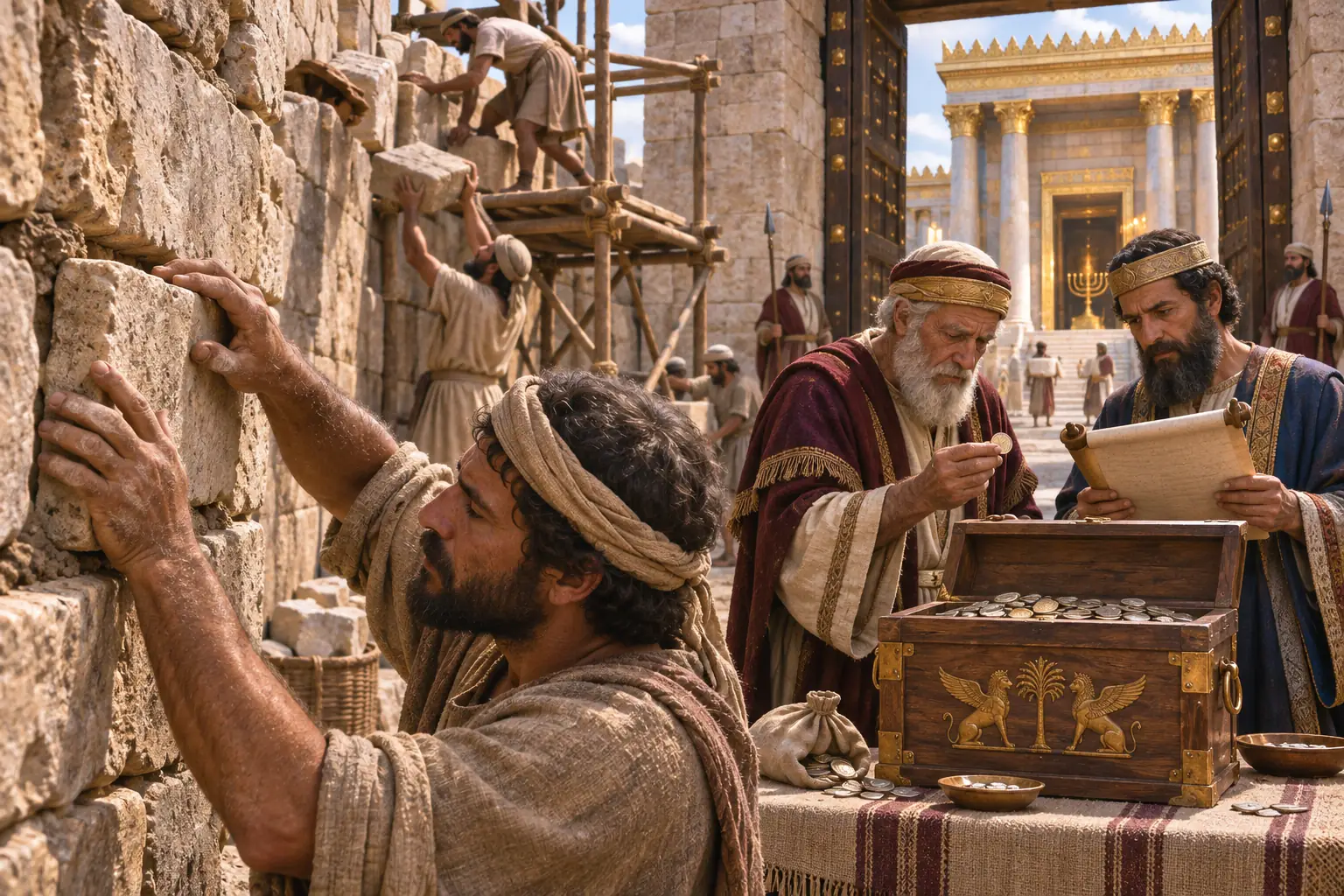
A chest is placed outside the temple gate, and a public appeal goes throughout Judah and Jerusalem. Leaders and people respond with joy (24:8–10). Two representatives—the royal secretary and the high priest's officer—regularly empty the chest, providing shared oversight rather than leaving the money in one person's hands (24:11).
The funds employ masons, carpenters, and iron-and-bronze workers. The sanctuary is restored and strengthened; remaining funds provide vessels for temple service. Burnt offerings continue throughout Jehoiada's lifetime (24:12–14).
The Chronicler joins labor, accounting, and worship. Generosity becomes skilled work and responsible stewardship. Yet throughout Jehoiada's lifetime anticipates tragedy.
When the Priest Is Honored but His Teaching Is Abandoned (24:15–19)
Jehoiada dies at 130, and Judah buries the priest among the kings, honoring service rendered to God, the temple, and Israel (24:15–16). The priest without a crown receives royal honor.
After Jehoiada's death, Judah's officials bow before Joash, and the king listens to their counsel. The rulers abandon the Lord's house and serve Asherah symbols and idols (24:17–18). The contrast is painful: the people celebrated giving to God's house; influential voices now encourage forsaking the God of that house.
God sends prophets to call the people back, but the warnings are refused (24:19). Judgment is not portrayed as arriving without warning. Mercy first speaks, and the leaders refuse to hear. Honoring a mentor cannot replace obeying the mentor's teaching.
When the Repaired Courtyard Receives a Prophet's Blood (24:20–22)
The Spirit of God clothes Zechariah, Jehoiada's son. From a raised position, the prophet confronts the people: transgressing God's commands prevents the flourishing that covenant faithfulness brings; forsaking the Lord brings the terrible consequence of being forsaken (24:20).
Instead of repenting, the people conspire. By Joash's command, Zechariah is stoned in the courtyard of the Lord's house (24:21). The location indicts the king: a restored sanctuary becomes the scene of prophetic murder.
Verse 22 underlines failed memory: Joash does not remember Jehoiada's kindness. Zechariah's dying appeal asks the Lord to see and call the crime to account. The passage does not authorize religious retaliation today. The temple stones have been repaired. Covenant gratitude, justice, and listening have collapsed.
When the Crown Loses the Honor Given to the Priest (24:23–27)
At year's end a relatively small Aramean force attacks Judah, destroys leading officials, and carries spoil to Damascus. Chronicles interprets the reversal as judgment because Judah abandoned the Lord (24:23–24). Numbers, weapons, and royal status cannot secure a people who reject God's instruction.
The attackers leave Joash seriously wounded. Joash's servants then murder the king on his bed because of the bloodshed associated with Jehoiada's family (24:25–26). Political murder is described, not prescribed.
The burial comparison completes the tragedy: Jehoiada is buried among the kings; Joash is buried in David's city but not in the royal tombs (24:16, 25). The priest built God's house; the king betrayed the household that saved him. Amaziah succeeds Joash (24:27). The Davidic line continues, but the repaired temple bears witness against an unfaithful crown.
Theological Reflection: Restoration Must Reach the Heart
Borrowed Faith Cannot Replace a Personally Formed Heart
Joash's early faithfulness is real, yet bounded by Jehoiada's life (24:2, 17). The Chronicler exposes security through another person's convictions. Mentors can guide but cannot replace wholehearted seeking. Israel's call to love the Lord with the whole heart remains personal and communal (Deut 6:4–9).
Sacred Buildings Must Serve Sacred Justice
The chest, shared accounting, artisans, and temple vessels display commendable communal devotion (24:8–14). But a restored courtyard becomes a place of bloodshed (24:21). The paradox recalls prophetic rebukes against worship divorced from justice (Isa 1:11–17). A renovated sanctuary cannot excuse silencing victims or protecting abusers.
Prophetic Correction Is a Form of Covenant Mercy
God sends prophets before invasion (24:19–20). Zechariah's Spirit-empowered warning offers a road back, though the warning is rejected. Jesus later laments the killing of prophets and evokes Zechariah's blood in the temple tradition (Luke 11:49–51; cf. Matt 23:35, where the patronymic raises a textual-identification question). The church must test teaching by Scripture while refusing coercion and violence.
Judgment Does Not Extinguish the Davidic Promise
Joash dies dishonored, yet Amaziah succeeds to David's throne (24:25–27; cf. 21:7). Covenant continuity is not approval of royal evil. The story longs for a faithful king who never persecutes God's messengers. Jesus, the faithful Son of David, confronts corrupt worship and identifies his body as the temple raised through resurrection (John 2:13–22; Luke 1:32–33). God's people are called to become a dwelling shaped by that faithfulness (Eph 2:19–22).
Life Application: Repair More Than the Walls
- Audit both buildings and relationships. When fundraising for repairs, also examine conflicts, neglected teaching, and safeguarding failures (24:4–7, 21).
- Use transparent financial controls. Share oversight of offerings, publish accounts, pay workers fairly, and explain completed work (24:8–14).
- Develop convictions that endure leadership changes. Study Scripture and pray with others without making obedience dependent on one admired pastor or mentor (24:2, 17).
- Welcome truthful correction. Create channels where members, workers, and young people can raise concerns without retaliation (24:19–22).
- Honor mentors by practicing their teaching. Remember faithful elders through justice, gratitude, and continued service—not ceremonies alone (24:15–18).
- Protect vulnerable witnesses. Treat allegations of intimidation or harm seriously; seek lawful protection and independent investigation rather than institutional concealment (24:21–22).
- Measure reform over time. Revisit decisions after celebrations have ended. Ask whether worship, mercy, and moral courage have deepened (24:14, 17–19).
Reflection Questions
- What has been repaired visibly while spiritual or relational damage remains hidden?
- Whose approval has become more important than obedience to God's Word?
- Are financial practices clear enough to earn the community's trust?
- Who speaks difficult truth in the congregation, and what happens after that voice is heard?
- Which kindnesses, commitments, or covenant responsibilities have leaders forgotten?
Response Prayer
Lord of the house and the heart, thank You for every faithful worker, every generous giver, and every teacher who guards the light. Do not let fresh stones conceal unrepentant hearts. Help leaders receive correction, congregations protect witnesses, and disciples seek You beyond beloved mentors. Remember those harmed in places that should have offered refuge. Restore justice in the courts, honesty at the collection chest, and reverence at the altar. Through Jesus Christ, the faithful Son of David, rebuild the heart of Your people. Amen.
Window into What Comes Next
Joash leaves a repaired sanctuary and a wounded legacy. 2 Chronicles 25 introduces Amaziah, a king who begins by doing what is right, but not with a whole heart. Can outward obedience stand when divided loyalties are left untreated? The next chapter carries the warning forward.
Annotated Bibliography
- Dillard, Raymond B. 2 Chronicles. Word Biblical Commentary 15. Waco, TX: Word Books, 1987. Examines the literary contrast between Joash's temple reform and later apostasy.
- Hill, Andrew E. 1 & 2 Chronicles. NIV Application Commentary. Grand Rapids: Zondervan, 2003. Connects worship, leadership accountability, and covenant obedience with contemporary discipleship.
- Japhet, Sara. I & II Chronicles: A Commentary. Old Testament Library. Louisville: Westminster John Knox, 1993. Analyzes the Chronicler's distinctive presentation of Joash alongside Kings.
- Klein, Ralph W. 2 Chronicles: A Commentary. Hermeneia. Minneapolis: Fortress, 2012. Explores the prophetic speeches, temple-centered narrative, and historical questions.
- Sailhamer, John. First and Second Chronicles. Everyman's Bible Commentary. Chicago: Moody Press, 1983. Highlights Jehoiada's teaching role, the rejection of prophets, and hope beyond judgment.
- Williamson, H. G. M. 1 and 2 Chronicles. New Century Bible Commentary. Grand Rapids: Eerdmans, 1982. Places reform, apostasy, and Davidic continuity within the Chronicler's postexilic message.
Be the first to leave a comment.