

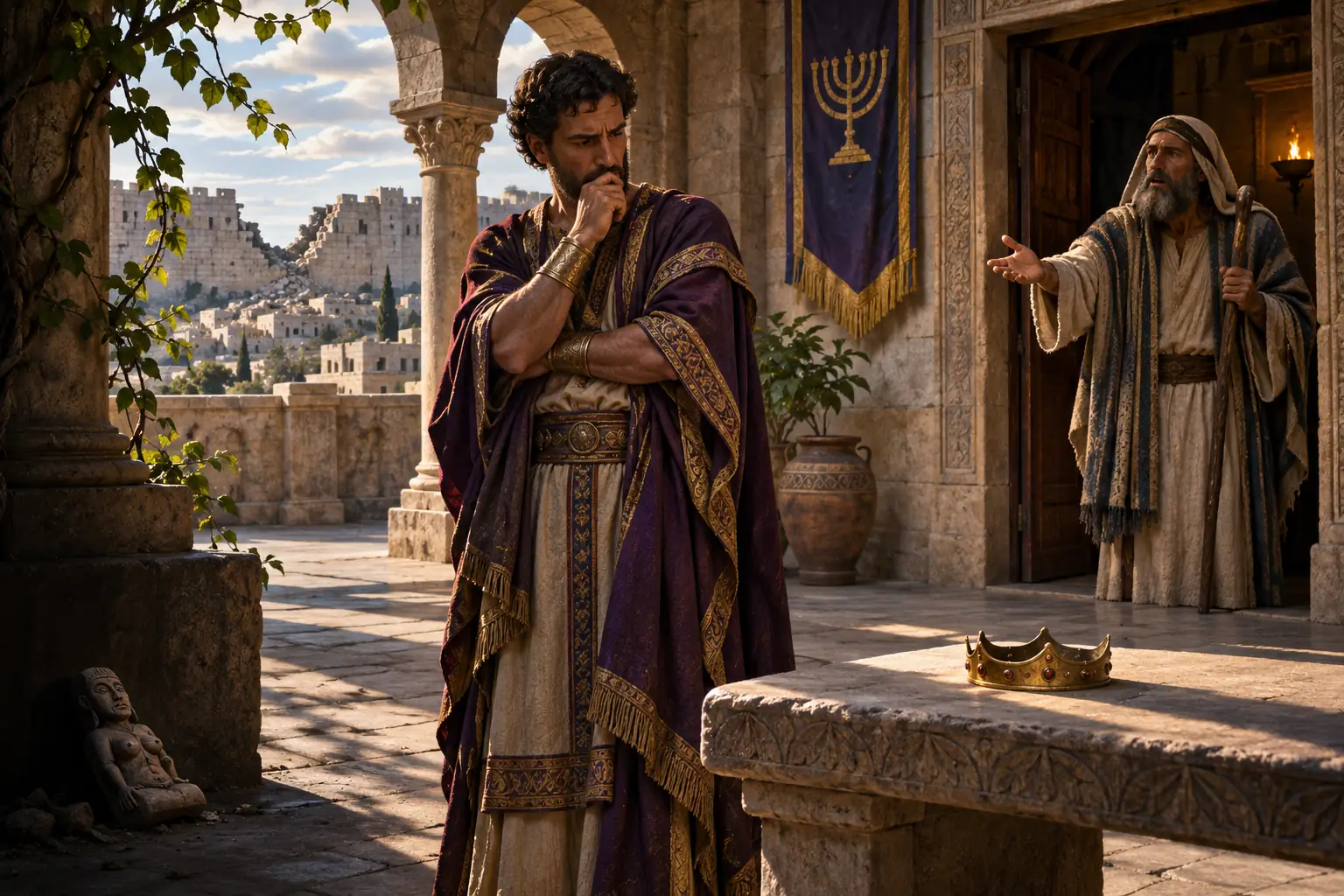
How can costly obedience continue after victory rather than give way to pride?
Study overview
One hand releases hired soldiers at a prophet's word. Another hand lifts the idols of a defeated nation. A crown can sit securely on the head while loyalty fractures in the heart.
Passage: 2 Chronicles 25:1–28 Controlling metaphor: A crown resting over a divided heart Heart-question: Can occasional obedience sustain a life whose deepest loyalties remain divided?
Introduction: The Danger of Being Right Only Sometimes
A leader may make one costly, courageous decision and later refuse the simplest correction. A congregation may defend biblical truth while quietly adopting the values of the surrounding culture. Faithfulness in yesterday's crisis cannot substitute for surrender today.
Amaziah's reign begins with the narrator's troubling qualification: the king does what is right before the Lord, but not with a whole heart (25:2). Amaziah respects Moses' law, listens to a prophet, and wins a battle. Yet victory becomes the doorway to idolatry, pride, national humiliation, and death.
This text is about partial obedience becoming a crisis of divided worship. The question is not whether Amaziah can obey once, but whether the crown will remain under the authority of the Lord when success offers competing gods.
Historical and Literary Context: The Heart Beneath the Crown
Second Chronicles 25 follows Joash's betrayal of the priestly family that once saved the Davidic dynasty (24:20–25). Amaziah inherits a wounded throne. The Chronicler addresses a later community whose survival depends on remembering that royal position and public achievement cannot replace wholehearted seeking.
Second Kings 14:1–20 shares the accession, punishment of the assassins, victory over Edom, defeat by Israel, and Amaziah's death. Chronicles expands the prophetic encounters and explicitly explains the king's collapse through idolatry and refusal to listen (25:7–10, 14–16, 20; Japhet 1993; Klein 2012). The Chronicler's evaluation in verse 2 governs the whole narrative.
The chapter recalls earlier warnings about dangerous alliances (19:2; 20:35–37), God's ability to save without numerical superiority (14:11), and a kingdom's obligation to heed the Law of Moses (25:4; Deut 24:16). For readers after exile, the issue is urgent: restoration must be more than a temporary burst of reform.
Walking Through the Text
When Justice Refuses to Become Revenge (25:1–4)
Amaziah becomes king at twenty-five, reigns twenty-nine years in Jerusalem, and is identified through his mother, Jehoaddan (25:1). The royal evaluation appears immediately: right conduct, not a whole heart (25:2).
Once Amaziah secures the throne, the king executes the servants who murdered Joash. Yet Amaziah does not execute their children, honoring the command in Moses' law that individuals answer for their own wrongdoing (25:3–4; Deut 24:16). This restraint matters. Royal grief does not authorize indiscriminate punishment.
The Chronicler begins with genuine obedience, not a caricature of an entirely evil king. The weakness lies deeper: correct decisions have not yet become settled allegiance.
When Obedience Costs a Hundred Talents (25:5–10)
Amaziah organizes Judah and Benjamin, numbering 300,000 fighting men. Seeking greater security, the king hires 100,000 soldiers from the northern kingdom for one hundred talents of silver (25:5–6).
A man of God warns against taking the northern troops: the Lord will not support that arrangement. God has power to help or to bring down (25:7–8). Amaziah's first concern is financial: What will happen to the paid silver? The prophet replies that the Lord can give much more (25:9).
Amaziah dismisses the hired soldiers despite the loss. Their anger foreshadows the raids in verse 13. The prophet's warning concerns this military partnership and the northern kingdom's covenant unfaithfulness; the passage does not declare every Israelite beyond God's mercy (cf. 11:16; 15:9).
Here obedience is measurable: relinquished money, reduced visible strength, and angry associates. Faith is not merely agreeing with truth but accepting its cost.
When Victory Leaves Blood on the Rocks (25:11–13)
Amaziah leads Judah against Edom in the Valley of Salt. Judah defeats 10,000 men of Seir; another 10,000 captives are thrown from a cliff and killed (25:11–12). Meanwhile, the dismissed northern soldiers raid Judean towns, kill 3,000, and carry away plunder (25:13).
The narrative records both victory and horrifying violence. The Chronicler associates Amaziah's success with obedience to prophetic counsel, but the account does not explicitly praise the killing of captives. Biblical description must not become modern permission for atrocities. The fuller biblical witness calls God's people to reject vengeance and love enemies (Rom 12:17–21; Matt 5:44).
The military outcome is therefore morally complex: a legitimate warning was obeyed; dreadful losses still followed. Success cannot erase the suffering left on the battlefield and in the villages.
When the Victor Bows to Defeated Gods (25:14–16)
After defeating Edom, Amaziah brings home the gods of Seir, makes them personal objects of worship, bows before them, and burns incense (25:14). The irony is devastating: the king worships gods unable to rescue their own people.
God sends a prophet who asks precisely that question (25:15). Instead of answering, Amaziah threatens the messenger: Who appointed the prophet as royal adviser? The prophet stops speaking and warns that God has determined judgment because Amaziah has acted wickedly and rejected counsel (25:16).
The contrast with verses 7–10 is deliberate. Earlier, Amaziah listens and accepts loss; now Amaziah silences correction after gaining victory. A heart divided by pride can tolerate God's voice during danger but resent the same voice during success (Sailhamer 1983).
When a Thistle Challenges a Cedar (25:17–24)
Amaziah consults advisers and challenges Joash, king of Israel, to battle (25:17). Joash replies with a parable: a thistle in Lebanon seeks a marriage alliance with a cedar, but a wild animal tramples the thistle (25:18). The point is unmistakable: triumph over Edom has inflated Amaziah's pride. Joash advises the king to remain at home (25:19).
Amaziah refuses. Verse 20 interprets the disastrous decision within God's judgment because Judah has embraced Edomite gods; divine sovereignty does not remove Amaziah's responsibility for ignoring warnings.
Israel defeats Judah at Beth-shemesh. Amaziah is captured, a four-hundred-cubit section of Jerusalem's wall is broken down, and temple and palace treasures are seized. Hostages are taken to Samaria (25:21–24).
The king who feared losing one hundred talents now loses the kingdom's wealth and security. The damaged wall becomes an outward picture of an inward breach: pride has opened what careful obedience once guarded.
When the Throne Remains but the King Falls (25:25–28)
Amaziah lives fifteen years after Joash of Israel's death, but the closing account contains no portrait of renewed devotion (25:25). From the time Amaziah turns away from the Lord, a conspiracy develops. Amaziah flees to Lachish, is killed there, and is brought back for burial (25:27–28).
The text does not explain every conspirator's motive, nor does it authorize assassination. The final note identifies apostasy as the defining turning point. Amaziah's crown passes away; the question of the Davidic promise remains.
Theological Reflection: The Whole Heart God Seeks
Occasional Obedience Is Not Wholehearted Allegiance
The opening verdict, not with a whole heart, explains the king's contradictory choices (25:2). Deuteronomy calls Israel to love God with all heart and strength (Deut 6:4–5). Chronicles repeatedly asks whether kings seek the Lord beyond moments of urgent need (2 Chr 12:14; 16:12). Character is revealed by repeated surrender, not one impressive decision.
True Trust Can Require Accepting a Financial Loss
Amaziah's hundred talents expose the hidden desire for security without surrender (25:6–10). The prophet does not promise a risk-free life or an automatic repayment schedule. The prophet teaches that resources cannot replace God's help. Churches and families may likewise need to abandon profitable arrangements that compromise justice or conscience (Prov 16:8).
Idolatry and Pride Make Correction Sound Like an Insult
The gods of defeated Edom are powerless, yet Amaziah bows to them and threatens the messenger who exposes the contradiction (25:14–16; cf. Isa 44:9–20). Idolatry is not confined to carved images: money, reputation, and control can become rival centers of trust (Col 3:5). Faithful communities need courageous truth-tellers and leaders willing to listen.
Judgment Exposes False Kingship; Hope Looks Beyond It
Jerusalem's breached wall exposes the consequences of royal self-deception (25:23). Yet Chronicles continues David's story, anticipating a king whose devotion will not fracture. Jesus, the faithful Son of David, resists the temptation to worship for worldly power (Matt 4:8–10) and leads through humility rather than domination (Phil 2:5–11). The path toward God's renewed dwelling begins with truthful worship and a whole heart (Eph 2:19–22).
Life Application: Guard the Heart Beneath the Crown
- Name the divided loyalty. Identify one decision in which reputation, income, or political advantage competes with God's instruction (25:2, 14).
- Accept the real cost of obedience. End an unjust contract or compromised partnership even when deposits, relationships, or opportunities are lost (25:6–10).
- Practice proportionate justice. Reject collective blame in homes, congregations, and institutions; investigate individual responsibility fairly (25:3–4).
- Refuse to romanticize victory. Count the cost borne by opponents, prisoners, neighbors, and families; refuse cruelty even when defending a legitimate cause (25:11–13).
- Keep correction safe. Give trusted people permission to question leaders; never intimidate those who raise biblical or ethical concerns (25:15–16).
- Review decisions after success. Invite prayerful scrutiny when a ministry grows, a project succeeds, or public praise increases (25:14, 19).
- Repair breaches before collapse. Where pride has damaged trust, confess specific wrongdoing, return what was taken, seek reconciliation, and accept accountability (25:21–24).
Reflection Questions
- Where does public obedience conceal a private divided heart?
- What financial loss am I unwilling to accept for faithfulness?
- Whose suffering has been ignored in celebrating an apparent victory?
- Which truthful voice do leaders dismiss as unwelcome interference?
- What practical repentance could rebuild a wall already weakened by pride?
Response Prayer
Lord of the undivided heart, look beneath the crown, beneath public service, beneath every successful campaign. Expose the small idols carried home after victory. Give courage to release costly compromises, wisdom to practice justice, and gentleness to receive correction. Remember those wounded by the battles of the powerful. Repair the walls that pride has broken; restore truthful worship where false security has taken Your place. Through Jesus Christ, the faithful Son of David, teach Your people to seek You with the whole heart. Amen.
Window into What Comes Next
Amaziah's divided heart leaves Judah wounded. 2 Chronicles 26 introduces Uzziah, a king who seeks God and grows strong—until strength itself becomes a temptation. Will success deepen reverence, or will the crown again forget its limits?
Annotated Bibliography
- Dillard, Raymond B. 2 Chronicles. Word Biblical Commentary 15. Waco, TX: Word Books, 1987. Examines Amaziah's contradictory reign and the narrative logic of judgment.
- Hill, Andrew E. 1 & 2 Chronicles. NIV Application Commentary. Grand Rapids: Zondervan, 2003. Connects royal decisions, prophetic counsel, and faithful leadership.
- Japhet, Sara. I & II Chronicles: A Commentary. Old Testament Library. Louisville: Westminster John Knox, 1993. Discusses the Chronicler's distinctive additions to the parallel in Kings.
- Klein, Ralph W. 2 Chronicles: A Commentary. Hermeneia. Minneapolis: Fortress, 2012. Analyzes literary structure, political history, and theological evaluation.
- Sailhamer, John. First and Second Chronicles. Everyman's Bible Commentary. Chicago: Moody Press, 1983. Emphasizes Amaziah's initial obedience, later idolatry, and rejection of prophecy.
- Williamson, H. G. M. 1 and 2 Chronicles. New Century Bible Commentary. Grand Rapids: Eerdmans, 1982. Situates Amaziah's rule within the Chronicler's postexilic appeal for wholehearted loyalty.
Be the first to leave a comment.