

How can success deepen humility and respect for the limits of authority?
Study overview
The king builds towers high above Jerusalem. Then a hand carrying incense reaches beyond its calling. Strength that once received God's help now resents God's limits.
Passage: 2 Chronicles 26:1–23 Controlling metaphor: A censer carried across a forbidden threshold Heart-question: When God makes us strong, will strength produce grateful service or the conviction that no boundary applies?
Introduction: When Success Stops Listening
Success tests faith. A struggling leader may welcome counsel; an admired leader may mistake applause for permission. A church may confuse impressive buildings and growing finances with divine approval.
Uzziah begins capably: Judah gains security, agriculture flourishes, and fame spreads. Yet the story turns: when Uzziah became strong, his heart became proud (26:16). The tower-builder eventually carries a censer into a priestly responsibility.
This text is about God-given strength becoming destructive presumption when humility disappears. Will success inspire worship—or an attempt to control worship?
Historical and Literary Context: The Crown and the Sanctuary
After Amaziah's divided loyalty and humiliating defeat (2 Chr 25), Judah installs Uzziah, also called Azariah in Kings (2 Kgs 15:1–7). Uzziah reigns for fifty-two years, a long period of achievement and eventual disgrace. The Chronicler addresses a community rebuilding covenant life after disaster.
Second Kings 15:1–7 gives a brief account of Uzziah's reign and illness. Chronicles expands the story, detailing public achievements, priestly resistance, and the spiritual cause of the king's exclusion (Japhet 1993; Klein 2012). The house of the Lord, not military glory, becomes the decisive measure of royal life.
The chapter recalls Amaziah's decline after success (25:14–16) and the law assigning incense service to Aaron's priests (Exod 30:7–8; Num 18:1–7). Uzziah's final years also invite comparison with Isaiah's vision of the Lord enthroned in the year of Uzziah's death (Isa 6:1–5).
Walking Through the Text
When a Young King Learns to Seek God (26:1–5)
The people make Uzziah king at sixteen. Uzziah rebuilds Eloth, reigns fifty-two years in Jerusalem, and is identified through his mother, Jecoliah (26:1–3). The opening evaluation is favorable: Uzziah does what is right before the Lord (26:4).
Uzziah seeks God during the days of Zechariah, a teacher associated with understanding the fear of God (26:5). This Zechariah's identity is uncertain; the text does not equate him with chapter 24's murdered priest. The refrain is central: as Uzziah sought the Lord, God helped Uzziah prosper.
Strength begins with teachability and continued seeking. Yet the reference to Zechariah foreshadows a question: will devotion remain when the teacher's influence no longer restrains the king?
When Help Becomes Visible Across the Borders (26:6–8)
Uzziah campaigns against the Philistines, breaks walls at Gath, Jabneh, and Ashdod, and establishes settlements in Philistine territory. God helps Uzziah against other neighboring groups, including Arabians and Meunites (26:6–7). The Ammonites pay tribute; Uzziah's reputation reaches toward Egypt (26:8).
The narrator repeatedly locates the source of strength beyond the king: God helped. Uzziah's military success is not presented as a self-created triumph. Ancient warfare and tribute do not authorize modern expansion or exploitation.
Fame can outpace humility and obscure God's help.
When Towers Rise and Fields Are Cultivated (26:9–10)
Uzziah strengthens Jerusalem's defenses at the Corner Gate, Valley Gate, and Angle, building towers and fortifying them. Additional towers and cisterns support livestock across the countryside (26:9–10).
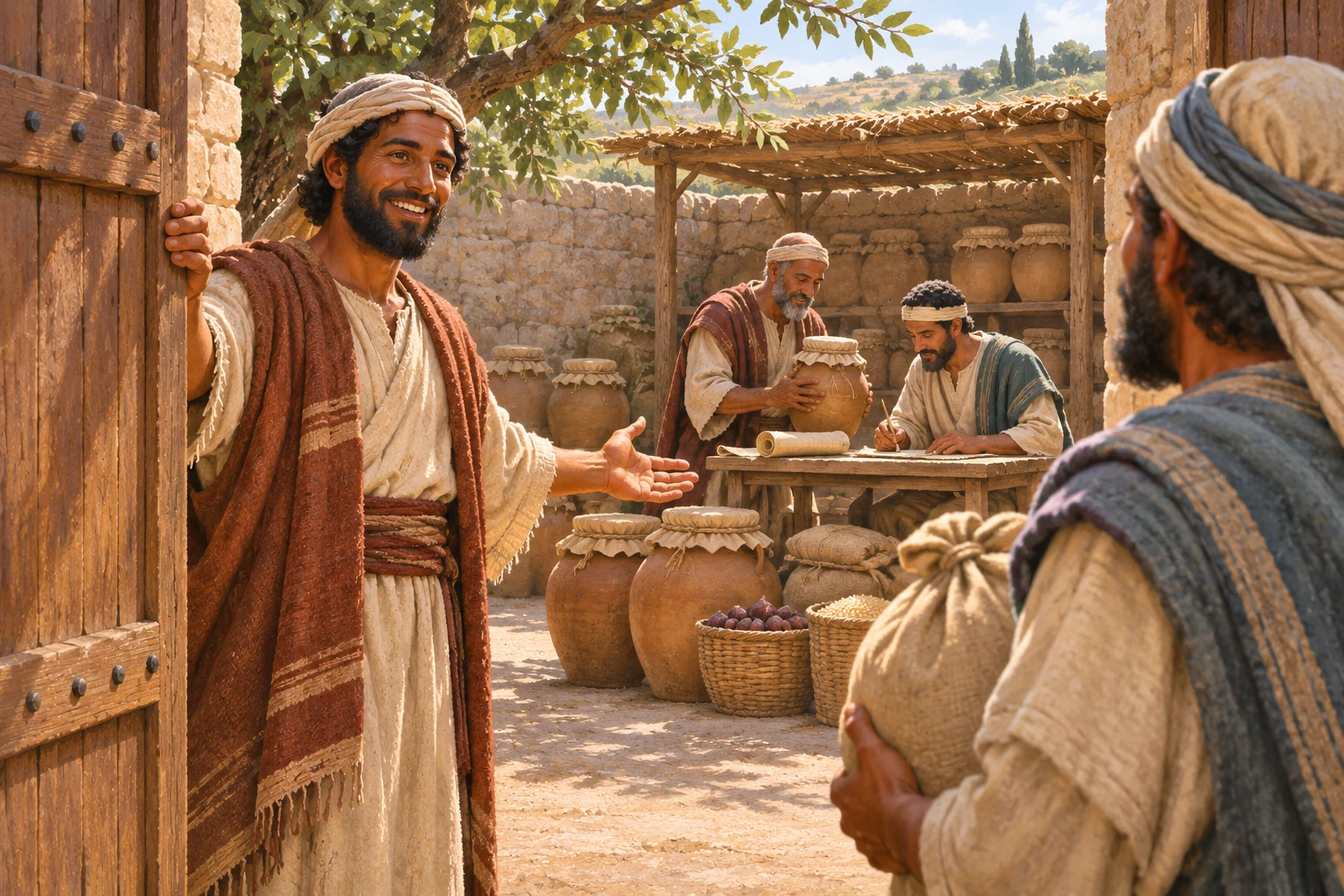
Uzziah employs farmers and vine-dressers because Uzziah loves the soil (26:10). The Chronicler refuses to reduce a successful kingdom to battles and palaces. Water, pastures, cultivated hills, and laboring households also sustain public life.
The details recall cultivating creation (Gen 2:15). Good leadership protects livelihoods. Yet irrigation, walls, and productive farms remain gifts to steward, not proof that the king is beyond correction.
When Engineering Makes the Kingdom Strong (26:11–15)
Uzziah organizes fighting forces under officers and commanders. The Chronicler reports 2,600 heads of families and 307,500 capable warriors, supplied with shields, spears, helmets, armor, bows, and slingstones (26:11–14).
Skilled workers construct defensive devices for towers and corners, described as equipment able to send arrows and large stones (26:15). The text does not explain the precise mechanics; modern reconstructions must remain tentative. The achievement is nevertheless striking: administration, craftsmanship, and military preparedness work together.
Uzziah was wonderfully helped until he became strong (26:15)—a celebration with a warning. Strength is a gift; strength is also the setting in which gratitude may decay into self-sufficiency.
When the Censer Crosses the Sacred Line (26:16–18)
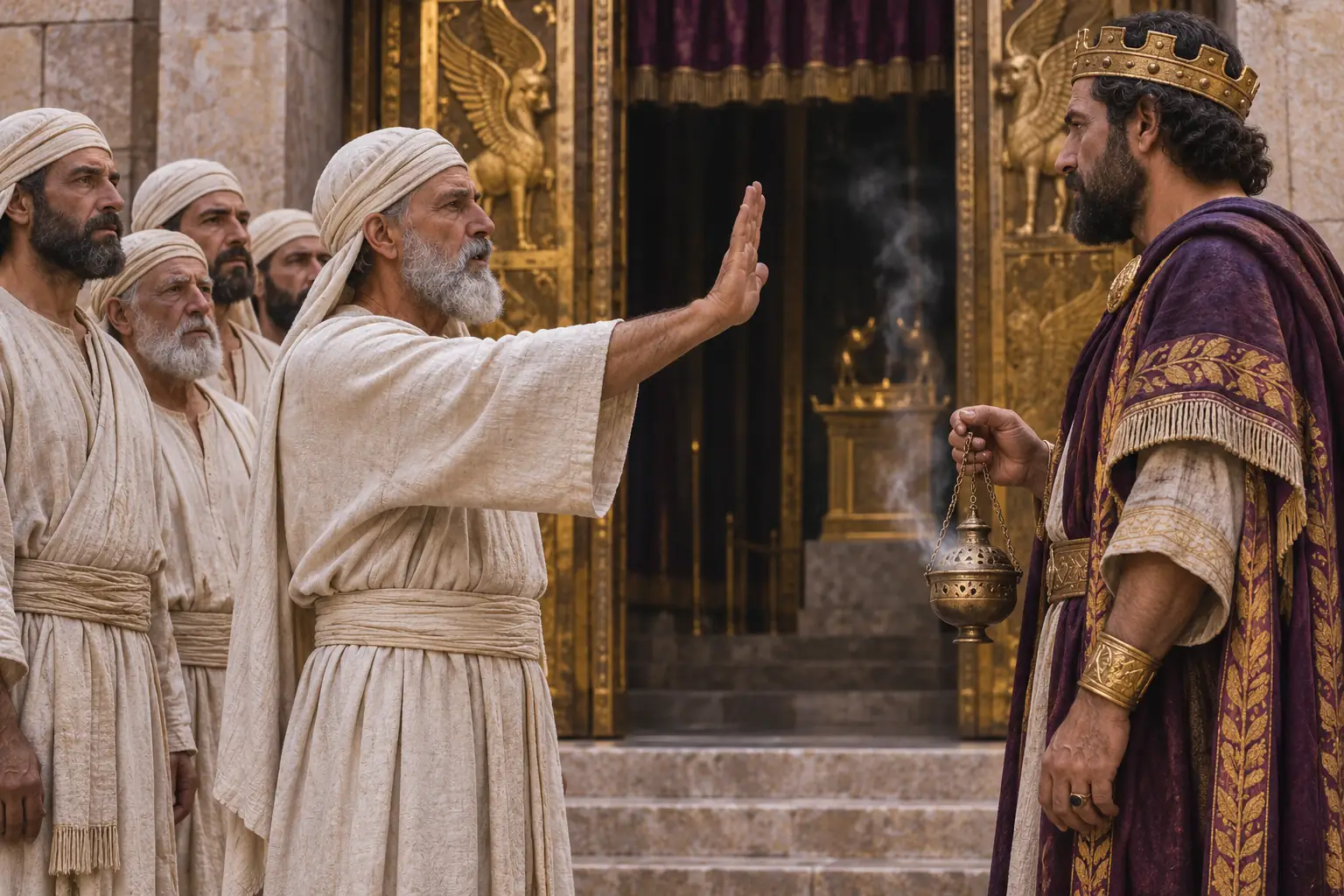
The turning point arrives with but: once strong, Uzziah becomes proud, acts unfaithfully, and enters the temple to burn incense on its altar (26:16). The problem is not a king praying or valuing worship. The problem is claiming a consecrated priestly duty that the Lord assigned to Aaron's descendants (Exod 30:7–8; Num 18:1–7).
Azariah the priest, accompanied by eighty courageous priests, follows and confronts the king (26:17–18). Azariah insists that royal authority cannot override priestly calling and commands Uzziah to leave.
This scene is not a struggle over professional jealousy. The Chronicler portrays a holy boundary safeguarding worship from unchecked power. The priests risk displeasing the most powerful person in the kingdom. Faithful resistance sometimes means telling a successful leader no.
When the Forehead Bears the Cost of Pride (26:19–23)
Uzziah becomes angry while holding the censer. A serious skin condition appears on Uzziah's forehead, in the temple before the priests (26:19–20). Many translations use leprosy, but the ancient Hebrew category covers conditions wider than the modern medical diagnosis of Hansen's disease (Lev 13). The narrative explicitly interprets this particular affliction as divine judgment; that interpretation must not be imposed on people experiencing illness today.
Uzziah leaves urgently and remains in a separate residence, excluded from the temple for the rest of his life. Jotham, Uzziah's son, manages the royal household and governs the people (26:21). The account ends with Isaiah named as a recorder of Uzziah's reign and with burial in a field belonging to the royal cemetery rather than the customary royal graves (26:22–23).
The tragedy is theological as well as personal. A descendant of David, whose line was associated with preparing God's house, becomes excluded from that house (1 Chr 17:12; Sailhamer 1983). Uzziah has towers and a throne but cannot enter the sanctuary. Greatness cannot command holiness.
Theological Reflection: Strength Under the Holy King
Seeking God Must Outlive Success
Verses 5 and 16 deliberately contrast seeking God with pride after prosperity. The Chronicler celebrates help received, not a formula guaranteeing wealth or health to every believer. God's gifts cannot become evidence that the recipient no longer needs God's instruction. A ministry's growth must deepen dependence, not silence examination (Deut 8:11–18).
Holiness Places Limits on Every Office
The censer signifies a responsibility entrusted to the priests. Kingship, however distinguished, cannot absorb every role. The Lord's people require accountability, proper stewardship, and courage to oppose misuse of authority (Num 18:7; 2 Chr 26:17–18). No pastor, president, donor, or board stands above correction. Honoring spiritual boundaries must also protect people from abuse rather than shelter powerful institutions.
Uncleanness Is Not a License to Stigmatize
Uzziah's exclusion makes the cost of covenant unfaithfulness visible within this narrative (26:21). The Bible does not teach that every illness is a punishment for individual sin (John 9:1–3). Jesus touches and restores people marginalized by skin disease (Mark 1:40–45). The church must offer medical care, dignity, and fellowship, not shame. Christ, the faithful high priest, opens access to God's mercy (Heb 4:14–16; 10:19–22).
Human Thrones Fall; God's Throne Remains
Uzziah dies, but Isaiah sees the Lord enthroned in the year of the king's death (Isa 6:1–5). The canonical juxtaposition does not prove the two accounts occurred simultaneously; it reveals an enduring theological contrast. Royal strength passes away. Divine holiness remains. In Jesus, the humble Son of David, authority is expressed through obedience and service rather than grasping privilege (Phil 2:5–11).
Life Application: Set Down the Censer
- Audit success honestly. After a promotion, financial gain, or growing ministry, name whom God used to help and where accountability has weakened (26:5, 15–16).
- Protect distinct responsibilities. Establish clear roles for pastors, elders, treasurers, caregivers, and boards; refuse unilateral control over worship or finances (26:17–18).
- Make correction possible. Give trusted colleagues safe channels to challenge leaders without threats, retaliation, or loss of employment (26:17–18).
- Value the fields beyond the walls. Invest in water, livelihoods, farming, and practical community care alongside visible buildings and ceremonies (26:9–10).
- Refuse to weaponize illness. Visit and support sick people; seek competent healthcare and never claim to know God's secret judgment over a diagnosis (26:19–21; John 9:3).
- Respond to rebuke without anger. When confronted with misuse of power, stop the disputed conduct, listen, confess, and cooperate with an independent review (26:18–20).
- Measure legacy by faithfulness. Ask whether public accomplishments are matched by humility, truthful worship, repaired relationships, and protection of vulnerable people (26:21–23).
Reflection Questions
- Which accomplishment has made my heart less willing to receive counsel?
- What sacred responsibility am I tempted to seize because I possess influence or resources?
- Who can tell our leaders the truth without suffering retaliation?
- Whose health or dignity has been harmed by careless religious judgments?
- What practical act of humility would show that God's help matters more than my reputation?
Response Prayer
Holy Lord, giver of strength and keeper of the sanctuary, save us from carrying proud hands across boundaries You have placed. Teach us to remember every unseen helper, every field that must be tended, every worker who deserves dignity. Give courage to those who must speak truth before powerful people, and humility to those who must listen. Where anger has entered the house of worship, restore reverence. Where illness has brought isolation, let compassion open the door. Under the reign of Jesus Christ, teach Your people to serve without grasping and to seek You when strength is greatest. Amen.
Window into What Comes Next
Uzziah's reign ends outside the temple, and Jotham assumes responsibility for Judah. 2 Chronicles 27 introduces a king who strengthens the temple without repeating Uzziah's intrusion. Yet the people continue in corruption. Can a leader walk rightly before God when communal renewal remains incomplete?
Annotated Bibliography
- Dillard, Raymond B. 2 Chronicles. Word Biblical Commentary 15. Waco, TX: Word Books, 1987. Explores the structural contrast between Uzziah's achievements and pride.
- Hill, Andrew E. 1 & 2 Chronicles. NIV Application Commentary. Grand Rapids: Zondervan, 2003. Connects royal leadership, holy service, and accountability.
- Japhet, Sara. I & II Chronicles: A Commentary. Old Testament Library. Louisville: Westminster John Knox, 1993. Examines Chronicles' expanded portrayal alongside Kings.
- Klein, Ralph W. 2 Chronicles: A Commentary. Hermeneia. Minneapolis: Fortress, 2012. Discusses the literary organization and priestly boundaries.
- Sailhamer, John. First and Second Chronicles. Everyman's Bible Commentary. Chicago: Moody Press, 1983. Highlights seeking God and the irony of a Davidic king barred from God's house.
- Williamson, H. G. M. 1 and 2 Chronicles. New Century Bible Commentary. Grand Rapids: Eerdmans, 1982. Places Uzziah's decline in the Chronicler's theology of covenant faithfulness.
Be the first to leave a comment.