

How can faithful leadership nurture communal repentance without replacing the people’s response?
Study overview
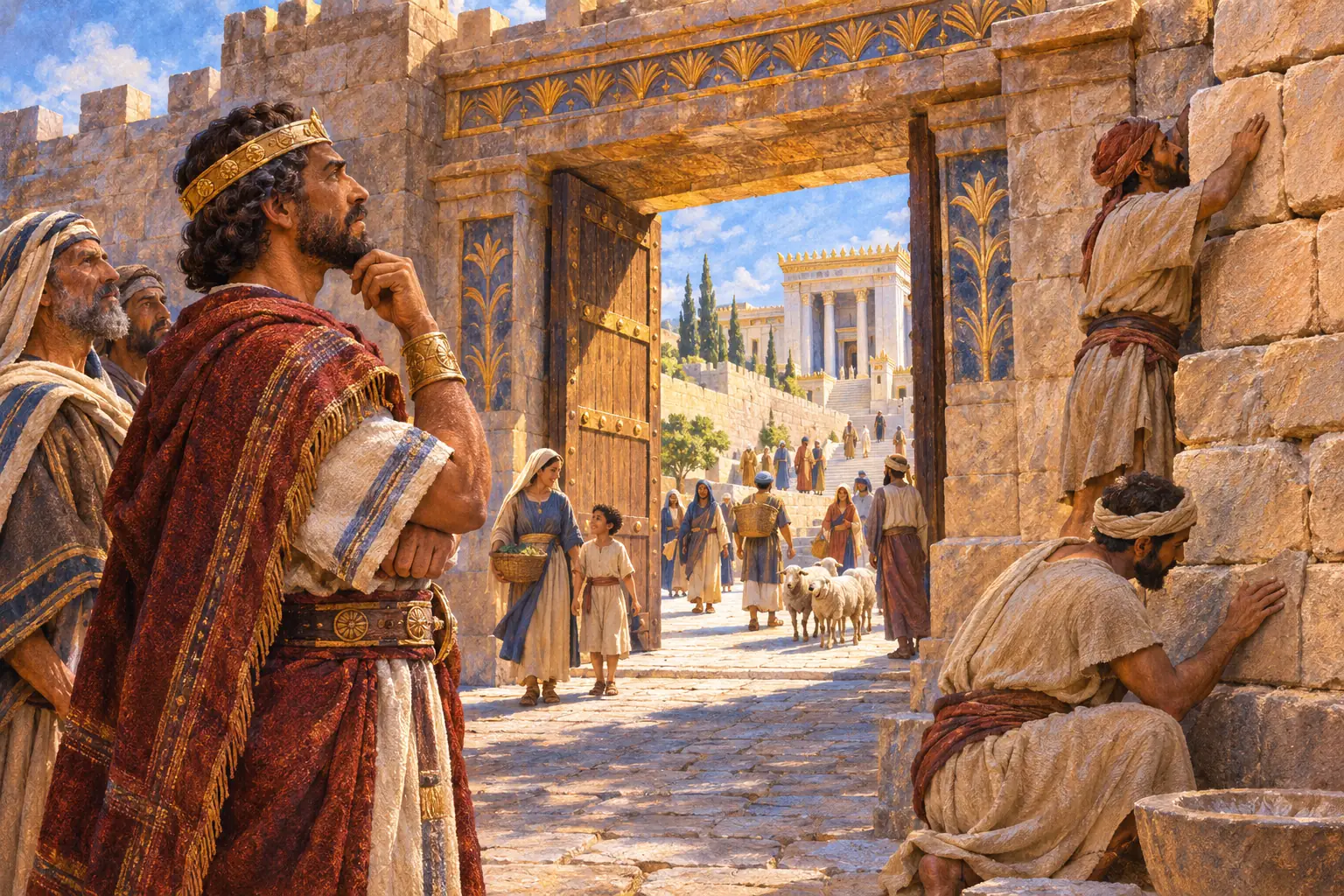
The king repairs the entrance to God's house. The walls rise, and Judah grows strong. Yet beyond the gate, a people still wander from the Lord.
Passage: 2 Chronicles 27:1–9 Controlling metaphor: A temple gate built beside neglected hearts Heart-question: Can a leader's faithfulness renew a community that refuses to share the same obedience?
Introduction: When the Gate Looks Better Than the People
Buildings can be repaired faster than communities renewed. A church paints its sanctuary while family resentments and dishonest practices remain. The entrance looks beautiful; the common life remains wounded.
Jotham offers a quieter chapter after Uzziah's dramatic disgrace. The new king respects God's house, strengthens Judah, and walks steadily before the Lord. But one sentence interrupts the praise: “the people still followed corrupt practices” (27:2). Royal integrity and communal faithfulness diverge.
This text is about a newly built gate becoming a witness to a community whose heart remains unrepaired. How can personal faithfulness become shared obedience?
Historical and Literary Context: A Son Who Honors a Boundary
Second Chronicles 27 belongs to the Chronicler's account of Judah's kings, written for a community learning to worship and live faithfully after the devastation of monarchy and exile. The governing question: Does royal faithfulness draw the people toward covenant life?
In chapter 26, Uzziah's greatness collapsed when the king entered the temple to burn incense, claiming a priestly responsibility (26:16–21). Uzziah's son Jotham had already administered affairs while his father lived in isolation (26:21). Now the narrator says Jotham did right but did not invade the temple (27:2). The contrast concerns unauthorized intrusion, not refusal to worship (Sailhamer 1983; Japhet 1993).
Second Kings 15:32–38 supplies a parallel account. Kings says the high places remained and worship there continued (15:35); Chronicles summarizes the communal problem as corruption (27:2). Kings also mentions growing pressure from Rezin and Pekah (15:37), while Chronicles highlights Jotham's ordered conduct, temple-related building, and strength. The accounts emphasize different dimensions (Dillard 1987; Klein 2012).
Walking Through the Text
When a New Name Enters the Royal Record (27:1)
Jotham begins ruling at twenty-five, reigns sixteen years in Jerusalem, and is identified through his mother, Jerushah, daughter of Zadok. The details situate Jotham in David's line; the text does not identify his maternal grandfather with the earlier priest Zadok.
The brief introduction reminds the reader that royal life is received, not invented. Jotham inherits both the privileges of David's throne and the consequences of Uzziah's pride. Faithfulness means deciding which inheritance to preserve and which patterns to reject.
When a King Honors the Door but the People Wander (27:2)
The narrator gives Jotham a positive assessment: the king does what is right before the Lord, as Uzziah did in the earlier faithful years. Then comes the distinction: Jotham does not enter the temple in the presumptuous way his father did. Royal authority has limits (26:16–18; Num 18:7).
But the same verse adds: the people continue acting corruptly. A good leader does not automatically make a good nation. Second Kings 15:35 identifies continuing high-place worship.
Jotham rejects his father's sacrilege, but Judah's habits endure. Leadership must still invite deeper reform.
When the Upper Gate Rises (27:3)
Jotham builds the Upper Gate of the house of the Lord and carries out extensive construction on the wall of Ophel, the area of Jerusalem near the temple complex. Temple access and civic protection matter to covenant life.
The text offers no architectural plan or proof of inward renewal. After Uzziah violated the sanctuary's boundary, Jotham honors the house through appropriate work rather than unauthorized priestly action. The king must serve worship, not possess every sacred function.
Stone gates may rise quickly; truth and obedience take longer to restore.
When Fortresses Spread Across the Hills (27:4)
Jotham builds towns in Judah's hill country and fortresses and towers in its wooded areas. Settlements and rural households also require protection.
Stronger defenses do not cure corruption. Walls protect from external threats without removing greed or injustice within.
Counting structures is easier than repairing relationships.
When Victory Meets the Test of Ordered Ways (27:5–6)
Jotham prevails against the Ammonites. For three years, the account records tribute amounting annually to one hundred talents of silver, ten thousand cors of wheat, and ten thousand cors of barley (27:5). The sums show strength, but the text does not describe the cost borne by Ammonite families; victory does not justify modern coercion.
The narrator then states the chapter's interpretive center: “Jotham became strong because he ordered his ways before the LORD his God” (27:6). Strength flows from settled conduct before God, not occasional prayer.
Compare Uzziah, whose strength became the occasion for pride (26:15–16). Jotham becomes strong without repeating that recorded trespass. Strength may inspire humility or presumption; royal discipline has not produced communal holiness.
When the Chronicle Ends and a Shadow Enters (27:7–9)
The narrator refers readers to the Book of the Kings of Israel and Judah for Jotham's other deeds, wars, and ways. The king's age and sixteen-year reign are repeated; Jotham dies, is buried in the City of David, and Ahaz succeeds him.
The closing is restrained: Jotham remains faithful, but collective renewal is missing (Sailhamer 1983).
The appearance of Ahaz at the last verse darkens the horizon. Second Chronicles 28 will expose devastating unfaithfulness. Jotham is not blamed for Ahaz's choices; one faithful reign cannot guarantee the next generation's heart.
Theological Reflection: Beyond the Repaired Gate
Personal Integrity Cannot Replace Communal Repentance
Jotham's faithfulness deserves recognition (27:2, 6), but Judah's corruption refuses to disappear (27:2). Leaders must teach and model faithfulness; the people must respond. Covenant renewal cannot be delegated to a pastor, parent, or ruler (Deut 6:4–9; Josh 24:14–15).
Worship Requires Both Honored Boundaries and Changed Lives
Jotham's temple gate recalls Uzziah's violation (26:16–21; 27:2–3). Honoring sacred responsibility matters. But buildings and correct procedures are not substitutes for lives shaped by God. Isaiah and Micah, whose prophetic books name Jotham among Judah's kings, also confront worship divorced from justice (Isa 1:11–17; Mic 3:9–12). These warnings need not refer specifically to Jotham's building works.
Strength Is Fruit of Faithfulness, Not a Certificate of Perfection
Verse 6 celebrates ordered ways before God. Judah remains sinful; prosperity is no universal promise. Deuteronomy warns against forgetting the Lord when strength grows (Deut 8:11–18). Biblical leadership therefore asks not only, “What did we build?” but, “Whose ways are we learning to walk?”
The Davidic Hope Must Reach Deeper Than One Good King
Jotham is faithful, but the next reign will be disastrous. Monarchy alone did not heal Judah. The Davidic promise calls for a king whose reign will bring righteousness and restored covenant life (2 Sam 7:12–16; Isa 9:6–7). Jesus, the faithful Son of David, forms a people into a living dwelling for God rather than merely repairing a stone sanctuary (Eph 2:19–22; 1 Pet 2:4–10). Hope calls for shared holiness and reconciliation.
Life Application: Repair the Life Beyond the Gate
- Audit the community, not only the building. After a renovation or successful campaign, ask whether forgiveness, honesty, protection of children, and care for struggling families have improved (27:2–3).
- Respect role boundaries. Refuse to use pastoral, financial, or political influence to seize responsibilities entrusted to others; establish independent accountability (27:2; 26:17–18).
- Teach beyond the sanctuary. Create regular Bible conversations in homes and among young people; a functioning entrance cannot replace formed disciples (27:2; Deut 6:6–9).
- Invest beyond the capital. Remember distant villages, rural schools, farmers, and neglected congregations when assigning resources (27:4).
- Examine the hidden cost of prosperity. Ask whether institutional income depends on coercion, unjust wages, or the exploitation of weaker neighbors (27:5; Mic 6:8).
- Make faithfulness habitual. Establish a weekly rhythm of prayer, Scripture, shared decisions, and truthful financial reporting—not merely occasional ceremonies (27:6).
- Prepare the next generation deliberately. Mentor younger leaders, welcome difficult questions, and make integrity visible before another Ahaz inherits influence (27:9; 28:1–4).
Reflection Questions
- Which visible achievement has distracted our community from an unresolved moral or spiritual problem?
- Which boundary of authority must be restored before another leader crosses it?
- Are our children receiving only religious events, or a living pattern of truthful discipleship?
- Who remains vulnerable outside the walls of our programs and budgets?
- What act of confession, restitution, teaching, or shared accountability would show that our hearts are being repaired?
Response Prayer
Lord of the house and the people, thank you for faithful hands that repair neglected gates and protect vulnerable homes. Save us from admiring stone while neglecting hearts. Teach our leaders to honor holy boundaries, and teach our communities to walk the same faithful road. Expose injustice hidden beneath impressive projects; give us courage to repent, restore what has been taken, and teach the young. Let the gate of worship open toward truth, mercy, and obedience. Through Jesus Christ, the faithful Son of David, make your people a living house of your presence. Amen.
Window into What Comes Next
Jotham's reign closes quietly, but the final name is ominous. Ahaz takes the throne in 2 Chronicles 28. Under Ahaz, corrupt worship moves from a lingering problem toward deliberate royal rebellion. The next question is urgent: What happens when the throne itself begins leading people away from the God whom Jotham sought?
Annotated Bibliography
- Dillard, Raymond B. 2 Chronicles. Word Biblical Commentary 15. Waco, TX: Word Books, 1987. Examines the Chronicler's presentation of Jotham and the theological evaluation of Judah's kings.
- Hill, Andrew E. 1 & 2 Chronicles. NIV Application Commentary. Grand Rapids: Zondervan, 2003. Useful for connecting covenant faithfulness, worship, and responsibilities of leadership.
- Japhet, Sara. I & II Chronicles: A Commentary. Old Testament Library. Louisville: Westminster John Knox, 1993. Illuminates Chronicles' literary decisions and contrasts with the account in Kings.
- Klein, Ralph W. 2 Chronicles: A Commentary. Hermeneia. Minneapolis: Fortress, 2012. Provides historical and exegetical detail on the reign and its evaluation.
- Sailhamer, John. First and Second Chronicles. Everyman's Bible Commentary. Chicago: Moody Press, 1983. Emphasizes Jotham's respect for the temple and the lack of a corresponding revival among the people.
- Williamson, H. G. M. 1 and 2 Chronicles. New Century Bible Commentary. Grand Rapids: Eerdmans, 1982. Helps locate Jotham's brief reign within the larger Davidic and postexilic narrative.
Be the first to leave a comment.