

How can practical mercy open a road home while leaders close the doors of worship?
Study overview
The king closes the doors of the Lord's house. Across a divided land, strangers to mercy remember their brothers. As Jerusalem darkens, a road toward home remains open.
Passage: 2 Chronicles 28:1–27 Controlling metaphor: Closed temple doors and the open road of mercy Heart-question: What happens when those entrusted with worship abandon God, while unexpected neighbors begin practicing covenant mercy?
Introduction: When the Doors Close from Within
Sometimes a community loses its spiritual center because leaders abandon the purpose of God’s house. A sanctuary may stand while justice disappears, children suffer, and powerful people call desperation wisdom.
Ahaz inherits Judah's throne after Jotham's comparatively faithful reign. Ahaz deepens the national fracture. Altars multiply as trust declines. Yet northern leaders stop the enslavement of captives and escort the wounded home.
This text is about covenant abandonment becoming a national catastrophe, while mercy among wounded neighbors becomes a sign that returning is still possible. Who is shutting the doors of worship, and who is opening a road for the suffering?
Historical and Literary Context: The Road Toward Exile
Second Chronicles 28 belongs to the account of Judah's kings (2 Chr 10–28). The Chronicler addresses a post-disaster community asking why Judah failed and how covenant life might return. Why could the Davidic monarchy not protect Judah? The Chronicler highlights a ruler who responds to correction not with repentance but with greater unfaithfulness (28:22; Sailhamer 1983).
The historical setting is the eighth-century crisis involving Aram, northern Israel, Judah, and Assyria. Second Kings 16 recounts the political alliance and altered temple practices; 2 Chronicles 28 gives unusual space to the prophet Oded, the release of Judah's captives, and the closing of the temple. These are differing emphases, not contradictory purposes (Japhet 1993; Klein 2012).
Isaiah also addresses Ahaz's fearful court (Isa 7:1–9). Against schemes built on fear, the prophet calls for steadfast faith. The Chronicler shows the tragic alternative.
Walking Through the Text
When the Crown Builds Altars to Destruction (28:1–4)
Ahaz begins ruling at twenty, reigns sixteen years, and receives an emphatically negative evaluation: Ahaz does not do what is right as David did. The narrative catalogs molten Baal images, sacrifices at unauthorized shrines, and offerings beneath spreading trees. Most horrifying, Ahaz burns his children in the Valley of Ben-hinnom (28:3).
The worship language exposes Ahaz's distorted priorities: practices forbidden by Israel's covenant, including child sacrifice (Lev 18:21; Deut 12:31). When worship is corrupted, the vulnerable pay first. A throne without reverence can become an altar on which others are sacrificed.
When Brother Turns Against Brother (28:5–8)
The Lord gives Judah into the hands of Aram and Israel. Damascus receives captives; Pekah's forces inflict terrible losses. Chronicles reports 120,000 killed in one day and 200,000 women and children taken captive. Zichri kills prominent members of Ahaz's court, including a royal son.
The narrator attributes Judah's defeat to forsaking the Lord (28:6), but this does not make every victim personally guilty. Families suffer for decisions made by rulers and soldiers.
Notice the repeated family language: Israel takes people described as brothers and sisters (28:8, 11). The divided kingdom has become a divided family. Divine judgment on Judah does not make northern Israel morally innocent. The next scene makes that unmistakable.
When a Prophet Stands Before the Returning Army (28:9–11)
At Samaria, Oded, a prophet of the Lord, confronts victorious northern soldiers. Oded acknowledges that Judah was handed over because of God's anger. Then the prophet condemns the victors' excessive fury and their intention to enslave their relatives.
Oded asks whether Israel too has guilt before God. The question exposes deception: being used within God's judgment does not authorize cruelty. Victory does not confer ownership of defeated neighbors.
The command is practical, urgent, and costly: return the captives. Mercy begins not with a speech about unity, but with relinquishing people treated as property.
When Mercy Gives Sandals and a Ride Home (28:12–15)
Four Ephraimite leaders—Azariah, Berechiah, Jehizkiah, and Amasa—oppose the soldiers. The leaders confess northern Israel's own guilt and refuse to add another offense. The soldiers leave the captives and plunder with the assembly.
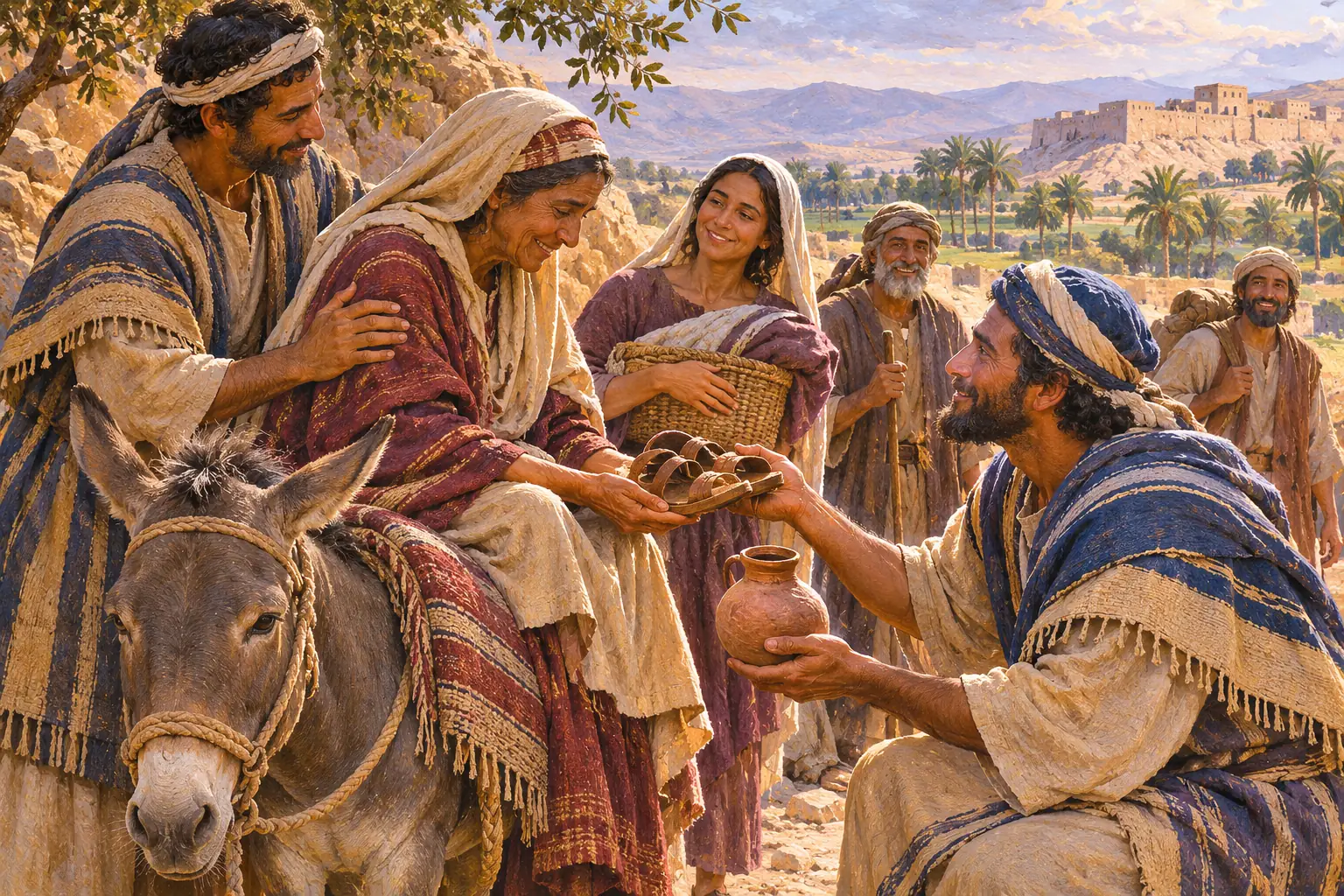
The named men then undertake a remarkable ministry: they clothe the exposed, provide sandals, give food and water, anoint the injured, and place the weak on donkeys. Finally, the caregivers bring the captives to their relatives at Jericho, the City of Palms, before returning to Samaria.
Each action answers a concrete deprivation. The return includes dignity, nourishment, transport, and family reunion. The captives need bread, not declarations of sympathy; the weak need transport, not slogans. Israel remains divided, but neighbors behave as kin.
The scene recalls the ethical force of the Good Samaritan story (Luke 10:30–37). This is a canonical resemblance, not proof that Luke directly borrowed the details. Mercy crosses boundaries where political hostility had taught people to see enemies.
When Security Is Purchased with Temple Treasure (28:16–21)
Meanwhile, Judah suffers further attacks from Edom and the Philistines. Ahaz appeals to Assyria. Tiglath-pileser comes, but the Chronicler says Assyria troubles rather than strengthens Judah.
Ahaz strips resources from the Lord's house, the royal household, and the officials to pay Assyria. The payment brings no deliverance (28:21). The king turns the community's sacred trust into a price for political protection.
Diplomacy is not always sinful. Ahaz chooses fearful dependence while refusing God's ways (Isa 7:4–9). A bargain that sacrifices covenant integrity may appear prudent and still deepen captivity.
When the Temple Doors Are Closed (28:22–27)
The narrator names the turning point with devastating clarity: in distress, Ahaz becomes still more unfaithful (28:22). The king reasons that Damascus's gods must be powerful because Aram prevailed. Ahaz therefore sacrifices to those gods, mistaking military outcomes for theological truth.
Finally, Ahaz cuts apart temple furnishings, shuts the doors of the Lord's house, and builds altars throughout Jerusalem and Judah (28:24–25). The house meant to gather God's people is deliberately closed; rival worship spreads from corner to corner. This is the reverse of David's preparation and Solomon's dedication (1 Chr 29; 2 Chr 6–7).
Ahaz dies and is buried in Jerusalem, but not in the royal tombs. His son Hezekiah succeeds him. The chapter closes without recording repentance. Yet the next king's name keeps the narrative from ending at a locked door.
Theological Reflection: Mercy Beyond the Locked Door
False Worship Always Damages Human Life
Ahaz's altars and the burning of children belong to the same moral landscape (28:2–4). Scripture refuses to separate devotion from the protection of vulnerable people (Deut 12:31; Mic 6:6–8). A community cannot compensate for violence, exploitation, or negligence with religious spectacle. The test of worship includes how children and powerless neighbors are treated.
Judgment Never Cancels the Duty of Mercy
Oded acknowledges God's judgment on Judah but rebukes Israel's brutality (28:9–11). The prophet denies both self-righteous triumph and indifference to suffering. God's people must confess communal wrong without blaming every victim, and must stop injustice even when the perpetrators claim religious justification.
The Road Home Is Built by Embodied Compassion
The Ephraimite leaders transform repentance into clothing, food, oil, sandals, transport, and reunion (28:12–15). This is covenant memory becoming public action. Their conduct anticipates the neighbor-love Jesus demands in Luke 10:25–37: not merely asking who qualifies for care, but becoming a neighbor to those in need.
The Closed House Exposes the Need for a Faithful Son of David
Ahaz closes the doors that Solomon opened for prayer (2 Chr 6:18–21; 28:24). Yet Isaiah's words in Ahaz's generation preserve a horizon of hope beyond failed royal power (Isa 7:14; 9:6–7). Christians recognize the fulfillment of Davidic hope in Jesus, whose life and resurrection establish access to the Father (John 2:19–22; Eph 2:18–22). The immediate answer comes through Hezekiah, who reopens the temple (29:3). Renewal requires accountable action.
Life Application: Open the Road of Mercy
- Protect children before protecting reputations. Establish safeguarding practices, confidential reporting, and accountable responses to abuse; do not cover harm with religious language (28:3).
- Refuse profitable cruelty. Examine labor arrangements, debt collection, and business decisions for people treated as disposable (28:9–11).
- Return what should never have been taken. Restore withheld wages, misused funds, stolen property, or reputations damaged by false accusations (28:11–14).
- Give practical help. Organize food, clothing, transport, medical support, and family reunification for people displaced or wounded by conflict (28:15).
- Audit desperate alliances. Ask what integrity a partnership, donation, or political favor would cost the church or household (28:16–21).
- Reopen neglected worship. Restore shared Scripture reading, prayer, truthful confession, and equitable access to congregational care (28:24–25).
- Act while correction is possible. Invite trustworthy people to question decisions before distress becomes stubbornness (28:22; Prov 12:15).
Reflection Questions
- Which people have been harmed while religious leaders pursued influence, safety, or prestige?
- Who is being treated as a burden or outsider when the covenant calls for neighbor-love?
- What specific restitution—not merely an apology—would repair damage within our community?
- Which alliance promises protection while quietly closing the doors of integrity and worship?
- What concrete act of care could open a road home for someone currently suffering?
Response Prayer
Lord of the covenant, forgive our closed doors and crowded altars. Forgive the times we traded truth for safety and overlooked wounded neighbors on the road. Give courage to speak like Oded, humility to confess like the Ephraimite leaders, and willing hands to clothe, feed, and carry those who cannot walk alone. Protect children, expose harmful alliances, and restore worship that serves life. Through Jesus Christ, the faithful Son of David, open a way for weary people to return. Amen.
Window into What Comes Next
Ahaz leaves behind broken furnishings and locked temple doors. Second Chronicles 29 opens with Hezekiah rising to undo this neglect. Priests and Levites will be summoned; doors will open; defilement will be carried away. The question now is: Can a community whose worship has been dismantled recover the courage to cleanse the house and seek the Lord again?
Annotated Bibliography
- Dillard, Raymond B. 2 Chronicles. Word Biblical Commentary 15. Waco, TX: Word Books, 1987. Discusses the Chronicler's theological account of Ahaz and Judah's disasters.
- Hill, Andrew E. 1 & 2 Chronicles. NIV Application Commentary. Grand Rapids: Zondervan, 2003. Connects the narrative's moral demands to covenant worship and communal responsibility.
- Japhet, Sara. I & II Chronicles: A Commentary. Old Testament Library. Louisville: Westminster John Knox, 1993. Examines the shaping of the Ahaz narrative and its relationship to Kings.
- Klein, Ralph W. 2 Chronicles: A Commentary. Hermeneia. Minneapolis: Fortress, 2012. Provides detailed historical and literary discussion of Judah's political crisis and the Chronicler's presentation.
- Sailhamer, John. First and Second Chronicles. Everyman's Bible Commentary. Chicago: Moody Press, 1983. Highlights Ahaz's increasing hardheartedness and the approach of the exile.
- Williamson, H. G. M. 1 and 2 Chronicles. New Century Bible Commentary. Grand Rapids: Eerdmans, 1982. Situates the narrative within Davidic promise, repentance, and postexilic hope.
Be the first to leave a comment.