

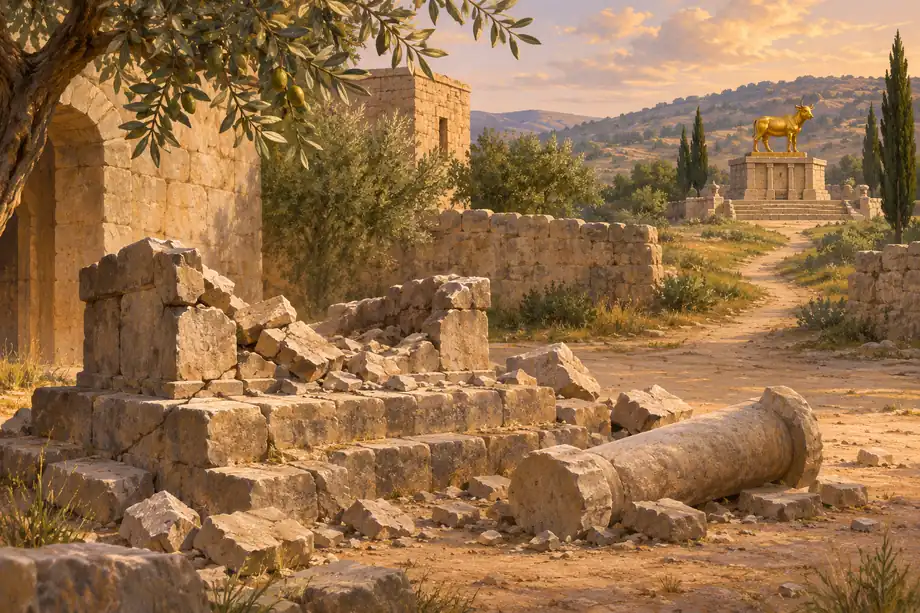
With Baal removed and the calves remaining, what failure of the heart does Jehu’s success expose?
Study overview
Letters of revolution, religious zeal, and the covenant's measure of a king
At Jezreel the chariot wheels have not stopped; at Samaria the letters arrive before the army. Officials change their allegiance, and princes discover that palaces cannot keep danger out. Baal's temple fills with worshipers dressed for sacrifice, but the celebration has been turned into a trap. An altar falls. A king's supporters call it victory. Yet at Bethel and Dan, the golden calves remain, untouched by the king's zeal. For a hand can pull down an idol before the crowd while a heart still clings to the throne it wants to keep.
- Primary passage:
- 2 Kings 10:1–36.
- Guiding question:
- Does the forceful removal of corrupt worship prove that the new king is faithful to the LORD with his whole heart?
- Central thesis:
- Second Kings 10 recounts a revolution that successfully ends Ahab's dynasty and dismantles the state-sponsored worship of Baal without bringing Israel into full covenant obedience. Jehu is commended for carrying out a specific divine judgment and criticized for continuing Jeroboam's sins. God's assessment of leadership is not limited to the evils a ruler removes; it also reaches the loyalties that remain.
Introduction — When the Revolution Itself Comes Under Judgment
Every revolution begins with a promise. A corrupt administration will end. A dishonest system will be exposed. The frightened will finally be free to speak. The change is greeted with relief, and sometimes with celebration. But when the streets grow quiet, a harder question is waiting: Has the new leader dismantled the old way of ruling, or merely taken the old ruler's place?
Second Kings 9 ended with the collapse of Jezebel's power. Joram, king of Israel, was dead. Ahaziah, king of Judah, had been killed. Jezebel had fallen from the royal window. The meeting beside Naboth's field returned the story to a vineyard stolen through lies and bloodshed (1 Kgs 21; 2 Kgs 9:21–26). Yet Ahab's house had more members, and Baal still had a powerful place in Israel's public religion.
Second Kings 10 follows Jehu toward Samaria. Chariots give way to letters. Royal servants become executioners. A crowded religious festival becomes the setting for a massacre. The temple of Baal is destroyed, and the revolution appears to have secured an extraordinary victory. Then the narrator interrupts the celebration with a sober verdict: Jehu acted rightly in bringing Ahab's dynasty to its appointed end, but Jehu did not take care to walk in the law of the LORD with all his heart (2 Kgs 10:30–31).
The chapter is therefore more than an account of a successful coup. It exposes the distance between a leader's public zeal and a leader's private loyalties. A king can tear down an altar that belongs to an enemy while protecting an altar that serves the king's own interests. The covenant asks not merely what a ruler has destroyed, but what that ruler continues to worship.
Historical and Literary Context — Ahab's House Falls, but the Covenant Still Stands
Kings is a theological account of political life. Its narrator does not measure rulers by military strength, economic ambition, or the number of years spent on the throne alone. Kings are judged against Israel's covenant with the LORD. Deuteronomy describes the king as a servant under instruction, not a figure above the law. A king must resist self-exaltation, read God's teaching, and remain accountable to the people whom the crown is supposed to serve (Deut 17:14–20).
Two overlapping histories of idolatry frame this chapter. Jeroboam I established calf shrines at Bethel and Dan, partly out of concern that a return to worship in Jerusalem would weaken the northern kingdom's political independence (1 Kgs 12:26–33). Later, Ahab and Jezebel strengthened the royal sponsorship of Baal worship (1 Kgs 16:31–33). This was not merely a change in religious imagery. The prophets of the LORD faced persecution, and Naboth was killed through manipulated legal proceedings so that Ahab could obtain the vineyard (1 Kgs 18:4, 13; 21:1–16). Idolatry and injustice traveled together.
Elijah announced judgment upon Ahab's family (1 Kgs 21:17–24). At Horeb, the LORD also named Hazael, Jehu, and Elisha within the continuing story of prophetic judgment and renewal (1 Kgs 19:15–18). Elisha subsequently sent a prophetic messenger to anoint Jehu as king (2 Kgs 9:1–10). Jehu's coup therefore stands within a longer narrative of God's confrontation with an abusive dynasty. Yet God's commission never places Jehu above the covenant law that condemns abusive rule in the first place.
The chapter follows a deliberate progression: Ahab's royal house and its supporters are eliminated (10:1–17); the official Baal cult is dismantled (10:18–28); Jehu receives both affirmation and censure as Israel begins losing territory to Aram (10:29–36). Provan observes that the narrative completes the predicted downfall of Ahab's house while drawing attention to the continuing sins of Jeroboam (Provan 1995, §42). Brueggemann draws attention to the momentum of violence once a revolutionary campaign has begun (Brueggemann 2000, 395–402).
The reader must hold two truths together. The LORD's word of judgment against Ahab does not fail. But the LORD's word remains the standard by which Jehu himself will be judged. Divine judgment is never a blank check for rulers to call every act of their own power righteous.
Walking Through the Text — From the Letters to the Calves
When Letters Become Weapons — Ahab's Seventy Sons (10:1–11)
Ahab's house still has seventy male descendants in Samaria. The designation sons can cover members of the royal family more broadly, rather than requiring the reader to imagine seventy children born to a single father in the narrowest sense. These potential heirs are under the care of Samaria's leading officials and guardians. Jehu writes a letter inviting the leaders to select the strongest royal candidate, place that candidate on the throne, and fight to defend Ahab's house (10:1–3).
The invitation sounds like a challenge, but the leaders see the trap. Two kings have already fallen before Jehu. Samaria's officials have no reason to expect a better outcome. The officials surrender their allegiance, declare themselves Jehu's servants, and refuse to make anyone else king (10:4–5).
Jehu's next letter demands proof of loyalty: the leaders must bring the heads of the king's sons. The officials kill all seventy and send the heads to Jezreel, where Jehu has them piled at the city gate (10:6–8). The detail is brutal. These are not abstract changes on a family tree. Human lives have become evidence of political compliance.
The letters also carry a troubling literary echo. In 1 Kings 21, Jezebel used letters to arrange Naboth's death. Now Jehu uses letters to arrange the deaths of Ahab's descendants. The moral situations are not identical, but the repetition raises a question about methods: could a new regime inherit the instruments of the one it overthrew?
Jehu addresses the crowd, acknowledges killing the king, and asks who killed the many whose heads lie by the gate. The speech links the dynasty's destruction to Elijah's prophetic word (10:9–10). But the question of human accountability cannot be answered simply by accepting the new ruler's explanation of events. Jehu also kills those connected with Ahab's house who remain in Jezreel (10:11).
The fulfillment of a prophetic warning does not make intimidation, manipulation, or indiscriminate violence ordinary methods for Christian leadership. The covenantal truth that oppressive power is answerable to God remains distinct from the claim that every act of an agent of judgment deserves imitation.
A Party of Visitors Meets a Violent Revolution (10:12–14)
On the road to Samaria, near the place where sheep are shorn, Jehu meets forty-two relatives of Ahaziah, king of Judah. Asked to identify themselves, the travelers explain that they are going to greet members of the royal households. Their answer suggests that the travelers do not yet know how drastically the political situation has changed (10:12–13).
Jehu orders the travelers seized alive, and the forty-two are killed near a cistern (10:14). The narrator does not present a case proving personal guilt for every individual in the group. The political and marital ties between Ahab's house and the Davidic house have now drawn Judah's royal family into the same spiral of death (2 Kgs 8:18, 26–27).
This is a difficult passage because the story's focus on dynastic judgment can obscure the faces of its victims. Biblical readers must not convert the report into permission to punish families for the wrongdoing of relatives. Deuteronomy insists upon the personal responsibility of those who commit wrong (Deut 24:16). The narrative reports what happened; the narrative does not command later believers to repeat Jehu's methods.
“Come, See My Zeal” — Jehu and Jehonadab (10:15–17)
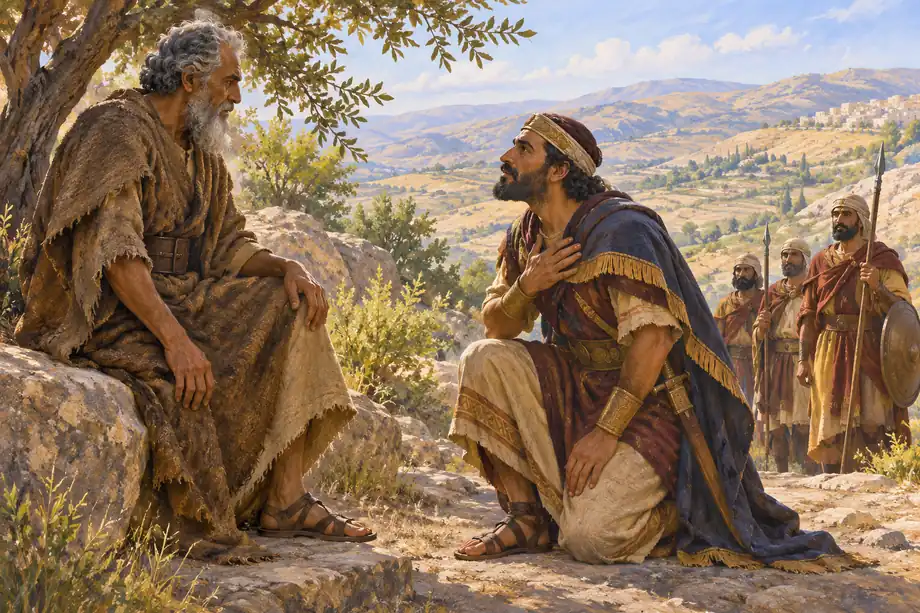
Jehu next meets Jehonadab son of Rechab. The conversation turns upon whether the two men share a loyal heart. The men take one another by the hand, and Jehonadab joins Jehu in his chariot. Jehu invites his new companion to witness his zeal for the LORD (10:15–16).
The invitation is striking. Zeal may arise from genuine conviction, yet public zeal can also become a performance designed to strengthen a ruler's reputation. The narrator does not provide a complete psychological portrait of Jehu. Still, the chapter's concluding judgment will make Jehu's appeal to zeal sound painfully incomplete. A man's desire to be seen as zealous is not the same as a heart fully directed toward God.
Jeremiah 35 later remembers the Rechabites for their loyalty to the practices handed down by their ancestor. In the present scene, Jehonadab accompanies Jehu and becomes a witness to the revolution. The text does not explicitly say that Jehonadab participated personally in every subsequent killing; readers should not assert more than the passage states.
Jehu proceeds to Samaria and completes the destruction of Ahab's remaining household (10:17). The repeated emphasis on leaving no survivor underscores the ruthlessness of the campaign. Yet the absence of a political rival is not the same thing as the absence of idolatry. The chapter is preparing to expose that difference.
When the Temple of Baal Becomes a Trap (10:18–28)
Jehu summons the people and announces that Ahab served Baal only a little but Jehu will serve Baal much more. Priests, prophets, and worshipers are ordered to attend a great sacrifice. Anyone who fails to appear is threatened with death. The reader is told what the worshipers are not: the announcement is a deliberate deception designed to gather them for destruction (10:18–19).
The temple fills with attendants. Special garments are distributed. Jehu and Jehonadab inspect the assembly, making sure none of the LORD's servants is present. Sacrificial proceedings begin. Outside, armed men receive instructions to let no participant escape, under threat of forfeiting their own lives (10:20–25).
After the offering, Jehu's soldiers slaughter those gathered. The cultic objects and sacred pillar are removed or destroyed, and Baal's temple is demolished and made into an unclean place. The former center of royal religious patronage becomes a public symbol of contempt for Baal (10:25–27). Verse 28 summarizes the result: Jehu eradicates the state-sponsored worship of Baal from Israel. The text does not require the stronger claim that every trace of Baal influence vanished permanently from the people.
The theological context explains why the narrator presents the downfall of Baal's institution as consequential. The episode's means, however, remain horrifying. A deceitful festival has been used to engineer mass killing. Reading Kings through the teaching of Jesus cannot turn this account into approval for coercive conversion or violence against those who worship differently. When Jesus' disciples wanted to call down destructive fire on a village, Jesus rebuked the impulse (Luke 9:51–56). Jesus taught love for enemies and forbade personal vengeance (Matt 5:43–48; Rom 12:17–21).
Zeal for God cannot become a license for cruelty merely because violence has been wrapped in religious language. The narrative reveals the gravity of idolatry; the gospel reveals the way Jesus calls disciples to confront evil without surrendering their calling to love.
The Calves That Remain — The King's Double Verdict (10:29–31)
The heart of the chapter comes immediately after the report of Baal's destruction. The narrator states that Jehu did not abandon the sins of Jeroboam son of Nebat: the calf worship associated with Bethel and Dan (10:29; 1 Kgs 12:26–33).
The LORD then acknowledges Jehu for carrying out judgment upon Ahab's house and promises that Jehu's descendants will occupy Israel's throne through the fourth generation (10:30). This is a real but limited dynastic promise, distinct from the enduring promise associated with David's house (2 Sam 7:12–16). Yet the next verse records the decisive shortcoming: Jehu was not careful to walk in the law of the LORD with his whole heart (10:31).
Neither side of this verdict may be erased. Jehu did not accomplish nothing good. The removal of royal support for Baal marked a serious religious and political break. Yet Jehu remained implicated in the system of worship established by Jeroboam. The calf shrines at Bethel and Dan endured. A religious arrangement closely connected to the political security of the northern kingdom remained intact.
The text does not give us Jehu's private diary. We cannot prove that he consciously preserved the calves for one stated reason. Nevertheless, the political origins of Jeroboam's shrines make a searching pastoral question unavoidable: Can rulers be bold against the idol that belongs to a defeated enemy while remaining unwilling to confront an idol that benefits the new regime?
Hosea 1:4, with its announcement concerning bloodshed at Jezreel, complicates the wider prophetic assessment of Jehu's house. Scholars differ over the precise relationship between that prophecy, Jehu's actions, and the later history of the dynasty. Hosea should not be used to erase the positive verdict of 2 Kings 10:30, and the positive verdict should not be used to silence the moral questions that the surrounding narrative raises.
When the Kingdom Begins to Shrink (10:32–36)
The final scene refuses to end in uncomplicated triumph. Hazael of Aram begins taking Israelite territory east of the Jordan, including regions associated with Gilead and Bashan (10:32–33). The narrator interprets this loss as part of the LORD's dealings with Israel. This theological account of defeat does not authorize Hazael's brutality, already anticipated in Elisha's grief at 2 Kings 8:12.
Jehu reigns twenty-eight years, dies, and is succeeded by Jehoahaz (10:34–36). The revolution has established a new dynasty. It has not established a fully obedient Israel. The book of Kings repeatedly returns to this unsettling distinction: a throne can change hands without a nation's worship being renewed from the heart.
Theological Reflection — What Remains After an Idol Falls?
God's word judges both the old palace and the new
Elijah's warning was fulfilled against Ahab's house (1 Kgs 21:21–24; 2 Kgs 10:10–11). Yet Jehu, the instrument of that judgment, was still accountable to the same covenant law (Deut 17:18–20). A commission to address injustice does not confer unlimited moral authority upon the person carrying out the commission. Leaders need communities capable of speaking truth without fear of retaliation.
Half-completed reform can preserve a useful idol
Jehu confronts Baal but leaves Jeroboam's calves in place. His mixed record exposes the ease with which reform can become selective: condemning the errors of opponents while protecting the practices that sustain one's own influence. True repentance reaches financial arrangements, religious customs, accountability, and treatment of vulnerable people (Isa 1:11–17; Mic 6:6–8).
Religious zeal must answer to justice and mercy
Elijah spoke of zeal for the LORD (1 Kgs 19:10, 14), and Jehu publicly displays his own zeal (2 Kgs 10:16). Yet zeal must be tested by truthfulness and the treatment of people. Jesus rebukes religious exactness that neglects justice, mercy, and faithfulness (Matt 23:23). Jesus also rejects leadership defined by domination (Mark 10:42–45). The Christian canonical movement does not make Jesus into a Jehu with a stronger sword. Jesus is the faithful King whose justice is inseparable from sacrificial service, whose cross confronts evil, and whose resurrection opens the way to a renewed creation (Luke 23:34; Col 2:13–15).
Judgment does not extinguish the promise
The loss of territory to Hazael reveals the insecurity of a kingdom rich in military ambitions yet divided in worship. But God's promise to David has not disappeared (2 Sam 7:12–16; 2 Kgs 8:19). Chapter 11 will bring the question of David's line into sharp focus: will the royal seed survive Athaliah's campaign? The hope of Scripture does not rest on Jehu's ability to construct a perfect nation. It rests upon the LORD's covenant faithfulness and, ultimately, upon the promised King.
Life Application — Do Not Tear Down One Altar While Guarding Another
- Audit the reforms that conceal remaining failures. A church leader may address financial mismanagement while leaving decisions opaque. Establish transparent reviews and shared oversight (2 Kgs 10:29–31).
- Refuse to use fear as proof of loyalty. Jehu pressures Samaria's officials into demonstrating submission through bloodshed. In churches, homes, and workplaces, make space for evidence, respectful disagreement, and accountable decisions (10:4–7; Prov 15:22).
- Distinguish spiritual zeal from personal branding. Before announcing a reform, ask whether the action protects people and honors God or mainly builds the leader's reputation (10:16; Matt 6:1–4).
- Protect families from collective blame. The deaths of Ahaziah's relatives display the danger of vengeance spreading through kinship and association. Reject inherited stigma and collective punishment (10:12–14; Deut 24:16).
- Join sound worship to practical justice. Correct doctrine is not an excuse for ignoring widows, the poor, the displaced, or those harmed by abusive power (Isa 1:15–17; Jas 1:27).
- Name the golden calf your system benefits from. Money, popularity, institutional prestige, and fear of losing supporters can shape decisions more effectively than open idolatry. Identify one costly change that would bring practice into line with confession (1 Kgs 12:26–33; 2 Kgs 10:29).
- Evaluate leadership after the celebration ends. Measure long-term care for households, fairness in decisions, and faithfulness to God's word—not merely the excitement surrounding a new leader (10:32–36; Deut 17:19–20).
Reflection Questions
- Which practices of a former leader are publicly condemned but quietly preserved under a different name?
- Where does Jehu's zeal for the LORD become entangled with the need to secure political power?
- Why must 2 Kings 10:30 and 10:31 be read together rather than allowing either verse to cancel the other?
- What golden calves might survive within a family, church, or institution after a seemingly successful season of reform?
- How does Jesus reshape the relationship between power, justice, and victory over evil (Mark 10:42–45; Matt 5:43–48)?
Response Prayer — Lord, Do Not Leave the Heart Behind
LORD of covenant faithfulness and justice,
Human revolutions can change the names written on palace doors, but only the light of your word can expose the idols hidden within a human heart. Do not allow your people to rejoice over the sins of others being uncovered while protecting familiar wrongdoing behind respectable excuses.
Give leaders courage to surrender the habits that preserve influence at the expense of truth. Give pastors wisdom to teach with integrity rather than fear. Give parents, teachers, and community leaders patience to listen to the vulnerable and to correct wrongdoing without cruelty.
As the story of Jehu reminds us of blood spilled in the name of judgment, teach us to honor human life and pursue justice in ways that respect your image in every neighbor. As the golden calves remain standing at Bethel and Dan, reveal the hidden altars that still need to fall in our own lives.
Jesus, faithful King, guide our hearts into wholehearted obedience, justice that protects our neighbors, and mercy that opens the road to life. Amen.
Window into the Next Chapter — David's Heir Hidden in a Room
Second Kings 10 closes after Jehu has reigned over Israel for twenty-eight years. Ahab's house has been destroyed, Baal has lost the patronage of the throne, and yet the calves of Bethel and Dan remain. Even the new dynasty faces Hazael's encroaching armies.
Second Kings 11 will take the reader to Judah, where the collapse of Ahab's house has already injured David's royal family. Athaliah will attempt to destroy the royal offspring. But Jehosheba will hide a child named Joash, and the priest Jehoiada will help preserve the life through which God's promise will continue.
In chapter 10, royal children are killed to make a throne secure. In chapter 11, one royal child is protected so that the promise will not perish. Watch the difference between power that tries to survive by removing others and faithfulness that risks everything to protect life. Can the lamp of David remain burning when the palace itself grows dark?
Bibliography (SBL Author–Date)
- Brueggemann, Walter. 2000. 1 & 2 Kings. Smyth & Helwys Bible Commentary. Macon, GA: Smyth & Helwys.
- Leithart, Peter J. 2006. 1 & 2 Kings. Brazos Theological Commentary on the Bible. Grand Rapids: Brazos Press.
- Provan, Iain W. 1995. 1 and 2 Kings. New International Biblical Commentary. Peabody, MA: Hendrickson. Reprinted by Baker Books, 2012.
Reading note
Editorial note: The positive evaluation of Jehu's specific action in 2 Kings 10:30 must be read alongside the negative assessment of his covenant obedience in 10:29, 31. The article does not turn Jehu's mass killings into a model for the church or interpret every military setback as direct punishment for a particular offense. Hosea 1:4 raises a disputed question that calls for care.

Be the first to leave a comment.