

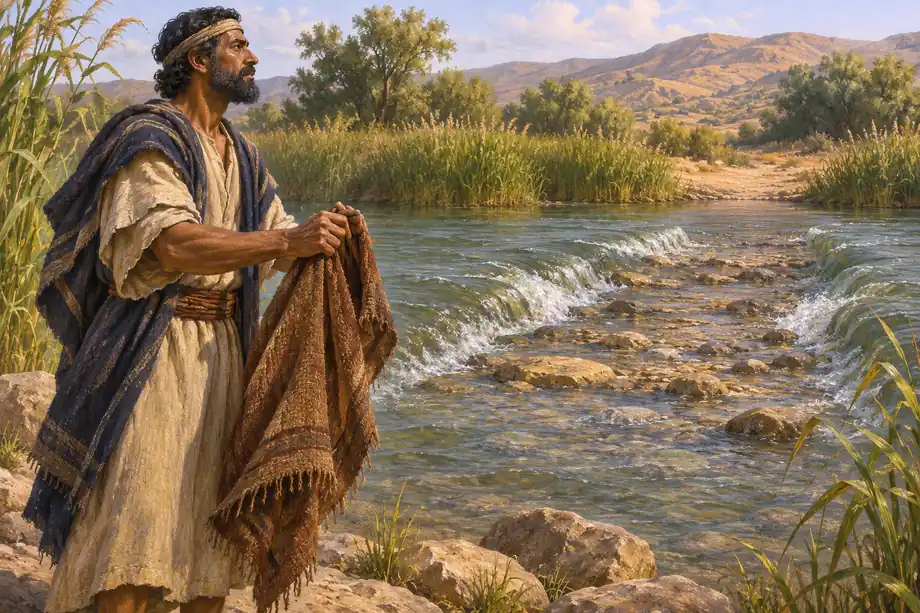
With Elijah’s mantle in Elisha’s hands, where did the true source of ministry become visible?
Study overview
Elijah’s departure, Elisha’s calling, and blessing and judgment in the land
The king’s sickbed has fallen silent. But the prophet is still on the road. Gilgal recedes; Bethel passes. Jericho watches; the Jordan opens. A teacher departs without a visible grave. A disciple remains with grief and a mantle. The fire-filled sky is not the end of the story. A question rises beside the river: Where is the LORD, the God of Elijah? When the waters part once more, the answer begins to emerge: a servant may leave, but the LORD’s work remains.
- Key passage:
- 2 Kings 2:9–15, 19–22.
- Guiding question:
- What remains when a faithful and influential servant of God departs, and how should the next generation respond?
- Central claim:
- Second Kings 2 shows that prophetic authority passes forward through renewed dependence on the LORD, not possession of Elijah’s reputation; the Spirit of God sustains a ministry that brings life and warns against covenant rebellion.
Introduction — When the Mantle Remains but the Wearer Is Gone
When a family loses a wise parent, a congregation says goodbye to a longtime pastor, or a community enters a new season of leadership, one question soon becomes larger than the name of the successor: Will the good work continue? The chair remains. The books remain. People remember the familiar voice. But a mantle hanging on a wall cannot guide a heart toward God by itself.
Second Kings 1 ended with Ahaziah, a king who possessed a throne but refused to heed the LORD. Chapter 2 turns to Elisha, a disciple without a throne who longs for the inheritance of faithful service. The promised window at the end of the previous chapter now opens: a journey through Gilgal, Bethel, Jericho, and the Jordan; Elijah’s departure; and the prophet’s mantle resting in Elisha’s hands.
The chapter does not present an ordinary transfer of office. Instead, the reader travels through farewell, grief, loyalty, and the demanding discovery that God can work through another servant. Elisha must cross a river without Elijah. Other prophets struggle to accept their teacher’s departure. A city receives life-giving water. Then the road to Bethel brings a deeply troubling judgment scene that demands careful interpretation.
This is a story about the departure of a servant and the enduring presence of God. Faithful reading has to hold two truths together. The blessing of the LORD does not belong to a single leader. Yet an appeal to divine authority must never become an excuse for careless or unaccountable power. The mantle is important because of the God who calls, not because the fabric possesses an independent magic.
Historical and Literary Context — From the Royal Palace to the Riverbank
First and Second Kings form one continuous theological narrative. Kings measure royal life against covenant loyalty, rather than wealth, military success, or the length of a reign alone (Deut 17:18–20; Provan 1995, introduction). Within that story, prophets interrupt royal plans with a word that cannot be purchased. Elijah announced drought before Ahab, saw the LORD answer by fire on Carmel, encountered God at Horeb, confronted the seizure of Naboth’s vineyard, and finally challenged Ahaziah’s consultation of Baal-zebub (1 Kgs 17–21; 2 Kgs 1).
Yet Elijah’s story is not a portrait of uninterrupted heroic confidence. The prophet fled in fear, asked to die, and believed that no faithful witness remained (1 Kgs 19:1–18). The LORD responded with a future assignment and called Elisha from the fields (1 Kgs 19:16, 19–21). Second Kings 2 is therefore not a sudden change of subject. The chapter brings into view a seed of succession planted during the earlier prophet’s season of exhaustion.
The journey begins in Gilgal, continues through Bethel and Jericho, and reaches the Jordan River. These places carry memories of Israel’s entrance into the promised land under Joshua (Josh 3–5). Crossing to the far bank and then returning evokes Moses at the sea and Joshua at the Jordan (Exod 14:21–22; Josh 3:14–17). Scripture does not explicitly explain every stop as an allegorical reenactment of the conquest. Still, the shared language of divided waters, crossing, and succession makes the literary connection compelling (Provan 1995, comments on 2 Kgs 2:7–15).
Groups called the sons of the prophets appear at Bethel and Jericho (2 Kgs 2:3, 5, 7). This term describes prophetic communities, not necessarily the biological children of prophets. These communities witness the transition and preserve a faithful vocation in a northern kingdom compromised by rival shrines and mixed allegiance (1 Kgs 12:26–33). Bethel, meanwhile, is the center of Jeroboam’s alternative worship and carries a history of resisting the prophetic word (1 Kgs 13:1–10).
The Christian connection need not make every detail an immediate prediction of Jesus. The larger biblical pattern is clear enough: God gives the Spirit, sustains faithful witness after a leader departs, and ultimately reveals the risen King whose Spirit empowers the people of God (Luke 1:17; 9:28–36; Acts 1:8–11).
Walking Through the Text — From Farewell to Fresh Commission
“I Will Not Leave You”: The Road of Loyalty (2:1–6)
The reader is told from the beginning that the LORD is about to take Elijah up by a whirlwind. Elijah knows that departure is near. Three times the older prophet asks Elisha to remain behind: on the way from Gilgal, then at Bethel, and then at Jericho. Three times Elisha refuses to leave. The repeated vow becomes the refrain of faithful persistence.
The sons of the prophets also know that the LORD will take Elijah away that day. Elisha acknowledges the news and asks the prophets not to discuss the matter. Silence does not necessarily mean disbelief. Sometimes grief makes people careful with words. Knowing that separation is coming does not make separation painless.
Is Elijah testing the disciple’s resolve, or hoping to leave the disciple behind? The narrator does not explain Elijah’s motive. Claims about the prophet’s private intention should therefore remain tentative. The observable fact is Elisha’s endurance. The disciple remains committed to the calling received while plowing a field (1 Kgs 19:19–21). The loyalty is more than attachment to Elijah’s fame; Elisha will not run away from a responsibility that is coming closer with every mile.
When the River Opens the First Time (2:7–8)
Fifty members of the prophetic company stand at a distance as Elijah and Elisha reach the Jordan. Elijah rolls up the mantle and strikes the water. The water divides, and the two prophets cross on dry ground. The scene recalls Israel’s escape through the sea and entrance through the Jordan (Exod 14:21–22; Josh 3:15–17).
The mantle is not a magical charm with power trapped in cloth. The action signals that the LORD of Moses and Joshua still leads the covenant people. Ahaziah died on a sickbed despite the power of the royal court (2 Kgs 1:17). Elijah now crosses a river without an army, relying on the God who speaks and acts. The contrast asks a sharp question: Where does Israel’s true strength reside?
Even those watching from a distance do not necessarily understand everything being witnessed. The story distinguishes seeing a sacred event from accepting the responsibility that follows the event. That distinction will matter when the fifty men are sent to search for Elijah.
The Firstborn’s Inheritance and the Fire of Farewell (2:9–12)
Across the Jordan, Elijah invites Elisha to make a request before their separation. Elisha asks for a “double portion” of Elijah’s spirit. This is not necessarily a claim to twice the number of miracles or twice the prophet’s fame. Israelite inheritance law gave a firstborn son two shares of the father’s estate (Deut 21:15–17). Elisha speaks as an heir seeking the equipment necessary to carry forward a prophetic vocation, not as a customer trying to acquire supernatural power (Provan 1995, comments on 2 Kgs 2:9–12).
Elijah calls the request difficult. The sign of its granting will be whether Elisha sees the teacher’s departure. The Spirit cannot be transferred at will by a famous religious figure. God remains the giver and the ultimate authority behind prophetic succession.
Suddenly a chariot of fire and horses of fire separate the two prophets. The text says that Elijah goes up to heaven in a whirlwind; the chariot separates Elijah and Elisha, but Scripture does not say that Elijah rides inside the chariot (2 Kgs 2:11). This distinction is worth preserving, even though many familiar biblical pictures suggest otherwise (Brueggemann 2000, 296–97).
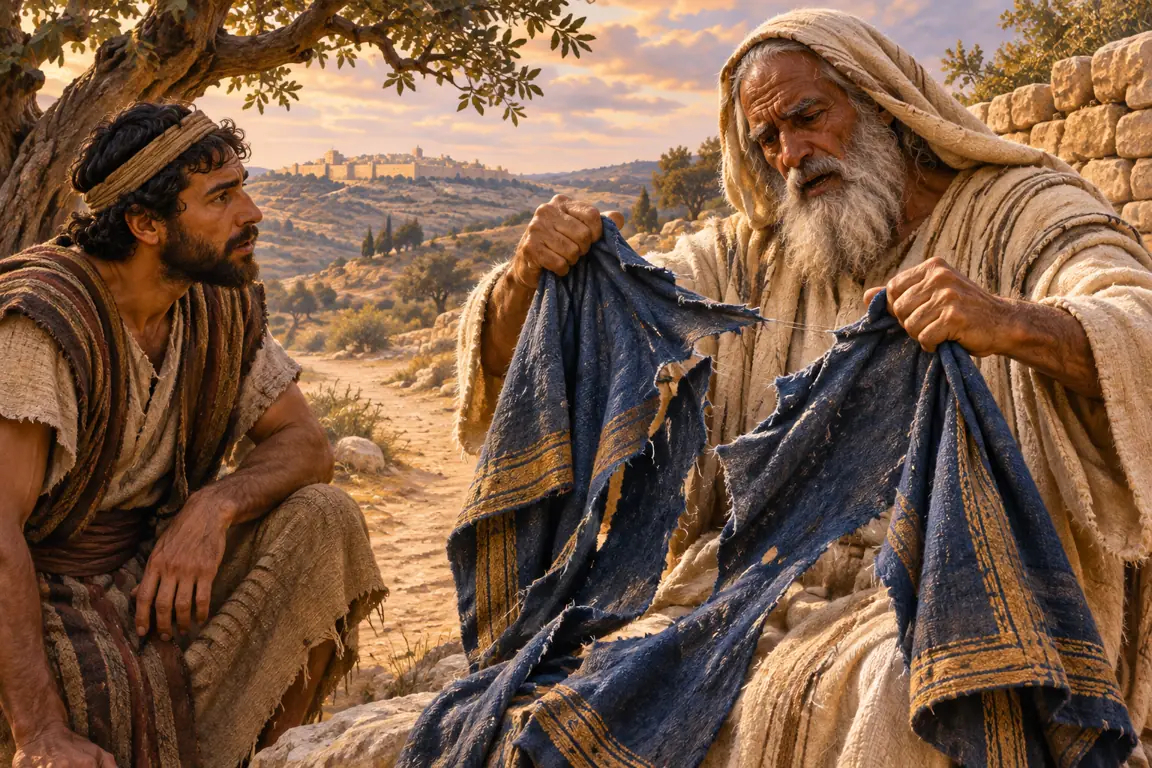
Elisha sees the departure, cries out, and tears Elisha’s own clothes in grief. The cry, “My father, my father! The chariots of Israel and its horsemen!” honors the departing prophet as a more dependable source of Israel’s protection than the impressive machinery of royal warfare (2 Kgs 6:16–17; 13:14). An earthly military chariot can intimidate a neighboring nation. The presence of the LORD accomplishes what royal hardware cannot guarantee.
The Mantle Returns to the Jordan: Is God Still Here? (2:13–18)
Elisha picks up Elijah’s fallen mantle, returns to the Jordan, and asks, “Where is the LORD, the God of Elijah?” The question is not merely a request to prove that Elisha has become important. It is a prayer for divine faithfulness in the absence of a familiar teacher. The mantle strikes the water; the river divides again. The former disciple crosses back into the land where ministry, public conflict, and practical needs await.
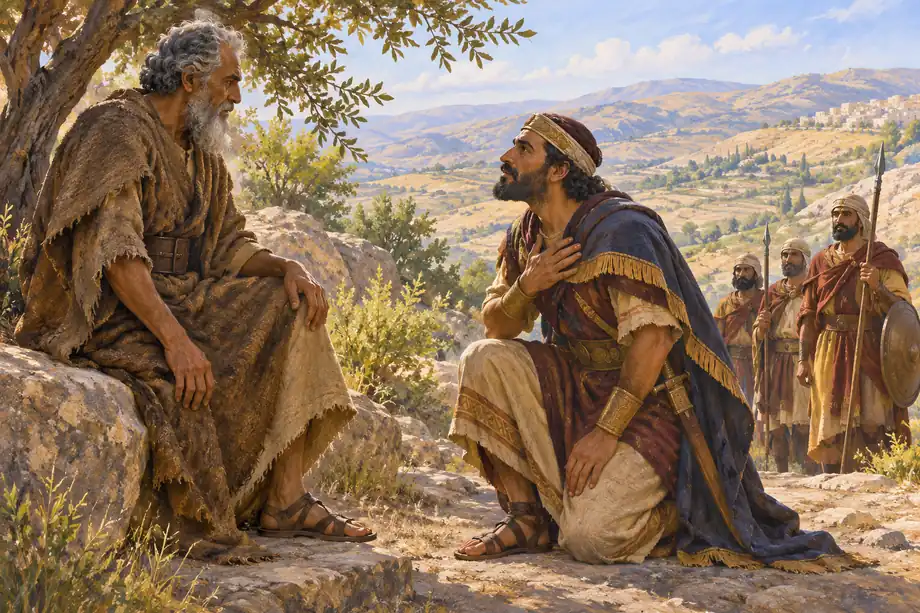
The sons of the prophets recognize that Elijah’s spirit now rests upon Elisha and bow before the new prophetic leader. Nevertheless, the company insists on sending fifty men to search for Elijah. Elisha initially refuses. Under continued pressure, Elisha agrees. The three-day search produces nothing.
The reader knows that Elijah was taken up, while the searching prophets did not witness the departure as Elisha did. Accepting a new leader can remain difficult even after evidence of a new calling appears. The narrative does not resolve every philosophical question about Elijah’s condition after being taken. The central emphasis is more immediate: the LORD has not abandoned Israel’s prophetic witness (Provan 1995, comments on 2 Kgs 2:15–18).
When Jericho’s Water Is Healed (2:19–22)
Elisha’s first public action after returning is not an attempt to claim a throne. Residents of Jericho report an urgent problem: the city’s location is pleasant, but the water is bad and the land suffers harmful consequences. Elisha asks for a new bowl with salt, goes to the source, and announces the LORD’s word that the water has been healed.
The salt and bowl belong to a prophetic sign. The account does not teach that ordinary salt can make every polluted spring safe to drink. The healing is credited to the LORD, not to a water-treatment technique that can be reproduced without testing or safeguards. The city gains a restored source of life, and the possibility of a flourishing community becomes visible again.
The newly commissioned prophet serves the public good. The king who sought security for personal survival is gone; a community seeking help receives life-giving mercy. Elisha’s ministry begins by listening to a real problem facing neighbors, not by chasing a reputation for spectacular acts.
Bethel: A Difficult Story That Cannot Be Read Carelessly (2:23–25)
From Jericho, Elisha travels toward Bethel. A group described by Hebrew words that can refer to children or young people comes out and mocks the prophet, including taunts about going up and being bald. The language does not establish beyond dispute the precise ages of those involved. The phrase “Go up!” may also recall Elijah’s ascent, but the narrator does not explain the taunt completely.
Bethel has been associated with rival worship since Jeroboam (1 Kgs 12:28–33). In that context, the mockery may signal hostility toward the prophetic vocation, not merely jokes about appearance. Elisha pronounces a curse in the name of the LORD. Two female bears emerge from the woods and maul forty-two members of the group. Second Kings 2:24 reports that forty-two were mauled; the verse does not explicitly state that all forty-two died.
The incident is deeply disturbing. The absence of further details should not be filled with invented claims that every person in the group was a violent criminal. Nor does the passage offer a model for punishing children for teasing, for questioning a sermon, or for resisting an adult leader. The narrative places a severe judgment beside the healing at Jericho, but provides no license for parents, pastors, teachers, or officials to abuse children. In the light of Jesus, disciples are called to welcome children and love enemies (Mark 10:13–16; Luke 6:27–36).
The chapter closes with Elisha visiting Mount Carmel and then Samaria. The itinerary returns the new prophet to Elijah’s familiar landscape and toward the royal confrontations still ahead.
Theological Reflection — Who Carries God’s Work Forward?
God Does Not Belong to Any One Servant
Elijah’s departure does not bring the LORD’s word to an end. The mantle falls, but the authority of the Spirit does not originate in fabric, family reputation, or a leader’s public recognition. Elisha’s double portion expresses a responsibility to carry faithful witness forward. The church likewise does not belong to a gifted pastor, founder, or public teacher. God gives growth; servants plant and water (1 Cor 3:5–7).
Crossing the Jordan Reveals an Ongoing Calling
Elijah travels from the land to the far side of the Jordan; Elisha returns to the land. The river recalls the exodus, Joshua’s entry into Canaan, and the continuing vocation of covenant faithfulness. The God of Israel remains present through successive generations. A new leader may inherit precious memories, but must still obey the living LORD in new circumstances. No inherited mantle removes the need for listening and faithful action.
Blessing and Judgment Stand Together Without Sanctifying Abuse
Jericho receives healing; Bethel encounters a terrifying judgment. The tension must not be erased, but neither should every animal attack or tragedy today be declared a direct punishment from God. The covenant tradition contains blessings and warnings (Deut 28). Yet Christian practice must also be governed by Jesus, who rebukes calls for retaliatory heavenly fire and receives little children (Luke 9:54–56; Mark 10:14). Respect for a difficult biblical judgment does not require imitation of violence.
Jesus Brings the Story Toward Its Fulfillment
John the Baptist comes in the spirit and power of Elijah (Luke 1:17). Jesus appears with Moses and Elijah on the mountain of transfiguration (Luke 9:28–36). After the resurrection, Jesus ascends and promises the Holy Spirit for the disciples’ witness (Acts 1:8–11; 2:1–4). This pattern does not make Jesus merely another successor in a prophetic chain. Jesus is the risen King, and the Spirit of Christ empowers the church to bear witness. Elisha’s healing of damaged water offers a small but meaningful sign of the larger divine purpose to heal creation (Rev 22:1–3).
Life Application — Carry the Mantle Without Worshiping the Mantle
- Prepare the next generation before the farewell. A church or family leader can teach a younger disciple Scripture, integrity, and the practical work of service. Healthy ministry must not depend on one person’s private knowledge (2 Tim 2:2).
- Ask for character and responsibility, not celebrity. Before accepting leadership, consider which people will be served and which habits must grow. A prophetic inheritance is not a license for self-promotion (2 Kgs 2:9; Mark 10:42–45).
- Make room for grief without surrendering the future. When a congregation loses a teacher, allow honest mourning and plan a faithful transition. Elisha tore clothing in grief before crossing the Jordan (2 Kgs 2:12–14).
- Measure ministry by the good it brings to neighbors. Organize support for safe water, medical care, or a struggling household. Elisha’s salt is not a substitute for modern water-quality testing (2 Kgs 2:19–22; Jas 2:15–17).
- Never weaponize the Bethel story against children. Parents and teachers should choose patient correction, fair accountability, and protection of human dignity over threats and violence (Mark 10:14; Eph 6:4).
- Resist the worship of gifted leaders. During a transition, ask less about the biggest name and more about fidelity to Christ’s word and the building up of the community (1 Cor 3:4–7).
- Make leadership succession an act of discernment. Pray together, listen to those affected, and establish clear accountability before transferring responsibility (Acts 13:1–3; 15:6–22).
Reflection Questions
- Which important work in the family, church, or community depends too heavily on one person, and what practical step would prepare a successor?
- How does Elisha’s request for a “double portion” differ from a desire for power, admiration, or personal recognition?
- Elisha grieved before continuing. Which loss needs honest acknowledgment before a new chapter of service can begin?
- Why should the healing of Jericho’s water be central to evaluating the social fruit of spiritual ministry?
- What questions does the Bethel episode raise about judgment and the worth of human life, and how does Jesus’ example rule out abusive applications?
Response Prayer
LORD, God of Elijah and Elisha, when familiar voices fall silent and unfamiliar roads open, grant faithfulness rooted in divine grace rather than human fame. Teach the church to honor faithful teachers without turning a teacher’s mantle into an idol. Comfort families and congregations mourning parents, leaders, and devoted servants. Give new leaders humility, wisdom, and courage. As the water of Jericho was healed, bring restoration to places in the community where the sources of life have become sources of suffering. Protect children and young people from the cruelty of those holding authority. Do not let a difficult account of judgment obscure the mercy revealed in Jesus. Risen King Jesus, guide the church by the Holy Spirit. At every new Jordan, teach the people of God to ask where the LORD is leading and how the call of the LORD should be answered today. Amen.
Window into the Next Chapter — The River Has Opened, but the Wilderness Awaits
Second Kings 2 closes with Elisha established as a prophet and returning to Samaria. Yet the land is not at peace. The rebellion of Moab, briefly noted in 2 Kings 1:1, returns to the foreground in chapter 3. Jehoram, the new king of Israel, will join Jehoshaphat of Judah and the king of Edom in a military campaign against Moab. When the armies run out of water in the wilderness, royal power will again confront its limits (2 Kgs 3:4–12).
Notice the developing tension. Elisha has just healed a city’s water, but now the prophet will face a shortage threatening several armies. The LORD’s word will bring unexpected help. Still, the war narrative will not finish with a simple victory to celebrate. Can kings listen to the word of God when ambition, fear, and the terrible cost of war become entangled?
Bibliography (SBL Author–Date)
- BibleProject. n.d. “The Books of Kings.” Overview guide to 1 and 2 Kings.
- Brueggemann, Walter. 2000. 1 & 2 Kings. Smyth & Helwys Bible Commentary. Macon, GA: Smyth & Helwys.
- Leithart, Peter J. 2006. 1 & 2 Kings. Brazos Theological Commentary on the Bible. Grand Rapids: Brazos Press.
- Provan, Iain W. 1995. 1 and 2 Kings. New International Biblical Commentary. Peabody, MA: Hendrickson. Repr., Grand Rapids: Baker Books, 2012.
Reading note
Editorial note: This study distinguishes explicit narrative statements from interpretive possibilities. The chariot of fire separates Elijah and Elisha, while Elijah ascends in the whirlwind. The Hebrew expressions concerning age in the Bethel story permit different understandings, and 2 Kings 2:24 does not explicitly state that all forty-two people died. The judgment narrative cannot be used to justify violence against children or critics.
Be the first to leave a comment.