

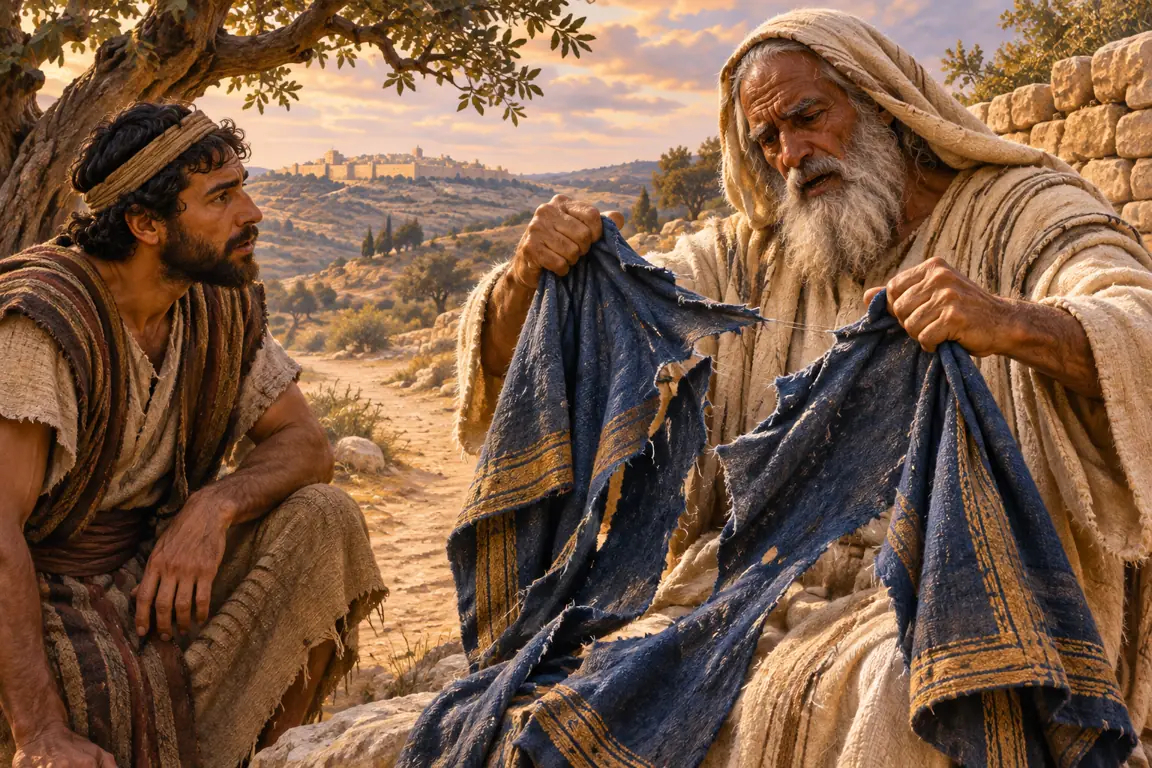
How can a torn cloak announce judgment while a preserved lamp sustains hope?
Study overview
Solomon’s Divided Heart, God’s Judgment, and Hope within the Broken Kingdom
Key passage: 1 Kings 11:36–39 — God preserves a lamp for David’s house in Jerusalem and limits the duration of the announced affliction. (Summary, not a direct quotation.)
Gold cannot hold a wandering heart. A new cloak falls into twelve pieces. Across the kingdom, old wounds become adversaries. In Jerusalem, a lamp remains beneath the promise of God.
Introduction — A Life Can Drift beneath the Applause
A tree can carry green leaves while damage spreads inside the trunk. The first signs may seem small: a neglected root, a widening crack, a season of unexamined weakness. The eventual fall surprises the passing observer, but the collapse has a history.
Solomon’s fall has a history as well. First Kings 11 follows impressive reports of wisdom, wealth, and international honor. Yet earlier chapters have already introduced compromises involving royal desire, Egypt, horses, labor, and divided priorities. The new chapter brings the heart’s direction into the open.
The verdict is painful. The king once described as loving the LORD now loves relationships carrying allegiance toward other gods. Public worship changes, opponents emerge, and a prophet tears a new cloak to announce a divided kingdom. The consequences reach beyond the king’s private life.
Can God’s promise survive the failure of a gifted ruler? First Kings 11 exposes divided devotion becoming public fracture, while revealing judgment restrained by God’s continuing faithfulness to David. The chapter calls for serious examination of desire and power. The preserved lamp also prevents the torn cloak from becoming the final word of the biblical story.
Historical and Literary Context — The Warnings Become a Verdict
Chapters 1–10 describe Solomon’s accession, gift of wisdom, building enterprises, prayer, and accumulated splendor. The warnings of 2:1–4, 6:11–13, and 9:1–9 have kept covenant faithfulness before the king. Chapter 11 supplies an explicit theological assessment before Solomon’s death closes the reign.
The language of love and the heart binds the story together. Solomon loved the LORD in 3:3. The king asked for a listening heart in 3:9 and called Israel toward wholehearted devotion in 8:61. Now the narrator repeatedly describes a heart turned away. Provan traces the movement from earlier indications of divided loyalty to open apostasy (Provan 2012, commentary on 1 Kgs 11:1–13).
Deuteronomy supplies the background: love God wholeheartedly, resist relationships leading toward other gods, and prevent a king’s multiplication of wives from turning the royal heart (Deut 6:5; 7:3–4; 17:17). The chapter brings the remaining royal prohibition into focus after the gold and horses of chapter 10.
The narrative moves from the verdict against Solomon to external opponents, Jeroboam’s rise, Ahijah’s prophetic sign, and the king’s death. The promise of 2 Samuel 7 remains active within the judgment. Tim Mackie’s supplied article emphasizes the cumulative compromises and the continuing hope for a faithful Davidic king (Mackie 2017, 5–7). The chapter marks the end of Solomon’s united reign and prepares the division of Israel.
Walking Through the Text
Love Becomes a Rival Allegiance — 11:1–8
Solomon loves many foreign women, including Pharaoh’s daughter. The narrator counts seven hundred royal wives and three hundred concubines. The scale exposes the multiplication prohibited in Deuteronomy. The relationships belong within the world of royal desire and political alliances, with worship drawn into the arrangement.
The repeated emphasis falls upon the heart. In Solomon’s old age, the wives turn the king toward other gods. The king’s heart is no longer wholly devoted to the LORD. The narrative names cults including Ashtoreth and Chemosh and records the building of high places near Jerusalem for rival worship.
The issue must be read precisely. Earlier chapters welcomed skilled assistance from Tyre and recorded the queen of Sheba’s praise of the LORD. Foreign identity alone cannot explain the verdict. The present concern is the abandonment of covenant allegiance through relationships and practices Solomon knowingly embraces.
The wives’ influence is part of the account, but responsibility remains with the king. Solomon follows other gods and sponsors the sanctuaries. The narrator declares Solomon’s conduct evil before the LORD. A gifted ruler has failed to practice the wholehearted devotion once commended to the people (Brueggemann 2000, 141–143).
Judgment Tears the Kingdom but Preserves a Future — 11:9–13
The LORD is angry because Solomon’s heart has turned away despite two divine appearances and explicit instruction. The problem is sustained disobedience in the face of received grace and knowledge.
God announces a kingdom torn away and given to a royal servant. The language recalls Samuel’s verdict against Saul (1 Sam 15:27–28). David’s dynasty receives no automatic exemption from moral judgment.
Yet the sentence includes restraint. The division will occur in the son’s reign, and a portion will remain for the sake of David and Jerusalem. Delay does not mean approval, and preservation does not erase the loss. God’s promise places a limit around the judgment (Provan 2012, commentary on 1 Kgs 11:9–13).
The passage holds a severe consequence and an unextinguished future together. The royal heart has divided; the nation will bear the fracture. The promise continues through the wounded history.
Unhealed Histories Return as Adversaries — 11:14–25
The LORD raises Hadad, an Edomite royal survivor, as an adversary. The account remembers the killing in Edom during David’s wars under Joab. Hadad escaped as a child, found refuge in Egypt, married into Pharaoh’s household, and later asked to return to the homeland.
The royal story now includes the memory of a victim beyond Israel’s borders. Earlier military success has left surviving people and unresolved loss. The narration does not provide a complete chronology of Hadad’s later campaigns, but the hostility has a recognizably human history.
God also raises Rezon, a fugitive associated with the defeat of Zobah. Rezon gathers a band and gains power in Damascus. Opposition appears along the kingdom’s outer edges. Solomon’s earlier language of rest on every side now meets the account of adversaries.
The narrator places divine judgment within historical agents and remembered violence. The theological interpretation belongs to the particular story; contemporary hostility should not be labeled God’s verdict through convenient guesswork. Here the chapter explicitly identifies God’s action and shows royal power unable to erase the past.
A Capable Worker Emerges from the Kingdom’s Burdens — 11:26–28
Jeroboam, son of Nebat, enters from within Solomon’s service. An Ephraimite associated with Zeredah and the widow Zeruah, Jeroboam becomes important in the labor arrangements of the house of Joseph. Solomon recognizes the young man’s ability and places Jeroboam over the work.
The rebellion is connected with construction at the Millo and the City of David. The narrator does not provide a full record of Jeroboam’s motives. The setting nevertheless places a future challenge inside the machinery sustaining royal achievement.
Competence cannot guarantee permanent loyalty to an existing ruler. The man promoted by Solomon will receive a calling concerning the kingdom’s future. The next movement makes the prophetic word, rather than Jeroboam’s ability alone, decisive.
A Torn Garment Announces Division and a Lamp — 11:29–39
Outside Jerusalem, Ahijah of Shiloh meets Jeroboam. The prophet tears a new cloak into twelve pieces and gives Jeroboam ten pieces, explaining the LORD’s intention to divide the kingdom. The enacted sign makes the announced tearing visible.
Ahijah repeats the charge of abandoned worship and the preservation of David’s house. The promise of a lamp in Jerusalem describes continuing dynastic life. The oracle speaks of one tribe remaining; the following chapter also includes Benjamin alongside Judah (12:21). Judah is the central retained kingdom in the account, while the precise tribal counting remains debated. The main emphasis is the loss of most of the realm and the preservation of a promised remnant (Provan 2012, commentary on 1 Kgs 11:26–39).
Jeroboam receives a substantial opportunity: kingship and the promise of an enduring house, conditioned upon listening, obedience, and righteous conduct. Replacing a failed ruler will not abolish the moral obligations of rule.
Verse 39 adds a brief, important limit: the affliction of David’s descendants will not last forever. The chapter supplies no timetable. The statement leaves hope within judgment. Brueggemann notes the prophetic speech’s refusal to abandon David even while announcing a new royal possibility (Brueggemann 2000, 146–148).
The King Reaches for Violence and the Reign Ends — 11:40–43
Solomon seeks Jeroboam’s death. Jeroboam escapes to Egypt and remains under Shishak’s protection until Solomon dies. The account does not describe Solomon’s reception of the warning as repentance. The attempt to secure the throne instead recalls the use of force at the beginning of the reign.
The final notice refers readers to a record of Solomon’s acts and wisdom, reports forty years of rule, and names Rehoboam as successor. Kings is consciously selective: the royal archive may contain further achievements, but the present narrative has delivered a covenant verdict.
Solomon is buried in the City of David. The wealth remains incapable of preventing death, and a change of ruler cannot automatically restore unity. The torn cloak waits for chapter 12; the lamp remains within God’s promise.
Theological Reflection — A Whole Heart and a Preserved Hope
Worship gives direction to public life
The king’s private attachments become sponsored sanctuaries and national consequences. Worship concerns the loyalties shaping resources, policy, and relationships. The chapter’s warnings therefore reach beyond an isolated religious habit. A community should ask about the loves actually governing decisions when obedience becomes costly.
Responsibility cannot be transferred to an influence
Solomon receives warnings, makes choices, and authorizes rival worship. The influence of intimate relationships does not cancel agency. The passage calls leaders to examine discernment and boundaries without turning women or outsiders into a general explanation for human failure. The accountable subject of the royal verdict is Solomon.
Judgment can travel through ordinary history
Hadad’s memory, Rezon’s power, labor arrangements, a prophetic encounter, and a succession all enter the theological account. Divine sovereignty does not make historical causes unreal. Human actions leave consequences reaching beyond a ruler’s preferred story of success. Honest repentance must therefore attend to harm already carried by other people.
Grace preserves a future without denying the fracture
The division is real, delayed, and limited. The lamp and the final limit upon affliction keep the Davidic promise within view. God’s faithfulness neither blesses Solomon’s apostasy nor surrenders the promised future to the king’s failure. Hope survives through mercy serious enough to confront wrongdoing.
Canonical and Christological Horizon — The Torn Kingdom Awaits a Faithful Son
The torn garment recalls Saul’s loss of kingship, while the preserved lamp develops the promise to David (1 Sam 15:27–28; 2 Sam 7:12–16). Psalm 132:17 later joins the lamp for David with God’s anointed king. In Kings, the lamp first concerns continuing dynastic life; the broader canon carries the Davidic hope forward.
The prophets envision restoration beyond division. Ezekiel’s sign of the joined sticks announces Judah and Joseph becoming one people under a Davidic shepherd (Ezek 37:15–28). The promise addresses the fracture without pretending the judgment never occurred.
Luke announces Jesus’ kingship upon David’s throne and an enduring kingdom (Luke 1:32–33). Jesus embodies the faithful sonship Solomon compromised. In the wilderness, Jesus refuses a route to kingship purchased through false worship (Matt 4:8–10). The contrast directly illuminates the issue of allegiance at the heart of Solomon’s collapse.
The faithful King serves and gives life, then rises beyond the death ending every ordinary reign (Mark 10:45; Acts 2:29–36). The church’s hope rests upon Christ’s fidelity, while disciples are called into enduring love and obedience. The torn cloak exposes the need for a greater King; the preserved promise leads the story toward Jesus and the restoration of God’s people.
Life Application — Guard the Direction of Love
- Name a competing loyalty. Identify a relationship, appetite, or ambition repeatedly excusing a clear disobedience. Describe the actual choice without blaming an influence for the whole decision.
- Act upon a warning already received. Return to a neglected biblical instruction or a trusted person’s concern. Make one concrete change before seeking further reassurance.
- Examine leadership’s public effects. Review a decision affecting workers, family members, or congregants. Ask about the burdens and wounds extending beyond the leader’s immediate circle.
- Set faithful boundaries within close relationships. Explain a conviction with kindness and refuse participation in a practice violating allegiance to God. Preserve respect and care while accepting the cost of disagreement.
- Hear an old wound without defending the whole institution. Listen to an affected person’s account, seek corroboration where needed, and identify a practical step of acknowledgment or repair.
- Receive hope as a summons to return. Bring failure into confession and accountable change. Let mercy produce faithful action rather than postpone a necessary response.
Reflection Questions
- How does the repeated language of heart and love reveal the movement from chapter 3 to chapter 11?
- Where does the text place responsibility upon Solomon despite the influence of close relationships?
- How do Hadad, Rezon, and Jeroboam expose the limits of royal success?
- Which warning or neglected duty currently requires a practical response?
- How do the preserved lamp and the faithful kingship of Jesus sustain hope without minimizing the seriousness of sin?
Response Prayer
Faithful God, search the loves shaping daily choices. Expose devotion divided beneath successful appearances. Receive confession without excuse and grant courage to respond to the word already heard.
Protect households and congregations from the wounds of careless leadership. Give wisdom within close relationships, strength for faithful boundaries, and humility to acknowledge harm. Let the memory of injured people find a truthful hearing.
Keep mercy from becoming permission to delay obedience. Preserve hope where failure has torn trust, and guide repentance toward patient repair. Sustain the courage to serve after pride has been exposed.
Risen Jesus, faithful Son of David, gather scattered hearts beneath the reign of Christ. Let the cross break the grip of rival worship and the Spirit form wholehearted love. Carry God’s people toward the promised restoration, where division yields to peace and divine faithfulness fills renewed creation. Amen.
Window into What Comes Next — The Torn Cloak Enters Public Life
Solomon has died, Rehoboam has inherited the throne, and Jeroboam is waiting in Egypt. First Kings 12 will bring the people’s request concerning the heavy yoke, the new king’s choice of counsel, and the public fracture announced by Ahijah.
The next chapter will connect the prophetic word with decisions made in an assembly. The kingdom’s future will turn through a question about listening and burden. Can a new ruler hear the people, or will inherited greatness answer with a heavier hand?
Bibliography
- Brueggemann, Walter. 2000. 1 & 2 Kings. Smyth & Helwys Bible Commentary. Macon, GA: Smyth & Helwys. Especially 141–151.
- The Holy Bible: King James Version. 1769 edition. “1 Kings 11.” Bible Gateway. Scripture summaries and interpretive paraphrases are distinguished from direct quotation throughout the study.
- Mackie, Tim. 2017. “Solomon: Love Him or Hate Him? A Tale of Wisdom, Wealth, and Lots of Women.” BibleProject, April 2. Supplied PDF, especially 5–7.
- Provan, Iain W. 2012. 1 & 2 Kings. Understanding the Bible Commentary Series. Grand Rapids: Baker Books. Originally published 1995. Sections “Solomon’s Apostasy (1 Kgs. 11:1–13)” and “Opposition and Death (1 Kgs. 11:14–43),” including additional notes. Section references used because the supplied electronic edition has no stable printed pagination.
Be the first to leave a comment.