

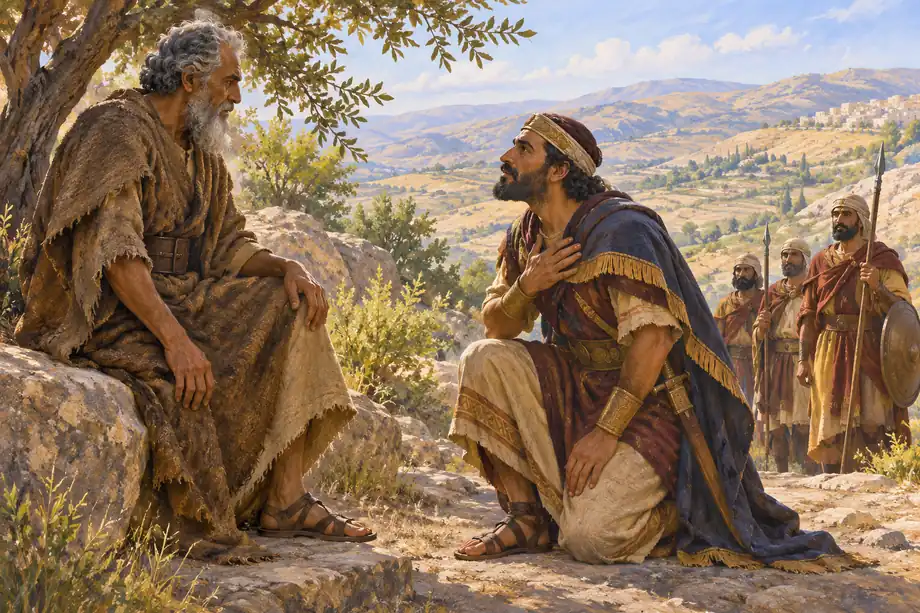
Why did the kneeling captain find a path to safety beyond the reach of royal commands?
Study overview
Ahaziah’s sickbed, Elijah’s question, and the authority of the LORD’s word
Yesterday, an arrow found a king on the battlefield. Today, another king lies wounded in bed. Yesterday, Ahab wanted a prophecy that sounded pleasant. Today, Ahaziah wants an answer that will quiet fear. Messengers set out toward Ekron, but God’s word meets them on the road. Royal commands climb a hill; fire comes down. At last, a soldier kneels, and a company of men is spared. The question still hangs in the air: Is there no God in Israel?
- Key passage:
- 2 Kings 1:3–4, 13–15.
- Guiding question:
- Where do people look for security when status, strength, and careful plans fail?
- Central claim:
- Ahaziah’s illness exposes a deeper sickness in Israel’s monarchy: the desire to know tomorrow while refusing to listen to the God who speaks today.
Introduction — When a Sickbed Becomes a Throne Room
There are moments when power cannot protect the powerful. A hospital door closes. A physician speaks carefully. A family waits. An impressive title, a large bank account, and the ability to command other people cannot order a broken body to mend. The question presses forward: Will I recover? Underneath that question, however, lies another: Whom will I trust?
Ahaziah, Ahab’s son and the king of northern Israel, arrives at such a moment. A fall through the latticework of an upper room leaves the king seriously injured. Instead of seeking the LORD, Israel’s covenant God, Ahaziah sends messengers to consult Baal-zebub, the god of Ekron, about whether the king will recover (2 Kgs 1:2).
Elijah enters the story, not carrying royal credentials or a military escort, but bearing a question that exposes the court’s deepest assumption: does the king of Israel now live as though the God of Israel does not exist?
The royal palace wants a reassuring prognosis. God’s prophet confronts a failed allegiance. The king wants information about the future; the LORD calls the present course of the king’s life into question. The resulting story contains armed detachments, terrifying fire, a humble commander, and a royal death. Yet these are not disconnected wonders gathered for excitement. Each scene presses one question closer to the heart: What happens when human authority encounters the authority of the living God?
The answer is both sobering and hopeful. Judgment in this chapter is real. So is mercy. The third commander finds that humility can open a path where coercion brings disaster. The chapter leaves the church with no permission to celebrate violence, but with every reason to reconsider the direction of trust.
Historical and Literary Context — The Father Rejected the Word; the Son Rejects Its Source
The division between 1 and 2 Kings is a familiar feature of modern Bibles, but the larger narrative is continuous. Kings was originally transmitted as one work. Its narrator is not merely recording royal succession. The story interprets public life by the standards of Israel’s covenant: fidelity to the LORD, obedience to Torah, and justice rather than royal self-exaltation (Deut 17:14–20; Provan 1995, introduction).
The final chapter of 1 Kings provides the immediate doorway. Ahab planned to retake Ramoth-gilead from Aram. The king preferred the optimistic chorus of court prophets over the unwelcome testimony of Micaiah. Ahab imprisoned the truth-teller and entered battle in disguise. The disguise could not prevent the fulfillment of the LORD’s word (1 Kgs 22:5–38).
First Kings closes by introducing Ahaziah as a king who continues the religious direction of Ahab and Jezebel, together with the inherited sins of Jeroboam. Ahaziah serves Baal rather than turning Israel back to the LORD (1 Kgs 22:51–53). Thus the promised window from the previous chapter opens exactly where the story leads: the father sought a favorable word about war; the son seeks reassurance about illness from a rival god. The crisis has moved from the battlefield to a sickbed, but the struggle over trust remains.
Second Kings 1:1 adds a seemingly abrupt political notice: Moab rebels after Ahab’s death. The rebellion will be explored in 2 Kings 3. Here the notice reveals weakening royal control beyond Israel’s borders. Then the camera moves inward, from a politically unstable kingdom to its injured monarch. A kingdom is losing its grip outside the palace, while the king is losing strength inside it.
Ekron was a Philistine city. The name Baal-zebub is often rendered “lord of the flies.” Scholars have suggested that the form might be a deliberately derisive alteration of another title for Baal, although this remains a proposal rather than a demonstrated certainty (Provan 1995, note on 2 Kgs 1:2). The main issue is not the precise history of the name. Ahaziah has appealed to a religious authority other than Israel’s covenant God.
Torah had warned Israel against divination and attempts to secure forbidden spiritual knowledge (Deut 18:9–15). This warning does not condemn physicians, medicine, or responsible medical investigation. Ahaziah’s offense is not the search for treatment. It is the transfer of spiritual allegiance to Baal-zebub. The narrative makes that choice visible through a chain of messengers, repeated words, and the movement of people who go up or come down. The king can dispatch agents, but cannot command divine truth (Leithart 2006, commentary on 1 Kgs 22:41–2 Kgs 1:18).
Walking Through the Text — Five Scenes on the Road Between Palace and Hill
When Moab Revolts and the King Falls (1:1–2)
The opening line is political: Moab rebels. A dependent territory challenges Israel’s control. Immediately the narrative becomes personal. Ahaziah falls through the lattice of an upper room in Samaria and is badly injured. The public weakening of the kingdom and the private weakness of the king mirror each other.
A royal inquiry about survival might sound sensible. Yet the destination matters. Ahaziah orders messengers to ask Baal-zebub of Ekron if the king will recover. The journey becomes a map of the king’s allegiance. The officials carry more than a medical question. They carry the confession of a court willing to seek its ultimate answer from another god.
The audience knows something the king seems unwilling to face. The LORD’s warning through Micaiah had already proved true in Ahab’s death (1 Kgs 22:28, 34–38). Ahaziah’s response to vulnerability is therefore not simply innocent ignorance. It continues a family pattern of resisting revelation that makes uncomfortable demands.
When God’s Messenger Intercepts the King’s Messengers (1:3–8)
The angel of the LORD sends Elijah to intercept the royal delegation. Hebrew sharpens the literary contrast: Ahaziah sends messengers (malʾakim), while the LORD sends a messenger (malʾak) to commission the prophet. The palace has a route planned; heaven interrupts the route.
Elijah asks whether there is no God in Israel that the king must consult Baal-zebub in Ekron. The question is not a claim that the LORD’s power ends at Israel’s border. It confronts Israel’s betrayal of the very God who redeemed the nation and established the covenant (Exod 20:2–3; Deut 6:4–5).
The prophet announces that Ahaziah will not rise from the sickbed. The messengers return early. The surprised king asks why. After hearing a description of the stranger’s hairy garment and leather belt, Ahaziah identifies Elijah (2 Kgs 1:7–8). The garment description may point to a hair cloak or a notably hairy appearance; translations differ. The clothing later recalls John the Baptist’s prophetic appearance (Mark 1:6).
An important distinction emerges: recognizing a prophet is not the same thing as receiving God’s word. Ahaziah knows who has spoken, but does not respond by submitting to what has been said.
When the Palace Commands and Fire Descends (1:9–12)
Ahaziah sends a captain and fifty soldiers to bring Elijah down from a hill. The first captain addresses Elijah as a “man of God” but immediately follows the title with the king’s command. The vocabulary acknowledges prophetic identity; the posture attempts to place prophetic authority beneath the throne.
Elijah replies that if the prophetic title is true, fire should come down from heaven. Fire consumes the captain and the fifty soldiers. A second captain arrives with another fifty and a more urgent command. The pattern is repeated, and the second company perishes.
The fire recalls Mount Carmel. There, fire revealed that the LORD, rather than Baal, was the living God (1 Kgs 18:36–39). Here fire declares that the word of the LORD cannot be captured by the instruments of state power. The king appears to believe that gathering soldiers can solve the problem created by the truth. The story demonstrates otherwise.
This is one of the hardest scenes in Elijah’s ministry. The deaths of a hundred soldiers and two captains must not be softened into a thrilling display of supernatural power. The passage depicts divine judgment and reveals the terrible human cost of arrogant authority. It does not authorize religious leaders to threaten dissenters, call down destruction upon critics, or confuse harshness with holiness.
Later, when disciples of Jesus propose heavenly fire against an unwelcoming Samaritan village, Jesus rebukes the proposal (Luke 9:51–56). Reading the two passages together requires Christian readers to honor the seriousness of judgment while refusing to turn Elijah’s exceptional act into a pattern for Christian retaliation.
When a Commander Climbs the Hill to Kneel (1:13–15)
Ahaziah sends a third company. The third commander does not repeat the swagger of the first two captains. The officer climbs the hill, kneels before Elijah, and pleads for the lives of both captain and soldiers.
This is the narrative’s great reversal. The commander remains responsible for a military unit, but does not treat that unit as expendable proof of royal strength. The petition recognizes that every life has value. Instead of pretending that the judgment is unreal, the officer appeals for mercy in the presence of judgment.
The angel of the LORD tells Elijah to go down without fear. The prophet descends, not because a royal command has finally prevailed, but because the LORD authorizes the journey. In the earlier scenes, captains tried to make Elijah come down by force. In this scene, humility precedes a safe descent.
The verbs of ascent and descent are therefore more than movements across a hillside. They reveal opposing postures of the heart. Pride tries to drag truth to the palace. Humility bows before truth and asks that life be spared (Prov 15:33; Brueggemann 2000, 283–89).
When the Word Stands and the King Dies (1:16–18)
Elijah stands before Ahaziah at last. The prophet does not bargain or deliver a new, more flattering message. The original verdict returns: because Ahaziah consulted Baal-zebub as if Israel had no God, the king will not rise from the bed. Death follows according to the LORD’s word spoken through Elijah.
Ahaziah leaves no son to succeed him. Jehoram becomes king (2 Kgs 1:17–18). The following chapters identify Jehoram as another son of Ahab, and thus Ahaziah’s brother (2 Kgs 3:1; 9:24). The judgment earlier announced against Ahab’s house is not canceled by the fact that the dynasty survives this particular royal death. The more complete reckoning lies ahead (1 Kgs 21:21–29; Provan 1995, §32).
The repeated prophecy has proved stronger than the repeated commands of the court. Yet the final scene is not an invitation to congratulate Elijah or despise the dead king. It is a summons to ask why a ruler who recognized the prophet still refused to heed the living God.
Theological Reflection — Where Judgment and Mercy Meet
The place where counsel is sought reveals the place where trust is lodged
Ahaziah does not make a formal public declaration that the LORD has ceased to exist. The journey to Ekron nevertheless says as much in practice. A person’s center of allegiance is often revealed less by religious vocabulary than by the authority accepted when fear arrives. Seeking medical skill, reliable evidence, wise counsel, and pastoral care can be faithful expressions of wisdom. Seeking a source of spiritual control that displaces God is another matter (Deut 18:9–15; Jas 1:5).
Kings are accountable to the word they cannot control
Ahab imprisoned Micaiah; Ahaziah sought to overpower Elijah. Both kings confused the power to issue orders with the right to determine what is true. Yet Deuteronomy required Israel’s king to read and obey the law rather than rise above fellow Israelites (Deut 17:18–20). A crown does not grant permission to rewrite the covenant. The same warning addresses church, family, and civic leadership: office is a responsibility, not an exemption from truth.
Judgment is real, and humility matters within the story of judgment
The descending fire resists easy explanation. The deaths are grave, and the narrative offers no permission to make violence a routine religious tool. The third commander does not erase the announced judgment against Ahaziah. The commander does, however, open another possibility for the people under the officer’s care: preservation through humble appeal. The narrative holds mercy and judgment together without confusing either with the other (2 Kgs 1:13–17).
Jesus reveals the character of the true King
The Elijah story points beyond itself without disappearing into an easy moral comparison. When Jesus’ disciples wish to destroy a Samaritan village with heavenly fire, Jesus rebukes the disciples (Luke 9:51–56). The Messiah refuses to turn prophetic precedent into a license for revenge. Jesus confronts evil with truth, mercy, self-giving love, the cross, and resurrection (Luke 23:34; Rom 12:17–21). The New Testament does not abolish divine judgment; it places final judgment in the hands of the risen Lord who first comes to save (John 3:16–17; Acts 17:31).
There is another striking canonical echo. In the Gospels, opponents accuse Jesus of driving out demons by the power of Beelzebul, a related name (Matt 12:22–28). Jesus responds by identifying the liberating work of God’s Spirit and the arrival of God’s kingdom. Ahaziah sought life from a false source. In Jesus, the life-giving reign of Israel’s God has drawn near. The chapter’s question—Is there no God in Israel?—receives its fullest Christian answer in the presence and work of Christ.
Life Application — Faithful Steps When Control Is Lost
- During illness, combine prayer with responsible care. Seek qualified medical treatment, follow sound medical guidance, and resist spiritual manipulation directed at vulnerable patients. Trust in God need not compete with medicine (Luke 10:34; Jas 5:14–16).
- Examine the authority behind advice. Before decisions about marriage, finances, ministry, or employment, ask whether the counsel respects truth, Scripture, and the dignity of affected people (Prov 11:14; Jas 3:17).
- Refuse to silence difficult voices. A parent, pastor, or institutional leader can make space for honest criticism without punishing the person who brings an unwelcome report (Prov 12:15; Deut 17:20).
- Protect people who carry out instructions. Count the human cost before issuing risky orders. The first two captains lead their companies into death; the third pleads for the lives of the entire company (2 Kgs 1:9–14).
- Practice humility before conflict escalates. Apologize for a contemptuous remark, revisit a reckless decision, or ask a neglected colleague to speak freely (Prov 15:1; 18:13).
- Do not baptize cruelty as zeal. Elijah’s fire must not become a warrant for intimidation, curses against opponents, or violence in the church. Jesus rebukes disciples who want to summon destructive fire (Luke 9:54–56).
- Plan faithfully without pretending to own tomorrow. Make responsible choices and trust the future to the Lord rather than surrendering life to fear or the illusion of control (Jas 4:13–15; Rom 8:38–39).
Questions for Reflection
- When health, livelihood, or family stability is shaken, which source receives the final word: fear, a prediction, status, money, or Scripture?
- How can believers distinguish legitimate professional help from attempts to obtain forbidden spiritual certainty?
- Within a family, church, or institution, who may be afraid to speak truth because leaders respond harshly to difficult news?
- What does the third commander teach about leadership that values the lives of people placed under authority?
- How should Jesus’ rebuke in Luke 9 reshape Christian interpretation and application of the fire in 2 Kings 1?
A Prayer of Response
Living LORD, when carefully arranged plans collapse and fear enters the rooms of ordinary life, teach every heart to seek the voice of truth. Save the church from wandering among promises of secret certainty while the Scriptures remain open. Give wisdom to receive sound medical care, honest advice, and the companionship of faithful neighbors. Give leaders ears for warnings that sting. Give those who serve under authority courage to speak truth with respect. Protect the sick from exploitation and despair. Teach every community to kneel like the third commander, to value the lives of others, and to plead for mercy instead of the victory of pride. In Jesus Christ, the King of truth and mercy, renew trust in the living God. When tomorrow cannot be controlled, grant grace to obey today. Amen.
Window into the Next Chapter — When the Mantle Falls, Will the Word Continue?
Second Kings 1 ends with the death of Ahaziah, but Elijah’s prophetic work has not yet reached its final scene. Chapter 2 takes the reader away from a royal sickbed and onto the road through Gilgal, Bethel, Jericho, and the Jordan. Elisha refuses to remain behind. The river parts. Elijah is taken away, and the prophet’s mantle passes into Elisha’s hands (2 Kgs 2:1–14).
Watch the contrast. Ahaziah possesses a throne but refuses the LORD’s word. Elisha possesses no throne, yet longs to inherit faithful service. Chapter 1 shows that a king cannot possess or control the prophet. Chapter 2 will show that the departure of a prophet does not mean the departure of God. Will the LORD’s life-giving word continue when the familiar messenger is no longer present?
Bibliography (SBL Author–Date)
- BibleProject. n.d. “The Books of Kings.” Overview guide to 1 and 2 Kings.
- Brueggemann, Walter. 2000. 1 & 2 Kings. Smyth & Helwys Bible Commentary. Macon, GA: Smyth & Helwys.
- Leithart, Peter J. 2006. 1 & 2 Kings. Brazos Theological Commentary on the Bible. Grand Rapids: Brazos Press.
- Provan, Iain W. 1995. 1 and 2 Kings. New International Biblical Commentary. Peabody, MA: Hendrickson. Repr., Grand Rapids: Baker Books, 2012.
Reading note
Editorial note: This study offers a text-rooted, canonical, and pastoral reading of 2 Kings 1. Proposed explanations of the name Baal-zebub and its relationship to Beelzebul are presented as scholarly possibilities, not established linguistic certainties. Medical care is distinguished from Ahaziah’s appeal to a rival source of religious revelation.

Be the first to leave a comment.