

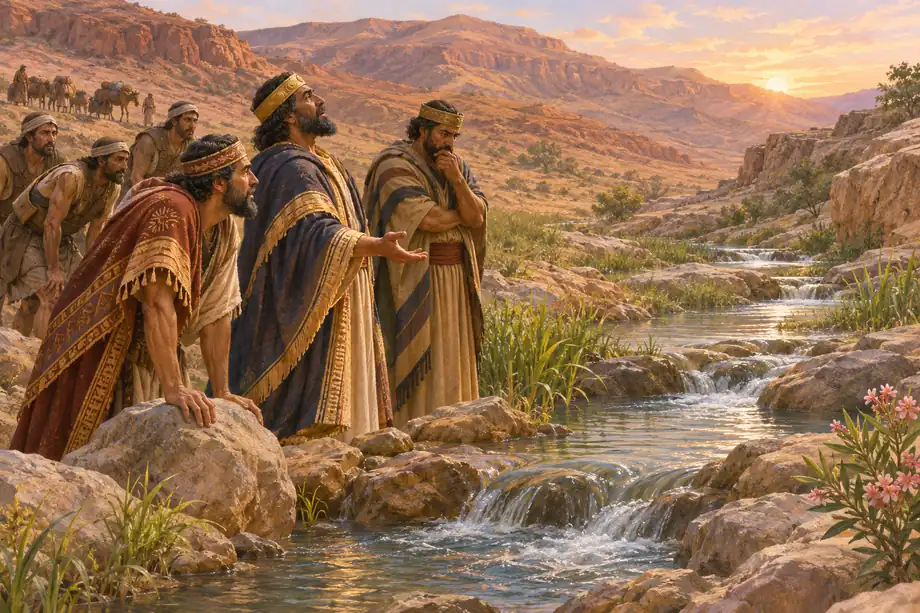
Why does merciful water in the wilderness leave Moab’s war without a simple song of victory?
Study overview
Three kings, Elisha’s word, and the uncontrollable cost of war
Elijah’s mantle has crossed the Jordan. But royal crowns still hunger for victory. Three kings enter the wilderness; their armies have strength, but no water. The LORD can fill a valley without rain. Morning comes; the water gleams like blood. Victory begins almost like a song, then reaches a wall and falls silent. On that wall, a child becomes a father’s sacrifice. An army withdraws; the questions remain. Does God’s word endorse every war? And who pays for the ambitions of kings?
- Key passage:
- 2 Kings 3:9–20, 25–27.
- Guiding question:
- What happens when rulers seek God’s help only after setting out under the guidance of their own interests and calculations?
- Central claim:
- Second Kings 3 reveals the LORD who gives water in the wilderness and speaks a word kings cannot purchase; yet divine help in a crisis does not vindicate every political ambition or turn war into a simple story of triumphant conquest.
Introduction — Armies with Everything Except Water
Sometimes a small necessity exposes the fragility of a grand plan. A convoy can have vehicles, guards, supplies, and maps yet lack a few containers of drinking water. A room full of leaders can speak confidently about victory while leaving an essential question unanswered: Is the mission itself just?
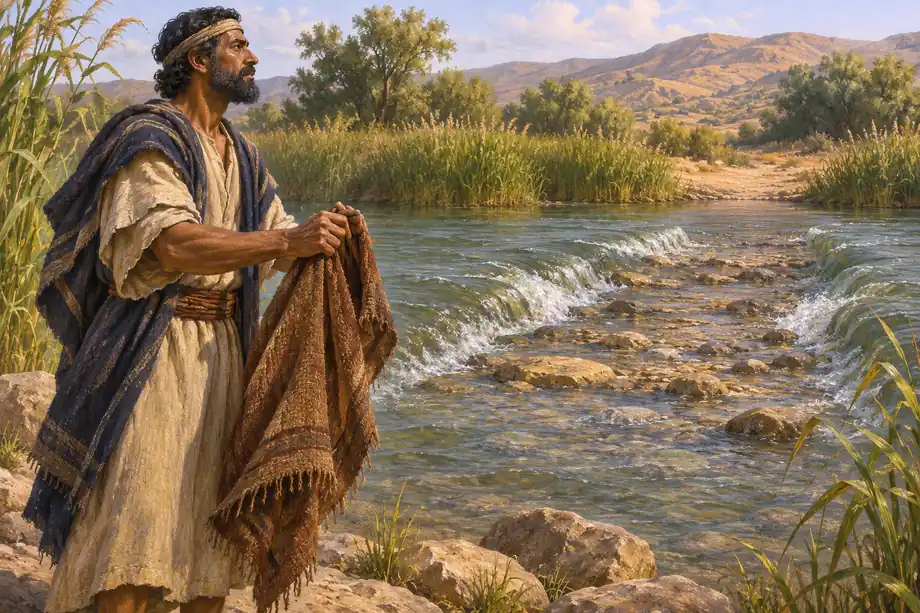
At the close of 2 Kings 2, Elisha had returned from the Jordan, newly established in prophetic responsibility. The river had divided, and the waters of Jericho had been healed. Now Elisha encounters another crisis involving water. This time, however, the crisis does not begin in a widow’s home or a troubled city. It unfolds during a military campaign initiated by kings. The window promised at the end of the previous chapter opens wide: Jehoram of Israel, Jehoshaphat of Judah, and the king of Edom find themselves stranded in a waterless wilderness.
In some respects, the episode resembles Israel’s journey from Egypt. Yet the narrator does more than recall an old miracle. The story asks whether an appeal for God’s help can be separated from the desire to restore Moab to tribute-paying dependence. A prophet refuses to flatter the throne, and the LORD supplies a desperate need. But the conclusion brings no uncomplicated celebration. The king of Moab offers his firstborn son as a burnt offering on a city wall, and Israel’s army retreats.
This chapter is about divine provision meeting the limits of human victory. Water can arrive without visible rain, but miraculous water is no permission slip to abandon questions of justice, worship, or the human cost of war. A king may receive help without being granted ownership of God’s purposes.
Historical and Literary Context — From Ahaziah to Jehoram
First and Second Kings form one continuous account in which royal success is measured by covenant loyalty, not governing skill alone (Deut 17:18–20). First Kings 22 portrayed Ahab seeking a reassuring prediction about the campaign at Ramoth-gilead, while Micaiah spoke an unwelcome word. Second Kings 1 portrayed Ahaziah, Ahab’s son, asking Baal-zebub of Ekron about an injury rather than consulting the LORD. Second Kings 2 then told of Elijah’s departure and Elisha’s succession. Now chapter 3 returns to the palace and tests another ruler from Ahab’s household.
Ahaziah died without a son to inherit the throne (2 Kgs 1:17–18). Jehoram, also called Joram in some English versions, reigned in Israel. The narrator distinguishes Jehoram from Ahab and Jezebel: Jehoram removed the pillar of Baal erected by his father. Nevertheless, Jehoram persisted in the sins of Jeroboam—the rival northern worship system that distorted Israel’s covenant allegiance (2 Kgs 3:1–3; 1 Kgs 12:26–33). A partial reform is not the same thing as wholehearted conversion. The careful evaluation resists two extremes: Jehoram is not depicted as identical to his parents, but neither is Jehoram declared a faithful king.
Moab lay east of the Dead Sea. Its ruler, Mesha, had been supplying Israel with a substantial annual tribute involving sheep and wool (2 Kgs 3:4). Following Ahab’s death, Moab rebelled (2 Kgs 1:1; 3:5). This is a political event; the narrator does not first announce that the LORD commanded Israel to invade. Jehoram requested cooperation from Jehoshaphat of Judah. Jehoshaphat agreed using language strikingly similar to an earlier alliance with Ahab (1 Kgs 22:4; 2 Kgs 3:7).
The southern approach through the wilderness of Edom would bring the coalition against Moab from an unexpected direction, but the maneuver required access to water. Provan observes a significant difference from 1 Kings 22: whereas Jehoshaphat earlier requested divine counsel before battle, the king here approves the coalition and discusses the route before asking for the LORD’s word (Provan 1995, comments on 2 Kgs 3). The narrative develops through a familiar but unsettling sequence: strategic confidence, thirst, prophetic speech, unexpected deliverance, apparent victory, and a finale resistant to easy explanation.
The story echoes the water crises of Exodus 17:1–7 and Numbers 20:1–13. Joshua’s crossing of the Jordan also lingers in the background of Elisha’s ministry (Josh 3:14–17). Yet Deuteronomy 20:19–20, which protects fruit trees in siege warfare, introduces a different and disquieting comparison with the devastation of Moab’s land. Kings does not resolve every ethical question in advance. The text invites a careful encounter with a victory whose costs refuse to disappear.
Walking Through the Text — When Water Arrives Before Victory
A King Changes an Altar but Not His Ways (3:1–3)
Jehoram’s reign begins with a qualified assessment. The king does evil in the sight of the LORD, but not in precisely the same manner as Ahab and Jezebel. Removing Baal’s pillar represents a real departure from one feature of the previous regime. Yet continued participation in Jeroboam’s sins preserves an alternative framework for worship and allegiance. Kings measures leaders by covenant obedience, not economic management or battlefield success alone (Exod 20:2–6; Deut 6:4–5).
Leaders can dismantle one visible symbol of corruption without confronting the assumptions that made corruption normal in the first place. The opening assessment therefore prepares the chapter’s deeper test. Will Jehoram seek the LORD before choosing the road? Or will the king invoke God only after the chosen road leads into trouble?
Three Kings, One Coalition, and No Water (3:4–10)
Mesha refuses continued subordination after Ahab’s death. Jehoram assembles Israel’s forces and asks Jehoshaphat to join the campaign. The king of Judah agrees, and the coalition chooses a route through Edom. Edom’s ruler becomes the third king in the expedition. After seven days of marching around the wilderness route, the army and its animals have no water.
The coalition possesses three kings but lacks what an ordinary household knows is essential: drinkable water. Jehoram responds by lamenting that the LORD has gathered the kings to deliver them to Moab (3:10). Yet the preceding verses describe the decision to campaign as Jehoram’s own initiative (3:6–8). When human plans fail, blaming God can become easier than examining the plans themselves. Acknowledging divine sovereignty is not the same as surrendering personal responsibility.
The shadow of Ahab’s earlier campaign grows longer. Once again, a royal house needs a word from God. Once again, the danger lies in treating divine guidance as a late addition to a political decision already made.
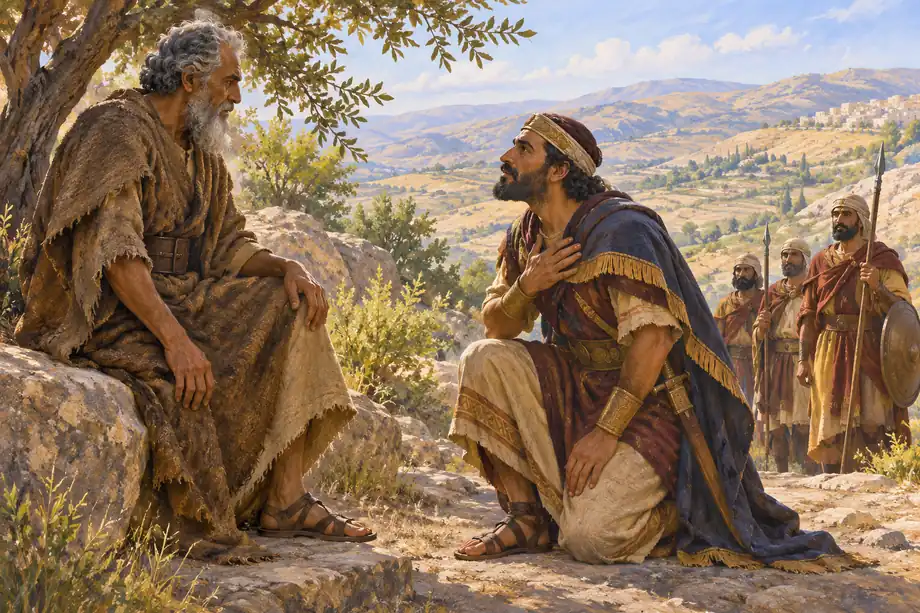
A Prophet Who Does Not Work for the Palace (3:11–15)
Jehoshaphat finally asks whether a prophet of the LORD is nearby. A royal attendant identifies Elisha in an unexpectedly humble way: Elisha used to pour water on Elijah’s hands (3:11). The description carries a quiet literary irony. A servant remembered for an act involving water is now sought by rulers desperate for water.
Elisha does not rush to reassure Jehoram. The prophet pointedly suggests that the king consult the prophets associated with Ahab and Jezebel. Jehoram again insists that the LORD has assembled the coalition for destruction. Elisha then makes clear that the presence of Jehoshaphat is the reason for engaging with the kings at all (3:13–14). The prophet’s authority cannot be reduced to a royal communications office.
Before speaking, Elisha requests a musician. While the musician plays, the hand of the LORD comes upon the prophet (3:15; compare 1 Sam 10:5–6). The narrative associates music with the prophetic moment; it does not claim that the right performance can force God to speak. The source of revelation remains the LORD. In contrast to the reassuring chorus surrounding Ahab in 1 Kings 22, Elisha begins with an unwelcome confrontation before delivering an unexpected promise.
Water without Wind or Rain (3:16–20)
Elisha announces that the valley will hold water although no wind or rain will be seen. The prophet also declares that the LORD will give Moab into the coalition’s hand. In many translations, verse 16 sounds like an instruction to dig ditches. The Hebrew may alternatively be understood as a declaration that the LORD will fill the valley with pools or depressions. The decisive feature is the promise of water where no visible source appears (Provan 1995, note on 2 Kgs 3:16).
By morning, around the time of the offering, water comes from the direction of Edom and fills the land (3:20). Scripture does not spell out the physical process by which the water arrives. The emphasis falls on the LORD as the provider of life in the wilderness. Echoes of Israel receiving water during the exodus return (Exod 17:1–7).
This is mercy, but mercy creates an ethical question. God’s provision rescues exhausted soldiers and animals even though the expedition was not initiated by first seeking God’s counsel. Rescue from the consequences of a decision does not prove that every part of the original decision was right. Gratitude should lead to humility, not to an inflated claim that every strategic ambition now carries divine endorsement.
When Water Looks Like Blood (3:21–25)
The Moabites see the water reflecting the morning sunlight and mistake the red appearance for blood. Assuming that the allied kings have fought and destroyed one another, the Moabites rush forward to collect plunder. Instead of an unguarded camp, the advancing troops encounter Israel’s forces. The coalition drives the Moabites back, attacks cities, scatters stones across productive land, blocks springs, and cuts down good trees. Devastation reaches beyond soldiers into the landscape that sustains farming, livestock, and household life.
Elisha’s speech had anticipated these actions in verse 19. Nevertheless, the proximity of this devastation to the restrictions concerning fruit trees in Deuteronomy 20:19–20 raises a genuine moral tension. That command may not apply in identical fashion to every feature of this particular conflict, yet the tension should not be erased. Leithart (2006, comments on 2 Kgs 3) presses the reader to notice a war waged not merely against opposing troops, but against fields, springs, and trees.
What kind of victory makes good land unproductive and closes the wells on which future families will depend? The prophetic message has begun to take shape, but the narrative has not reached its last and most disturbing scene.
The Wall of Moab: A Horrifying Sacrifice and an Incomplete Triumph (3:26–27)
Moab’s king attempts to break through the besieging forces with seven hundred swordsmen, apparently toward the king of Edom, but the attempt fails. The king then offers his own firstborn son—the royal heir—as a burnt offering on the city wall. The narrator does not name the child, but narrative silence must never be confused with the child’s lack of worth.
Then great wrath comes against Israel, and the Israelite forces withdraw (3:27). Crucially, the verse does not explicitly identify whose wrath has arisen. Some interpreters understand an eruption of Moabite fury after witnessing the king’s desperate act. Others suggest judgment from the LORD upon Israel. Still others discuss how a Moabite religious perspective might connect the event with Chemosh. None of these suggestions justifies a confident claim that Chemosh overpowered the LORD or that Israel’s God approved of child sacrifice (Provan 1995, note on 3:27; Brueggemann 2000, 314–18; Leithart 2006, comments on the chapter).
The question of the oracle’s fulfillment also resists a quick answer. Much of the foretold attack and devastation took place, but the coalition did not secure the uncomplicated, permanent triumph the reader might have expected. Provan emphasizes that the oracle described what would happen without disclosing the campaign’s entire outcome; Brueggemann highlights the unresolved tension between prophetic assurance and historical reversal. Both observations help the reader resist easy triumphalism.
The narrative ends at the boundary of what has been revealed. A faithful reader should not fill every silence with an invented certainty. The chapter’s final sound is not a victory trumpet. It is a question lingering over a devastated land.
Theological Reflection — The Mercy of Water and the Judgment of War
Seek the LORD before choosing the route
Jehoshaphat asks for the LORD’s prophet only after the coalition runs out of water. In 1 Kings 22:5, the same king had requested divine counsel before the campaign. The difference exposes the spiritual danger of habit: a leader can know the importance of prayer and nevertheless forget that knowledge when a promising new alliance appears. Trust cannot be reduced to an emergency service called after a strategy fails. Deuteronomy 17:18–20 places the king under the written instruction of the covenant. The king does not receive authority to turn God’s word into a stamp of approval for already completed decisions.
Grace does not remove moral accountability
The LORD supplies water, but the narrator never says that the military decision began with a divine command to invade Moab. There is a distinction between help and approval. A community can be rescued from the outcome of a reckless decision and still need to repent of the recklessness. The Elijah–Elisha tradition does not belong to the royal household. Prophetic ministry must remain free to address abuses of power and defend those vulnerable to royal ambitions. Covenant loyalty concerns not only whether a plan achieves its declared goal, but also the character and cost of the means employed.
The limits of conquest and the dignity of those who bear the cost
The coalition’s valley fills with water, while the springs of Moab are stopped up. The disturbing contrast refuses to leave the reader comfortable: life-giving water for one army accompanies the destruction of another land’s means of sustaining life. Ancient warfare reached into orchards, herds, farms, and the lives of children. The child offered on the wall interrupts every easy song of military victory. Jesus calls disciples to love enemies rather than treating entire populations as expendable instruments in the pursuit of advantage (Matt 5:43–48; Luke 6:27–36).
The good news points beyond the power of kings
Elisha’s ministry witnesses to the God who brings life into the wilderness. Within the broader biblical story, Jesus is the King who offers living water and reveals divine kingship by giving himself, not by sacrificing children to preserve royal power (John 4:10–14; 7:37–39; Mark 10:42–45). The death of Moab’s crown prince is neither a pattern to imitate nor a straightforward parallel to the cross. Christ willingly gives his own life for others. Moab’s king gives the life of a son amid the desperate defense of a throne and city. The moral and theological distinction matters. Jesus also rebukes disciples who seek destructive fire against an unreceptive Samaritan village (Luke 9:51–56). The church is called to bring truth and mercy together, not to baptize a ruler’s ambitions without examination.
Life Application — Before Entering the Wilderness
- Seek wisdom before making a costly commitment. Before a partnership, loan, public campaign, or new ministry assignment, examine motives, consequences, biblical principles, and counsel from trustworthy people (Prov 15:22; Jas 1:5).
- Do not use God’s name to conceal personal choices. Claims that “God told me” require humility and accountability. Such claims must never become tools for silencing necessary questions (Jer 23:16–22).
- Distinguish rescue from approval. Recovery from financial or medical danger does not automatically validate the choices that created the danger. Give thanks for mercy, then address the underlying problem (Ps 139:23–24).
- Protect the community’s wells. In church, village, or institutional planning, ask what each proposal will do to water, food, children, farming livelihoods, and poorer households (Deut 20:19–20; Prov 31:8–9).
- Listen to those without impressive titles. A servant points the kings toward Elisha. Attendants, teachers, younger workers, and people close to a community’s suffering often recognize realities overlooked by the powerful (2 Kgs 3:11).
- Never sacrifice children for adult prestige. Reject plans that place the safety and dignity of children beneath the reputation, wealth, or influence of those in authority (Matt 18:5–6).
- Admit the limits of interpretation. Where Scripture does not identify the source of wrath or disclose every cause of an event, teach what the text says and acknowledge that several explanations remain debated (Deut 29:29).
Five Reflection Questions
- Which major decision in life or ministry is moving forward before prayerful consideration, biblical examination, and wise counsel?
- Where might Jehoram’s partial reform be repeated today—removing a visible symbol of compromise while leaving the underlying loyalties untouched?
- How can a faith community distinguish God’s help during a crisis from a leader’s claim that God approved every preceding decision?
- When a leader speaks about winning, who or what might be left without water—children, poor families, farmers, the natural world, or peaceful neighbors?
- What does the unresolved wrath in 2 Kings 3:27 teach about humility when the Bible refuses to give an interpreter every desired explanation?
A Prayer in Response
LORD of the wilderness and the living spring, forgive the human habit of moving before listening. We study our maps, count our resources, form alliances, and then call upon the LORD when the water is gone. Give leaders in families, churches, and communities the courage to ask questions of justice before setting out. Teach every congregation to hear faithful voices without influential titles. Grant gratitude for unexpected water and humility to examine the choices that brought the thirst. Protect children from the ambitions of adults. Guard the fields, springs, and peace of neighbors. When the biblical story ends without satisfying every question, rescue the church from the pride of pretending to know everything. Jesus Christ, Prince of Peace, teach the people of God to give themselves for the life of others rather than demanding the lives of others in pursuit of victory. Amen.
A Window into the Next Chapter — From the Noise of War to a Widow’s Door
Chapter 3 ends with soldiers leaving Moab and the question about wrath still unanswered. Chapter 4 will move the reader from kingdoms fighting over tribute to households struggling to survive. A widow burdened by debt and threatened with the loss of her children will seek Elisha’s help. A small supply of oil will become the beginning of liberation. Then a woman of Shunem will prepare a room for the prophet; a son will be born, and a mother’s grief will turn a household into a place where life is sought through prayer (2 Kgs 4:1–37).
The wilderness of chapter 3 needed water for armies; the homes of chapter 4 will need oil, bread, and breath. Watch how the scale of God’s kingdom shifts—from the power to overwhelm a city to the power to preserve a widow, a child, and the hungry. What kind of victory does the LORD want a community to remember?
Bibliography (SBL Author–Date)
- BibleProject. n.d. “The Books of Kings.” https://bibleproject.com/guides/books-of-kings/.
- Brueggemann, Walter. 2000. 1 & 2 Kings. Smyth & Helwys Bible Commentary. Macon, GA: Smyth & Helwys.
- Leithart, Peter J. 2006. 1 & 2 Kings. Brazos Theological Commentary on the Bible. Grand Rapids: Brazos Press.
- Provan, Iain W. 1995. 1 and 2 Kings. New International Biblical Commentary. Peabody, MA: Hendrickson. Baker Books edition, 2012.
Reading note
Editorial note: The wording of 2 Kings 3:16 may describe either an instruction to make ditches or a declaration concerning the valley’s pools. The source of the wrath in 3:27 is not explicitly stated; Moabite anger, divine judgment, and interpretations involving the Moabite cult remain debated. Scripture does not authorize child sacrifice.
Be the first to leave a comment.