

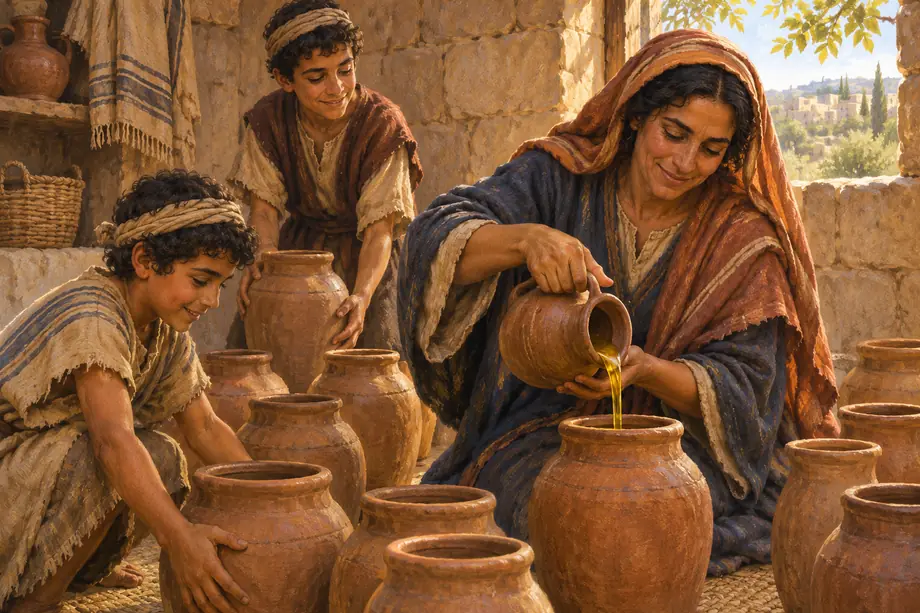
How do a widow's oil, a room in Shunem, and twenty loaves reveal the measure of God's reign?
Study overview
When God's word enters homes threatened by debt, death, and hunger
The wilderness is behind us; the noise of battle fades. But a widow stands at the door, still waiting for help. A jar holds a little oil, while a debt threatens to take two sons. A home in Shunem opens an upper room, but that same room will hear a mother's grief. In a famine, a cooking pot becomes dangerous; twenty loaves look small before a hundred hungry people. Then the word of the LORD arrives: not like the marching of an army, but like oil being poured, breath returning, and bread remaining on the table.
- Key passage:
- 2 Kings 4:1–7, 18–37, 38–44.
- Guiding question:
- What does God's kingdom look like when the burden of life is found not in a palace, but in a widow's debt, a mother's grief, and a community's hunger?
- Central claim:
- Second Kings 4 reveals that the LORD who rules the history of kings also governs ordinary life by bringing freedom, life, and provision; God's covenant people are called to make divine compassion visible in their households and communities.
Introduction — When God Comes to the Front Door
Some crises never make the news. A widow counts debts after a funeral. A mother holds a child with a terrible headache. A hungry family looks into a cooking pot and wonders whether dinner will stretch far enough. The deepest needs do not always demand a public platform. Often those needs require someone who will listen, hands ready to help, and hope that means more than kind words.
At the end of 2 Kings 3, three kings marched home from a deeply troubling war. The coalition of Israel, Judah, and Edom had witnessed water arriving in the wilderness, but the campaign against Moab ended with an appalling act: the Moabite king offered his firstborn son as a sacrifice, and the Israelite army withdrew (2 Kgs 3:26–27). Chapter 4 moves the camera away from marching armies. The new locations are smaller: a widow's house, a guest room, a communal cooking place, and a gathering of hungry people.
This change of scenery is not a break from the book's theology of kingship. In these rooms, the reign of the LORD becomes more concrete. Human governments worry about tribute and territory; the LORD hears the cries of people who may never be noticed by royal officials. Elisha is not merely a prophet who challenges kings. The prophet now enters the lives of people struggling with debt, infertility, bereavement, unsafe food, and famine.
This chapter tells of life refusing to surrender the final word to debt, death, and hunger. Yet these miracles are not a promise that every faithful family will become wealthy or see a loved one immediately restored. They are signs of God's character and an invitation to build communities in which the gift of life is shared in practical, tangible ways.
Historical and Literary Context — A Different Measure of the Kingdom
First and Second Kings belong to a single sustained prophetic account. Kings are weighed by covenant faithfulness, not by the size of an army or the prosperity of a royal treasury (Deut 17:18–20). Since the division of Israel, the story has repeatedly linked distorted worship with the abuse of power and injustice. Ahab seized Naboth's vineyard through deception and violence (1 Kgs 21). Ahab's son Ahaziah sought an oracle at Ekron rather than the LORD (2 Kgs 1). Jehoram's military alliance sought Elisha's counsel only after the expedition found itself stranded without water (2 Kgs 3).
Now the prophet attends to people who cannot command an army. The first woman is the widow of a member of the prophetic communities, groups of people associated with the training and practice of prophetic ministry (2 Kgs 2:3, 5; 4:1). A creditor threatens to take the widow's two sons into debt servitude. Debt servitude was a recognized practice in the ancient world, but Israel's covenant law placed restraints on economic exploitation and demanded special care for widows, children, and those living in poverty (Exod 22:22–24; Deut 15:1–18; Lev 25:39–43). The scene lays bare the painful distance between an economy shaped by human vulnerability and the justice demanded by the LORD.
Shunem was a settlement in the northern kingdom of Israel. There, a woman with considerable resources receives Elisha and arranges a small furnished upper room: a bed, table, chair, and lamp (2 Kgs 4:8–10). Although this woman possesses material means, the household carries a different form of vulnerability. The woman has no child, and the husband is advanced in years. Chapter 4 refuses to measure human need only in terms of money.
Later, at Gilgal, famine makes the preparation of food a matter of survival for the prophetic community. The chapter contains five wonders arranged within four stories: the widow's oil (4:1–7), the birth and restoration of the Shunammite's son (4:8–37), the removal of danger from a pot of stew (4:38–41), and a small offering of bread feeding a crowd (4:42–44). Brueggemann highlights the movement from public prophetic interventions among rulers to pastoral acts that defend life among vulnerable people (Brueggemann 2000, 319–29). Provan draws attention to the deliberate echoes of Elijah's provision for the widow of Zarephath and restoration of her son (1 Kgs 17:8–24; Provan 1995, comments on 2 Kgs 4).
The God who confronted Ahab on a mountain remains the God who enters a kitchen. The scale changes; the divine faithfulness does not.
Walking Through the Text — Oil, Breath, and Bread
A Little Oil Facing a Mountain of Debt (4:1–7)
The widow cries out to Elisha. The deceased husband feared the LORD, but the husband's devotion did not prevent financial distress. A creditor intends to take two sons in payment. This opening is an important correction to shallow religious slogans: faithfulness does not automatically remove economic hardship. Debt here threatens more than possessions. Debt threatens the freedom of the children and the future of the family.
Elisha asks a practical question: What do you have in the house? The widow can identify only a small jar of oil. Elisha then tells the woman to borrow many empty vessels from neighbors, shut the door with the sons inside, and pour oil into the vessels. The sons bring one vessel after another, while the mother pours. The oil continues until the available containers are full. Elisha instructs the widow to sell the oil, pay the debt, and live on the remainder.
The extraordinary provision does not remove the ordinary responsibilities of life. The account contains a plan, participation from neighbors, the children's labor, repayment, and provision for future living. The oil is not a scheme for riches without accountability. The real deliverance is a family rescued from being torn apart by debt. The episode points back to Israel's covenant obligation to prevent unending economic bondage (Deut 15:7–11; Neh 5:1–13). The first people delivered in the chapter are not royal officials. They are two sons who were about to lose their freedom.
A Small Room Opens the Door to Hope (4:8–17)
A woman from Shunem recognizes Elisha as a holy man of God and repeatedly offers the prophet a meal. Hospitality becomes a sustained practice. The household provides an upper room containing a bed, table, chair, and lamp. None of these objects is spectacular. Together, however, the furnishings become a picture of space set aside for welcome and service.
Elisha offers to use influence with the king or the commander of the army on the woman's behalf. The woman declines that opportunity, explaining that the household is settled among its own people. Gehazi notices another reality: the woman has no son, and the husband is old. Elisha promises that the woman will embrace a son at about the same time the following year. The woman's startled response reveals a fear of hope being awakened only to be disappointed again (4:16). The child is born, as promised.
The story recalls Abraham and Sarah (Gen 18:9–14). The comparison does not mean that every childless person receives a promise of pregnancy. Rather, the biblical narrative repeatedly portrays God giving a future where human expectations have reached their limits. The most beautiful surprise is that this great gift follows an act of hospitality without bargaining. A room prepared for someone else becomes the room in which a household will encounter the mystery of God's gift of life.
A Mother Refuses Easy Answers (4:18–30)
The boy grows. One day, while visiting the father and the harvesters, the child cries out in distress about his head. A servant carries the child to the mother, and the boy dies on the mother's lap. Scripture does not identify a medical cause of death. The mother places the child on the prophet's bed and shuts the door.
The Shunammite takes a donkey and travels to Mount Carmel to find Elisha. The husband is puzzled because the day is neither a new moon nor a Sabbath, occasions associated with consulting prophets (4:23). The woman's brief response that all is well should not be mistaken for a claim that no tragedy has occurred. The words belong to a determined effort to take the matter directly to the prophet.
Elisha sees the woman coming and sends Gehazi to ask about the family's welfare. The mother reaches Elisha and grasps the prophet's feet. Gehazi attempts to push the woman away. Elisha admits that the LORD has concealed the matter (4:27). This confession matters: the prophet serves God's word but does not possess unlimited knowledge. The mother asks why a son was promised if the gift was to become a source of overwhelming grief. Elisha sends Gehazi ahead with the prophet's staff, but the mother refuses to leave without Elisha. The mother's determination echoes Elisha's own refusal to abandon Elijah during the final journey (2 Kgs 2:2, 4, 6).
This passage does not teach anyone to avoid medical care, and the mother's insistence is not grounds for blaming bereaved parents who have experienced different outcomes. The passage gives space to grief that refuses to be silenced by quick religious answers.
When a Staff Is Not Enough, the Prophet Prays (4:31–37)
Gehazi arrives first and places the staff upon the boy, but no voice or sign of life follows. The prophet's staff is not a magical instrument that operates apart from God. When Elisha reaches the house, the prophet goes into the room, shuts the door, and prays to the LORD. Elisha stretches out upon the boy's body, and warmth returns. After walking about the room, Elisha repeats the action. The boy sneezes seven times and opens his eyes.
Seven may evoke the biblical language of completeness, but the passage does not present seven sneezes as a religious method to reproduce. The essential point is that the LORD hears prayer and restores life. Elisha calls the mother, who bows in gratitude and takes up the child (4:36–37). The scene recalls Elijah's prayer for the widow's son at Zarephath (1 Kgs 17:17–24).
The Shunammite does not receive a theory of suffering. The mother receives back the child who had died. God's intervention is a sign that death does not possess ultimate authority, but the narrative does not erase the grief of families whose loved ones are not restored in the present age. Christian hope rests finally in the resurrection of Jesus and God's promised renewal of creation, not in a claim that every death will be reversed immediately (1 Cor 15:20–26; Rev 21:4).
Death Hidden in a Cooking Pot (4:38–41)
Elisha returns to Gilgal during a famine. The prophetic community requires food. One member gathers produce from a wild vine, cuts the unknown gourds into a large cooking pot, and unwittingly introduces danger into the meal. As the food is served, the men recognize something wrong and cry out that death is in the pot. Scripture does not precisely identify the plant. The story must not be used as a botanical guide to distinguish edible and poisonous species.
Elisha asks for flour, places flour in the pot, and the food becomes fit to eat. The flour is not presented as a universal antidote to poison. It functions within the narrative as a sign of God's provision in a time of hunger. Even a prophetic community faces mistakes, weariness, and shortages. A ministry devoted to life must also exercise ordinary wisdom in food preparation and harm prevention. Faith must never become a reason to neglect safety.
Small Loaves Beyond the Arithmetic of Scarcity (4:42–44)
A man from Baal-shalishah brings twenty barley loaves and fresh grain from the firstfruits. Elisha orders the food to be distributed among the people. A servant questions how such a small amount could feed one hundred people. Elisha repeats the instruction, now accompanied by the LORD's word: the people will eat, and some will remain. The bread is distributed; everyone eats, and there are leftovers.
The chapter began with a little oil and ends with more bread than a community consumes. In both stories, the resources already at hand become a means of caring for others. Elisha does not hoard the offering as a private reserve; the bread is carried to the people. The miracle bears witness to God's generosity while challenging the fear-driven instinct to keep every resource for oneself (Exod 16:16–18; John 6:5–13).
The leftover bread is a picture of grace moving a community from anxious scarcity toward generous sharing.
Theological Reflection — Measuring Kingship by the Gift of Life
The Torah protects families, not merely property
The widow's plight must not be reduced to a private problem solved by one supernatural intervention. Deuteronomy 15 and Leviticus 25 require economic limits and concrete protection for poor families. In 1 Kings 21, royal power helped take a man's inheritance; in 2 Kings 4, the LORD's word protects children from being taken in payment of a debt. Covenant justice concerns the structure of economic life, not only occasional generosity (Brueggemann 2000, 327–28).
God's presence can be encountered in a small room
The Shunammite's upper room is no temple, but hospitality, prayer, and restored life fill the space. The Jerusalem temple signified God's presence among Israel; even Solomon acknowledged that the LORD could not be contained in a building (1 Kgs 8:27). The woman's hospitality resonates with the call to welcome God's messengers and strangers (Matt 10:40–42; Heb 13:2). Hospitality does not purchase miracles. Hospitality does, however, make room for covenant love to become visible.
A prophet serves God's power rather than manufacturing it
Elisha did not know about the child's death until the matter came to light (4:27). Gehazi's staff failed to restore the boy (4:31). These details distinguish divine gift from religious technique. A leader's spiritual calling is no justification for claiming guaranteed results, controlling grieving people, or rejecting professional help. Trustworthy spiritual authority takes the shape of prayer, humility, accountability, and care.
From Elisha to Jesus: Bread, widows, and victory over death
Elisha continues Elijah's ministry (1 Kgs 17:8–24), but the biblical storyline reaches toward Jesus. Jesus meets a widow at Nain and restores the widow's son (Luke 7:11–17). Jesus feeds a crowd with a small quantity of bread and leaves food remaining (Mark 6:35–44). Jesus also announces the Messiah's work among the poor, captive, and oppressed (Luke 4:18–19). These acts show God's rule entering the lives of suffering people. Yet there is a decisive difference: Jesus' resurrection is not merely a temporary return to mortal life. Jesus' resurrection inaugurates new creation itself (1 Cor 15:20–23). Elisha's signs point forward to that wider horizon of redemption (Leithart 2006, comments on 2 Kgs 4).
Life Application — Empty Vessels Need Neighbors
- Notice debt that threatens a household. A church or study group can establish a confidential way to identify families facing predatory debt, school-fee pressures, or potential loss of housing. Offer dignified help accompanied by sound financial planning, not public embarrassment (2 Kgs 4:1–7).
- Turn hospitality into real space. A family may offer a meal, transportation, time, or a safe room to someone in need. The Shunammite's bed, table, chair, and lamp show how ordinary objects can become the setting for meaningful care (4:8–10).
- Listen to grief before offering explanations. A bereaved parent or seriously ill neighbor does not need an immediate religious formula. Presence, attentive listening, and prayer offered with permission are forms of genuine ministry (4:18–30; Rom 12:15).
- Do not turn signs into guaranteed techniques. Oil, a staff, and flour belong to the story, but none offers a procedure for becoming rich, raising the dead, or treating poisoning. Seek qualified medical and practical assistance in emergencies (4:1–7, 31, 38–41).
- Treat food safety as an expression of love. When providing meals, examine food quality, water, storage, and preparation practices. Christian care protects health as well as distributing supplies (4:38–41).
- Share available resources before surrendering to the fear of insufficiency. A congregation can organize a modest food bank, neighbor-to-neighbor pantry, or communal meal that welcomes hungry people without favoritism (4:42–44; Jas 2:15–17).
Reflection Questions
- Which family in the local community bears debt, illness, or hunger in silence, and what is one responsible step toward assistance this week?
- Why does Elisha ask what the widow has at home before issuing instructions (4:2)? What does this question teach about recognizing both the resources and dignity of people living in poverty?
- How does the Shunammite's hospitality differ from offering service in order to secure benefits (4:8–17)?
- What warning does Gehazi's ineffective staff offer to leaders who rely on symbols, position, or technique rather than the living God (4:29–31)?
- Should a church be evaluated chiefly by the size of its gatherings or by the life restored in households and neighborhoods (4:38–44; Luke 4:18–19)?
Response Prayer — LORD of the Empty Vessels
LORD, God of Elijah and Elisha, Father of Jesus Christ,
Hear the cries rising from homes burdened by debt. Protect children from becoming the price paid for economic failure. Open the eyes of the church to recognize families who need help without humiliation. Teach neighbors to bring vessels of assistance rather than words of condemnation.
Draw near to grieving mothers and exhausted fathers. Bless caregivers who listen without pretending to know every answer. Give wisdom to healthcare workers and strength to families awaiting healing. Make room for honest lament as well as faithful prayer.
Remove the poison of selfishness from the common pot. Bless the small loaves shared with hungry people. Keep the desire for miracles from replacing obedience, justice, and compassion.
Through the risen Jesus, sustain hope in the new creation. May the lives of ordinary people become living signs that God's kingdom brings life where fear has settled in. Amen.
Window into the Next Chapter — A Foreigner Arrives with a Wound
Chapter 4 has shown the LORD at work among Israel's households and prophetic communities. Chapter 5 will place an outsider at the center of the narrative: Naaman, commander of the army of Aram. Naaman possesses honor, military success, and gifts sufficient to impress a king. Yet a serious skin disease exposes the limits of the commander's power. Hope will come from an unexpected voice—a young Israelite girl taken captive from home (2 Kgs 5:1–3).
Elisha will direct Naaman toward the waters of the Jordan, but Naaman's pride will make a simple instruction difficult to accept. Meanwhile, Gehazi will face another test: the temptation to make personal profit from God's freely given grace. Watch the contrast between a foreigner who lays down pride to receive healing and an insider who allows greed to take root. Who will truly understand the generosity of the LORD?
Bibliography (SBL Author–Date)
- BibleProject. n.d. “The Books of Kings.” BibleProject. https://bibleproject.com/guides/books-of-kings/.
- Brueggemann, Walter. 2000. 1 & 2 Kings. Smyth & Helwys Bible Commentary. Macon, GA: Smyth & Helwys.
- Leithart, Peter J. 2006. 1 & 2 Kings. Brazos Theological Commentary on the Bible. Grand Rapids: Brazos Press.
- Provan, Iain W. 1995. 1 and 2 Kings. New International Biblical Commentary. Peabody, MA: Hendrickson. Baker Books edition, 2012.
Reading note
Editorial note: The signs in 2 Kings 4 reveal the LORD's life-giving character; the passage does not promise automatic healing, pregnancy, or financial prosperity for every reader. The plant in 4:39 is not scientifically identified, and the passage does not teach flour as an antidote to poisoning.


Be the first to leave a comment.