

Why does Jehu’s revolution return the question of peace to Naboth’s field?
Study overview
Anointing oil, racing chariots, and the justice that comes back for an answer
Yesterday, a vineyard was stolen; today, wheels thunder along the road. Yesterday, Naboth's voice was silenced; today, God's word calls injustice by name. A flask is opened in a private room; a trumpet sounds before the soldiers. Watchmen ask whether peace is coming; chariots answer with the sound of revolt. Beside the ground that remembers blood, another king falls. And beneath the shouting of a new victory, an old question refuses to die: Is the downfall of an oppressor enough to give birth to a just kingdom?
- Primary passage:
- 2 Kings 9:1–37.
- Guiding question:
- What happens when God's long-delayed judgment meets human ambition, and who can bring genuine peace?
- Central thesis:
- Second Kings 9 tells the story of judgment delayed but not forgotten. Jehu is anointed to bring Ahab's dynasty to an end, and the injustice done to Naboth returns to demand an answer. Yet a narrative that recounts a divinely announced judgment does not automatically endorse every act of violence committed by the new ruler. God demands justice, and those who claim to administer justice remain answerable to God.
Introduction — When History Returns to a Stolen Field
Injustice has a way of looking finished when powerful people close the file. A farmer loses a field. A family loses a home. A witness loses a voice. Somewhere in a palace, officials sign papers and move on. Meals are served, alliances are renewed, and the machinery of government keeps turning. But the earth under the farmer's feet remembers a different story.
That is where 2 Kings 9 takes us.
Chapter 8 ended with a precarious arrangement of power. Hazael had taken the throne of Aram. Joram, king of Israel, had withdrawn to Jezreel to recover from wounds received in battle. Ahaziah, king of Judah, had come to visit the wounded ally (2 Kgs 8:28–29). The royal families appeared to have time on their side. But the next chapter turns the political landscape upside down.
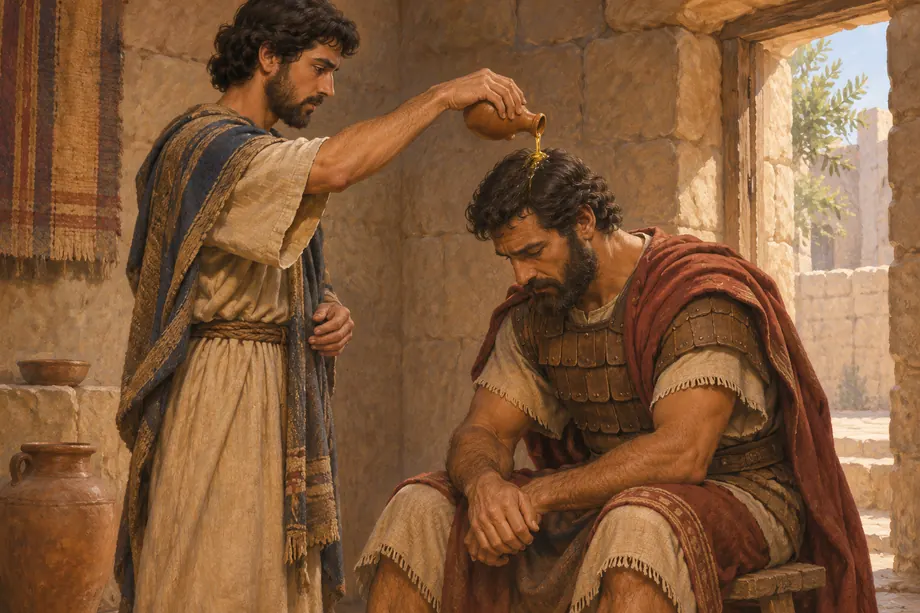
Elisha sends a young member of the prophetic community to Ramoth-gilead with a flask of oil. A military commander named Jehu is quietly anointed king. Within hours, a private word becomes a public rebellion. Chariots race toward Jezreel; sentries struggle to identify the approaching force; a wounded king goes out expecting an answer about peace.
The decisive meeting occurs beside a piece of ground associated with Naboth. In 1 Kings 21, Naboth had refused to surrender his family's inheritance to Ahab. Jezebel then engineered Naboth's death, and Ahab took possession of the vineyard. Elijah announced divine judgment, but the promised reckoning seemed to stretch beyond the lifetime of the original offenders (1 Kgs 21:17–29). Now that reckoning reaches Ahab's household.
Yet the narrative leaves another question on the table. Jehu is commissioned through a prophetic message, but Jehu is also a ruthless soldier and an ambitious new king. The text exposes the certainty of God's concern for justice without giving later readers permission to turn vengeance into a ministry. The question is not merely whether an evil regime will fall. The question is what sort of rule will grow in its place.
Historical and Literary Context — A Word That Outlived a Generation
Kings is theological history, not a neutral collection of royal achievements. The narrator measures kings by fidelity to the covenant: worship, justice, and obedience to the LORD matter more than military success or public acclaim. Deuteronomy envisioned a king under God's instruction rather than above it—one who would read the law, resist self-exaltation, and refuse to accumulate power without restraint (Deut 17:14–20).
Ahab's dynasty repeatedly reversed that vision. Ahab's marriage to Jezebel helped establish royal support for the worship of Baal in the northern kingdom (1 Kgs 16:29–33). The persecution of the LORD's prophets became part of the kingdom's history (1 Kgs 18:4, 13). Yet the story of Naboth shows that false worship was not merely a private religious error. It had public consequences. Jezebel used letters, false witnesses, and a corrupted legal process to have an innocent man killed so that the king could have a vineyard (1 Kgs 21:1–16).
Naboth understood the vineyard as an inherited responsibility, not merely a possession available to the highest bidder (Lev 25:23; 1 Kgs 21:3). The covenant's care for land, households, and truthful testimony therefore collided with a crown that expected every obstacle to disappear. Elijah announced judgment on Ahab's house. When Ahab humbled himself, the announced disaster was postponed to the next generation rather than canceled (1 Kgs 21:17–29).
At Horeb, the LORD also directed Elijah toward Hazael, Jehu, and Elisha as participants in the next phase of the story (1 Kgs 19:15–18). By 2 Kings 8, Hazael had become king of Aram. Now Jehu enters the center of the stage. As Provan notes, 2 Kings 9 moves toward the long-anticipated downfall of Ahab's house (Provan 1995, §41).
The geography is heavy with memory. Ramoth-gilead is the contested frontier where Ahab died in battle (1 Kgs 22:29–38). It becomes the site where Jehu is anointed. Jezreel, the destination of Jehu's chariot, contains the royal residence and the disputed ground associated with Naboth. These are not disposable details of the travel itinerary. The places themselves recall a kingdom's unfinished moral business.
One word keeps sounding across the chapter: peace, Hebrew shalom (2 Kgs 9:17–22, 31). In the immediate dialogue, the word can ask whether the approaching party is friendly or hostile. But the prophetic tradition gives peace a deeper resonance. Genuine peace is the fruit of righteousness, not the temporary quiet imposed by fear (Isa 32:17; Jer 6:14). This makes every repetition of the question painfully ironic. The royal house wants to know whether danger is approaching, while the story asks whether a dynasty built on injustice has ever possessed genuine peace.
Walking Through the Text — Five Scenes from an Unfinished Reckoning
Oil in the Inner Room, a Trumpet Outside the Door (9:1–13)
Elisha calls a young man from the prophetic community and sends the messenger to Ramoth-gilead. The instructions are precise: take a flask of oil, find Jehu son of Jehoshaphat son of Nimshi, bring the commander into an inner room, anoint Jehu, and leave without delay. Secrecy and speed mark the beginning of a revolution.
The message names Jehu king over Israel and commissions judgment against Ahab's house for the blood of the LORD's servants and prophets. Jezebel is singled out in the announced judgment (9:6–10; cf. 1 Kgs 18:4, 13; 21:23). The young prophet is not manufacturing a fresh grievance. The word returns to a long-established pattern of persecution and injustice.
Yet anointing is not the equivalent of declaring that everything the anointed person will do is morally right. Israel's kings stand under the same Torah that judges other Israelites. The oil signifies a responsibility before God, not immunity from God's scrutiny.
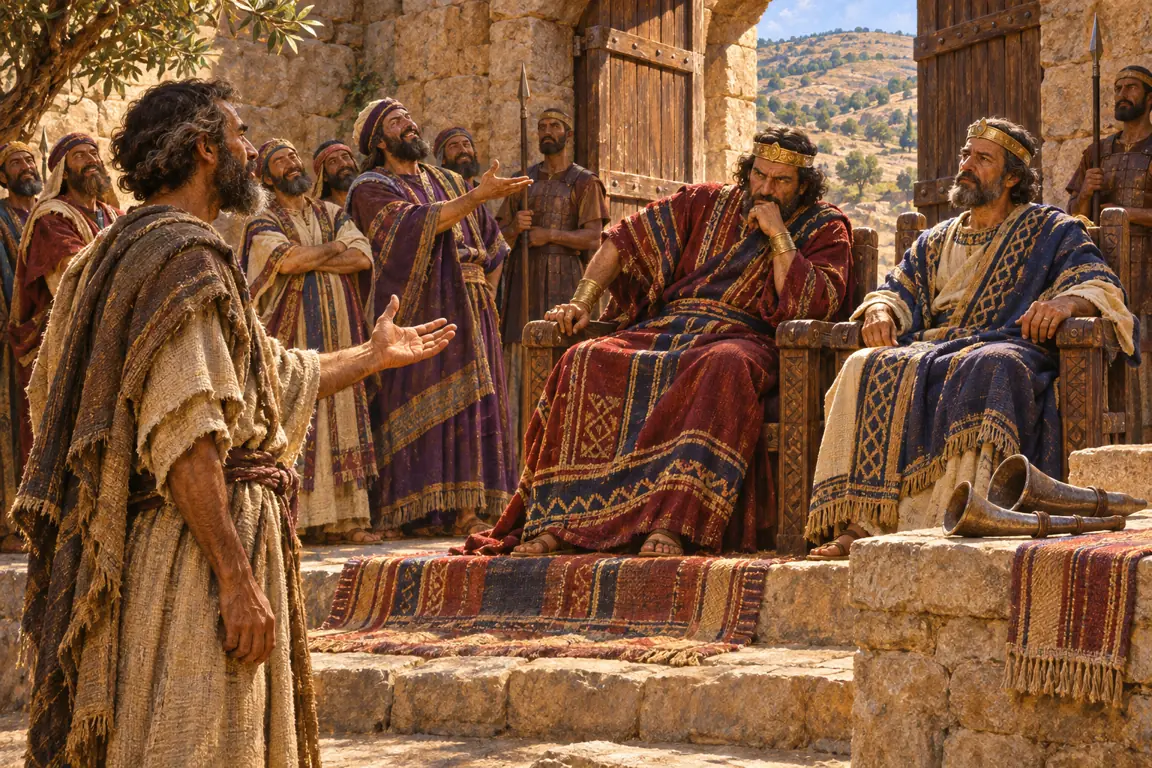
After the messenger runs away, the officers question Jehu about the strange visitor. Their dismissive language labels the prophetic messenger a madman. Jehu initially evades the question, but eventually reports the anointing. The officers spread garments beneath Jehu, blow a trumpet, and proclaim a new king (9:11–13).
Brueggemann distinguishes the private anointing from the public acclamation. The prophetic act names a ruler; the officers' public response makes the political rebellion visible (Brueggemann 2000, 381–84). The story invites attention to both movements. A word of judgment stands behind the change in power, but a group of armed men must still decide what to do with that word. The endorsement of an army does not, by itself, demonstrate covenant faithfulness.
As the Chariots Race, the Question of Peace Returns (9:14–20)
Joram remains at Jezreel, recovering from wounds suffered against the Arameans. Jehu and fellow officers at Ramoth-gilead prevent news of the uprising from reaching the palace ahead of the rebel force. Jehu then drives toward Jezreel.
A watchman notices the approaching company. The king sends a horseman to ask whether the travelers come in peace. Jehu refuses to answer and orders the messenger to fall in behind the chariot. A second messenger receives the same treatment. Neither returns to the king. The watchman eventually identifies the peculiar manner of driving: the leading chariot is moving with the reckless speed associated with Jehu (9:17–20).
The repeated question about peace is a literary drumbeat. The palace is looking for reassurance; the road is carrying a coup. Jehu has no intention of preserving the peace as Joram understands it. The watchman can describe the speed of the chariot but cannot yet name the full moral weight of the encounter.
Peace cannot be secured by a polite greeting while the foundations of government remain stained by unaddressed wrongdoing. The king hears the sound of advancing wheels. Readers hear the older word spoken through Elijah.
Naboth's Field Demands an Answer (9:21–26)
Joram and Ahaziah each go out in a chariot to meet Jehu. The confrontation takes place beside ground associated with Naboth the Jezreelite (9:21). Joram again asks whether peace has arrived. Jehu responds that peace is impossible while the religious betrayal and sorceries associated with Jezebel continue (9:22). The reference to sexual unfaithfulness belongs to the covenant's language for idolatry and betrayal; it is not a license for misogynistic insults (cf. Hos 2:2–13; Deut 18:10–12).
Joram recognizes the revolt and turns to flee, warning Ahaziah. Jehu draws a bow and strikes Joram with an arrow. Then Jehu orders the officer Bidkar to throw Joram's body on Naboth's plot. Jehu explicitly recalls the LORD's word concerning the blood of Naboth and Naboth's sons (9:24–26).
The mention of Naboth's sons is significant. First Kings 21 recounts Naboth's murder but does not independently narrate the sons' deaths. Second Kings 9:26 supplies the additional detail; the narrator does not tell us precisely when or how those deaths occurred. A careful reading should preserve that silence rather than invent a fuller story.
The judicial meaning of the location, however, is unmistakable. Naboth's case was not a minor property disagreement. A powerful household corrupted the courts, destroyed a family, and seized an inheritance. The covenant prohibited false testimony, bribery, and the perversion of justice (Exod 23:6–8; Deut 16:18–20). The dead farmer's field now becomes the backdrop for the downfall of a royal heir.
The story identifies the execution as part of a prophetic reckoning, but it does not eliminate every moral question about Jehu's wider campaign. The LORD has not forgotten the field; the people of God must not forget the sanctity of human life either.
Judah's Ahaziah Flees, but Royal Alliances Have Consequences (9:27–29)
Seeing Joram's death, Ahaziah, king of Judah, attempts to escape. Jehu orders the pursuit and the attack. Ahaziah is wounded in the chariot, reaches Megiddo, and dies there. The royal servants take the body to Jerusalem for burial among the kings of Judah (9:27–28). A notice concerning the beginning of Ahaziah's reign follows in verse 29.
This Ahaziah of Judah must not be confused with Ahaziah of Israel, who died in 2 Kings 1. The Judean king had entered the political and familial network of Ahab's house and had followed its religious direction (2 Kgs 8:25–29). Those connections place Ahaziah in the path of Jehu's revolt.
Nevertheless, the prophetic commission delivered in 9:6–10 specifically condemns Ahab's house and Jezebel; it does not explicitly name Ahaziah of Judah as a target. The death of Ahaziah therefore raises the question of how far an agent may extend a claimed mandate. A narrated death should not be treated as a separately stated divine command when no such command appears in the text.
Second Chronicles 22:7–9 recounts Ahaziah's downfall with differences of sequence and detail. A responsible interpretation need not erase those differences through an imagined itinerary. The point of Kings is clear enough: Judah's alliances and spiritual compromise have brought devastating consequences. A royal partnership can connect two kingdoms politically while drawing both into shared disaster.
Jezebel at the Window, and Royal Splendor Turns to Dust (9:30–37)
Jehu arrives at Jezreel. Jezebel prepares her eyes and hair or head ornamentation, and appears at a window. Some interpretations treat the appearance as seduction. Yet the text does not require that reading. Jezebel may instead be maintaining the public dignity and defiance of a queen, deliberately confronting the man who has killed a king.
Jezebel calls Jehu another Zimri. The earlier Zimri had assassinated a king and enjoyed only a brief reign before destruction (1 Kgs 16:8–20). Jezebel's words amount to a sharp political challenge: What sort of peace can a regicide bring, and how long can such a ruler last? Even at the brink of death, the queen is not portrayed as surrendering the argument (9:30–31).
Jehu asks the palace attendants who stands with him. Two or three eunuchs look out. At Jehu's command, they throw Jezebel from the window. Blood splashes, horses trample the fallen queen, and Jehu goes inside to eat and drink. Later, Jehu orders a burial, noting that Jezebel was a king's daughter. But most of the body has been consumed by dogs, as Elijah's earlier oracle had foretold (9:32–37; 1 Kgs 21:23).
The scene is deliberately disturbing. It dramatizes the humiliation of a dynasty that thought itself untouchable. Yet the suffering and desecration of a body must never be presented as entertainment for Christian readers. Brueggemann observes both the prophetic framework of Jehu's revolution and the unsettling ruthlessness of the man carrying it out (Brueggemann 2000, 385–90).
The fulfillment of a judgment oracle is not an invitation to imitate the violence of an ancient coup. The narrative records the end of Jezebel's power. The rest of Scripture still requires readers to ask how justice is to be pursued faithfully.
Theological Reflection — Justice, Peace, and the Limits of Power
God's justice remembers the people power has forgotten
Naboth had a vineyard. Ahab had a throne. In 1 Kings 21, the throne appeared to be stronger than the farmer. In 2 Kings 9, the farmer's name reappears when a royal heir falls. The Torah protected the boundaries of an inheritance and the integrity of the courts (Deut 16:19–20; 19:14). The LORD does not separate worship from a neighbor's right to life and livelihood. Naboth's field stands as a witness that time cannot transform injustice into righteousness. Delay is not the same as divine indifference.
Genuine peace cannot be painted over injustice
The chapter asks about shalom again and again. The royal household wants safety, but the prophetically announced reckoning reveals the absence of covenant peace. Later prophets will denounce leaders who promise peace while wounds remain untreated (Jer 6:14; Ezek 13:10). Nevertheless, the answer to false peace is not to bless every violent act performed by a revolutionary. Biblical peace joins truth, justice, protection, and restored relationships (Isa 32:17; Ps 85:10).
A divine commission does not make the commissioned agent morally untouchable
Jehu is anointed, but Jehu's own reign will be weighed. Second Kings 10:30 recognizes the fulfillment of judgment against Ahab's house; 10:31 immediately reports Jehu's failure to follow the law of the LORD wholeheartedly. Hosea 1:4 also announces judgment concerning the bloodshed of Jezreel. The exact relationship between that oracle and Jehu's acts has generated differing interpretations. Together, these texts prevent a simplistic conclusion that whatever Jehu did must have been right. A person used within God's providence remains accountable for motives, methods, and obedience.
Jesus reveals the King who does not turn dominion into self-serving violence
Jehu's story deepens the longing for a ruler capable of confronting evil without becoming captive to domination. Jesus announces God's kingdom, challenges religious and political hypocrisy, and teaches that rulers must serve rather than lord power over others (Mark 1:14–15; 10:42–45). Jesus does not abolish the truth that God judges evil. Yet Jesus calls disciples to peacemaking, love for enemies, and refusal of personal vengeance (Matt 5:9, 43–48; Rom 12:19–21). At the cross, the Messiah confronts the powers of evil through self-giving love and opens the way toward forgiveness and new creation (Col 2:13–15; Rev 21:1–5).
Jehu exposes the limits of a kingdom built through bloodshed. Jesus reveals a King whose authority is expressed through justice, service, sacrificial love, and the promise that evil will not have the final word.
Life Application — Do Not Mistake Revenge for Peace
- Remember the person whose rights were violated. Identify a neighbor, employee, or family whose land, wages, home, or reputation was taken through deception. Help the affected person seek documented, lawful restoration rather than letting the case disappear once the powerful have moved on (1 Kgs 21; 2 Kgs 9:25–26).
- Test claims of peace against lived reality. In a church, workplace, or household, do not pronounce peace while intimidation, exploitation, and substantiated complaints remain unaddressed (9:17–22; Isa 32:17).
- Keep spiritual authority accountable. A pastoral calling, leadership position, or religious title never places a person above truth, lawful procedures, or correction (Deut 17:18–20; 2 Kgs 10:31).
- Refuse to celebrate an opponent's suffering. Condemning injustice is different from delighting in humiliation, cruelty, or death. Protect even the dignity of an adversary and an adversary's family (Prov 24:17–18; Matt 5:44).
- Examine the cost of alliances. Ahaziah's association with Ahab's house became a source of danger. Before accepting a political, commercial, or religious partnership, examine the partner's practices and the likely effects upon vulnerable people (2 Kgs 8:27–29; 9:27–29).
- Make room for truthful witnesses. The prophetic message arrived from beyond the palace. Establish safe ways for whistleblowers, members, or employees to report abuse and receive an impartial hearing (9:1–10; Prov 31:8–9).
- Evaluate the path as carefully as the outcome. A seemingly worthy goal cannot excuse dishonesty, cruelty, or unlimited coercion. Ask whether the means of a proposed change honor human life, truthful speech, and love of neighbor (9:14–37; Rom 12:17–21).
Reflection Questions
- Why does the narrator bring readers back to Naboth's field at the death of Joram, and what does this return teach about delayed justice (1 Kgs 21; 2 Kgs 9:21–26)?
- How does the palace's definition of peace differ from shalom rooted in righteousness? How could a church or community recognize the difference (9:17–22; Isa 32:17)?
- What did Jehu's anointing authorize, and why can a divine calling never justify everything a leader chooses to do (9:1–13; 10:30–31)?
- What does the death of Judah's Ahaziah reveal about partnerships shaped by ambition rather than covenant faithfulness (8:25–29; 9:27–29)?
- How does Jesus teach believers to confront injustice without turning personal vengeance into a religious duty (Mark 10:42–45; Matt 5:43–48; Rom 12:19–21)?
Response Prayer — Lord, Remember Naboth's Field
LORD, God of truth and justice,
Hear the cry of families whose fields have been stolen, homes taken, and names pushed aside by powerful people. Remember those denied a fair hearing, and those whose suffering was dismissed because the guilty had influence.
Teach the church not to cover open wounds with easy words of peace. Guard leaders from disguising ambition as calling or anger as righteousness. Give judges, pastors, employers, and public servants the courage to listen to witnesses, search for truth, and refuse the rewards of corruption.
When evil must be confronted, protect the heart from delighting in another person's humiliation. Give courage to defend the vulnerable, patience to follow just processes, and humility to remember that every leader stands beneath divine judgment.
Jesus, Prince of Peace, form communities where strength becomes service, truth meets mercy, and justice makes room for repentance and restoration. Amen.
Window into the Next Chapter — The Revolution Continues, but Jehu Will Be Weighed
Second Kings 9 closes with Jezebel's power broken. Joram is dead. Ahaziah of Judah is dead. The palace at Jezreel has changed hands. But Ahab's dynasty is not yet fully dismantled, and Baal worship remains deeply entangled with the royal order.
Second Kings 10 follows Jehu into the next stage of the revolution. Letters will reach Samaria; Ahab's descendants will be killed; people associated with Ahaziah will encounter Jehu; and the worship of Baal will be attacked through a deadly deception. The narrator will finally offer a strikingly double-edged assessment: Jehu fulfilled the announced judgment against Ahab's house, yet Jehu did not walk wholeheartedly in the law of the LORD (2 Kgs 10:30–31).
Watch the difference between removing someone else's idols and allowing God to confront the idols within the reformer's heart. A leader may tear down an altar in public while quietly building another altar to self-interest. Will this revolution bring covenant loyalty, or another turn of the wheel of power?
Bibliography (SBL Author–Date)
- BibleProject. n.d. “The Books of Kings.” BibleProject. https://bibleproject.com/guides/books-of-kings/.
- Brueggemann, Walter. 2000. 1 & 2 Kings. Smyth & Helwys Bible Commentary. Macon, GA: Smyth & Helwys.
- Leithart, Peter J. 2006. 1 & 2 Kings. Brazos Theological Commentary on the Bible. Grand Rapids: Brazos Press.
- Provan, Iain W. 1995. 1 and 2 Kings. New International Biblical Commentary. Peabody, MA: Hendrickson. Reprinted by Baker Books, 2012.
Reading note
Editorial note: Ahaziah of Judah in 9:27–29 is not Ahaziah of Israel from 2 Kings 1. The reference to Naboth's sons in 9:26 adds a detail absent from the earlier account in 1 Kings 21. Differences between 2 Kings 9 and 2 Chronicles 22 concerning Ahaziah's end are not artificially harmonized. Jehu's anointing and the fulfillment of prophetic judgment do not imply that all violence committed by Jehu is a model for believers to imitate.
Be the first to leave a comment.