

How do a restored field and Elisha’s tears reveal the difference between protecting life and exploiting people?
Study overview
Justice for one household, a prophet's tears, and David's lamp amid the darkness of kings
Samaria's gates have opened; bread has returned after famine. Yet beyond the city stands a field without its family, a home waiting for familiar voices. A woman comes back to recover an inheritance. A prophet travels to the house of a sick king. Gifts arrive on the backs of camels; an ambitious heart hides a blade. Hazael hears news of a crown; Elisha sees suffering and begins to weep. In Judah, David's lamp is still burning, but the winds of Ahab's house blow through the palace. Can a throne safeguard a land when justice, worship, and truth are abandoned?
- Primary passage:
- 2 Kings 8:1–29.
- Guiding question:
- What happens when God restores justice to one household while kings continue making decisions that carry nations toward judgment?
- Central thesis:
- Second Kings 8 tells of an inheritance restored to the Shunammite woman, yet also of royal power corrupted by deception, brutality, and covenant disloyalty. God's work is visible in a recovered field, a prophet's tears, and the enduring promise of David's lamp—even as royal households move closer to catastrophe.
Introduction — A Woman Seeks a Field; Kings Seek Security
When famine passes and a family finally returns home, the journey may not be over. The old village can still be there, but the family field may have another occupant. The house may have changed hands. Seven seasons of harvest may have passed without the rightful family receiving any income. Surviving a disaster does not automatically restore a life.
This is the reality awaiting the woman of Shunem. At the end of 2 Kings 7, the city of Samaria received unexpected relief: the enemy had fled, food was available, and people living outside the gates became the bearers of good news. But a market full of grain does not answer every question. What happens to a household displaced by famine? Can a woman obtain justice from the royal court? What happens when the families ruling the nations continue to make choices that endanger their neighbors?
Second Kings 8 opens with a familiar household. The Shunammite woman once welcomed Elisha and later received her son back from death (2 Kgs 4:8–37). The story then moves to Damascus, where King Ben-hadad is ill and a courtier named Hazael visits Elisha. The conversation begins as a request for medical news and ends under the shadow of a violent future. Finally, the camera moves south to Judah. Jehoram and Ahaziah are assessed not according to family prestige but according to covenant loyalty. The religious failures of Ahab's family have traveled south through royal marriage and political partnership.
The disturbing contrast at the center of this chapter is simple: authority can restore a family's field, or authority can steal an entire people's future. The great question is not merely who occupies the throne, but whose voice is heard, whose life is protected, and whose God is worshiped.
Historical and Literary Context — From Samaria's Gate to the Courts of Aram and Judah
First and Second Kings form one extended account of Israel's royal history, interpreted through the covenant. After Solomon, the northern kingdom of Israel and the southern kingdom of Judah developed rival capitals, conflicting religious policies, and sometimes dangerous political alliances. Kings measures rulers by their allegiance to the Lord, their approach to worship, and the consequences of royal decisions for the community (Deut 17:14–20; 1 Kgs 12–16). Military success is never the final measure of a king.
In 2 Kings 4–7, Elisha has stood close to vulnerable households, foreign neighbors, and a starving city. Chapter 8 brings these stories into the larger movement toward judgment against Ahab's dynasty. The divine commission concerning Hazael, Jehu, and Elisha from 1 Kings 19:15–18 has not disappeared. Neither has the prophetic verdict against Ahab's household (1 Kgs 21:21–29). The death of Ahaziah of Israel in 2 Kings 1 did not bring that larger story to its end. Provan reads 2 Kings 8 as a narrative threshold: the figures who will shape the next great upheaval are taking their places (Provan 1995, §40).
The events in chapter 8 should not automatically be forced into one uninterrupted chronological sequence. The Shunammite was warned about a seven-year famine before leaving home (8:1–2). Her return may be a retrospective episode inserted here to complete an earlier story. The text does not establish that those seven years are precisely the same event as the siege-induced famine in Samaria in 6:24–7:20. Likewise, Gehazi's conversation with the king in 8:4 follows the account of Gehazi's skin disease in chapter 5 in the literary arrangement. This does not demonstrate that Gehazi was healed; the narrative may be arranging material by theological purpose rather than by strict chronology.
The return of the family land recalls the Torah's insistence that the land belongs ultimately to the Lord and that family inheritance must not be treated as a possession available for unlimited seizure (Lev 25:23–28; Deut 19:14). It also calls to mind Naboth's vineyard, taken through the injustice of Ahab and Jezebel (1 Kgs 21). One royal court once destroyed a man to take his inheritance. Here another royal judgment restores a woman's inheritance. The contrast reveals two possible uses of power: protection or plunder.
Meanwhile, Hazael's rise in Aram and Judah's imitation of Ahab's household place the entire region under increasing strain. Yet the promise given to David remains a lamp that God has not extinguished (2 Kgs 8:19; 2 Sam 7:12–16). That promise does not excuse the behavior of David's descendants. Rather, it means that human failure has not persuaded God to abandon the deeper purpose of redemption.
Walking Through the Text — Five Scenes Between a Field and a Sword
The Famine Ends, but the Field Has Not Returned (8:1–3)
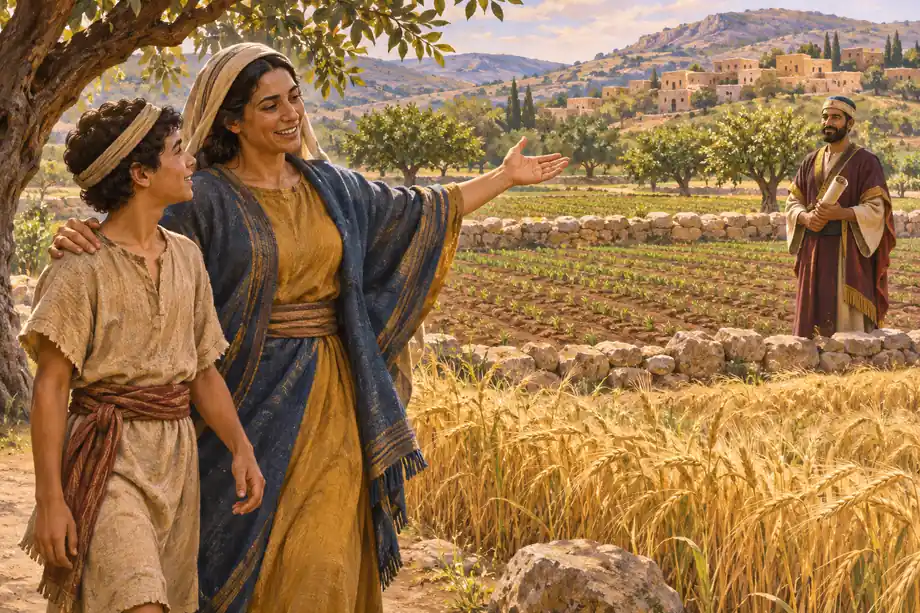
Elisha warns the Shunammite woman to take her household away because the Lord has announced a famine lasting seven years. The woman responds and lives in Philistine territory for that period. When the seven years have passed, the woman returns and appeals to the king for her house and land.
Listening to the prophetic warning has protected the family from one danger, but obedience has not eliminated every hardship. Temporary safety has generated another problem: rebuilding a settled life. The woman acts by seeking legal redress. The narrator does not identify the person who took possession of the land and does not explicitly describe the woman as a widow. The narrative's concern is the recovery of a household, not the reconstruction of every missing detail in the family's history.
Deuteronomy prohibits moving an ancestral boundary marker (Deut 19:14), and Leviticus 25 places land within the Lord's wider covenant economy. A claim for a field therefore concerns much more than investment income. Land means belonging, continuity, food, and the possibility of a future. Restoration is not merely breathing after a famine; restoration includes the opportunity to live with dignity and begin again.
The Story of a Raised Child Becomes Evidence for Justice (8:4–6)
At the very moment the woman approaches the court, the king is speaking with Gehazi about Elisha's mighty acts. Gehazi recounts the resurrection of the Shunammite woman's son. Then the woman and her son appear. Gehazi recognizes the household at the center of the story, and the king hears the woman's claim. A royal official receives orders to return all the family's property, including the proceeds of the land during the years of absence.
This restoration goes beyond placing a name back on a title document. The missed yield of the fields matters. In a farming community, several years of produce may determine whether a returning household starts anew with independence or with crushing debt. The king uses public authority to recognize an individual's claim. The narrator also suggests that the memory of God's life-giving work can reach into matters of law, land, and economic survival.
Brueggemann hears the echo of Israel's inheritance laws and the contrast with Naboth's stolen vineyard (Brueggemann 2000, 365–69). The contrast should be kept intact. The book of Kings does not portray every ruler as doing evil in every individual action. A bad ruler can sometimes make a right judgment. Yet one just decision cannot overturn the wider covenant assessment of a royal household.
Remembering the mighty acts of God becomes socially meaningful when remembered mercy moves those with authority to practice justice today. The testimony of an earlier miracle becomes part of a present act of restitution.
Forty Camel-Loads, a Death Announcement, and a Prophet's Tears (8:7–13)
Elisha arrives in Damascus. Ben-hadad, king of Aram, is sick and sends Hazael to ask the Lord whether the king will recover. Hazael takes an extraordinary gift from Damascus, described in terms of forty camel-loads (8:9). In 2 Kings 1, Ahaziah of Israel sought Baal-zebub of Ekron instead of Israel's God. Here a foreign king seeks an answer through the Lord's prophet. The reversal exposes the strange state of covenant allegiance in Israel.
Elisha's words in 8:10 present a genuine textual difficulty. In some readings and translations, the answer suggests that Ben-hadad could recover from the illness, although the king will nevertheless die. Another reading makes the message that Ben-hadad will not recover. What is clear in the story is the announcement of the king's death and the murder that follows in 8:15. A disputed Hebrew reading should not be made the basis for a confident doctrine that God instructs prophets to deceive (Provan 1995, note on 8:10).
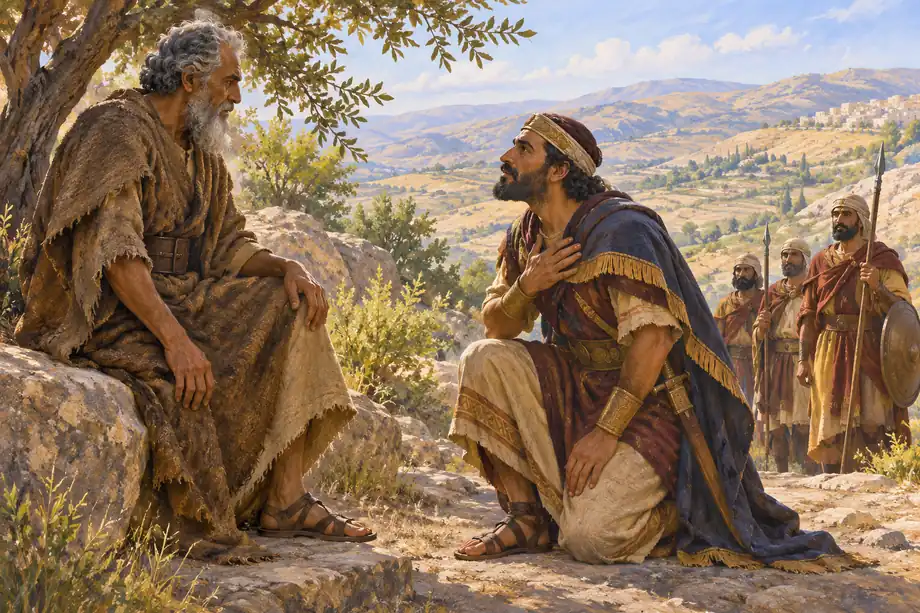
Then Elisha begins to weep. The prophet sees the suffering Hazael will inflict upon Israel: fortified places burned, young people killed, and families subjected to horrifying violence (8:12). Elisha sees beyond the respectful courtier bearing expensive gifts. Hazael responds by describing Hazael's low status as that of a dog. The reply is not convincing proof of moral innocence. Elisha announces that Hazael will become king of Aram.
A faithful prophet does not celebrate the prospect of national disaster simply because a prediction will be fulfilled. Elisha's tears recognize the human cost of the future. God's foreknowledge of wickedness is not the same as divine moral permission to commit atrocities (Amos 1:3–5).
Hazael Gains a Throne by Taking Ben-hadad's Life (8:14–15)
Hazael returns to Ben-hadad with reassuring words. On the following day, Hazael takes a cloth or covering, wets the material, and places the wet fabric over the king's face until Ben-hadad dies. Hazael then becomes king.
The text places prophetic disclosure alongside assassination, but the passage contains no divine command instructing Hazael to murder Ben-hadad. A prediction of future rule must not be transformed into moral authorization for the act used to secure the throne. Reaching the throne does not prove righteousness. Hazael will play a part in the history of judgment upon Israel, yet Hazael's cruelty remains subject to divine judgment (Amos 1:3–5).
At the beginning of chapter 8, a ruler uses royal power to return a field. In Damascus, a member of the royal court uses privileged access to take a life and seize authority. The contrast shows that power possesses no built-in moral innocence. The question facing every leader is whether authority will protect life or destroy life. Elisha's tears are the proper moral backdrop to Hazael's crown.
David's Lamp Burns While Judah Imitates Ahab's House (8:16–29)
The narrative now turns to Judah. Jehoram, son of Jehoshaphat, becomes king and reigns for eight years. Jehoram is joined in marriage to Ahab's family, and the narrator offers a negative assessment: Jehoram follows the pattern of Israel's kings and does evil in the Lord's sight (8:18). Yet because of the promise to David, the Lord does not utterly destroy Judah. The promise of a lamp for David and David's descendants remains (8:19; 2 Sam 7:12–16).
Meanwhile Edom rebels against Judean control and establishes independent rule. Jehoram's nighttime military action does not recover the former arrangement. Libnah also rebels (8:20–22). These events reveal Judah's weakened hold over surrounding territory. Modern readers should be careful not to confuse the narrator's account of the loss of royal control with a moral condemnation of a subject people's desire for independence. The text reports an imperial contraction; the report does not establish a general right for empires to hold other peoples in permanent subjection.
After Jehoram dies, Jehoram's son Ahaziah reigns in Judah for one year. Ahaziah of Judah in 8:25–29 is not Ahaziah of Israel, who died in 2 Kings 1. The Judean king's mother, Athaliah, belongs to the royal family of Omri (8:26). Ahaziah also imitates Ahab's dynasty. Ahaziah joins Joram (Jehoram), king of Israel, in war against Hazael at Ramoth-gilead. Joram is wounded and returns to Jezreel to recover. Ahaziah of Judah comes to visit the wounded northern king (8:28–29).
Chapter 8 ends with two kings brought together by family links and military injury. The alliance may look politically secure, but a prophetic sentence still hangs over Ahab's house. Royal marriage can join two dynasties, but dynastic solidarity cannot replace faithful allegiance to the Lord. David's lamp remains lit; that light, however, does not turn Judah's wrongdoing into innocence.
Theological Reflection — Inheritance, Tears, and the Lamp of Promise
Land justice belongs to covenant life
The Shunammite does not simply seek the king's charity. The woman appeals for family property and the produce associated with that property. Israel's Torah protects inherited boundaries and refuses to let powerful individuals erase the place of vulnerable neighbors (Lev 25:23–28; Deut 19:14). Naboth's vineyard shows what happens when power becomes an instrument of theft. The Shunammite's story shows what happens when public authority provides redress. Justice touches houses, fields, lost income, and the conditions necessary to rebuild a life—not merely the language of compassion.
Genuine prophecy makes room for tears, not delight in destruction
Elisha announces Hazael's rise and yet mourns the violence to come. The prophet does not stand as a fan of war or rejoice in the opportunity to be proved correct. Prophetic truth confronts the reality of military power turned against children and households. Elisha's tears anticipate the grief of Jesus over Jerusalem, when Jesus sees a city failing to recognize the things that make for peace (Luke 19:41–44). Judgment is real, but loving concern for the people affected by judgment must never be dismissed.
God's promise never makes kings immune from moral assessment
David's lamp in 8:19 recalls the promise of 2 Samuel 7:12–16. The promise endures despite Jehoram's failure, but the narrator still names Jehoram's evil. Divine faithfulness does not become a cloak for religious or political wrongdoing. In the wider biblical story, the continued promise to David deepens the longing for a king who will not exploit the throne. Messianic hope grows amid the failure of ordinary rulers (Isa 9:6–7; 11:1–5; Luke 1:32–33).
Jesus reveals a kingdom of restoration rather than plunder
Jesus announces good news for the poor, freedom for the oppressed, and hope for those carrying suffering (Luke 4:18–19; 7:22). Jesus does not turn authority into an opportunity to seize power through cruelty. Instead, Jesus teaches that true greatness serves rather than dominates (Mark 10:42–45). The Shunammite's recovered field is a small but tangible picture of a world in which justice can be restored. In the ministry of Jesus, that hope opens toward new creation, when God will dwell with humanity and wipe away tears (Rev 21:1–5). The way of the Messiah is not to sacrifice people in order to preserve a kingdom; the way of the Messiah is to give life in order to save people.
Life Application — Protect the Field, Hear the Tears, Examine the Crown
- Restore what has been unjustly withheld. If a household, employee, or neighbor has lost property or wages during a crisis, investigate the evidence and seek restitution, including any losses that ought to be addressed (8:3–6; Deut 24:14–15).
- Do not confuse obedience with a trouble-free life. The Shunammite followed Elisha's warning yet still had to pursue a land claim. Support households returning from illness, displacement, or food insecurity even after the original emergency has passed (8:1–3).
- Allow testimonies of God's goodness to strengthen present justice. Gehazi's recollection helps bring the woman's story before the king. Let the church's memory of mercy lead toward advocacy, wise counsel, and practical assistance (8:4–6; Jas 2:15–17).
- Never treat predicted success as permission to commit wrong. Hazael's future reign did not justify murder. Evaluate leadership not only by outcomes but also by the means used to obtain influence, wealth, or public honor (8:13–15; Prov 16:8).
- Let the suffering of vulnerable people inform decisions. Elisha's tears refuse to normalize the cruelty of war. In ministry, business, or public leadership, ask who may lose safety, food, or a home because of a proposed decision (8:11–12; Prov 31:8–9).
- Evaluate alliances by faithfulness, not short-term gain. Jehoram and Ahaziah of Judah followed the pattern of Ahab's house. Examine partnerships in business, politics, and religious institutions through the lenses of truth, justice, worship, and care for neighbors (8:18, 25–29).
- Hold on to hope without defending abusive leaders. David's lamp survived by God's promise, not because every descendant of David governed well. Seek leadership shaped by Jesus and refuse to conceal wrongdoing in order to defend an institution (8:19; Mark 10:42–45).
Reflection Questions
- How could the Shunammite obey Elisha's warning and still need to pursue restitution, and what practical care can a community offer families returning from crisis (8:1–6)?
- What does the contrast between the Shunammite's land and Naboth's vineyard reveal about a ruler's responsibility toward households with little political power (1 Kgs 21; 2 Kgs 8:3–6)?
- Why does Elisha weep over the suffering expected under Hazael, and which decisions today require the same capacity for grief, honesty, and courage (8:11–13)?
- What distinguishes foreknowledge of an event from moral approval of an evil means of bringing the event about, particularly in Hazael's accession (8:10–15)?
- How does David's promised lamp sustain hope without excusing Jehoram and Ahaziah of Judah, and how does Jesus reveal a different kind of kingship (8:18–29; Luke 1:32–33)?
Response Prayer — Restore the Field; Keep the Lamp Burning
Lord, God of justice and mercy,
Hear the cries of families returning home to find land taken, houses damaged, and years of labor lost. Give judges, public servants, and community leaders the courage to listen carefully and decide fairly. Let offices and courts become places of protection rather than doors that push vulnerable people deeper into despair.
Place Elisha's tears before every leader tempted to treat war and suffering as ordinary headlines. Restrain the desire to rejoice at another person's downfall. Teach those entrusted with authority to count the cost of decisions for children, households, and nations. Protect the church from partnerships that exchange truth for temporary advantage.
Your promise to David endured through generations of disobedience. May Jesus Christ, the true King, teach families and congregations to live in justice, humility, and love. Where land has been taken, bring restitution. Where a sword is lifted, awaken repentance and protect the threatened. Where leadership has grown dark, let the light of truth shine.
Amen.
Window into the Next Chapter — Anointing Oil and Approaching Judgment
Chapter 8 ends with Joram of Israel recovering from battle wounds in Jezreel. Ahaziah of Judah has come to visit. Hazael now sits on the throne of Aram. Readers who remember the commission of 1 Kings 19:15–18 know that one more name is waiting to step onto the public stage: Jehu.
In 2 Kings 9, a young member of the prophetic company will be sent to anoint Jehu privately. Chariots will then race toward Jezreel, and the old word concerning Naboth's vineyard will begin to find a terrible fulfillment (1 Kgs 21:17–24; 2 Kgs 9:1–10, 21–26). Yet judgment carried out by human agents introduces a further question: Can a person charged with confronting injustice turn that calling into an excuse for personal ambition and unchecked violence?
Watch how God's word reaches the corridors of power and how the memory of stolen land returns to demand an answer. The Shunammite's field has been restored; Naboth's field has not been forgotten.
Bibliography (SBL Author–Date)
- BibleProject. n.d. “The Books of Kings.” BibleProject. https://bibleproject.com/guides/books-of-kings/.
- Brueggemann, Walter. 2000. 1 & 2 Kings. Smyth & Helwys Bible Commentary. Macon, GA: Smyth & Helwys.
- Leithart, Peter J. 2006. 1 & 2 Kings. Brazos Theological Commentary on the Bible. Grand Rapids: Brazos Press.
- Provan, Iain W. 1995. 1 and 2 Kings. New International Biblical Commentary. Peabody, MA: Hendrickson. Baker Books edition, 2012.
Reading note
Editorial note: The Shunammite's famine episode may be retrospective; the Hebrew reading of 8:10 concerning Ben-hadad is disputed; Gehazi's presence at court does not establish healing after 5:27; the Shunammite is not explicitly called a widow; and Ahaziah of Judah is distinct from Ahaziah of Israel. Foreknowledge of Hazael's rise does not justify assassination or atrocities.

Be the first to leave a comment.