

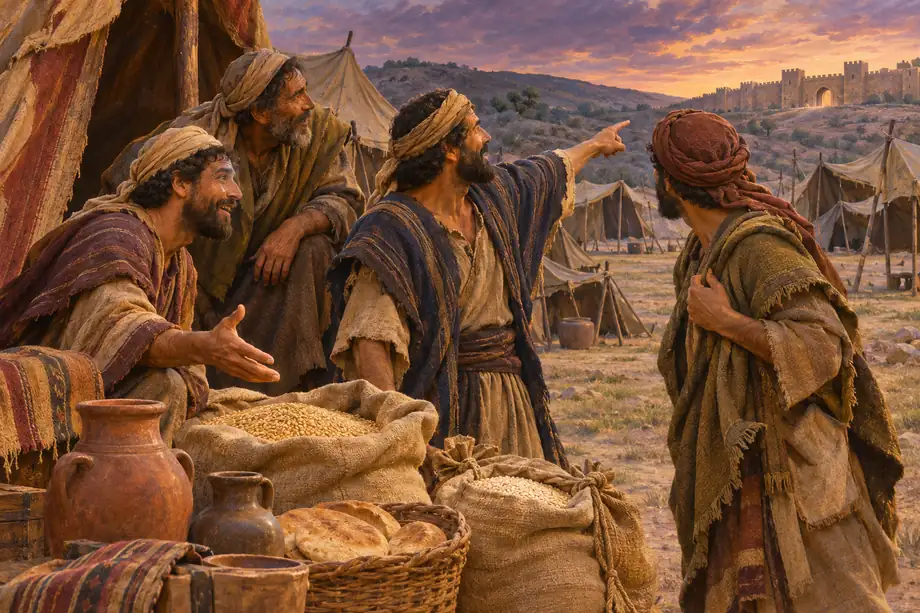
How does news of an empty camp turn four men at the gate from recipients of relief into witnesses of life?
Study overview
When unexpected witnesses announce God's provision, and the gates of Samaria become a test of trust
The city walls are high; the cooking pots are empty. A king can count the soldiers but cannot count enough grain. A prophet speaks of tomorrow's bread; an officer hears only impossibility. Beyond the gate, four hungry men walk toward an enemy camp. No trumpets greet the travelers; no swords defend the road. The tents are full, and the enemy is gone. Now another question rises above the abandoned fires: How can good news remain hidden while a city is dying of hunger?
- Primary text:
- 2 Kings 7:1–20.
- Guiding question:
- What happens when God's promised provision arrives through witnesses society overlooks, while people in authority struggle to believe?
- Central thesis:
- Second Kings 7 is the story of a starving city's unexpected deliverance becoming good news entrusted to neglected witnesses; divine provision calls for trust, truthful verification, and generous communication rather than hoarding or contempt.
Introduction — A City Can Have Walls and Still Be Hungry
A city may look secure from a distance. Gates stand, guards remain at their posts, and a king still occupies the palace. Yet every household knows the truth when the grain jar is empty. Children do not eat political promises. Mothers cannot prepare tomorrow's meal from the sound of a royal decree. Siege warfare exposes the painful difference between a fortified city and a flourishing community.
That is where 2 Kings 6 leaves Samaria. Ben-hadad of Aram has surrounded the city, and scarcity has become unbearable. The horror of the mothers' story in 6:26–29 reveals not ordinary discomfort but a society breaking under the weight of hunger. The king has torn royal clothing, worn sackcloth, and finally directed fury toward Elisha. The question at the end of chapter 6 is whether the LORD can still be awaited when hope seems delayed (6:30–33).
Chapter 7 answers in an unexpected way. Elisha announces that ordinary food will become affordable again by the next day. The royal officer dismisses the possibility. Meanwhile, four men with a serious skin condition stand near the city gate, with no safe option remaining. These four men cross toward the Aramean camp and discover something neither palace nor marketplace has imagined: the besieging army has fled, leaving provisions behind.
At first the men eat, take possessions, and hide valuables. Then conscience interrupts appetite. The men recognize a day of good news and the wrong of withholding the discovery. Bread has been found while neighbors are still starving.
The chapter is not a formula guaranteeing overnight financial miracles. It is a prophetic narrative showing that the LORD's word can expose the limits of royal power and make the disregarded into bearers of life-giving news. The story also asks whether communities that receive provision will widen the table—or protect private abundance behind a new gate.
Historical and Literary Context — The Price of Bread in a Kingdom of Idols
First and Second Kings form one extended theological history. Kings are measured by covenant faithfulness, worship, and justice, rather than military achievements alone. Deuteronomy had warned Israel that covenant betrayal could culminate in invasion, siege, and famine (Deut 28:49–57). The terrible scenes of 2 Kings 6 illustrate the human cost of such a collapse, without permitting readers to blame each suffering family for individual wrongdoing. The failures of rulers fall heavily on people with little power.
The northern kingdom's story has moved from Jeroboam's competing sanctuaries (1 Kgs 12:25–33), through Ahab and Jezebel's promotion of Baal worship (1 Kgs 16:29–33), to the prophetic ministries of Elijah and Elisha (1 Kgs 17–2 Kgs 13). Ahab's son Jehoram rules during the Aramean crisis. The nation possesses military and royal institutions but repeatedly depends on a prophet who refuses to serve as the king's employee.
Chapter 7 continues the same episode that began in 2 Kings 6:24. The chapter division should not conceal the continuity: the hunger of 6:25 explains the astonishing promise of 7:1, and the despair of 6:33 makes the officer's disbelief intelligible. The gate of Samaria becomes the chapter's controlling image. At the gate, scarce grain should once again be traded (7:1). Outside the gate, four afflicted men consider possible death (7:3). At the gate, the news is reported (7:10–11). Finally, at the gate, a royal officer is trampled during the rush for food (7:17–20).
The prices in 7:1 reverse the grotesque prices of 6:25. Elisha predicts a seah of fine flour for a shekel and two seahs of barley for a shekel. A seah is an ancient dry measure; the exact modern conversion is not essential to the narrative. The difference between famine prices and ordinary market abundance is the point. The Hebrew story does not primarily teach a modern monetary exchange rate; the price labels demonstrate a dramatic change in access to food.
The repeated prediction and fulfillment at the beginning and end (7:1–2; 7:16–20) frame the scenes of discovery, announcement, and investigation. Peter Leithart identifies this pattern as a literary enclosure: the officer's challenge is repeated near the conclusion, showing that the royal objection has not undone the prophetic word (Leithart 2006, commentary on 2 Kgs 6:24–7:20). Provan stresses how the royal officer's inability to imagine recovery differs from the actual, unexpected course of the narrative (Provan 1995, §39). Brueggemann draws attention to the good news of bread carried from the margins of the city toward its center (Brueggemann 2000, 353–63).
Walking Through the Text — Six Movements from Famine to Feast
Tomorrow's Market Against Today's Despair (7:1–2)
Elisha addresses the royal household with a promise about the next day: fine flour and barley will be sold at radically reduced prices at the gate of Samaria. The announcement is striking because the siege has already pushed residents into desperation. Elisha does not describe a plan for irrigation, a new supply route, or negotiations with Aram. Elisha speaks the word of the LORD.
The officer on whose hand the king leans responds with an objection: even if the LORD opened windows in heaven, could such a change happen? The phrase recalls divine provision in passages such as Genesis 7:11 and Malachi 3:10. The officer's words treat the promise as beyond possibility. Elisha answers with a severe prediction: the officer will see the abundant food but will not eat from the supply.
The text distinguishes the officer's scorn from the kind of responsible investigation that appears later. Asking how relief might arrive is not automatically unbelief; an officer charged with public welfare may need evidence. Here, however, the response is a dismissive verdict against a specific prophetic promise. The palace has acquired the habit of measuring God's future only by the city's present resources.
The first contest is not between two armies. The first contest is between an announced word of hope and a royal imagination imprisoned by scarcity. The severity of the officer's fate will need to be held together with the narrative's concern for a suffering community; the passage is not permission to pronounce doom on everyone who struggles with doubt.
Four People at the Edge of the Gate (7:3–4)
The narrator suddenly leaves the palace. Four men with a serious skin disease are at the entrance to the city. The Hebrew term describes a category of skin conditions rather than identifying modern Hansen's disease with certainty. The text locates the men at the gate but does not explicitly explain every social or ritual circumstance behind the location. What matters for the plot is vulnerability: remaining where the men stand means death by starvation; entering the famished city offers no relief; approaching the Arameans might lead either to food or to death.
The men reason carefully. The choice is not between comfort and danger, but between almost certain death and a risky possibility of life. The decision to approach the Aramean camp is not described as a heroic military strategy or a spiritual revelation. Hunger has pushed the men toward a practical step.
Samaria's rulers have not found a way to feed the city. Yet the narrative follows people without military command, social prestige, or secure standing. The turning point begins when people considered peripheral take a step that powerful people have not taken. The story does not romanticize exclusion; hunger and insecurity are real wounds, not qualifications a person must earn before God will act.
The Enemy Hears an Army That Is Not There (7:5–7)
At dusk, the four men reach the outer part of the Aramean camp and find no guards. The narrator then supplies the explanation: the Lord has caused the Aramean troops to hear the noise of chariots, horses, and a great army. The soldiers conclude that Israel has hired Hittite and Egyptian kings to attack Aram. Panic takes hold. The Arameans abandon tents, horses, donkeys, and supplies, fleeing for their lives.
The reader knows more than the four travelers. The men have not defeated the army, and the Israeli king has not negotiated a victory. The sound of battle produces a flight without the reported battle. In Dothan, the servant of Elisha needed opened eyes to perceive fiery horses and chariots (2 Kgs 6:15–17). In chapter 7, the Arameans hear what appears to be an overwhelming coalition. The paired scenes portray the LORD as ruler of circumstances beyond the control of kings.
The precise physical mechanism of the sound is not explained. The narrator assigns the Aramean panic to divine action; responsible interpretation need not invent the unseen details. The event also exposes the fragility of intimidating military appearances. An army that made an entire city tremble has itself fled from a fear.
The road toward life opens before the people of Samaria know that the siege has ended. Deliverance has occurred, but deliverance remains undiscovered. In the next scene the question changes from what God has done to what the discoverers will do with the knowledge.
Bread First, Then the Burden of Good News (7:8–11)
The four men enter a tent and eat and drink. The men take silver, gold, and clothing, hide the goods, and repeat the action in another tent. The scene is deeply human. After prolonged hunger, available bread is almost impossible to resist; after deprivation, treasure appears to promise future security. The narrator does not present the initial gathering of goods as the climax of the chapter.
The change arrives in the men's conversation. The four recognize that keeping silent is wrong on a day of good news. Delay until morning would mean allowing neighbors to remain hungry while food is available. The men decide to return and report the discovery. The report travels from the city gatekeepers to the royal household.
The narrative uses a cluster of reporting verbs to trace the movement of information through the city (7:9–11). The social boundary is crossed by speech before the military boundary is crossed by the crowd. People whom the narrative first introduces near the edge now become the indispensable messengers at the center of the story.
The expression good news first refers to a concrete development: the enemy has fled and food is available. The Hebrew Bible often associates announced good news with a real change in the fortunes of God's people (Isa 40:9; 52:7). The Christian gospel reaches its climax in Jesus' life, death, and resurrection (Mark 1:14–15; 1 Cor 15:1–4). That later gospel should not be read back as though the four men preached a developed Christian creed. Yet the narrative prepares Christian readers to understand why genuine good news matters for bodies as well as hearts.
Food kept hidden cannot feed the city. A message of hope becomes an act of neighbor-love when the message directs hungry people toward provision. The four men are not merely objects of charity; the four become agents of public rescue.
The King Investigates: Caution Is Not the Same as Contempt (7:12–15)
The king wakes and hears the report. Instead of celebrating at once, the king suspects an ambush. Perhaps the Arameans have left the camp deliberately empty, intending to lure starving citizens into open ground. A servant proposes sending scouts with some of the horses that remain. A small reconnaissance party follows the Aramean route as far as the Jordan, finding clothing and equipment scattered by the fleeing soldiers. The investigators return with confirmation.
The king's caution deserves careful handling. The text has already told readers why the Arameans fled, but the people in the city have not heard the narrator's explanation. A responsible ruler has reason to guard against a trap. The scouting mission tests the report and establishes a basis for public action. The text does not depict evidence-gathering as an offense against faith.
Nevertheless, the contrast is sharp. The four men discover an unlikely fact and tell the truth. The king can initially imagine only another enemy scheme. The palace eventually benefits from the initiative of people outside its plans. Verification becomes part of the path by which the good news reaches the starving population.
Faith need not abandon examination; wise examination must remain open to an answer that fear did not expect. A church, family, or community can apply the same distinction when assessing news of help: check what needs checking without ridiculing the possibility of genuine relief.
Bread at the Gate, but Not for the Skeptical Officer (7:16–20)
The people go out and plunder the abandoned camp. Flour and barley become available at the prices Elisha announced. The narrator repeats the prediction and emphasizes fulfillment according to the word of the LORD. The same gate that confined hunger becomes a place where grain can again be purchased.
Yet the ending is not uncomplicated celebration. The king has assigned the officer who mocked Elisha's promise to supervise the gate. In the rush of the crowd, the officer is trampled and dies. The officer sees the abundance but does not share the meal, exactly as Elisha said. The narrative repeats the officer's challenge and Elisha's response (7:17–20), so that the fulfillment of the word closes the chapter.
Readers should resist treating the officer's death as a casual joke about skepticism. A human life is lost; the scene is severe. The narrative presents the death as the fulfillment of a particular judgment, not as a timeless rule that questioning religious leaders deserves violence. The responsible modern response is humility before the text, not the celebration of someone else's destruction.
The reversal remains profound. Four people facing death outside the gate find bread and bring saving news. A powerful officer at the gate sees the food but dies without eating. Social position does not guarantee discernment, and apparent insignificance does not prevent a person from becoming a witness to God's goodness. The city survives, but the reader has been made to consider both the mercy of rescue and the cost of contempt.
Theological Reflection — The God Who Makes Bread into News
Covenant faithfulness is measured at the table
Kings repeatedly exposes the distance between the appearance of royal order and the reality of covenant well-being. The collapse of food supply in 2 Kings 6 makes the failure of public life visible; the availability of grain in 2 Kings 7 represents actual relief. Scripture's vision of blessing includes justice, bread, rest, and the dignity of vulnerable neighbors (Deut 15:7–11; Ps 72:1–4, 12–14). Spiritual language cannot excuse indifference to the hungry. Christian ministry should announce God's kingdom while working to make food, care, and fair treatment accessible (Jas 2:14–17).
The prophetic word is not the king's possession
Elisha does not announce the market's reversal as a royal public-relations campaign. The prophetic word interrupts despair and resists the palace's attempt to define the future. The fulfillment establishes Elisha's credibility within this narrative (Deut 18:21–22). The chapter does not authorize modern preachers to make precise forecasts without warrant or to shame hearers who ask for verification. The prophetic challenge is to refuse the claim that visible arrangements exhaust what God can do (Jer 32:17).
The marginalized can carry indispensable truth
The four men are identified by physical affliction and exposed circumstances, yet the four convey news necessary for the city's survival. This reversal belongs to a wider biblical pattern: a captive Israelite girl directs Naaman toward healing (2 Kgs 5:2–3), and the poor are not forgotten in God's regard (1 Sam 2:7–8; Luke 4:18). The story does not say suffering automatically makes someone wise or that every excluded person speaks for God. The story does expose the arrogance of refusing to hear good news from unexpected people.
From a recovered market to the Messiah's table
The four men's good news is historically specific: the Aramean siege has been broken and food can be taken from an abandoned camp. Jesus later announces the kingdom through both teaching and feeding, addressing hungry bodies as well as sinful and wounded lives (Mark 6:34–44; Luke 4:18–21). The risen Christ commissions witnesses, including people the powerful would not naturally select (Luke 24:46–49; Acts 4:13). These are canonical connections, not claims that every detail in 2 Kings 7 directly predicts a New Testament event. The fuller gospel is that Jesus has confronted sin and death, and God's promised new creation will exclude hunger, tears, and death (Rev 7:16–17; 21:1–5). The bread at Samaria's gate is not the whole gospel; the rescued city offers a window onto the God whose mercy reaches human beings in embodied need.
Life Application — Open the Gate, Share the News
- Ask who is hungry before praising a successful institution. A church, school, or ministry should examine whether struggling families can access food, transport, medicine, and basic assistance. Make one concrete adjustment in the next budget meeting (2 Kgs 6:24–7:1; Jas 2:15–17).
- Listen to people working at the margins. Invite domestic workers, people living with disability, young people, and families receiving aid to describe actual needs and available solutions. Do not reduce people to their struggles (7:3–11).
- Distinguish honest questions from cynical dismissal. Investigate unusual claims, verify reports, and seek trustworthy witnesses. Avoid the officer's assumption that an unexpected answer must be impossible (7:2, 12–15).
- Share useful news promptly. When a food program, medical service, scholarship, or emergency shelter becomes available, send accurate details to those most likely to benefit. Include eligibility, contact information, and access limitations rather than inspirational language alone (7:9–11).
- Refuse to turn relief into private prestige. The men first hid valuables, but later saw the duty to tell others. A ministry entrusted with supplies should keep transparent records and use fair distribution procedures (7:8–10; 2 Cor 8:20–21).
- Prepare for crowds and protect vulnerable people. The death at the gate warns against disorder amid urgently needed resources. Plan safe queues, clear communication, priority assistance for those at risk, and accountable leadership (7:16–20).
- Hold spiritual witness and practical care together. Speak about Jesus while also feeding, visiting, protecting, and listening. The gospel must never become an excuse for neglecting a neighbor's immediate hunger (Luke 9:10–17; 1 John 3:17–18).
Reflection Questions
- Why did Elisha's promise seem impossible in Samaria, and what kinds of scarcity make the future difficult to imagine in a family, church, or community today (7:1–2)?
- How did the four men move from a strategy for individual survival toward a responsibility for the whole city, and what present opportunity requires a similar change (7:3–11)?
- What is the difference between the officer's dismissive response and the king's decision to send investigators, and how can faith communities preserve both trust and careful verification (7:2, 12–15)?
- What would it mean for a local congregation to treat reliable information about food, health care, and support services as good news that must not be hidden (7:9–11; Jas 2:14–17)?
- What warning does the death at the gate give about contempt, crowded systems, and the responsibilities of people in power (7:16–20)?
Response Prayer — Let Bread Reach the City
LORD of Israel, God of mercy and truth,
Look upon communities whose storehouses are empty and whose doors close before nightfall. Remember parents who cannot find supper for their children, and people pushed outside the gate by sickness, poverty, or prejudice. Give courage to those facing impossible choices; provide wise companions and practical paths toward safety.
Open the ears of leaders who have forgotten the voices of the overlooked. Give discernment that examines reports carefully without turning suspicion into contempt. Guard the hands entrusted with food, money, and public authority. Let no one use scarcity to purchase applause or to exploit desperate neighbors.
Teach churches and households the honesty of the four travelers: a day of good news is not a day for hiding bread. Through Jesus Christ, the Bread of Life, join truthful witness to shared meals, prayer to compassion, and hope to patient service. May the hungry find help, the frightened find protection, and the proud learn humility.
Amen.
Window into the Next Chapter — A Field Restored and a Throne Under Judgment
The gates of Samaria open, and the market fills with grain. But one morning of relief has not repaired the whole kingdom. A household still needs a secure home, the Shunammite woman still needs just treatment, and the royal house of Ahab still stands beneath the prophetic warnings of earlier chapters.
Second Kings 8 will first return to the woman of Shunem, whose son Elisha restored to life (2 Kgs 4:8–37). After a prolonged absence during famine, the woman will appeal to the king for the return of land and household property (8:1–6). At precisely the right moment, the story of the woman's restored son will be recalled in the royal court. The next scene will then move toward Aram, where Elisha confronts the coming rise of Hazael (8:7–15). The chapter also traces further trouble among the kings of Judah.
Watch what happens when the God who opened Samaria's gate also protects a family's rightful inheritance—and when royal power again comes under the shadow of the prophetic word. Bread is necessary; justice for the land and the future of the people matters too.
Bibliography (SBL Author–Date)
- BibleProject. n.d. “The Books of Kings.” BibleProject. https://bibleproject.com/guides/books-of-kings/.
- Brueggemann, Walter. 2000. 1 & 2 Kings. Smyth & Helwys Bible Commentary. Macon, GA: Smyth & Helwys.
- Leithart, Peter J. 2006. 1 & 2 Kings. Brazos Theological Commentary on the Bible. Grand Rapids: Brazos Press.
- Provan, Iain W. 1995. 1 and 2 Kings. New International Biblical Commentary. Peabody, MA: Hendrickson. Reissued by Baker Books, 2012.
Reading note
Editorial note: The serious skin condition in 7:3 cannot be identified with certainty as modern Hansen's disease, and the chapter does not explicitly explain why the four men are standing at the gate. The king's reconnaissance is not identical to the royal officer's mockery. The rapid fall in grain prices belongs to the specific prophetic account and should not be marketed as a universal promise of financial reversal.

Be the first to leave a comment.