

Why does Elisha feed soldiers sent to capture the prophet, while Samaria later runs out of bread?
Study overview
From the debt of a borrowed tool to the famine of Samaria: the eyes of faith and the limits of power
An iron blade sinks into the Jordan; a worker fears a neighbor's unpaid debt. War chariots surround Dothan; a frightened servant can see only the enemy. The LORD opens eyes, and the hillside burns with fire; soldiers who came with swords are seated at a table. But the tables of Samaria will not remain full. War returns; prices soar and mercy runs thin; a mother's cry rises from the city wall. When a city runs out of bread, the question is not merely whose army is larger, but who will listen to the word of the LORD.
- Primary text:
- 2 Kings 6:1–33.
- Guiding question:
- What happens when fear and hunger narrow a community's vision, and the word of God calls people to recognize help, show mercy to enemies, and wait for deliverance?
- Central thesis:
- Second Kings 6 reveals that the LORD cares both about an ordinary person's borrowed tool and about the fate of a nation. True strength appears in opened eyes, enemies fed rather than slaughtered, and faithfulness tested when a city's tables stand empty.
Introduction — When the Table Becomes the Measure of a Kingdom
A worker can lose a tool, and a household's fragile finances suddenly become uncertain. A town can be surrounded by troops, and its people can wake to a morning filled with fear. A nation can possess a king, officials, walls, and weapons, yet discover during a siege that none of these can place a loaf of bread on the table. These problems may seem unrelated. In 2 Kings 6 they converge on one question: Where does security come from, and whose life is power meant to protect?
At the end of 2 Kings 5, Naaman the Aramean had returned home healed and confessing the God of Israel. Gehazi, Elisha's servant, had attempted to turn grace into income and left under judgment. A reader might hope that Naaman's transformation would also heal the relationship between Aram and Israel. But one person's encounter with mercy does not instantly undo a long history of conflict. War still hangs over the land.
Chapter 6 begins with a small loss: a borrowed axhead slips into the river. The scene then widens to Dothan, where horses and chariots surround a prophet's dwelling. Finally, the walls of Samaria are encircled by an Aramean army, and hunger drives the city into unspeakable suffering. Between these episodes comes an astonishing decision: Elisha forbids the killing of captured soldiers and orders a feast for the enemies of Israel. For a moment, the enemy's table becomes brighter than the palace's war room.
This chapter does not promise that faithful people will never lose property, face danger, or suffer during war. It calls readers to see that the LORD's rule cannot be measured by military strength alone—and that God's way may refuse what fear considers an obvious victory.
Historical and Literary Context — A Prophet Between Small Houses and Great Wars
First and Second Kings are two portions of one prophetic account of Israel's monarchy. Kings are evaluated by covenant loyalty, worship, and justice, not merely by impressive building projects or military success (Deut 17:14–20). Decisions about gods, borders, and alliances carry consequences for ordinary families. Prophets stand as witnesses that a royal throne is never the highest authority in the land (1 Kgs 18:17–21; 21:17–24).
Elisha ministers during the ongoing struggle between Israel and Aram. In chapter 5, Naaman of Aram received healing from the God of Israel, but the narrative also reminded readers that an Israelite girl had been taken captive during an Aramean raid. Chapter 6 places these same neighboring nations in conflict once more. Neither king is named in 6:8–23; the narrative context points toward Jehoram of Israel, but the storyteller keeps attention on the prophet rather than on royal titles. In 6:24, the Aramean king is named Ben-hadad.
The settings shift from a prophetic community near the Jordan, to Dothan, and then to Samaria. These movements are theological, not merely geographical. The first episode concerns a community's work and the rights of a neighbor. The second concerns national security and a king's use of force. The third exposes the collapse of justice under the pressure of famine. The communities of prophets are not portrayed as a perfect alternative nation, yet their existence shows that the work of the LORD has not been confined to palace administration (2 Kgs 2:3–5; 4:38).
The chapter presents sharply contrasting responses to trouble. In 6:1–7, an anxious worker admits the loss and receives help. In 6:15–23, a terrified servant receives opened eyes, while captured enemies receive food. In 6:24–33, a grieving king moves toward rage and threatens the prophet's life. The worker asks for help; the prophet asks for sight; the king looks for someone to blame.
Provan observes that Elisha's ministry reaches both a single Israelite facing an apparently minor loss and the international politics of Israel and Aram (Provan 1995, §§38–39). Brueggemann attends to the wonder of floating iron and the extraordinary feast that interrupts war's customary logic (Brueggemann 2000, 341–53). Leithart emphasizes how the care of a neighbor's property and the feeding of enemies express, rather than contradict, the social ethic of Torah (Leithart 2006, commentary on 2 Kgs 6:1–23).
Walking Through the Text — From the River to the Walls of Samaria
A Borrowed Axhead Sinks (6:1–7)
The sons of the prophets tell Elisha that their gathering place has become too small. The community plans to go to the Jordan, gather timber, and build a more adequate place. Elisha agrees. When asked to accompany the workers, the prophet goes with them. During the work, the iron head of an ax falls into the river. The worker cries out because the axhead was borrowed (6:5).
The problem is not simply the disappearance of a piece of metal. The worker has an obligation to the owner. Iron tools carried real value, and Israel's law addressed responsibility when borrowed property was lost or damaged (Exod 22:14–15). The text never gives the price of the tool or the man's income. Nevertheless, the worker's distress makes sense: the laborer may not have the means to replace a neighbor's property.
Elisha asks where the axhead fell. The prophet cuts a stick, throws the wood into the water, and causes the iron to float. Elisha tells the worker to retrieve the tool; the worker reaches out and takes it (6:6–7). The story presents a wonder, not a method for recovering metal through a clever device. What was lost is returned, and the community's work can continue.
Earlier, Elisha had helped a widow whose children were threatened by debt (2 Kgs 4:1–7). Now a borrowed tool receives the prophet's attention. In the world governed by the LORD, a neighbor's rights and a laborer's anxiety are not too small to matter.
Royal Secrets Are No Longer Secret (6:8–12)
The king of Aram plans ambushes, but Elisha repeatedly warns the king of Israel about dangerous locations. Israel's king takes precautions, and the Aramean strategy fails. Convinced that a traitor is hiding in the royal court, the Aramean king confronts the officers. An officer explains that Elisha tells the king of Israel even the words spoken in the Aramean king's private bedroom (6:12).
The narrative does not explain how Elisha receives the information. The point is not an ancient lesson in intelligence operations. The scene dramatizes the limits of royal secrecy before the LORD. The ruler who believes safety depends on concealed information discovers that palace walls cannot silence the word of God.
The Aramean king's response is almost comical. Rather than question the wisdom of waging war against a prophet whose warnings keep proving reliable, the king sends troops to arrest Elisha. A ruler unable to hide military plans from the prophet assumes that a plan to capture the prophet will succeed. The fear of losing control can make power less thoughtful rather than more effective.
Dothan: When the Eyes See Only One Army (6:13–17)
The Aramean king learns that Elisha is in Dothan and sends horses, chariots, and a large force by night. When morning comes, Elisha's servant sees the city surrounded and cries out in fear. Elisha answers with a command not to fear, declaring that those with the prophet are more numerous than those with the Arameans (6:16).
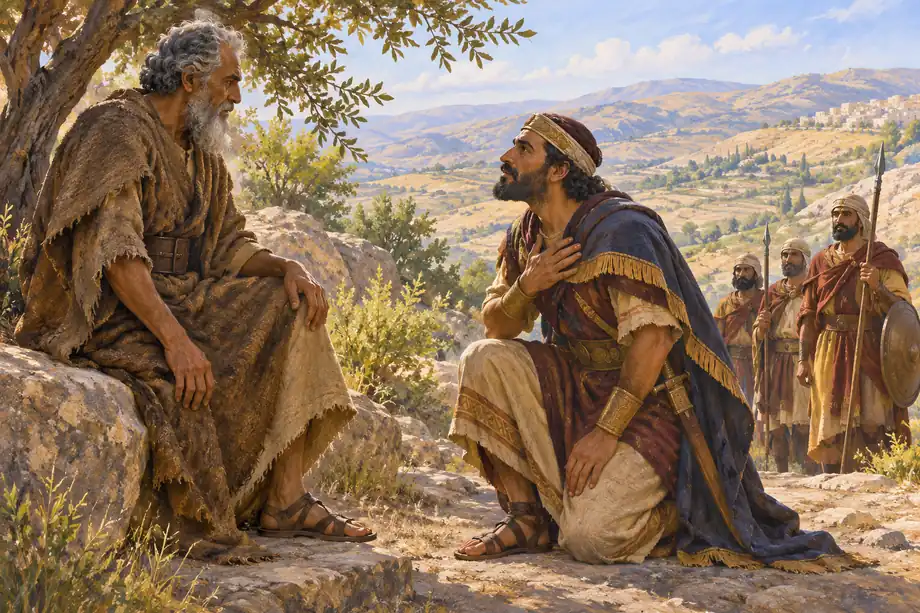
By ordinary sight, the reassurance sounds like bad arithmetic. The servant sees an army outside and only a few people inside. Elisha then prays that the LORD will open the servant's eyes. The servant looks again and sees the hill filled with horses and chariots of fire surrounding Elisha (6:17).
These fiery chariots recall the scene in which Elijah was taken from Elisha's sight (2 Kgs 2:11–12). In the biblical imagination, the heavenly host belongs to the sovereign rule of God, whose authority extends beyond any army gathered on earth (Ps 103:19–21). The text does not identify individual angels, calculate their number, or offer a map of the invisible world. Instead, the vision announces that the visible danger is not the whole of reality.
Elisha does not pray for God to invent a new defense. The prophet prays for the servant to recognize a defense that ordinary perception had missed. This episode does not guarantee that every believer will see fiery horses or escape every injury. It does challenge the assumption that fear gives a complete account of the world (Ps 46:1–3; Rom 8:31–39).
Soldiers Who Came with Swords Receive Bread (6:18–23)
When the Aramean soldiers approach, Elisha asks the LORD to strike the force with a condition often translated as blindness. The Hebrew term sanwērîm, also found in Genesis 19:11, may describe disorientation or inability to perceive surroundings rather than total physical blindness. The soldiers can still follow Elisha on the road (Provan 1995, note on 2 Kgs 6:18).
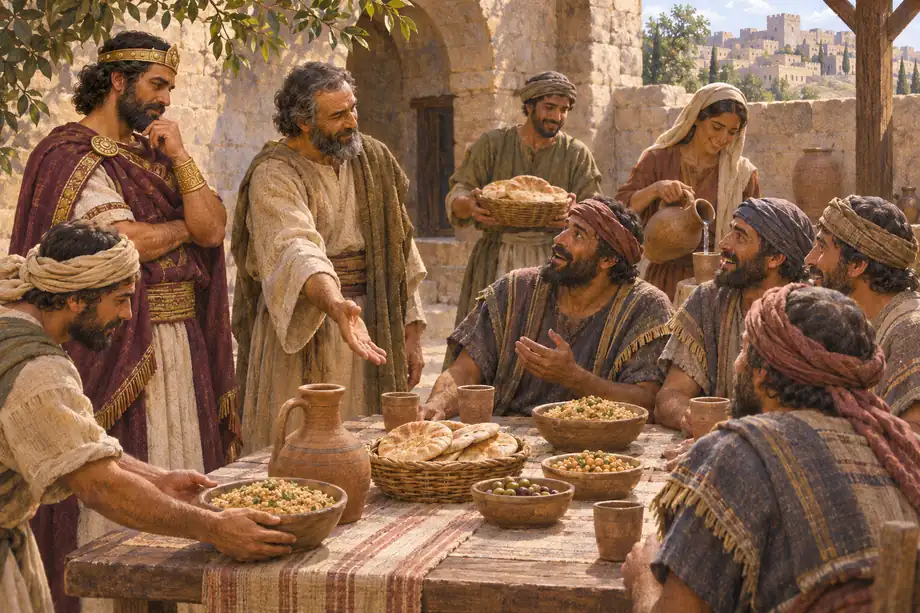
Elisha leads the Arameans into Samaria. The prophet asks the LORD to open their eyes, and the soldiers recognize that they are standing in Israel's capital. Seeing the enemies within reach, the king of Israel asks permission to kill them. Elisha refuses. Instead, the prophet tells the king to set food and water before the soldiers. The king prepares a great feast and then sends the Arameans home (6:20–23).
Power changes shape before the reader's eyes. Armed troops march to Dothan hoping to seize a prophet. Those same soldiers find themselves at a table in Samaria receiving food from enemies. The king imagines victory through slaughter; the prophet transforms an opportunity for revenge into an act of hospitality. For a time, Aramean raiding bands stop entering Israelite territory (6:23).
This feast is not proof that reconciliation is effortless or that war has ended forever. It offers another possibility: people who have the power to destroy an enemy may instead use power to protect life. The act anticipates the wisdom of feeding an enemy who is hungry and giving water to an enemy who is thirsty (Prov 25:21–22; Rom 12:18–21).
When the Feast Gives Way to a Starving City (6:24–30)
Verse 24 introduces an abrupt and disturbing reversal. Ben-hadad, king of Aram, mobilizes an army and besieges Samaria. The earlier report that raiding bands stopped attacking Israel (6:23) did not promise a permanent peace. A full-scale siege now cuts the capital off from food and trade. The prices of desperate substitutes for food rise sharply (6:25). The exact identification of the substance sometimes translated “dove's dung” is debated. The meaning of the scene, however, is beyond dispute: people have reached the edge of starvation (Brueggemann 2000, 353–54).
While the king of Israel walks along the city wall, a woman cries for help. The king replies that, if the LORD does not help, the threshing floor and winepress cannot supply relief (6:27). The woman then discloses an appalling event. Two women had agreed to use their children as food. One woman's son was killed and eaten, but the other woman hid her child when the second day came (6:28–29).
The story must not be told for shock value or used to heap blame on the women while overlooking the brutality of siege warfare. The event shows a society driven toward the destruction of family bonds and human dignity. The covenant warnings about siege and famine echo painfully in the background (Deut 28:52–57; Lam 4:9–10). A literary contrast also reaches back to two women seeking Solomon's judgment over a living child (1 Kgs 3:16–28). Solomon was able to preserve life through wise judgment. The present king cannot produce either food or a remedy.
The king tears his clothes, revealing sackcloth beneath the royal garment (6:30). The sign of grief may be genuine, but grief alone is not the same as covenant faithfulness. In a starving city, the test of leadership is not the ability to identify a scapegoat; it is the willingness to face suffering truthfully and defend people whose lives have become precarious.
God's Word Stands at the Door (6:31–33)
After hearing the woman's story, the king swears that Elisha's head will be removed that day. A messenger is sent to the prophet. Elisha is sitting in a house with the elders of the city and is aware of the approaching threat. The prophet tells the elders to shut the door against the messenger because the king is following close behind (6:32).
The chapter closes with a bitter question: if this disaster has come from the LORD, why should anyone wait for the LORD any longer (6:33)? The exact speaker of the final line is not entirely clear in the Hebrew narrative. The words may be the king's message spoken through the messenger (Provan 1995, note on 2 Kgs 6:33). In either reading, royal power has exhausted its patience and turns its anger toward God's witness.
Compare the responses earlier in the chapter. The worker who lost the axhead admitted the problem and received help. The servant who feared the surrounding army was given a larger vision. The king who cannot feed the city recognizes the limits of human provision but answers failure by threatening the prophet. The text deliberately leaves the crisis unresolved at the close of verse 33. The promise of deliverance will come in 2 Kings 7:1. The elders shut a door against threatened violence, but the word of the LORD has not been shut out of Israel's future.
Theological Reflection — Opened Eyes and a Widened Table
The LORD Cares About Justice in Ordinary Work
A lost axhead represents a neighbor's property, a worker's responsibility, and a genuine fear of debt. Elisha does not dismiss the situation for lacking national importance. Torah placed moral weight on the treatment of borrowed belongings (Exod 22:14–15). Biblical faith cannot speak of spirituality while ignoring wages, debts, tools, workplace safety, and the rights of neighbors. In Elisha's ministry, the Creator who rules the world also cares about the tools held in working hands (Leithart 2006, commentary on 2 Kgs 6:1–7).
The Eyes of Faith See More Than Weapons
At Dothan, the servant lacks knowledge of the LORD's protection. Elisha's prayer opens the servant's eyes. The heavenly chariots recall the biblical vision of heaven and earth under one divine reign (1 Kgs 22:19; Ps 103:19–21). The passage does not authorize imaginative catalogs of invisible beings or claims that someone's private vision can settle every dispute. Rather, the story warns against allowing fear, military capacity, or visible evidence alone to become a community's ultimate source of meaning (Brueggemann 2000, 345–51).
Covenant Victory Can Look Like a Feast
Elisha commands bread instead of bloodshed. The command resonates with the social ethic of Israel's law and wisdom, which call for the protection of neighbors and practical kindness even toward enemies (Exod 23:4–5; Prov 25:21). Jesus later commands love for enemies and rebukes disciples eager to call down judgment by fire (Matt 5:43–48; Luke 9:54–55). Jesus does not deny the seriousness of evil in order to show mercy. At the cross, Jesus reveals the costly way of confronting evil without answering cruelty with the same cruelty (Rom 12:20–21; 1 Pet 2:21–24).
The God Who Feeds Enemies Hears a Starving City
Chapter 6 refuses to end at a happy banquet. The siege reveals that temporary truces do not erase the wounds of war or prevent a society from unraveling. The women's terrible story insists that worship is hollow when children and families are left exposed to hunger and brutality (Isa 1:15–17; Jas 2:14–17). Jesus proclaims good news to the poor, feeds the hungry, and welcomes those pushed to society's margins, carrying the life-giving work glimpsed in Elisha's ministry toward its fulfillment (Luke 4:18–19; 9:12–17). The hope of new creation is the hope of a feast for the nations and the end of death and mourning (Isa 25:6–9; Rev 21:1–5).
Life Application — Faithfulness When Tools and Bread Run Short
- Return borrowed property with integrity. Review unpaid debts, borrowed equipment, books, or ministry funds. If something has been lost or damaged, tell the owner promptly and discuss a fair response rather than hiding the problem (2 Kgs 6:1–7; Exod 22:14–15).
- Notice the small needs of working people. Church, school, and community leaders can ask workers about necessary tools, transport costs, safe conditions, and burdens carried silently. Service to the LORD begins long before a public ceremony (6:1–7).
- Pray for sight without abandoning sound judgment. During family, church, or public conflict, name the real risks and the help already available. Combine prayer with reliable information, wise counsel, and appropriate safety measures; the vision at Dothan is not a reason to ignore danger (6:15–17).
- Refuse to celebrate an enemy's destruction. When someone who has caused harm becomes vulnerable, pursue justice without delighting in humiliation or cruelty. Feeding an enemy need not mean removing accountability or necessary boundaries (6:20–23; Rom 12:18–21).
- Measure leadership by the condition of family tables. Church, community, and government budgets should attend to children, patients, low-income households, and families displaced by violence. Food insecurity is not merely a statistic; prolonged hunger attacks human dignity (6:24–30; Prov 31:8–9).
- Do not turn truth-tellers into scapegoats. When a crisis worsens, distinguish the actual causes of suffering from anger directed at those who bring unwelcome news. Provide safe ways to offer counsel and question decisions without threats or retaliation (6:31–33).
Reflection Questions
- Why did the loss of a borrowed axhead matter so deeply, and how can a community protect people vulnerable to debt or seemingly minor financial losses (6:1–7)?
- How did the Aramean king and Elisha's servant fail to see the situation in different ways, and how does fear distort leadership today (6:8–17)?
- What kind of strength did Elisha demonstrate by refusing to kill the Arameans, and what safe, practical act of reconciliation might follow from this passage (6:18–23)?
- Why did the feast for enemies not end the war, and what does Samaria's famine reveal about the limits of short-lived successes (6:23–30)?
- What warning emerges when a king threatens a prophet instead of addressing a city's suffering, and how should leaders respond when waiting becomes painful (6:31–33)?
Response Prayer — Open Our Eyes, Widen Our Table
LORD, God of Israel and Creator of heaven and earth,
Look upon working hands and the fear of losing a neighbor's property. Teach faithfulness in debts, tools, and small promises. Look upon hearts trembling before visible threats. Open the eyes of faith, so that fear cannot erase the memory of divine care or silence the counsel of wisdom.
Teach communities to exercise strength with justice and mercy. Give leaders courage to set a table rather than rush toward revenge. Where hunger, war, and children's suffering are present, restrain the impulse to blame and awaken the willingness to help. Protect vulnerable people; bring food, justice, and peace to neighborhoods under strain.
Through Jesus Christ, the merciful King who has confronted evil and overcome death, give hope that does not evade the truth. Let the word of the LORD remain a lamp even when the gates of Samaria are shut. Amen.
Window into the Next Chapter — Bread Tomorrow, but Who Will Believe?
Second Kings 6 closes with Samaria under siege, families suffering hunger, and a king who has grown weary of waiting. The fiery chariots at Dothan were real within the story, but the test of faith remains severe when the table is empty. Chapter 7 begins at the very point where the king's question leaves the reader: Elisha declares that food will be available at dramatically lower prices in Samaria's gate by the next day. A royal officer struggles to believe that such a reversal could come so quickly (7:1–2).
The first news of deliverance will not come from the palace or from victorious commanders. Four people with a skin condition, waiting at the city gate, will encounter an astonishing discovery and face a moral question: can news that saves lives be kept private (7:3–10)? Watch how the LORD turns overlooked people into messengers of bread and hope—and how disbelief can leave someone outside a joy already visible to the eyes.
Bibliography (SBL Author–Date)
- BibleProject. n.d. “The Books of Kings.” BibleProject. https://bibleproject.com/guides/books-of-kings/.
- Brueggemann, Walter. 2000. 1 & 2 Kings. Smyth & Helwys Bible Commentary. Macon, GA: Smyth & Helwys.
- Leithart, Peter J. 2006. 1 & 2 Kings. Brazos Theological Commentary on the Bible. Grand Rapids: Brazos Press.
- Provan, Iain W. 1995. 1 and 2 Kings. New International Biblical Commentary. Peabody, MA: Hendrickson. Baker Books edition, 2012.
Reading note
Editorial note: Verses 6:24–29 describe extreme suffering and violence amid famine and siege; the narrative does not praise those acts. The Hebrew term sanwērîm (6:18) does not require the interpretation of complete physical blindness. The speaker of 6:33 remains a question of literary interpretation.

Be the first to leave a comment.