

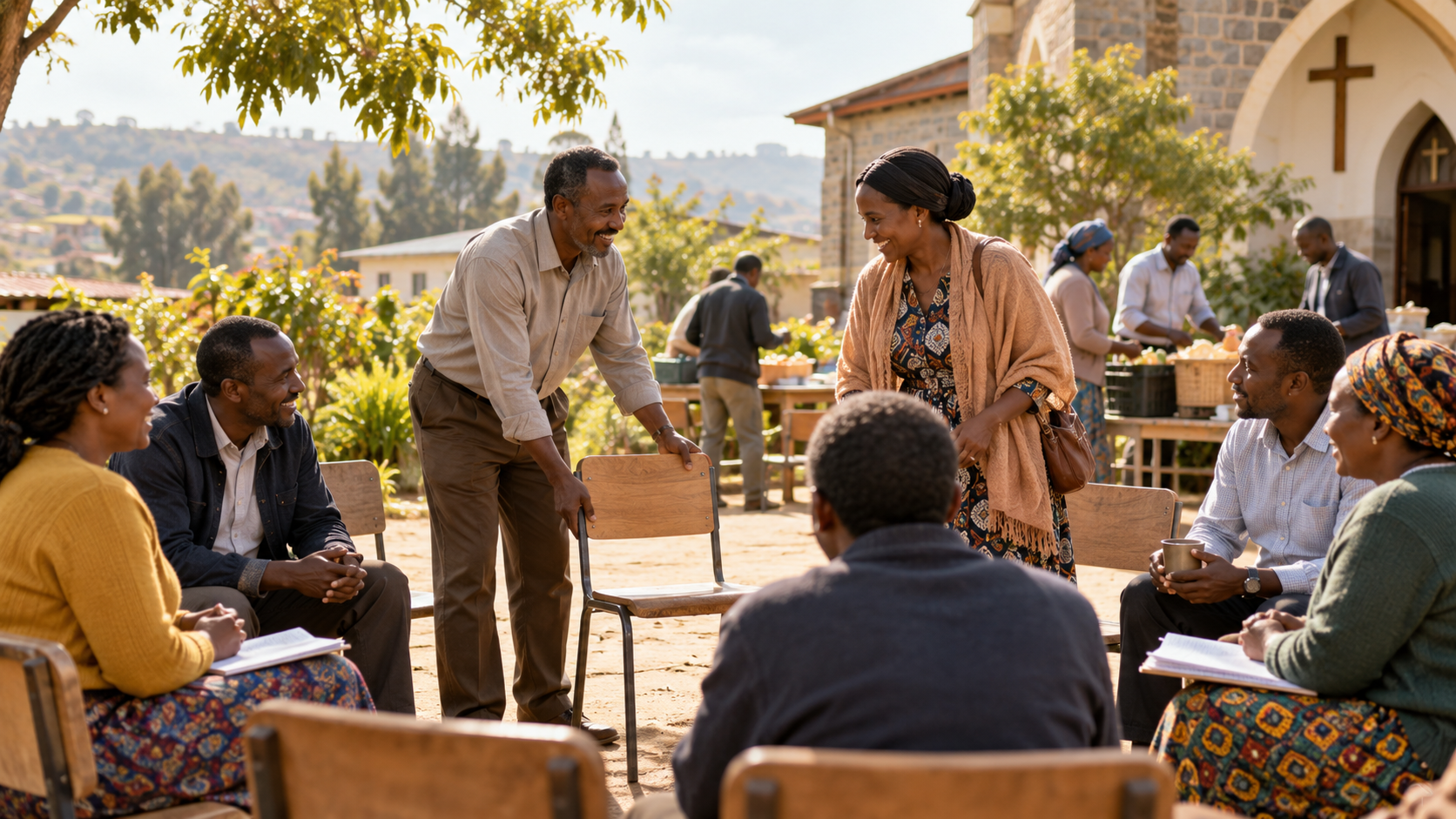
When your season of leadership has ended, will people remember how important you were—or will they live more fully because you helped them follow Jesus?
Primary Scriptures and translation
Primary Scriptures: Mark 10:35–45; Ephesians 4:1–16; 2 Corinthians 5:17–20; Revelation 21:1–5
Bible translation: New Revised Standard Version Updated Edition (NRSVUE). Biblical passages are paraphrased unless explicitly marked as quotations.
When the chair becomes bigger than the calling
Consider this fictional illustration. In one village, the chairperson of a school committee was celebrated for raising funds and completing new classrooms. The accounts looked impressive. Yet teachers were afraid to raise concerns, parents rarely helped shape decisions, and a child with additional needs was consistently overlooked. When the chairperson moved away, almost everything stopped.
At another school, a leader had fewer ready-made answers. She listened carefully, established transparent financial procedures, invited teachers and parents to share responsibility, and made room for families whose voices had rarely been heard. The buildings were modest, but the community had learned to work together. When she left, the work continued.
The illustration raises a real question: Does a good leader build dependence on one person—or a community able to flourish beyond that person's presence?
This series is not simply a collection of techniques for chairing meetings, managing budgets, or attracting followers. Its central question is deeper: How does a leader prepare people to live under the reign of Jesus and participate in his mission in the world?
We write for pastors, parents, teachers, youth mentors, business leaders, and community organizers. Truth, justice, love, and accountability matter in every setting. Yet the church has a distinctive mission to proclaim Christ and make disciples; a Christian-run school or business is not thereby a church.
Listening to Jesus before listening to leadership experts
In Mark 10:35–45, James and John ask Jesus for places of honor. The other disciples become angry. Jesus is on the road toward Jerusalem, where suffering and death await him; his followers are still measuring greatness by proximity to power. Jesus does not pretend that leadership and authority are unimportant. He transforms their meaning. Rather than imitate rulers who dominate others, his disciples must learn to serve. He points to his own self-giving mission as the pattern of that life.
This text concerns discipleship as Jesus approaches the cross. Applied today, it does not eliminate difficult decisions. It means that Christian authority is never permission to use people, but a responsibility to serve them truthfully and lovingly.
Ephesians 4:1–16 portrays a community growing in humility, love, and unity. Christ gives gifts; leaders equip the whole body for ministry. Leaders who hold every task tightly may appear indispensable while preventing others from growing.
In 2 Corinthians 5:17–20, Paul connects new creation with the ministry of reconciliation. God is acting in Christ to restore what sin has fractured. His people bear witness to that work. The church therefore cannot measure its mission only by its buildings, calendar, membership figures, or public reputation.
Begin with God's story, not only the leader's dream
Scripture opens with God's good creation and humanity's responsibility to care for it (Genesis 1–2). Sin damages relationships with God, neighbors, and the created world. God calls Abraham so that the families of the earth may be blessed. He rescues Israel, speaks through the prophets about justice and restoration, and brings the story to its decisive turning point in Jesus—the crucified and risen King. Revelation 21:1–5 directs our hope toward God's promised renewal of all things.
Our work belongs within that story. God's kingdom is his reign of justice and life through Christ—not another name for a denomination, an expansion plan, or a powerful personality. The church witnesses to the kingdom; it neither owns nor completes it.
In his discussion of Ephesians and new creation, N. T. Wright presents the church as a Spirit-formed sign of the renewal launched by Jesus' resurrection. We draw on that emphasis while offering our own pastoral applications—not a leadership theory jointly authored by Wright and others.
Every budget and plan should therefore ask: Are we drawing people toward Christ, and are we serving neighbors beyond our familiar circle?
Believe: Leadership begins by trusting Jesus
Our motto begins with Believe. Before we ask what a leader can accomplish, we ask whom the leader trusts. Faith is not confidence that every strategy will succeed. It is entrusting our lives, choices, and ambitions to Jesus, who remains Lord when the outcome is different from what we wanted.
Powerful speakers may still fear correction; busy pastors may fail to hear wounded people. We are not the saviors of those we lead. Grace precedes achievement; the Spirit forms character. Leadership skills cannot manufacture spiritual life.
Churches nurture this faith through worship, prayer, Scripture, and discipleship. Schools and workplaces should see its fruit in fairness, honesty, and care. Does our professed faith shape how people experience our leadership?
Become: The leader remains a disciple being formed
Become is an invitation to transformation. Jesus never calls leaders to stand over others as though their own growth were complete. He calls us to follow him. In Philippians 2:1–11, Paul urges the community to pursue the interests of others by adopting the self-giving mind of Christ. Humility is not self-contempt. It is refusing to turn responsibility into a weapon for self-importance.
John Maxwell's five levels of leadership show why a title is not enough: relationships, results, and developing people matter. His model offers useful insights, but the gospel asks something further: Does our influence help people mature or make them dependent on us?
Formation includes receiving correction. Gifted leaders can cause harm; people must be able to ask questions, report abuse, and challenge decisions without retaliation. Forgiveness differs from reconciliation, restored trust, and reinstatement to authority. No leader's reputation justifies sacrificing vulnerable people's safety.
Leaders have limits. Elijah received care in exhaustion (1 Kings 19); Jesus invited his disciples to rest (Mark 6:30–32). Seeking help and sharing work can be faithful acts.
Bless: Let your position become a path for others to flourish
Bless turns our attention outward. The quality of leadership is revealed partly by what happens to people who hold little power. Can the quiet student be heard? Does a widow receive the care she needs? Can a young believer develop their gifts? Is a person reporting harm treated with dignity and protected from intimidation?
Acts 6:1–7 recounts complaints that some widows were overlooked in food distribution. Rather than dismiss the concern, the community changed its arrangements. For churches, word and service belong together. Schools, charities, and companies can similarly identify exclusions and repair unfair systems, while retaining their distinct purposes.
Simon Sinek's WHY, HOW, WHAT framework offers a useful distinction between purpose, ways of working, and visible activities. It is a tool for asking better questions, not a source of the gospel. For a Christian community: Why are we here? To serve God's purposes and bear witness to Christ. How will we work? Through truthfulness, love, justice, and accountability. What will we do? Teach, listen, serve, protect, reconcile, and equip others.
Sinek's long-term perspective can help prepare those who follow us. But an infinite mindset is not eternal life: Christian hope rests on resurrection, not an organization's endless survival.
The questions this series will not avoid
We will confront hard decisions, harmful conflict, genuine unity, succession, change, trust, exhaustion, and hope amid suffering.
Large numbers, beautiful buildings, and strong revenues may signal progress but can conceal wounded people. We will also ask about financial integrity, safety, participation, discipleship, transparent decisions, and complaints.
Good leaders make mistakes, but grace never cancels accountability. Love need not silence wrongdoing; unity need not erase difference; obedience to God must not excuse abuse.
The kingdom is already, but not yet: Christ is risen and the Spirit works, while evil and death await final defeat. Institutional success cannot complete God's future.
The journey through the series
The articles form a learning pathway:
- Calling and the heart of service (articles 1–2): leadership under Jesus and the example of the Good Shepherd.
- Purpose, trust, and decisions (articles 3–6): shared mission, truthful relationships, listening, justice, and accountability.
- Developing others and leaving a legacy (articles 7–9): empowering people, preparing successors, and leading through change.
- Character under pressure (articles 10–12): courage with humility, receiving help during exhaustion, and sustaining hope in darkness.
- Healing relationships and shared belonging (articles 13–14): truth in conflict and unity without erasing differences.
- The continuing journey (article 15 onward): a culture of service that makes room for everyone to contribute, with further themes to follow.
Read alone or in a group. Begin with Scripture, engage the questions, take one practical step, and invite trustworthy feedback. Our aim is not to finish many articles but to live differently.
A difficult question: If Scripture is our authority, why read Maxwell or Sinek?
Scripture gives us our story and moral direction, though not every modern management procedure. Practitioners and research may help with planning and developing people, but their proposals need testing. Influence may manipulate; productive systems may harm; impressive mission statements may obscure selfish ambition.
Therefore we will not present Wright, Maxwell, and Sinek as if they had written a shared theory of leadership. Wright helps us attend to resurrection and new creation. Maxwell offers useful questions about influence and developing people. Sinek helps us examine purpose, trust, and organizational continuity. Jesus remains our measure; other voices are conversation partners to be engaged with discernment.
Life Application
- State your purpose. In one sentence, describe how the people you serve should flourish—not how your own status should grow.
- Name an unheard voice. Who is usually absent when decisions affecting them are made?
- Examine your use of authority. Which recent decision reflected listening, and which may have been shaped by fear or self-protection?
- Make accountability accessible. Clarify how someone can report misconduct, coercion, or harm without being forced to confront an alleged perpetrator.
- Equip another person. Teach one meaningful responsibility and provide real authority, support, and feedback.
- Respect your limits. Protect time for rest, prayer, and family, and review responsibilities that should be shared.
- Measure the right fruits. Look for truthfulness, safety, trust, participation, growth, and service to neighbors—not numbers and income alone.
Weekly Exercise: A Mirror for Leadership
Goal: Identify one place where your leadership can move from being indispensable to making others stronger.
- Read Mark 10:35–45 and Ephesians 4:11–16 twice. Write down one phrase or idea that challenges or encourages you.
- Ask one person you lead: What could I change so that you can serve or work more safely and freely? Listen without defending yourself.
- Record one practice that is helping people and one that needs to change. Resist the urge to edit out uncomfortable feedback.
- Tell a trusted learning partner about one action you will take this week and how you will seek feedback.
- At week's end, consider whether someone gained genuine voice, support, or opportunity. Any disclosure of abuse or serious harm should be handled through appropriate safeguarding procedures rather than this ordinary reflection exercise.
Reflection and Discussion Questions
- In Mark 10:35–45, what understanding of greatness does Jesus challenge, and why was that hard for the disciples?
- How does Ephesians 4 distinguish the work of leaders from the work of Christ's whole body?
- If Jesus is King, what practices in our church or organization confirm—or contradict—that confession?
- Who may be benefiting from our leadership while someone else is overlooked? How would we know?
- How can we distinguish healthy influence from creating dependence on one personality?
- How does our reporting process protect people who raise concerns from intimidation and retaliation?
- How does the promise of new creation sustain faithful action without claiming that we have already completed God's kingdom?
- What one step will you take this week so another person can grow, be heard, or be better protected?
Conclusion: The chair will pass; let the blessing remain
Return to the imagined schools: one depended on a chairperson; the other made room for a community to grow. Are we erecting monuments to our names—or planting trees that will shade people we may never meet?
Jesus calls us from status to vocation, from possessing power to sharing responsibility, and from appearing great to becoming a blessing. We will not make this journey by effort alone. We will listen to Scripture, depend on the Spirit, receive correction, and take small but honest steps of obedience.
Prayer: Lord Jesus, faithful King and Servant, forgive us when we have used responsibility to seek recognition rather than to build others up. Teach us to listen, to speak the truth, to act justly, and to protect those at risk. By your Spirit, form us into disciples who equip other disciples, and into people whose lives become a blessing. Amen.
Next reading: Begin with Good Leadership: Calling and Jesus, the opening article on position, calling, and the example of Jesus. It asks what leadership means under his authority and how that calling changes our use of power.
References
- The Bible, NRSVUE: Mark 10:35–45; Ephesians 4. Additional passages: Genesis 1–2; 1 Kings 19; Mark 6:30–32; Acts 6:1–7; 2 Corinthians 5:17–20; Philippians 2:1–11; Revelation 21:1–5.
- N. T. Wright, “Beginning to Think About the New Creation”, N. T. Wright Online.
- John C. Maxwell, “The 5 Levels of Leadership”, John Maxwell, August 30, 2016.
- Simon Sinek / The Optimism Company, Start with WHY; The Infinite Game; Leaders Eat Last. These are references for the leadership ideas discussed, not sources of invented quotations.
- Maisha Kamili, Good Leadership: Calling and Jesus and Good Leadership: A Shepherd’s Heart.

Be the first to leave a comment.