

The wall is standing, but the heart is wandering. The songs have risen, but the storerooms are empty. The Sabbath has been pledged, but the gates are crowded with traders. The covenant has been signed, but compromise has found a room in the temple. Jerusalem is restored enough to expose the wound: stone can be repaired faster than the human heart.
01
Introduction
Some endings do not give us the comfort we expect. After the joy of Nehemiah 12, we might expect the story to close with a shining city, faithful worship, strong families, holy Sabbath, and a people finally healed. The wall has been rebuilt. The Law has been read. The people have confessed. The covenant has been signed. The city has sung.
But Nehemiah 13 pulls us back into the ache. The final chapter reveals compromise in the temple, neglect of Levites, Sabbath violation, economic disorder, intermarriage, and Nehemiah’s fierce reforms. The city has gates again, but the people’s practices are breaking the covenant they vowed to keep.
This chapter asks a sobering question: What happens when outward restoration succeeds, but inward transformation remains unfinished?
This text is about reform exposing the wounded heart, because walls, vows, ceremonies, and strong leadership cannot complete what only God’s deeper renewal can heal.
Nehemiah 13 is not a neat conclusion. It is a mirror. It shows us that revival moments can fade, vows can weaken, institutions can be corrupted, and leaders can grow severe under the burden of repeated failure. Yet the chapter also keeps hope alive by making us long for something more than reform from outside: the new heart, the faithful king, the Spirit-written law, and the mercy that rebuilds deeper than walls.
02
Historical and Literary Context
Nehemiah 13 forms the final chapter of Ezra–Nehemiah. It comes after the dedication of the wall in Nehemiah 12, where the joy of Jerusalem was heard far away [Neh. 12:43]. That celebration seemed to bring the restoration story to a high point. But chapter 13 shows that the covenant commitments of Nehemiah 10 have been neglected.
The chapter begins with the public reading of the Law and the exclusion of Ammonites and Moabites from the assembly because of the story of Balaam and Israel’s wilderness opposition [Neh. 13:1–3; Deut. 23:3–5]. Then the narrative shifts to events during Nehemiah’s later return to Jerusalem after a period back with King Artaxerxes [Neh. 13:6–7]. During his absence, serious abuses have developed.
The failures in this chapter correspond closely to the pledges made in Nehemiah 10. The people had vowed not to neglect the house of God [Neh. 10:39], yet temple storerooms are misused and Levites are neglected [Neh. 13:4–14]. They had vowed to keep the Sabbath from marketplace trade [Neh. 10:31], yet buying and selling continue at Jerusalem’s gates [Neh. 13:15–22]. They had vowed covenant faithfulness in marriage [Neh. 10:30], yet intermarriage has again placed the next generation’s identity at risk [Neh. 13:23–29].
Literarily, Nehemiah 13 is shaped by reform episodes and repeated prayers: “Remember me, O my God” [13:14, 22, 31], and “Remember them, O my God” [13:29]. These prayers reveal Nehemiah’s longing for divine approval and justice. They also give the chapter a deeply personal tone. Nehemiah is not merely recording policy; he is pleading before God over a community that keeps slipping back.
Within the larger biblical story, this ending is intentionally unsettling. Ezra–Nehemiah began with hopes of return, temple, restored worship, and renewed covenant life. It ends with the realization that return from exile has not solved the deeper exile of the heart. The final word is not triumph but longing.
03
Walking Through the Text
When Scripture Separates the People Again [Nehemiah 13:1–3]
The chapter opens “on that day” with the Book of Moses being read in the hearing of the people [Neh. 13:1]. The Word is still central. Once again, Scripture exposes what the community must face.
The passage read concerns Ammonites and Moabites, who had not met Israel with bread and water in the wilderness but had hired Balaam to curse them. Yet God turned the curse into blessing [Neh. 13:2; Num. 22–24; Deut. 23:3–5]. In response, the people separate from Israel all those of foreign descent [Neh. 13:3].
This scene must be read carefully. The issue is not ethnic hatred as a spiritual ideal. The Old Testament itself includes foreigners who join Israel’s God and become part of the covenant story, such as Rahab and Ruth. The concern here is covenant loyalty and the danger of alliances that draw the people away from God.
Still, the scene also participates in one of Ezra–Nehemiah’s tensions. The prophets imagined nations streaming to Zion to worship the Lord [Isa. 2:2–4; Zech. 8:20–23]. Yet this community, fragile after exile, keeps drawing boundaries to preserve holiness. The longing remains: How will God form a holy people who also become a light to the nations?
When Tobiah Finds a Room in the Temple [Nehemiah 13:4–9]
The next scene is shocking. Eliashib the priest, who is related to Tobiah, prepares a large chamber for him in the courts of the house of God [Neh. 13:4–5]. This room had previously been used for offerings, incense, vessels, tithes, grain, wine, and oil for the Levites, singers, and gatekeepers.
Tobiah was one of Nehemiah’s persistent opponents [Neh. 2:10, 19; 4:3; 6:17–19]. Now, through relational and political networks, he has gained space inside the temple complex. The enemy who once mocked the wall now occupies a room where worship resources should be stored.
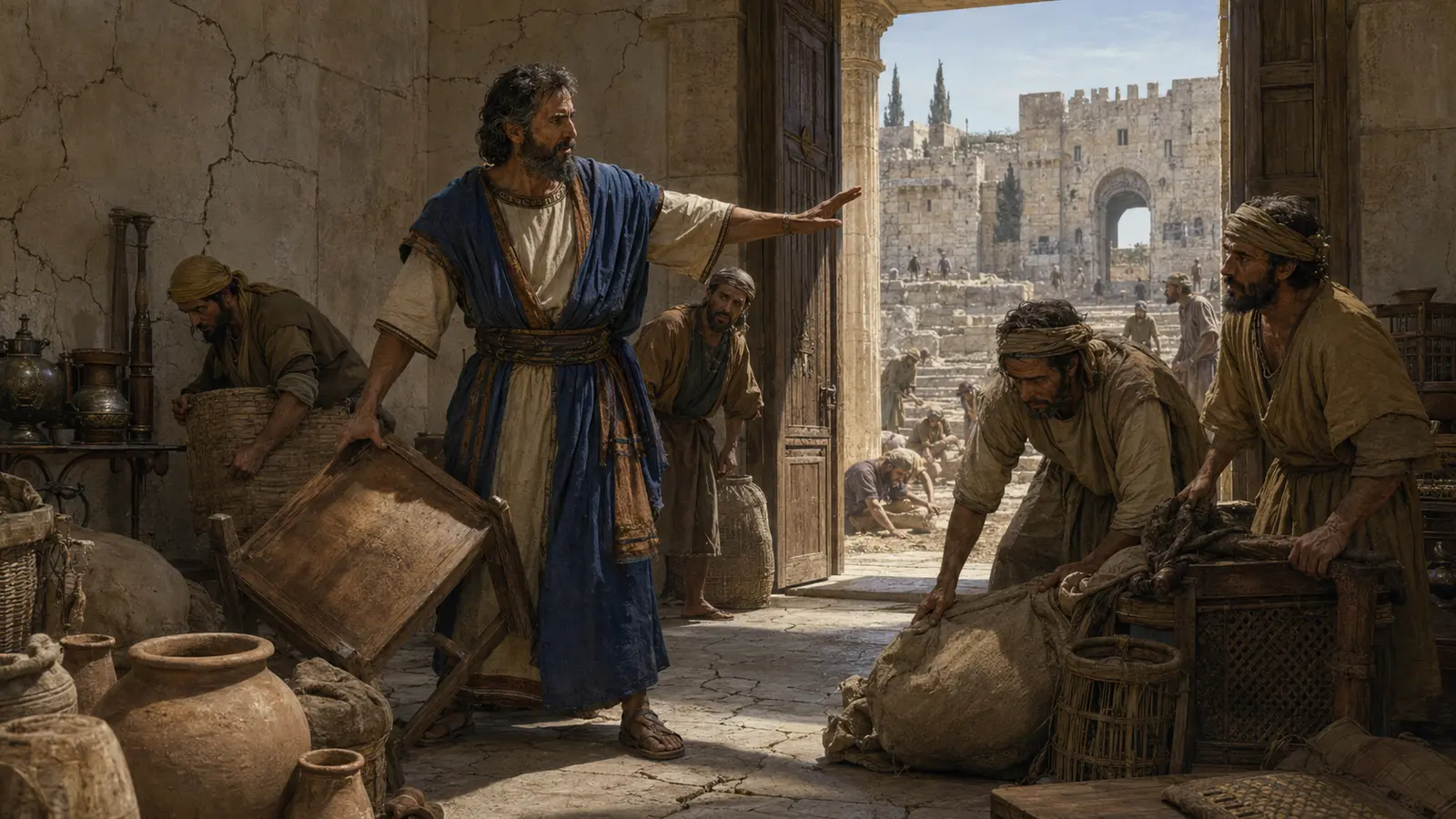
Nehemiah explains that he was not in Jerusalem at the time. He had returned to the king, and later received permission to come back [Neh. 13:6–7]. When he discovers the evil Eliashib has done, he is angry. He throws Tobiah’s household furniture out of the chamber, orders the rooms cleansed, and restores the vessels, offerings, and incense [13:8–9].
This is a vivid picture of compromised worship. The house of God has been rearranged to accommodate the wrong guest. What belonged to worship has been displaced for political convenience.
The application is sharp: the heart, like the temple chamber, can make room for what once opposed God. Reform sometimes begins by throwing out the furniture.
When the House of God Is Neglected [Nehemiah 13:10–14]
Nehemiah next discovers that the portions for the Levites have not been given, so the Levites and singers have returned to their fields [Neh. 13:10]. The worship system has begun to collapse because the community has failed to support those appointed to serve.
This directly violates the covenant pledge: “We will not neglect the house of our God” [Neh. 10:39]. The people had promised support for the temple, but the promise faded. The singers who once filled the wall with joy are now back in the fields because provision has stopped.
Nehemiah confronts the officials: “Why is the house of God forsaken?” [Neh. 13:11]. He gathers the Levites and restores them to their stations. Then all Judah brings tithes into the storehouses, and trustworthy men are appointed to distribute the portions [13:12–13].
The reform is practical: confrontation, restoration, accountability, distribution. Worship is not sustained by emotion alone. It requires faithful systems and trustworthy stewards.
Nehemiah then prays, “Remember me, O my God, concerning this, and do not wipe out my good deeds that I have done for the house of my God” [13:14]. The prayer reveals his burden. He wants God to see that he has acted for the temple’s good. But the repeated need for reform also reveals the weakness of the people’s vows.
When Sabbath Is Crowded by the Marketplace [Nehemiah 13:15–22]
Nehemiah then sees people treading winepresses, bringing grain, loading donkeys, and selling food on the Sabbath [Neh. 13:15]. Tyrian merchants are also bringing fish and goods into Jerusalem [13:16]. The Sabbath has become another market day.
Again, this breaks the covenant pledge of Nehemiah 10, where the people promised not to buy goods on the Sabbath or holy day [Neh. 10:31]. The rhythm of trust has been swallowed by commerce.
Nehemiah confronts the nobles: “What is this evil thing that you are doing, profaning the Sabbath day?” [Neh. 13:17]. He reminds them that their ancestors did the same, and God brought disaster on the city [13:18]. Sabbath violation is not minor forgetfulness. It repeats the covenant unfaithfulness that led to judgment.
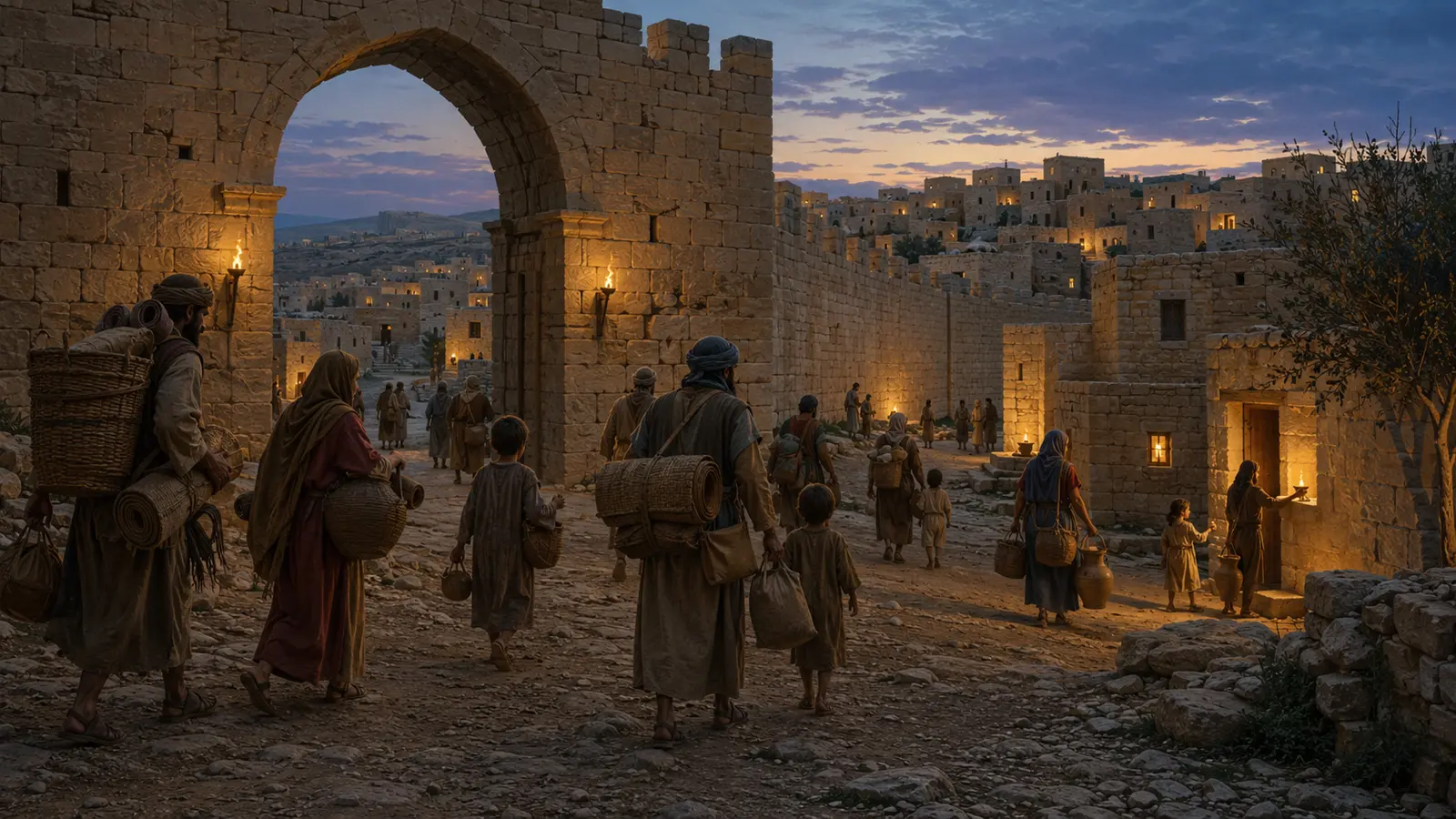
Nehemiah responds with strong action. He commands the gates to be shut before Sabbath and not opened until after it. He stations servants at the gates so no load can enter [13:19]. When merchants spend the night outside Jerusalem, he warns them that he will lay hands on them if they do it again [13:20–21]. Then he commands the Levites to purify themselves and guard the gates [13:22].
The gates that had been rebuilt to protect the city must now protect sacred time. The wall is not only for defense against enemies; it must also help the community resist the economy of endless production.
Nehemiah prays again: “Remember this also in my favor, O my God, and spare me according to the greatness of your steadfast love” [13:22]. Here his appeal rests not only on his deeds but on God’s covenant mercy.
When the Next Generation Loses the Language of Covenant [Nehemiah 13:23–27]
The next crisis concerns marriages with women of Ashdod, Ammon, and Moab [Neh. 13:23]. The most painful detail is that half of their children speak the language of Ashdod and cannot speak the language of Judah [13:24]. The issue is generational formation. The children are losing the language of covenant identity.
Language here is not merely grammar. It represents worship memory, Scripture instruction, prayer, story, and belonging. If the next generation cannot speak Judah’s language, how will they hear Torah, sing the Psalms, and carry the covenant story?
Nehemiah responds fiercely. He confronts them, curses them, beats some, pulls out their hair, and makes them swear by God not to intermarry [13:25]. This severity is troubling. The text reports his actions, but readers are invited to feel the tension. Nehemiah is zealous for covenant faithfulness, yet his methods are harsh.
He appeals to Solomon as a warning [13:26]. Solomon was loved by God and made king over Israel, yet foreign wives led him into sin [1 Kgs. 11:1–8]. If even Solomon fell, how can this fragile post-exilic community presume immunity?
The concern is real: covenant compromise can turn the heart from God. But the harshness of Nehemiah’s response also shows the limits of reform by force. Hair can be pulled; vows can be demanded; but only God can transform desire.
When Priestly Compromise Pollutes the Covenant [Nehemiah 13:28–29]
The final marriage-related example strikes at the priesthood. One of the sons of Joiada, son of Eliashib the high priest, is son-in-law to Sanballat the Horonite [Neh. 13:28]. Sanballat was another major opponent of the rebuilding work. Now his family is connected by marriage to the high priestly line.
Nehemiah drives him away. He then prays, “Remember them, O my God, because they have desecrated the priesthood and the covenant of the priesthood and the Levites” [13:29].
This is not a peripheral issue. The priesthood is meant to guard holiness, teach the people, and serve the house of God. When priestly leadership is compromised, the community’s worship is endangered at its center.
The chapter has come full circle. It began with Scripture’s concern over Ammon and Moab. It exposed Tobiah’s room in the temple. It revealed neglected Levites, broken Sabbath, compromised households, and priestly alliances with enemies. The problem is not one isolated failure. It is systemic relapse.
When the Book Ends with “Remember Me” [Nehemiah 13:30–31]
Nehemiah concludes: he cleanses the people from everything foreign, establishes duties for priests and Levites, provides for wood offering and firstfruits, and prays, “Remember me, O my God, for good” [Neh. 13:30–31].
These are the final words of the book.
The ending is striking. It does not end with the glory of God filling the temple. It does not end with a Davidic king on the throne. It does not end with nations streaming to Jerusalem. It does not even end with the people keeping covenant joyfully. It ends with Nehemiah still reforming, still cleansing, still organizing, still praying to be remembered.
This ending is not failure in the sense that nothing good happened. Much good happened. The wall was rebuilt. Scripture was read. Worship was restored. Injustice was confronted. But the ending shows that reform remains incomplete. The heart still needs a deeper work.
04
Theological Reflection
Walls Can Be Rebuilt Faster Than Hearts
Nehemiah 13 is the theological key to the whole book. The wall was finished in fifty-two days, but the people’s covenant faithfulness remains unstable. Structures can change quickly; hearts often resist deeply.
This does not mean structures do not matter. Walls, gates, storehouses, Sabbath practices, and temple service all matter. But they are not enough. Visible restoration must be joined to inner renewal.
Neglect Is One of the Great Enemies of Worship
The house of God is not destroyed by armies in this chapter. It is neglected. Storerooms are misused. Levites go unpaid. Offerings stop. Sabbath becomes ordinary commerce.
Spiritual decline often enters quietly. Not always through open rebellion, but through small permissions, delayed obedience, neglected rhythms, and practical compromises. The temple room becomes available to Tobiah because someone first stopped treating it as holy.
Sabbath Is a Protest Against Endless Commerce
Nehemiah’s Sabbath reform reminds us that sacred time is part of covenant life. Sabbath declares that God’s people are not slaves to production, trade, and appetite. It protects worship, rest, justice, and trust.
When the marketplace fills the gates on Sabbath, the community’s imagination is being discipled by Egypt again. Sabbath is a weekly Exodus—a sign that the Lord, not Pharaoh, owns time.
The Next Generation Needs the Language of Faith
The children who cannot speak Judah’s language embody a deep danger. Covenant faithfulness must be transmitted. If the next generation loses the language of Scripture, worship, prayer, and identity, restoration will not endure.
Every community must ask: What language are our children learning? Not only spoken language, but the language of desire, story, worship, justice, holiness, and hope.
Nehemiah’s Zeal Shows Both Courage and Limitation
Nehemiah is brave. He confronts powerful people, cleanses temple space, restores Levites, guards Sabbath, and defends covenant identity. Yet his severity also leaves us uneasy. His reforms are necessary, but they cannot produce the new heart promised by the prophets.
The book ends longing for something more: not less holiness, but deeper holiness; not weaker obedience, but Spirit-born obedience; not reform without love, but covenant faithfulness written within. Ezra–Nehemiah points beyond itself to the new covenant, to the faithful Messiah, and to the Spirit who renews the heart [Jer. 31:31–34; Ezek. 36:26–27].
05
Life Application
Do not mistake completed projects for completed transformation. A repaired structure may still hide an unrepaired heart.
Remove what has taken God’s room. Ask what “Tobiah furniture” has been allowed into spaces meant for worship, prayer, and obedience.
Do not neglect the house of God. Worship must be sustained through faithful giving, service, leadership, and practical care.
Guard sacred rhythms. Sabbath, prayer, Scripture, worship, and rest need protection at the gates of life.
Disciple the next generation intentionally. Teach the language of faith before another language of desire takes over.
Confront compromise, but beware harshness. Zeal for holiness must be joined with humility, mercy, and dependence on God’s Spirit.
Pray for renewal deeper than reform. Make changes where needed, but ask God to write obedience on the heart.
06
Reflection Questions
1. Where has your outward life been repaired while your inward life remains wounded or divided?
2. What has been given a “room” in your heart, home, church, or ministry that is displacing worship?
3. What sacred rhythm have you allowed the marketplace, busyness, or pressure to crowd out?
4. What language of faith must you intentionally pass to the next generation?
5. Where do you need reform, and where do you need to admit that reform alone cannot change your heart?
07
Response Prayer
Lord God of covenant mercy, Searcher of hearts, Builder of walls, and Giver of the Spirit, look upon us with compassion.
We confess that we often rebuild the outside while neglecting the inside. We repair gates, but leave our desires unguarded. We sing songs, but forget the storerooms. We sign promises, but drift from obedience.
Cleanse the rooms of our hearts. Remove what has no place in your temple. Restore neglected worship. Guard our Sabbaths. Teach our children the language of faith. Make our leaders faithful, our homes holy, and our communities honest before you.
But do more than reform us from the outside. Write your law within us. Give us new hearts. Fill us with your Spirit. Make us a people whose obedience flows not from fear alone, but from love awakened by your mercy.
Through Jesus Christ, the faithful covenant-keeper, the true temple, the Lord of the Sabbath, and the one who remembers us for good, Amen.
08
Window into the Whole Story
Nehemiah 13 closes Ezra–Nehemiah with unresolved tension. The people have returned, the temple has been rebuilt, the wall has been completed, Scripture has been read, confession has been made, covenant has been signed, and worship has been celebrated. Yet the final chapter reveals relapse.
This is not an accident. The ending teaches us how to read the whole book. Return from exile was mercy, but not the fullness of restoration. The people came home, but the heart still needed rebuilding. Jerusalem received walls, but Israel still needed the new covenant. Reform came through leaders, but deeper renewal would require God’s Spirit.
The movement of the book can now be felt clearly: return leads to rebuilding, rebuilding leads to worship, worship leads to confession, confession leads to covenant, covenant exposes failure, and failure creates longing for deeper grace.
Ezra–Nehemiah leaves us standing in a restored city with wounded hearts, waiting for the faithful Son, the true temple, the greater restoration, and the God who does not merely bring exiles home—but makes them new.
09
Bibliography
Boda, Mark J. Praying the Tradition: The Origin and Use of Tradition in Nehemiah 9. Berlin: de Gruyter, 1999.
Clines, David J. A. Ezra, Nehemiah, Esther. New Century Bible Commentary. Grand Rapids: Eerdmans, 1984.
Kidner, Derek. Ezra and Nehemiah. Tyndale Old Testament Commentaries. Downers Grove: InterVarsity Press, 1979.
Throntveit, Mark A. Ezra-Nehemiah. Interpretation. Louisville: John Knox Press, 1992.
Williamson, H. G. M. Ezra, Nehemiah. Word Biblical Commentary 16. Waco: Word Books, 1985.
Williamson, H. G. M. Ezra and Nehemiah. Old Testament Guides. Sheffield: JSOT Press, 1987.
Yamauchi, Edwin M. “Ezra-Nehemiah.” In The Expositor’s Bible Commentary, revised edition. Grand Rapids: Zondervan, 2010.
Be the first to leave a comment.