

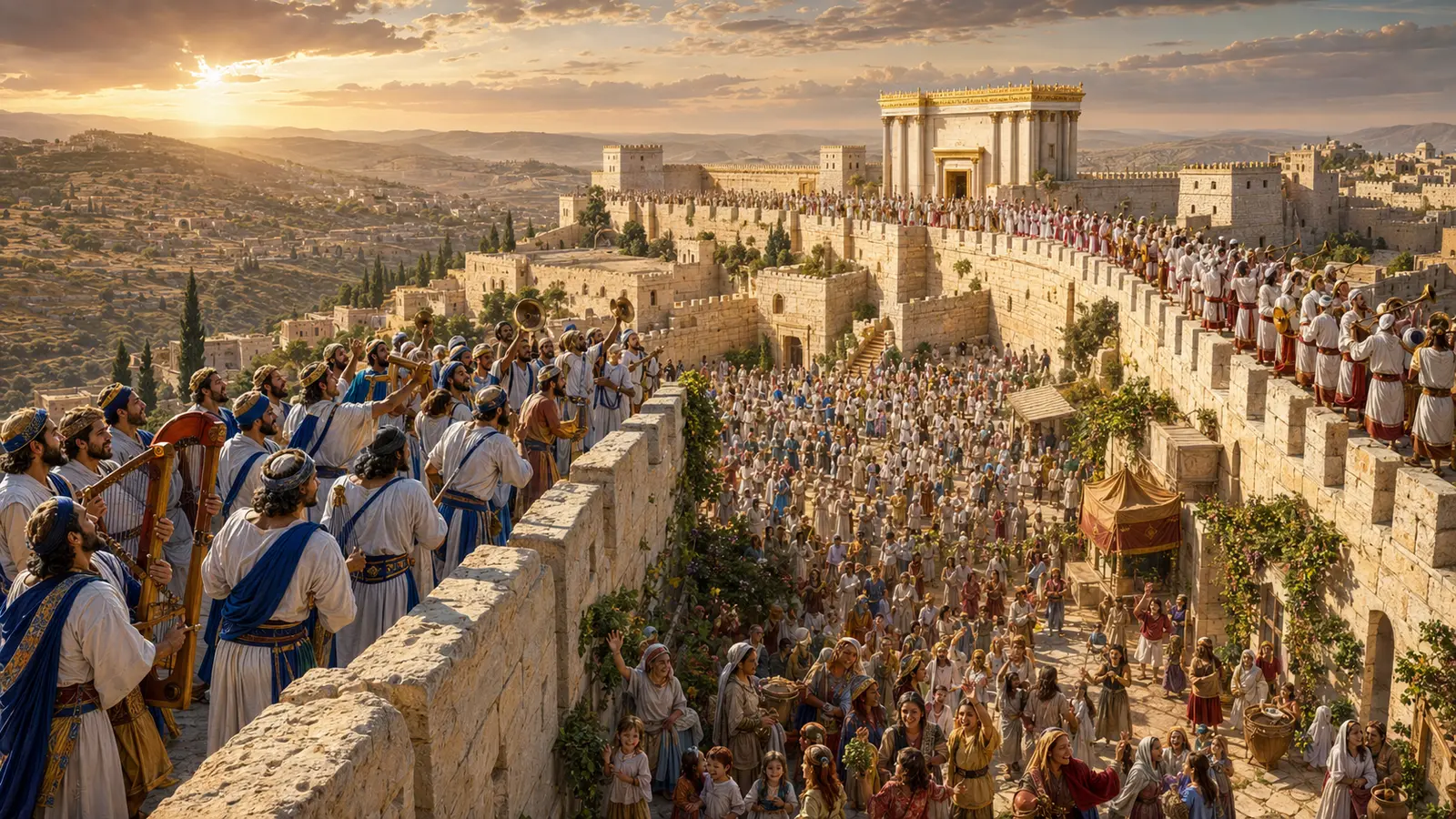
The wall that once carried shame now carries singers. The gates that once lay burned now hear thanksgiving. Priests purify, choirs ascend, cymbals ring, and the joy of Jerusalem is heard far away. The city has not only been repaired; it has been given back to worship.
01
Introduction
There are moments when healing must become public praise. The wound that once made people whisper must now become a place where thanksgiving is heard. The wall that once symbolized disgrace must become a platform for worship. Nehemiah 12 brings us to such a moment.
The wall has been rebuilt. The people have gathered around Scripture. They have confessed sin. They have signed covenant commitments. Jerusalem has begun to be repopulated. Now the city dedicates the wall—not with military boasting, not with political propaganda, but with purification, procession, music, sacrifice, and joy.
This chapter asks a beautiful question: What should God’s people do when mercy has repaired what shame once ruined?
This text is about rebuilt walls becoming public worship, because restoration is not complete until the work of God is returned to God in thanksgiving.
Nehemiah 12 is a chapter of names, singers, priests, Levites, processions, and offerings. It reminds us that worship does not float above history. Worship rises from places where God has acted. Songs are born beside repaired stones. Joy grows where mercy has met ruins. The people dedicate the wall because they know that the wall is not finally theirs. It belongs to the God whose good hand helped them build.
02
Historical and Literary Context
Nehemiah 12 follows the repopulation of Jerusalem in chapter 11. The wall had already been finished in Nehemiah 6, but the narrative delayed the dedication because the city first needed reordered communal life. The people had to hear the Law [Neh. 8], confess their sin [Neh. 9], renew the covenant [Neh. 10], and inhabit the city [Neh. 11]. Only then does the story turn to the public dedication of the wall.
This order is theologically important. A wall can be completed quickly, but a people must be formed patiently. The dedication in Nehemiah 12 is not simply the celebration of a construction project. It is the worshiping response of a community learning again to live under God’s Word.
The chapter opens with lists of priests and Levites from earlier generations [12:1–26]. Then it moves to the dedication itself [12:27–43]. Finally, it describes arrangements for temple offerings, singers, gatekeepers, and Levitical support [12:44–47]. The whole chapter connects memory, worship, and ongoing responsibility.
The dedication scene is rich with temple and procession imagery. Two great choirs give thanks and walk on the wall in opposite directions before meeting at the house of God [12:31–40]. The movement visually embraces the city. The wall is not merely looked at; it is walked, sung over, and offered back to God.
Within the larger Ezra–Nehemiah story, Nehemiah 12 is one of the high points of restoration. The shame of Nehemiah 1:3 is answered by the joy of Nehemiah 12:43. The broken wall has become a soundboard for praise. Yet the chapter’s joy should not make us forget the book’s deeper tension. Nehemiah 13 will soon show that celebration, however real, does not guarantee lasting faithfulness. Public worship must become enduring obedience.
03
Walking Through the Text
When Memory Names the Servants of Worship [Nehemiah 12:1–26]
The chapter begins with a long list of priests and Levites who came up with Zerubbabel and Jeshua [Neh. 12:1]. It then traces priestly and Levitical names across generations, including leaders in the days of Joiakim, Ezra, and Nehemiah [12:12–26].
At first glance, these names may seem like a delay before the dedication. But the list serves the theology of the chapter. Worship has a history. The singers who stand on the wall do not appear from nowhere. They belong to a long line of priestly and Levitical service stretching back to the first return from exile.
The list also legitimizes the worship order of the restored community. Ezra–Nehemiah cares deeply about continuity: continuity with the returned exiles, continuity with temple service, continuity with covenant identity, continuity with the God who has preserved a remnant.
Names resist forgetfulness. They say that God’s work is carried forward through generations of servants—some famous, many hidden. The dedication of the wall is not only Nehemiah’s victory. It belongs to a community whose worship has been preserved through exile, return, labor, and reform.
When the Levites Are Gathered for Gladness [Nehemiah 12:27–30]
The dedication begins by seeking the Levites “in all their places” and bringing them to Jerusalem “to celebrate the dedication with gladness, with thanksgivings and with singing, with cymbals, harps, and lyres” [Neh. 12:27].
This is a carefully prepared celebration. Joy is not treated as accidental. The people gather those whose vocation is to lead thanksgiving. Instruments are named. Singers come from the surrounding region [12:28–29]. Worship is organized because the moment matters.
Before the procession begins, the priests and Levites purify themselves, the people, the gates, and the wall [12:30]. This is striking. The wall is not dedicated by celebration alone but by purification. The people recognize that what has been rebuilt must be set apart before God.
Purification reminds us that worship is not merely emotion. The joy of the Lord is holy joy. The gates, walls, priests, Levites, and people are brought under the claim of God’s holiness. The rebuilt city must not become a monument to human achievement. It must become a vessel of covenant life.
When Thanksgiving Walks on the Wall [Nehemiah 12:31–37]
Nehemiah appoints two great choirs that give thanks [Neh. 12:31]. One goes to the south on the wall toward the Dung Gate, followed by leaders of Judah and priests with trumpets [12:31–36]. Ezra the scribe leads this first procession [12:36]. They pass important locations: the Fountain Gate, the stairs of the city of David, the house of David, and the Water Gate [12:37].
The symbolism is powerful. The wall is not only protecting worship; it is carrying worship. The singers walk where workers once labored and where enemies once mocked. Every step declares that shame has been answered by grace.
The route recalls the city’s sacred and royal memory. The city of David and the house of David remind readers of Jerusalem’s older vocation—its connection to kingship, promise, worship, and the hope of a faithful ruler. Yet no Davidic king sits on the throne here. The city is restored, but the kingdom hope remains incomplete.
This creates one of the chapter’s quiet tensions. The processions are joyful, but the deeper royal promise still waits. The wall sings, but Jerusalem still longs for the Son of David who will bring the fullness of God’s reign.
When Two Choirs Meet at the House of God [Nehemiah 12:38–43]
The second choir goes in the opposite direction, with Nehemiah following it, along with half the people [Neh. 12:38]. They pass the Tower of the Ovens, the Broad Wall, the Gate of Ephraim, the Gate of Yeshanah, the Fish Gate, the Tower of Hananel, the Tower of the Hundred, the Sheep Gate, and the Gate of the Guard [12:38–39].
The two choirs eventually stand in the house of God [12:40]. Ezra and Nehemiah, the scribe and the governor, are both associated with the celebration. The processions that began on the wall converge at the temple. This movement matters. The wall’s dedication ends at God’s house. The city’s security is returned to worship.
Then the people offer great sacrifices and rejoice, “for God had made them rejoice with great joy” [12:43]. The women and children also rejoice. The joy of Jerusalem is heard far away.
This is one of the brightest sentences in Ezra–Nehemiah. Earlier, Jerusalem’s broken wall brought disgrace [Neh. 1:3]. Now Jerusalem’s joy travels beyond the city. The sound that goes out is no longer shame but praise.
Yet notice the source of joy: “God had made them rejoice.” Their joy is not self-generated excitement. It is a gift. God does not merely command joy; he gives it. The community’s gladness is grace responding to grace.
When Celebration Becomes Ongoing Support [Nehemiah 12:44–47]
After the dedication, the chapter turns to practical arrangements. Men are appointed over storerooms for contributions, firstfruits, and tithes [Neh. 12:44]. These provisions support the priests and Levites, “for Judah rejoiced over the priests and the Levites who ministered” [12:44].
The singers and gatekeepers perform their service according to the command of David and Solomon [12:45]. The text reaches back to earlier worship traditions and highlights continuity with Israel’s liturgical memory. In the days of David and Asaph there were leaders of singers and songs of praise and thanksgiving to God [12:46].
The chapter ends by emphasizing daily portions for singers, gatekeepers, Levites, and priests [12:47]. Joy must become support. Dedication must become habit. The great sound of worship must be sustained by ordinary giving.
This final section keeps the celebration grounded. A moving worship service is not enough. The community must maintain the structures of worship after the music fades. Faithfulness continues in storerooms, schedules, offerings, and daily portions.
04
Theological Reflection
Restoration Should Return to Praise
Nehemiah 12 teaches that God’s restored gifts must be given back to God in worship. The wall was necessary for protection, but its dedication declares that security is not the highest good. God is.
Whenever God repairs what was broken, his people are invited to turn restoration into praise. Healing should not make us self-satisfied. Provision should not make us proud. Completed work should become thanksgiving.
Worship Requires Memory
The chapter’s lists and references to David, Asaph, Solomon, priests, Levites, singers, and gatekeepers show that worship is rooted in memory. The restored community is not inventing itself from scratch. It is receiving a story.
Healthy worship remembers. It remembers God’s acts, the gifts of previous generations, the songs handed down, the servants who carried the flame, and the covenant mercy that kept the people through judgment and return.
Joy Is Holy, Communal, and Given by God
The joy of Nehemiah 12 includes priests, Levites, leaders, women, children, singers, and the wider city. It is not private religious emotion alone. It is communal gladness before God.
The chapter also says God made them rejoice. This means joy is not merely a mood to manufacture but a grace to receive. Holy joy grows when people recognize the mercy of God in their history.
Celebration Must Become Sustained Faithfulness
The final verses shift from choirs to storerooms. This is deeply practical theology. Worship needs both moments and maintenance. A community may sing with great joy, but if it neglects the ongoing support of worship, the joy will fade into disorder.
This prepares us for Nehemiah 13, where some of these same commitments collapse. The contrast is intentional and sobering. The dedication is real, but the heart still needs deeper transformation.
The Singing Wall Points Beyond Itself
The wall’s dedication is glorious, but not final. Jerusalem sings, yet remains under Persian rule. The house of David is remembered, but no Davidic king reigns. The temple receives the processions, but the fullness of divine glory still feels awaited.
This longing points forward to Jesus, the true Son of David, the true temple, and the one who turns shame into joy through his death and resurrection. In him, God builds a people not merely around a stone wall, but into a living temple by the Spirit [Eph. 2:19–22; 1 Pet. 2:4–10].
05
Life Application
Dedicate completed work to God. When a project, season, or repair is finished, pause to return it to the Lord in thanksgiving.
Let former shame become praise. The place where you were once wounded may become a platform for testimony.
Prepare for joy. Worship often requires intentional gathering, planning, leadership, music, and participation.
Pursue purified celebration. Holy joy is not careless. Bring your life, work, and victories under God’s holiness.
Include the whole community. Nehemiah 12 names women and children in the joy. Restoration should make room for all generations.
Support worship after the celebration ends. Great moments need faithful systems, generous giving, and daily service.
Remember those who served before you. Your worship stands on the faithfulness of earlier generations.
06
Reflection Questions
1. What repaired wall in your life needs to be dedicated back to God in thanksgiving?
2. Where has God turned a place of shame into a place where praise can now be heard?
3. Is your joy rooted in God’s mercy, or only in visible success?
4. How are you helping sustain worship and ministry after the emotional high moments pass?
5. What memories, songs, or faithful servants from the past should your community honor more intentionally?
07
Response Prayer
Lord God of heaven, Giver of joy, Builder of broken walls, receive the work of our hands.
What you have helped us repair, we dedicate back to you. What once carried shame, turn into testimony. What once lay burned and broken, fill with songs of thanksgiving.
Purify our gates. Purify our walls. Purify our worship. Purify our hearts.
Teach us to rejoice as a people, not alone and not proudly, but with women and children, leaders and servants, singers and gatekeepers, all standing together in your mercy.
Let our joy be heard far away, not as noise of self-congratulation, but as witness to your faithful hand. And when the celebration ends, make us faithful in the storerooms, faithful in the offerings, faithful in the daily portions, faithful in the quiet work that sustains worship.
Through Jesus Christ, the true Son of David, the living temple, and the Lord who turns mourning into joy, Amen.
08
Window into What Comes Next
Nehemiah 12 ends with singing, sacrifice, gladness, and the joy of Jerusalem heard far away. It feels like a fitting conclusion. The wall is finished. The city is inhabited. The worship is ordered. The covenant is renewed.
But Nehemiah 13 will not let the story end with easy triumph. The final chapter reveals neglected temple service, broken Sabbath practices, compromised marriages, and Nehemiah’s fierce reforms. The joy was real, but the transformation remains incomplete.
The movement continues: rebuilt walls become worship, worship becomes joy, but joy must become enduring faithfulness.
The city has sung. Now the heart will be tested.
09
Bibliography
Boda, Mark J. Praying the Tradition: The Origin and Use of Tradition in Nehemiah 9. Berlin: de Gruyter, 1999.
Clines, David J. A. Ezra, Nehemiah, Esther. New Century Bible Commentary. Grand Rapids: Eerdmans, 1984.
Kidner, Derek. Ezra and Nehemiah. Tyndale Old Testament Commentaries. Downers Grove: InterVarsity Press, 1979.
Throntveit, Mark A. Ezra-Nehemiah. Interpretation. Louisville: John Knox Press, 1992.
Williamson, H. G. M. Ezra, Nehemiah. Word Biblical Commentary 16. Waco: Word Books, 1985.
Williamson, H. G. M. Ezra and Nehemiah. Old Testament Guides. Sheffield: JSOT Press, 1987.
Yamauchi, Edwin M. “Ezra-Nehemiah.” In The Expositor’s Bible Commentary, revised edition. Grand Rapids: Zondervan, 2010.
Be the first to leave a comment.