

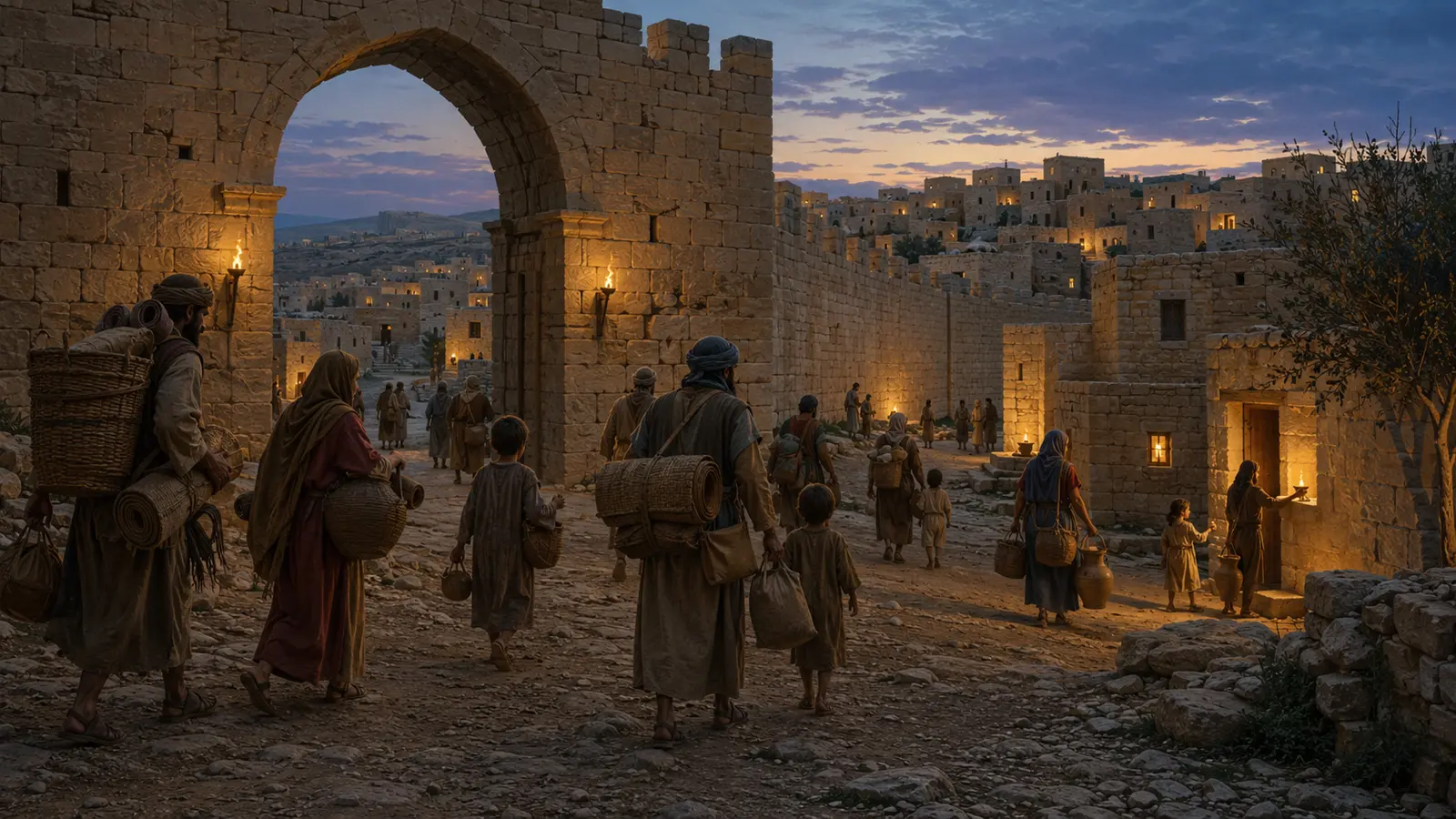
The wall is finished, the covenant is signed, and the city stands ready. But Jerusalem still needs people willing to live inside the promise. Stones can mark a holy city, but homes, tables, children, songs, and daily faithfulness must fill it. The rebuilt wall now waits for embodied obedience.
01
Introduction
There is a difference between loving a city from a distance and moving into it. There is a difference between applauding renewal and carrying its cost. Many people can celebrate a rebuilt wall; fewer are willing to inhabit the vulnerable place where the future must be lived.
Nehemiah 11 comes after the covenant renewal of Nehemiah 10. The people have heard Scripture, confessed sin, signed a covenant, and pledged not to neglect the house of God. Now the question becomes practical: Who will live in Jerusalem?
The city is called holy, but it is underpopulated. The walls stand, but the streets need households. The gates are repaired, but daily life must return inside them. The covenant must become more than ink on parchment; it must become bodies in neighborhoods, worship in rhythms, families in houses, and servants in their appointed places.
This text is about covenant commitment becoming inhabited faithfulness, because God’s restored city needs people willing not only to sign the promise, but to live inside its costly calling.
Nehemiah 11 may seem like another list of names, towns, and duties. But beneath the list is a living theology of presence. God is not rebuilding Jerusalem as a museum of sacred memory. He is forming a community where worship, work, leadership, song, service, and ordinary households bear witness to his covenant mercy.
02
Historical and Literary Context
Nehemiah 11 belongs to the closing movement of Nehemiah’s restoration narrative. The wall has been completed [Neh. 6:15]. The city has been guarded and ordered [Neh. 7:1–4]. The people have gathered around the Torah [Neh. 8], confessed their sins through the long memory of God’s mercy [Neh. 9], and entered into a written covenant pledge [Neh. 10]. Now the restored city must be populated.
Earlier, Nehemiah observed that Jerusalem was “wide and large,” but “the people within it were few, and no houses had been rebuilt” [Neh. 7:4]. This problem now receives attention. The leaders live in Jerusalem, and the rest of the people cast lots so that one out of ten may live in the holy city, while the remaining nine live in other towns [Neh. 11:1]. Some also willingly offer themselves to live in Jerusalem, and the people bless them [Neh. 11:2].
The chapter then lists residents of Jerusalem from Judah, Benjamin, priests, Levites, gatekeepers, and others [11:3–24], followed by people living in towns and villages throughout Judah and Benjamin [11:25–36]. The point is not merely census information. The text is showing a restored social and worship order. Jerusalem must be inhabited, but the surrounding towns also matter. God’s people are gathered in the city and scattered in the land.
Within Ezra–Nehemiah, this chapter continues the theme of partial restoration. The city has walls, but needs people. The people have covenant vows, but need lived obedience. The temple has service, but needs ordered personnel. Restoration is becoming visible, yet the deeper transformation remains under question.
Nehemiah 11 teaches that renewal is not complete when the walls are built or the covenant is signed. Renewal must move into addresses, occupations, neighborhoods, worship assignments, and daily habits. The holy city must become a lived city.
03
Walking Through the Text
When Leaders Live in the Holy City [Nehemiah 11:1]
The chapter begins: “Now the leaders of the people lived in Jerusalem” [Neh. 11:1]. This is a quiet but important statement. Leaders go first. They do not merely direct others into the hard place; they inhabit it themselves.
Jerusalem is called “the holy city” [11:1]. This phrase is not ornamental. Jerusalem is holy because it is set apart in relation to God’s name, temple, covenant story, and worship. But holiness here is not abstract. It must be inhabited. The city needs people whose lives correspond to its calling.
The rest of the people cast lots to bring one out of ten to live in Jerusalem. Casting lots in Scripture is a way of discerning or accepting divine ordering in communal decisions [Prov. 16:33]. The arrangement suggests both necessity and surrender. Jerusalem needs population, but no one seizes the decision merely through personal preference. The community submits the matter to ordered process under God.
The holy city is not filled by romance alone. It requires responsibility.
When Willingness Becomes Worthy of Blessing [Nehemiah 11:2]
Verse 2 adds a beautiful detail: “And the people blessed all the men who willingly offered to live in Jerusalem.” Alongside those chosen by lot, there are volunteers. They freely offer themselves for the city’s life.
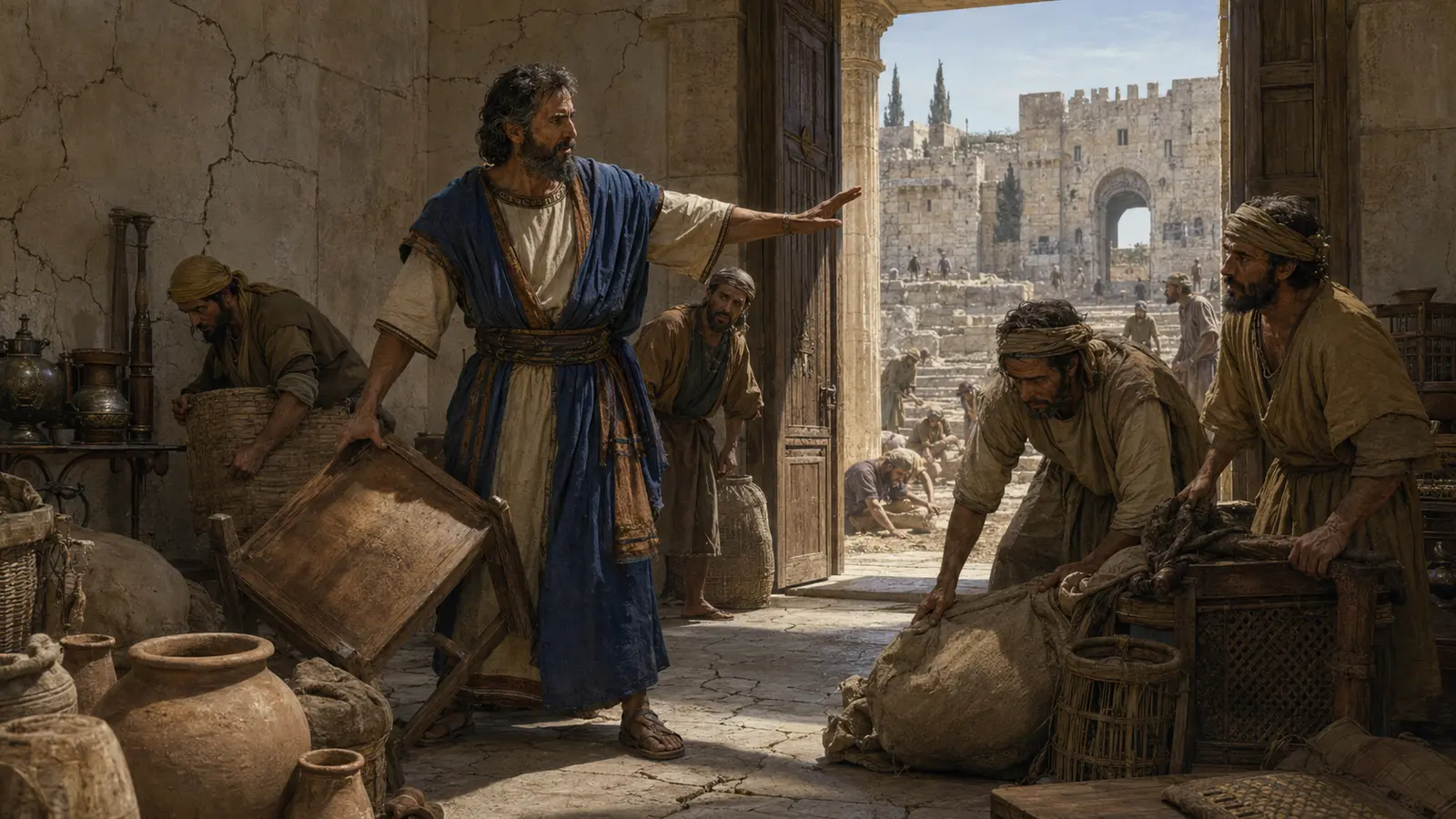
This willingness is costly. Living in Jerusalem may bring honor, but it also brings danger and burden. The city has recently been vulnerable. Opposition has not vanished. Houses must be rebuilt. Life inside the walls may require sacrifice, relocation, and exposure.
So the people bless them. They recognize that willing service should be honored. In God’s restoration work, there are people who do not wait to be forced, assigned, or pressured. They step forward because they see the need.
The blessing of the volunteers shows that covenant renewal needs willing hearts. Systems can assign duties, but love offers itself. Lots can distribute responsibility, but grace awakens generosity.
When Names Turn a City into a People [Nehemiah 11:3–9]
The list of residents begins with “the chiefs of the province who lived in Jerusalem” [Neh. 11:3]. The text names people from Judah and Benjamin, connecting the restored city to Israel’s covenant tribes and post-exilic identity.
From Judah, we hear of Athaiah and Maaseiah, whose ancestry is carefully traced [11:4–6]. From Benjamin, we hear of Sallu and others [11:7–9]. The list is not only administrative. It is an act of memory. The city is not filled by anonymous bodies but by remembered families.
In a post-exilic context, names matter. Exile dislocates. Empire reduces people to labor, tax categories, and displaced populations. But Scripture keeps naming. It resists erasure. These are not faceless settlers. They are sons and daughters within a story God has preserved.
The list also shows that restoration requires actual presence. It is not enough to admire Jerusalem’s significance. Someone must live there. Someone must light fires in houses, raise children near the gates, walk the streets, and make the holy city a habitation rather than a symbol.
When Priests and Levites Serve the House of God [Nehemiah 11:10–18]
The chapter then names priests who live in Jerusalem, including Jedaiah, Jachin, Seraiah, and others [Neh. 11:10–14]. Their responsibilities are connected to “the house of God” [11:11, 12]. This recalls the pledge of Nehemiah 10: “We will not neglect the house of our God” [Neh. 10:39]. Now that vow becomes personnel, service, and daily order.
Levites are also named, including Shemaiah, Shabbethai, Jozabad, Mattaniah, Bakbukiah, and Abda [Neh. 11:15–17]. Mattaniah is described as one who was “the leader of the praise, who gave thanks” [11:17]. This is a lovely phrase. Among the rebuilt walls, someone must lead thanksgiving.
The city needs more than guards and governors. It needs singers. It needs worship leaders. It needs people whose vocation is to help the community remember God’s mercy in song.
The number of Levites in the holy city is given as 284 [11:18]. Again, the detail emphasizes ordered worship. The renewed city is not merely political space. It is a worshiping space. The house of God must remain central, not as a decorative shrine, but as the heartbeat of communal identity.
When Gatekeepers Guard the Thresholds [Nehemiah 11:19–24]
The gatekeepers Akkub, Talmon, and their brothers are named, 172 in number [Neh. 11:19]. Gatekeepers have appeared several times in Nehemiah. They protect thresholds, regulate access, and help maintain order. A rebuilt city needs watchful servants at its entrances.
The chapter also mentions the rest of Israel, the priests, and Levites living in all the towns of Judah, each in his inheritance [11:20]. This balances the focus on Jerusalem. The holy city matters, but the wider land matters too. God’s people are not only called to central worship but also to faithful life in scattered towns.
Temple servants live on Ophel, and overseers are named [11:21–22]. There is even reference to the king’s command concerning the singers and their daily duty [11:23]. This shows how Persian imperial structures still frame aspects of Jewish life. The people are restored, but not fully free. They are home, yet still within empire.
Pethahiah is described as being “at the king’s side in all matters concerning the people” [11:24]. Again, the returned community lives in the tension between covenant identity and imperial administration. This is restoration, but not the full kingdom hope.
When the Land Around the City Also Matters [Nehemiah 11:25–36]
The final section lists villages and fields where people of Judah and Benjamin live [Neh. 11:25–36]. The geography stretches beyond Jerusalem into towns, settlements, and rural life.
This matters theologically. God’s restoration is not confined to the city center. The surrounding villages, fields, and households belong to the covenant story. Jerusalem is the holy city, but everyday faithfulness must also inhabit the land.
The list reminds us that not everyone is called to live in the same place or serve in the same way. Some live in Jerusalem. Others live in towns. Some serve in the temple. Others cultivate fields. Some guard gates. Others lead praise. Covenant faithfulness is distributed across many locations and vocations.
The holy city needs inhabitants, but the whole land needs witnesses.
04
Theological Reflection
Restoration Must Be Inhabited
Nehemiah 11 teaches that rebuilding is not complete until people live inside the restored space. Walls without inhabitants are only architecture. Covenants without daily obedience are only documents. Worship without households becomes thin.
God’s work moves from structure to habitation. This is a biblical pattern. God creates a garden and places humans there [Gen. 2:8, 15]. God instructs Israel to build a tabernacle so he may dwell among them [Exod. 25:8]. God’s presence fills the temple [1 Kgs. 8:10–11]. In the gospel, the Word becomes flesh and dwells among us [John 1:14]. In the new creation, God dwells with his people [Rev. 21:3].
Restoration is always moving toward holy presence.
Willing Sacrifice Sustains Covenant Community
The volunteers in Nehemiah 11 are blessed because they willingly offer themselves to live in Jerusalem. Their willingness reveals a central truth: communities are not renewed by spectators. They are renewed by people who offer themselves.
Every generation needs servants willing to inhabit hard places, repair neglected spaces, and bear the cost of communal faithfulness. The holy city does not remain alive through admiration from afar. It needs embodied commitment.
Worship Needs Order, People, and Daily Faithfulness
Priests, Levites, singers, gatekeepers, and temple servants fill the chapter. This shows that worship requires ordered service. Praise does not happen in a vacuum. Someone must prepare, lead, guard, organize, teach, sing, and support the house of God.
The covenant pledge not to neglect God’s house becomes real through assigned people doing daily work. Faithfulness is often less dramatic than crisis leadership but just as essential.
Jerusalem Is Rebuilt, but the Larger Hope Still Waits
Nehemiah 11 calls Jerusalem the holy city, but the chapter also reminds us that the people still live under Persian rule. The king’s command and representatives remain part of the story. The city is inhabited, but the kingdom has not fully come.
This tension points forward. The prophets imagined Jerusalem as a center of renewed worship and blessing for the nations [Isa. 2:2–4; Zech. 8:20–23]. Nehemiah’s Jerusalem is a real step in that direction, but not the completion. The deeper fulfillment comes in Jesus, who embodies God’s presence, gathers a renewed people, and sends them as a living temple into the world [John 2:19–21; Eph. 2:19–22; 1 Pet. 2:4–10].
05
Life Application
Move from admiration to inhabitation. Do not only celebrate renewal from a distance. Ask where God is calling you to live the commitment.
Bless willing servants. Communities should honor those who quietly offer themselves for costly, necessary work.
Let leaders go first. Faithful leadership inhabits responsibility before asking others to carry it.
Take ordinary service seriously. Singers, gatekeepers, servants, and households all matter in God’s restored community.
Do not neglect the house of God. Worship requires time, people, resources, planning, and faithful presence.
Serve where you are assigned. Some are called to the city, others to the villages. Faithfulness is not sameness.
Make covenant visible in daily life. Let your home, work, neighborhood, and schedule become places where obedience takes up residence.
06
Reflection Questions
1. Where have you admired God’s work from a distance without offering yourself to participate?
2. What costly place, role, or responsibility might God be inviting you to inhabit?
3. Who in your community needs to be blessed for quietly offering themselves in service?
4. Are you treating worship as something that “just happens,” or are you helping sustain it through faithful service?
5. What would it mean for your covenant commitments to take up residence in your daily habits, home, and neighborhood?
07
Response Prayer
Lord God of heaven, Builder of the holy city, Gatherer of names, and Keeper of covenant mercy, teach us to live inside the promises we have made.
Do not let us only admire the wall. Call us into the city. Do not let us only sign the covenant. Teach us to inhabit obedience. Do not let us only bless the work from afar. Make us willing servants in the place of need.
Give us leaders who go first, singers who keep gratitude alive, gatekeepers who guard with wisdom, families who fill the streets with faithfulness, and ordinary workers whose daily obedience becomes worship.
Show each of us our appointed place. Whether in the city or the village, at the gate or in the house, in public service or hidden labor, make our lives a dwelling place for your presence.
Through Jesus Christ, the Word who dwelt among us, the true temple, and the Lord who builds his people into a holy habitation, Amen.
08
Window into What Comes Next
Nehemiah 11 fills the city with names, households, leaders, priests, Levites, singers, gatekeepers, and servants. Covenant begins to take up residence. But the story now moves from habitation to celebration.
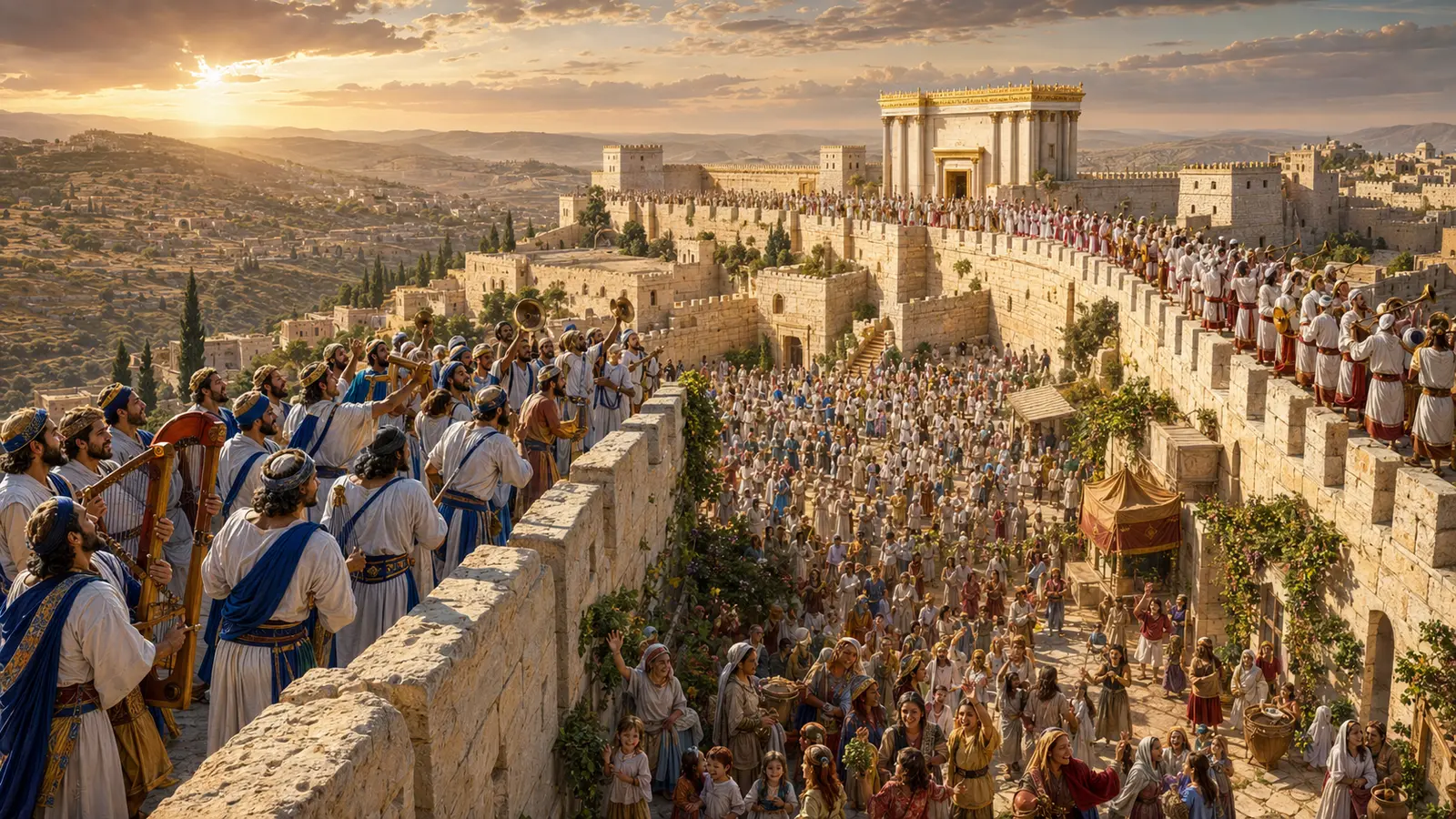
In Nehemiah 12, the wall will be dedicated with processions, choirs, sacrifices, and great joy. The city that once sat in shame will learn to sing around its repaired boundaries.
The movement continues: covenant becomes habitation, habitation becomes worship, and worship turns rebuilt walls into public praise.
The people have entered the city. Next, the city will lift its voice.
09
Bibliography
Boda, Mark J. Praying the Tradition: The Origin and Use of Tradition in Nehemiah 9. Berlin: de Gruyter, 1999.
Clines, David J. A. Ezra, Nehemiah, Esther. New Century Bible Commentary. Grand Rapids: Eerdmans, 1984.
Kidner, Derek. Ezra and Nehemiah. Tyndale Old Testament Commentaries. Downers Grove: InterVarsity Press, 1979.
Throntveit, Mark A. Ezra-Nehemiah. Interpretation. Louisville: John Knox Press, 1992.
Williamson, H. G. M. Ezra, Nehemiah. Word Biblical Commentary 16. Waco: Word Books, 1985.
Williamson, H. G. M. Ezra and Nehemiah. Old Testament Guides. Sheffield: JSOT Press, 1987.
Yamauchi, Edwin M. “Ezra-Nehemiah.” In The Expositor’s Bible Commentary, revised edition. Grand Rapids: Zondervan, 2010.
Be the first to leave a comment.