


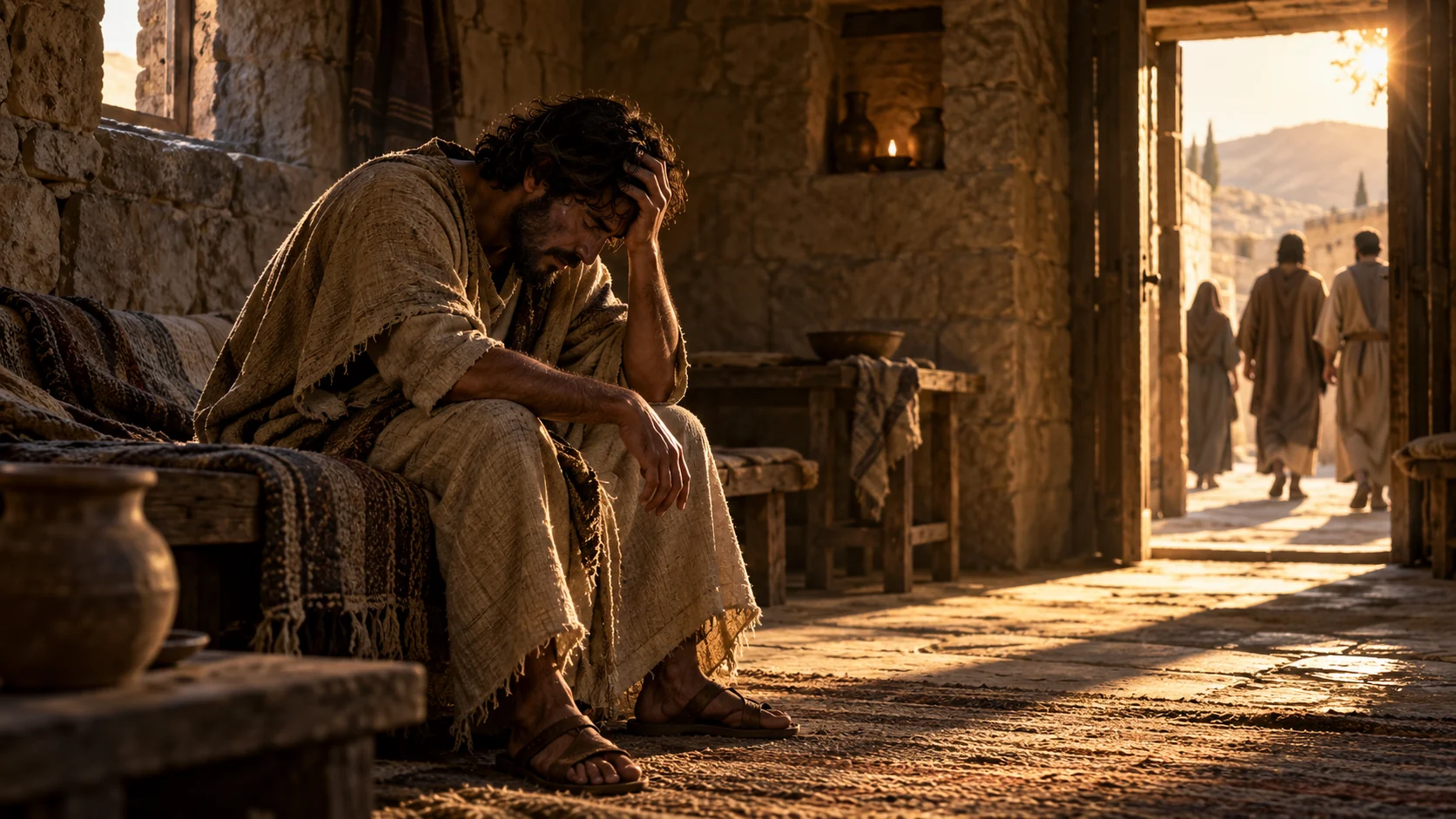
When Morning Becomes a Watchtower Before the city wakes, a wounded voice rises. Before the arguments begin, prayer is set in order. Falsehood may already be moving through the streets, but the faithful heart turns toward the King and watches.
01
1.0 Introduction: What Do You Do When Lies Wake Up Before You Do?
Some mornings begin before the sun. The body rises, but the mind is already surrounded by accusations, unfinished conflicts, and fears about what people may say next. Psalm 5 brings that crisis of truth, reputation, justice, and danger into God’s presence.
The enemies are dangerous chiefly through speech. Their mouths cannot be trusted; their throats are compared to open graves; their tongues are smooth while their hearts move toward destruction. The temptation is obvious: answer propaganda with propaganda, manipulation with manipulation, or rage with rage. David chooses another strategy. He speaks first to God.
This text is about threatened speech becoming watchful prayer, because the faithful answer to a campaign of lies is not to become another liar, but to place our words before the true King and wait for his way.
Psalm 5 is not passive. The worshiper asks for judgment, guidance, protection, and joy, yet refuses to become judge and propagandist. Before enemies define reality, Yahweh is “my King and my God.”
02
2.0 Historical and Literary Context: Dawn in the Opening Struggle of the Psalter
Psalms 1–2 introduce the Torah-shaped righteous person and Yahweh’s anointed king. Psalms 3–14 place those ideals inside conflict. Psalm 5 belongs to this movement, where the persecuted Davidic figure becomes a model of prayer.
Psalm 4 ends with sleep: the worshiper lies down in peace because Yahweh makes him dwell securely. Psalm 5 opens at morning. The night of surrender becomes the dawn of renewed dependence.
The psalm moves through prayer (vv. 1–3), God’s opposition to evil (vv. 4–6), worship and guidance (vv. 7–8), judgment of deceit (vv. 9–10), and the joy of those who take refuge in God (vv. 11–12).
03
3.0 Walking Through the Text
04
3.1 Psalm 5:1–3 — When Prayer Is Arranged Before the Day
The psalm begins with words, inward sighing, and a cry for help. God is asked to hear what is spoken and what is scarcely speakable. Prayer includes sentences, but also the pressure beneath them.
Then comes the grounding confession: “my King and my God.” David may be a king, but he begins the day by placing his authority under another throne. The person under attack does not need to seize ultimate control because the King is already present.
Verse 3 repeats “in the morning.” Its language can suggest arranging an offering or setting out a case. The final verb, “watch,” belongs to sentries and prophets looking for the first sign of God’s answer.
Prayer is therefore not throwing anxious words into the air. It is laying the case before God and taking up a watchpost.
05
3.2 Psalm 5:4–6 — When Holiness Gives No Guest Room to Falsehood
Yahweh does not delight in wickedness; evil cannot lodge with him; arrogance cannot stand before his eyes; falsehood and bloodthirsty deceit meet his opposition.
These lines sound severe until we remember what evil speech can do: destroy reputation, livelihood, community, even life. Scripture knows this pattern from Naboth to the false witnesses against Jesus.
God’s holiness is therefore good news for victims of lies. Yet the psalmist claims no moral perfection: verse 7 grounds his approach in God’s covenant love.
06
3.3 Psalm 5:7–8 — When Mercy Opens the House and Straightens the Road
“But I, through the abundance of your steadfast love, will enter your house.” The contrast with the wicked is sharp, but access rests on mercy. The threatened worshiper does not merely ask to be proved right; he bows. Vindication is secondary to worship.
Then the imagery moves from sanctuary to road: “Lead me in your righteousness because of my enemies; make your way straight before me.” Under attack, David does not ask only, “Remove them.” He asks, “Lead me.” Enemies create a moral danger as well as a physical one. Their deceit can tempt the righteous into crooked strategies.
The answer to crooked speech is not merely successful defense. It is a straight path.
07
3.4 Psalm 5:9–12 — When an Open Grave Meets an Encircling Shield
Verse 9 anatomizes deceit: mouth, heart, throat, tongue. The throat is “an open grave,” an image Paul later includes in Romans 3:13 when he argues that sin is not confined to somebody else’s enemies. The accusation ultimately circles back toward every human heart.
Verse 10 asks God to declare the attackers guilty, let their plans collapse, and drive them out because their rebellion is finally against God. This is difficult language, but its direction matters. The psalmist hands judgment upward rather than turning prayer into permission for private revenge.
The final movement becomes larger than the conflict: “Let all who take refuge in you rejoice.” The lonely voice of verse 1 discovers a community. God covers those who trust him, and verse 12 ends with favor surrounding the righteous like a large shield.
The psalm begins with threatening voices all around. It ends with God all around.
08
4.0 Theological Reflection
First, prayer is an alternative to reactive power. Psalm 5 teaches us to speak to God before we speak from fear.
Second, God’s holiness and mercy belong together. The God who rejects deceit is also the God whose abundant covenant love allows the worshiper to enter. Justice without mercy would crush us; mercy without justice would abandon victims.
Third, speech is spiritual action. Mouths can become graves and tongues can become weapons. Truthfulness is therefore not a minor virtue; it is part of covenant faithfulness.
Fourth, blessing is more than survival. Psalm 5 ends with refugees rejoicing under God’s favor—restoration to worshipful life.
09
5.0 Canonical and Christological Horizon
The Bible’s story of destructive speech begins in Genesis 3, where the serpent twists God’s words. Later, false witnesses become tools of injustice, as in Naboth’s murder.
Jesus enters that story as the faithful Israelite and true Davidic King. He begins days in prayer (Mark 1:35), refuses the tempter’s deceptive path, and later stands before false witnesses whose testimony cannot agree (Mark 14:55–59). He does not answer deceit by becoming deceitful. He carries faithful witness all the way to the cross.
The cross deepens Psalm 5’s prayer for judgment. Jesus exposes evil yet prays for enemies. Resurrection becomes God’s verdict that violent falsehood will not have the final word.
Romans 3 uses Psalm 5:9 to describe humanity’s shared bondage to sin. Christians therefore cannot use this psalm merely to label outsiders as liars. Before praying against deceptive speech, we must allow God to judge our own mouths. In Christ, the church is called to become a truth-speaking people whose words give life rather than open graves.
10
6.0 Life Application
1. Pray before you reply. When a hurtful message, accusation, or rumor arrives, resist the urge to answer immediately. Put the matter before God first.
2. Name God’s kingship before naming your enemies. Begin difficult mornings with “my King and my God.”
3. Examine your own speech. Ask whether your words clarify truth, flatter for advantage, exaggerate failure, or quietly damage reputation.
4. Seek a straight path, not merely a winning strategy. Refuse methods that contradict the character of the God whose help you seek.
5. Bring anger to God instead of turning it into vengeance. Lament allows strong requests while leaving final judgment in God’s hands.
6. Protect communities from lethal speech. Churches should take slander and false accusation seriously while using fair processes that protect both victims and the wrongly accused.
7. Watch after you pray. Look for wisdom, correction, courage, providential openings, and the next faithful step.
11
7.0 Reflection Questions
1. What accusation or unresolved conversation most often reaches my mind first in the morning?
2. Where am I tempted to fight crooked speech with crooked methods?
3. What does my recent speech reveal about what is happening in my heart?
4. Am I seeking God mainly to defeat an opponent, or also asking him to lead me in his straight way?
5. Who needs the protection of a truth-speaking, refuge-giving community around them right now?
12
8.0 Response Prayer
Yahweh, my King and my God, hear my words and the sighs I cannot explain. At the beginning of this day, I set my fears, accusations, anger, and unanswered questions before you. Keep falsehood from taking root in my mouth. Lead me in your righteousness when pressure tempts me toward crooked paths. Judge what destroys, protect the vulnerable, and surround all who take refuge in you with faithful favor. Through Jesus, the faithful King, make my words truthful, my worship humble, and my eyes watchful for your way. Amen.
13
9.0 Window into What Comes Next
Psalm 5 rises at dawn and watches for God. Psalm 6 moves into a darker room, where prayer is mixed with bodily weakness, fear, tears, and the aching question, “How long?” The watchman has learned to bring words to God; next, the sufferer must discover whether God also hears when words are almost drowned by weeping.
14
10.0 Bibliography
BibleProject. The Book of Psalms: Study Notes. BibleProject.
BibleProject. Visual Commentary: Psalm 8 Study Notes. BibleProject.
Goldingay, John. Psalms, Volume 1: Psalms 1–41. Baker Commentary on the Old Testament Wisdom and Psalms. Grand Rapids: Baker Academic, 2006.
Kidner, Derek. Psalms 1–72. Kidner Classic Commentaries. Downers Grove, IL: IVP Academic, 2008.
Wright, N. T. How God Became King: The Forgotten Story of the Gospels. New York: HarperOne, 2012.

Be the first to leave a comment.