


When Restlessness Becomes Trust Evening gathers around unfinished questions. Honor trembles, anger whispers, and people ask where good can still be found. Yet beneath the light of God’s face, a restless heart learns to sleep.
01
1.0 Introduction: What Do You Do with a Restless Heart at Night?
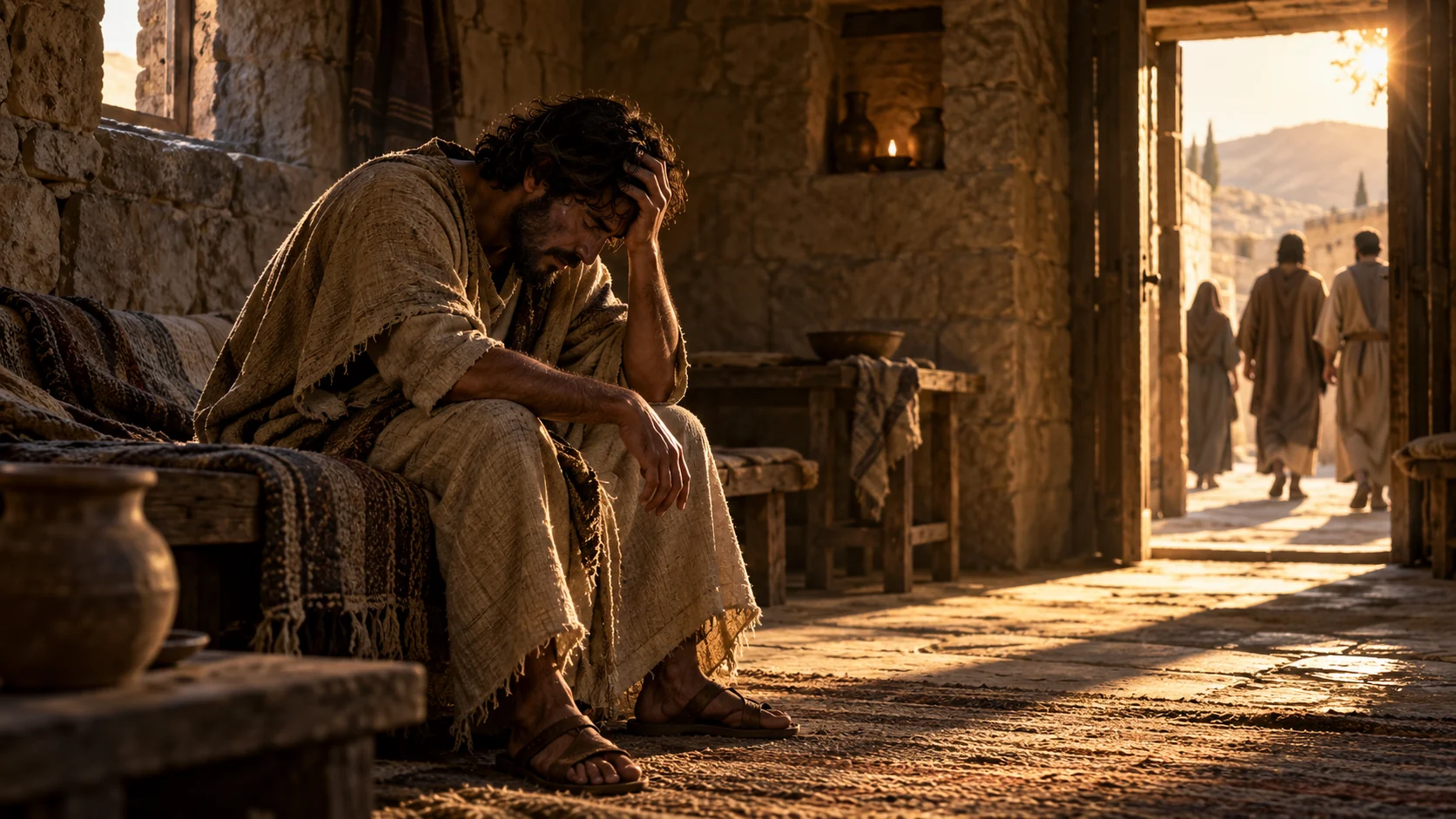
Night enlarges what the day left unresolved. A harsh conversation replays, reputation feels fragile, and anxiety grows louder in the dark. Psalm 4 enters that territory. It is often called an evening prayer because it ends with sleep, but its deeper subject is how to become inwardly quiet while life is still unsettled.
The psalmist faces people who turn honor into shame, love emptiness, and pursue falsehood. Around him are voices asking, “Who will show us good?” He prays from pressure and misunderstanding while others seek security somewhere other than Yahweh.
This text is about restlessness becoming trust, because biblical peace is not the absence of unresolved problems; it is the heart learning where its final security lies.
Psalm 4 moves from pressure to spaciousness, from reactive anger to silence, from anxious comparison to joy, and finally from wakefulness to rest.
02
2.0 Historical and Literary Context: An Evening Prayer Beside a Troubled King
Psalm 4 belongs to the opening Davidic collection. Psalms 1–2 introduce the righteous person and God’s anointed king; Psalms 3–14 place that royal hope inside conflict. BibleProject notes that David and the afflicted repeatedly seek refuge while surrounded by opponents. Psalm 4 fits the pattern: honor is attacked, falsehood circulates, and “many” question where good can be found.
Psalm 3 and 4 are close companions. Both mention calling, “many” voices, honor, and sleep. Psalm 3 can be heard at morning—“I lay down and slept; I woke again”—while Psalm 4 moves toward evening—“In peace I will lie down and sleep.” Absalom’s rebellion may stand in the background, but the language serves many seasons of slander, fear, and frustration.
The poem addresses God (v. 1), turns toward troubled people (vv. 2–5), then returns to God in confidence (vv. 6–8). Prayer surrounds confrontation.
03
3.0 Walking Through the Text
04
3.1 Psalm 4:1 — When a Tight Place Needs Room
The prayer begins urgently: “Answer me when I call.” The speaker addresses God as the God of his righteousness, or, in Goldingay’s rendering, his “faithful God.” Prayer is anchored in God’s character.
The verse contrasts a narrow place with spaciousness. Distress presses inward; deliverance makes room. Kidner highlights this movement from constriction to enlargement. Anxiety likewise narrows the mind until one problem seems to fill everything. Prayer reopens the horizon. Yet the psalmist still asks for grace: covenant confidence never eliminates dependence on mercy.
05
3.2 Psalm 4:2–3 — When Human Shame Meets Divine Recognition
The psalmist turns toward people who dishonor what should be honored. They love emptiness and seek falsehood—perhaps through slander, deceptive promises, false security, or substitutes for Yahweh. They are giving weight to what cannot finally carry them.
Verse 3 answers their verdict with God’s verdict: Yahweh has set apart the faithful person for himself and hears when that person calls. Public reputation and divine recognition are not identical. A crowd can misread a life, and a rumor can outrun truth. The “faithful” person is not claiming perfection; the Hebrew idea points toward covenant loyalty, a life oriented toward Yahweh.
06
3.3 Psalm 4:4–5 — When Anger Is Not Given the Throne
Verse 4 can mean “Be angry and do not sin” or “Tremble and do not sin.” Either way, strong emotion is acknowledged but restrained. The agitated person is sent to a quiet place: speak within your heart on your bed, and be still.
Before anger becomes retaliation, a cruel word, or a message sent too quickly, let it pass through silence. Paul later echoes the line in Ephesians 4:26. Scripture neither denies anger nor permits it to rule. Verse 5 then moves to worship: offer right sacrifices and trust Yahweh. Goldingay observes that true worship requires coherence between the altar and the life of the worshiper. Vindication must be entrusted to God.
07
3.4 Psalm 4:6–7 — When “Who Will Show Us Good?” Finds an Answer
“Many are saying, ‘Who will show us good?’” It is an enduring question: which leader, economy, relationship, opportunity, possession, or spiritual power can secure our future?
The psalmist answers with language recalling Israel’s priestly blessing: “Let the light of your face shine on us” (Num. 6:24–26). He asks not merely for better circumstances but for God’s favorable presence.
God has put more joy in his heart than others have when grain and wine increase. This is not contempt for material provision. The issue is its place. Circumstances can give pleasure, but they cannot carry the full weight of the soul. The speaker has discovered joy before the harvest changes.
08
3.5 Psalm 4:8 — When Peace Arrives Before the Problem Is Solved
The poem ends in bed: “In peace I will both lie down and sleep.” The critics may not have apologized and questions may remain, yet the speaker can sleep because Yahweh alone makes him dwell securely—unafraid.
Psalm 3 showed faith waking in the morning; Psalm 4 shows faith surrendering the night. Together they teach a daily rhythm: God sustains when we wake, and God remains God when we release an unfinished day.
09
4.0 Theological Reflection
First, God’s presence is the deepest meaning of “good.” Grain and wine are good, but not ultimate. The light of God’s face is the gift beneath every other gift.
Second, divine recognition can steady a shamed identity. Reputation matters, but it cannot replace God’s knowing. When public opinion becomes a courtroom, Psalm 4 reminds us that the final Judge is also the covenant Lord who hears.
Third, anger must be transformed before it becomes action. Biblical faith is not emotional numbness. It creates space in which anger can be named, examined, quieted, and surrendered instead of weaponized.
Fourth, peace is not a prosperity formula. Faithfulness does not guarantee more grain, more wine, or fewer problems. God himself becomes stable ground beneath unstable circumstances.
10
5.0 Canonical and Christological Horizon
Psalm 4 reaches backward to the Aaronic blessing of Numbers 6, where God’s shining face signifies favor, presence, and peace. Across Scripture, the longing for “good” is finally a longing for life under God’s blessing, not merely for gifts detached from the Giver.
Within the Psalter, Psalm 4 joins the portrait of the afflicted Davidic king who trusts Yahweh while misunderstood. That pattern leads toward Jesus without making every line a direct prediction. Jesus, the faithful Son of David, endured false accusation and public shame. In Gethsemane he brought anguish to the Father; resurrection became God’s vindication of the rejected King.
Jesus gives his disciples peace in a troubled world rather than immediate escape from it (John 14:27). His peace forms people who can refuse retaliation, pursue justice, and still rest their identity in God.
The biblical story ends with the desire Psalm 4 voices: God’s servants “will see his face” in the new creation (Rev. 22:4). The prayer for the light of God’s face moves toward a world where divine presence is enjoyed without obstruction.
11
6.0 Life Application
1. Name the narrow place. Tell God specifically what is making life feel cramped rather than hiding behind vague religious language.
2. Separate reputation from identity. Correct lies when wisdom requires it, but do not let another person’s verdict become your final definition.
3. Give anger a quiet interval. Before responding to provocation, create space to pray, reflect, and become silent before God.
4. Make worship truthful. Do not offer religious activity while protecting bitterness, deception, or revenge.
5. Ask what “good” means to you. Notice which outcome you secretly believe must happen before life can be good again.
6. Receive material gifts without worshiping them. Enjoy provision gratefully, but refuse to measure God’s favor only by money, health, or visible success.
7. Practice evening surrender. Name unfinished tasks and consciously return them to God before sleep.
12
7.0 Reflection Questions
1. What unresolved pressure becomes loudest in me when the day grows quiet?
2. Whose opinion has gained more authority over my identity than God’s recognition?
3. Where is anger asking me to act before wisdom has had time to speak?
4. What form of “grain and wine” am I tempted to treat as proof that God is good—or absent?
5. What would it look like tonight to entrust one unfinished problem to Yahweh and truly rest?
13
8.0 Response Prayer
Yahweh, when my world feels narrow, give me room in your mercy. When voices turn honor into shame, root my identity in your knowing. Meet my anger before it becomes harm; teach me to be still, worship truthfully, and trust you with vindication. Let the light of your face be better than the success I envy. Put your joy within me, and when night comes, teach me to release what I cannot finish. You alone are my safety. Give me peace to lie down without pretending every problem is solved. Through Jesus, the faithful and risen King, amen.
14
9.0 Window into What Comes Next
Psalm 4 closes with the worshiper lying down in peace. Psalm 5 opens at dawn: “In the morning you hear my voice.” The night has been surrendered, but the new day brings fresh decisions about truth, justice, enemies, worship, and guidance. Peace is not the end of discipleship; it prepares the heart to rise and walk faithfully again.
15
10.0 Bibliography
BibleProject. The Book of Psalms: Study Notes. BibleProject.
BibleProject. Visual Commentary: Psalm 8 Study Notes. BibleProject.
Goldingay, John. Psalms, Volume 1: Psalms 1–41. Baker Commentary on the Old Testament Wisdom and Psalms. Grand Rapids: Baker Academic, 2006.
Kidner, Derek. Psalms 1–72. Kidner Classic Commentaries. Downers Grove, IL: IVP Academic, 2008.
Wright, N. T. How God Became King: The Forgotten Story of the Gospels. New York: HarperOne, 2012.

Be the first to leave a comment.