

When Fear Becomes Trust The throne has vanished behind the hill, enemies multiply in the dark; yet beneath the shadow of the Shield, a hunted king lies down—and wakes.
01
1.0 Introduction: Can You Rest When Everything Is Falling Apart?
There are nights when the body is tired but the mind refuses to sleep. Betrayal, illness, debt, family conflict, or public humiliation can grow larger in the dark. Psalm 3 enters that kind of night. David is not praying from a quiet palace. The heading places him on the road, fleeing from Absalom, his own son, while enemies say that even God has abandoned him.
Yet the most startling line is not, “How many are my foes?” It is, “I lay down and slept; I woke again, for Yahweh sustained me” (Ps. 3:5). Sleep becomes theology. David cannot control the army, the city, or tomorrow, but he can entrust his vulnerable body to God for one night.
This text is about fear becoming trust, because biblical faith does not deny the enemies around us; it learns to sleep beneath the shield of God.
Psalm 3 neither calls danger imaginary nor makes faith emotional invulnerability. It teaches us to name the threat, remember God’s character, and return the outcome to him.
02
2.0 Historical and Literary Context: The Anointed King on the Run
Psalm 3 is the first prayer after the doorway of Psalms 1–2. Psalm 1 portrays the Torah-shaped righteous one. Psalm 2 announces Yahweh’s anointed king established on Zion despite raging nations. Then Psalm 3 shocks us: the king is surrounded, mocked, and apparently displaced. The decree of Psalm 2 has not removed conflict; it becomes the ground on which faith must stand inside conflict.
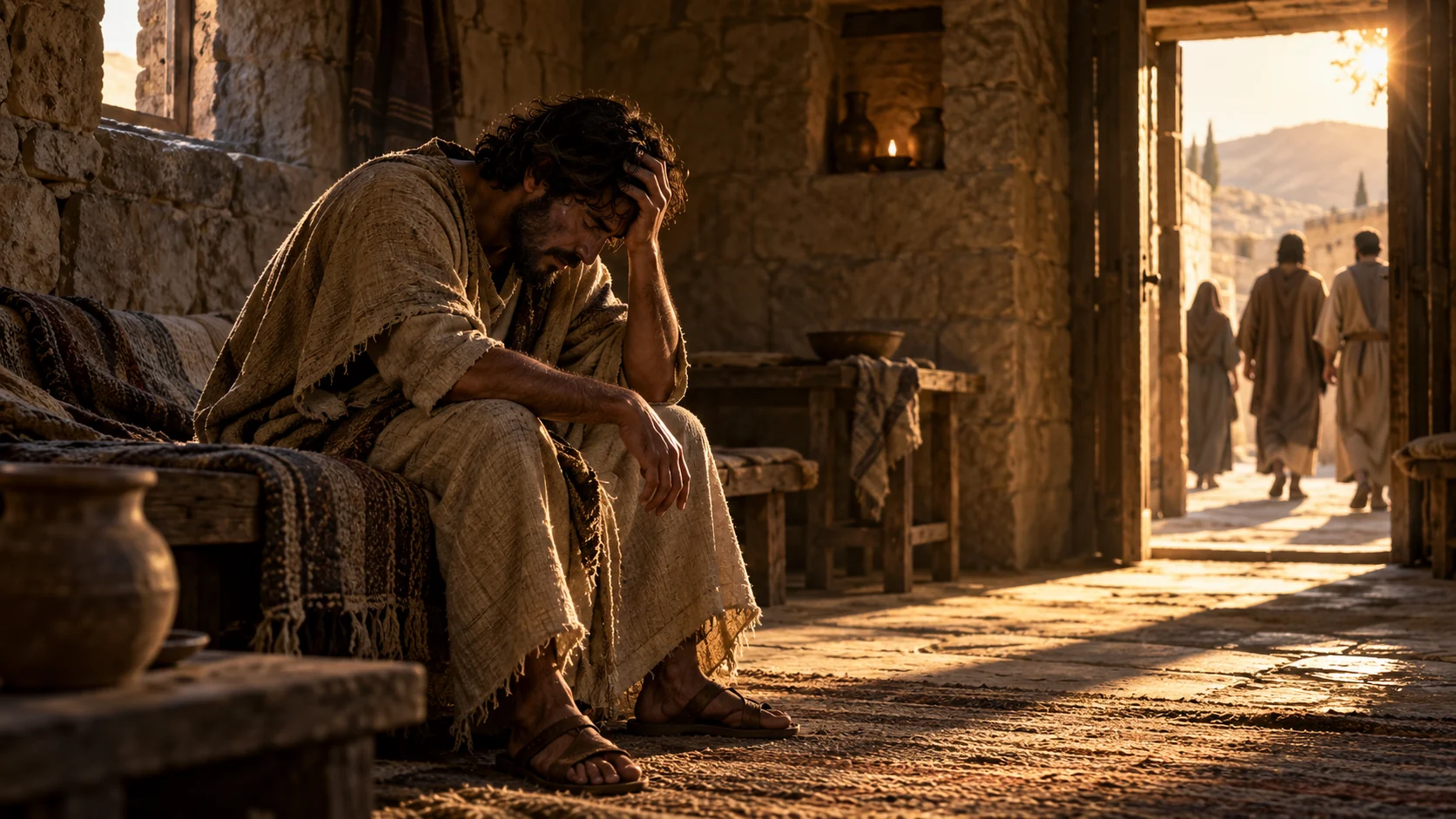
The superscription connects the poem with David’s flight from Absalom in 2 Samuel 15–18. His authority is collapsing, but the rebellion is also a family wound. David leaves Jerusalem weeping with his head covered (2 Sam. 15:30), while Shimei later interprets his suffering as divine judgment (16:5–8). The heading therefore makes betrayal, shame, and contested kingship the atmosphere of the prayer.
Literarily, Psalm 3 moves from lament (vv. 1–2), to trust (vv. 3–6), to plea and confidence (vv. 7–8). BibleProject reads Psalms 3–7 as portraits of persecuted David whose dependence on Yahweh becomes a model for later generations. This is a prayer school for people whose circumstances seem to contradict God’s promise.
03
3.0 Walking Through the Text
04
3.1 Psalm 3:1–2 — When the Crowd Says God Has Left You
The psalm begins with multiplication: many adversaries, many rising up, many voices. Fear often works through arithmetic. David is not merely outnumbered; he is being interpreted publicly: “There is no salvation for him in God.”
That accusation reaches deeper than, “You will lose.” It says, “God will not come for you.” The charge stings because David is not innocent of every failure. Yet he does not trust a spotless résumé; he throws himself on God’s covenant faithfulness.
Shame can turn real failure into a final verdict: You have sinned, therefore God has finished with you. Psalm 3 distinguishes conviction from condemnation. God can correct his people without declaring grace impossible.
05
3.2 Psalm 3:3–4 — When God Becomes the Shield Around You
Verse 3 pivots on two words: “But you.” The crowd has spoken; David now speaks to Yahweh. He names God as “a shield around me,” “my glory,” and “the lifter of my head.”
A handheld shield protects one direction, but David’s image is larger: Yahweh surrounds him. His security is not the absence of enemies but God’s presence. Though public honor has collapsed, “my glory” says dignity does not finally come from office or applause. Yahweh lifts the bowed head.
When David cries, God answers “from his holy hill.” Psalm 2 has just named Zion as the place of Yahweh’s king. David may be far from Jerusalem, but a rebel can occupy the capital without occupying heaven’s throne.
06
3.3 Psalm 3:5–6 — When Sleep Becomes an Act of Trust
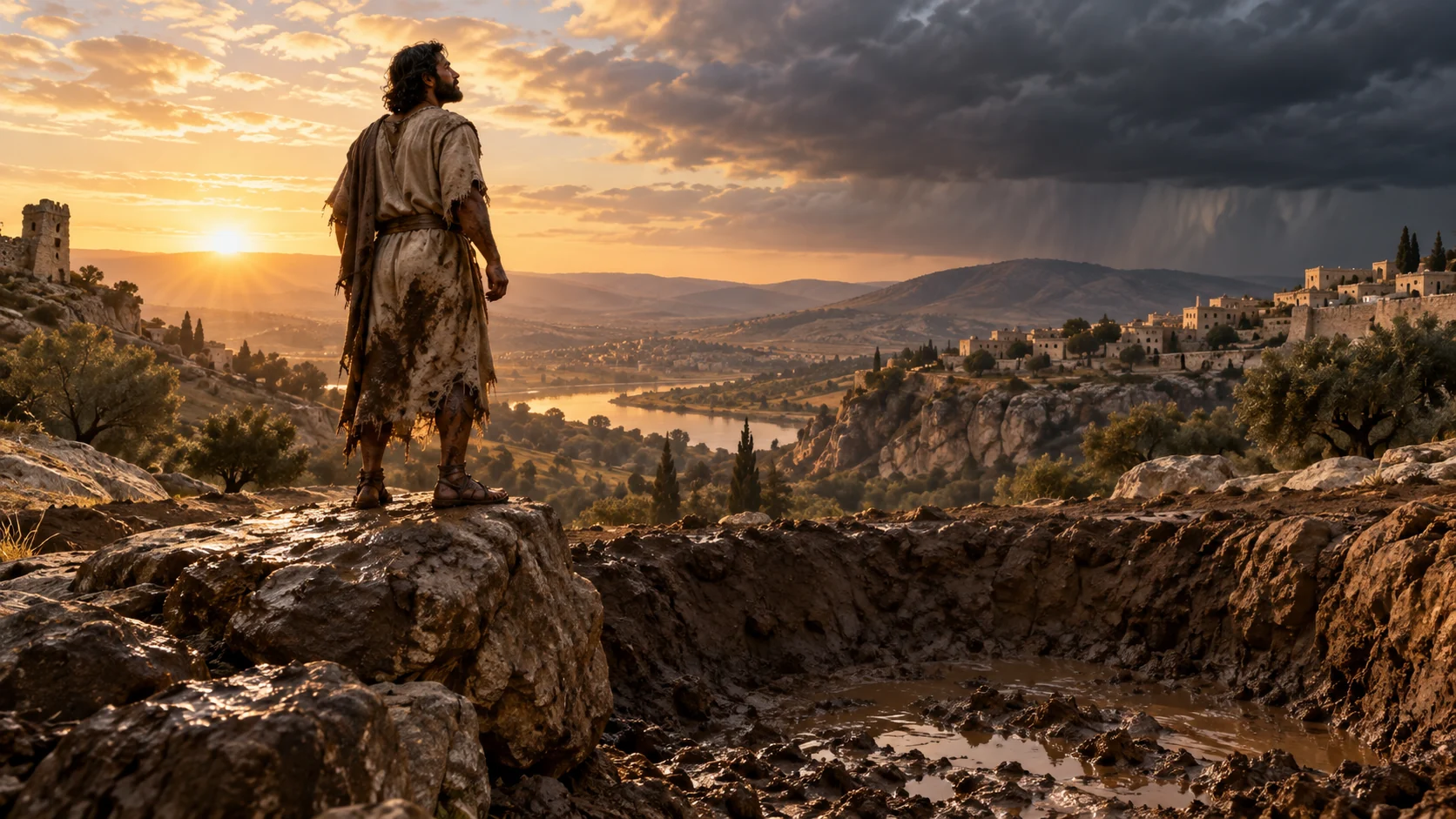
Then the psalm grows quiet: “I lay down and slept; I woke again.” There is no battle scene between those verbs. David simply sleeps.
Sleep requires surrender. For several hours we stop guarding the world. In danger, sleep can become a bodily confession: God remains awake when I do not. David wakes to discover that Yahweh has sustained him. The enemies remain; the location of his confidence has changed.
This is not a promise that every believer will escape violence or illness. The Psalms know loss and death. The point is that life is upheld by God, not by our control; and in the larger biblical story, death will not have the final word.
07
3.4 Psalm 3:7–8 — When Deliverance Becomes Bigger Than Me
The prayer becomes direct: “Arise, Yahweh; save me, my God!” The language about striking the jaw and breaking teeth is fierce. In the poem’s world, enemies are like predators whose ability to devour must be broken. The request is not permission for worshipers to become violent; it is an appeal for God to stop destructive power.
The final verse widens the horizon: “Salvation belongs to Yahweh; your blessing be on your people.” The psalm that began with my enemies ends with your people. Royal rescue is not private; God’s deliverance is meant to overflow as blessing.
08
4.0 Theological Reflection
First, faith speaks truth to fear without lying about danger. David counts the enemies before naming the shield. Biblical trust is reality interpreted in God’s presence.
Second, God’s presence gives an identity deeper than public shame. “My glory” means the crowd’s verdict is not ultimate. Titles, followers, and approval cannot carry the weight of identity; God must.
Third, rest can be an act of resistance. Psalm 3 teaches creaturely trust: we work, pray, repent, act wisely—and then we sleep.
Fourth, salvation is communal. God does not rescue us merely for private comfort; he restores people so they can become instruments of peace, justice, worship, and protection.
09
5.0 Canonical and Christological Horizon
Psalm 3 is not a direct prediction of Jesus, but it contributes to the Psalter’s portrait of the suffering Davidic king. Psalm 2 announces the anointed son; Psalm 3 shows the king rejected and surrounded. The New Testament finally identifies Jesus as David’s true heir whose kingship is revealed through suffering, death, and resurrection.
Jesus entered Jerusalem’s conflict by trusting the Father. Mocked and abandoned, he was treated as one from whom God’s favor had departed. Resurrection overturned the crowd’s verdict: the rejected King was vindicated.
Psalm 3:5 is not a coded prediction of resurrection. Yet its rhythm of lying down and waking gains deeper resonance in the completed biblical story. Jesus entrusts himself to the Father through death and is raised; even the grave lies within God’s saving reach.
Under the light of the cross, the violent imagery cannot license retaliation. We ask God to break the “teeth” of lies, injustices, addictions, and powers that devour human life, while learning from the crucified Messiah to love enemies and overcome evil with good (Matt. 5:44; Rom. 12:21).
10
6.0 Life Application
1. Name the threat before God. Do not spiritualize fear into silence. Bring what is actually frightening you into prayer.
2. Challenge condemning voices. Ask whether an accusation is God’s conviction leading toward repentance, or shame declaring that grace is no longer available.
3. Build a “But you, Lord” practice. After naming what is wrong, name what is true about God—his presence, mercy, justice, faithfulness, and power.
4. Recover sleep as creaturely trust. End the day, when possible, by returning unfinished problems to God rather than rehearsing them through the night.
5. Do not confuse public rejection with divine rejection. Losing status, influence, or approval does not prove that God has abandoned you.
6. Pray for evil to be disarmed, not for your heart to become cruel. Ask God to stop what devours people while refusing hatred as your method.
7. Let rescue become service. When God sustains you, ask whose head you can help lift and whose burden you can help carry.
11
7.0 Reflection Questions
1. Which voice in my life most often tells me, “God will not help you here”?
2. Where has public opinion become more important to me than God as “my glory”?
3. What unfinished burden do I need to return to God so that I can rest?
4. When I pray against evil, am I asking for justice or feeding my desire for revenge?
5. How could God’s sustaining grace in my life become a blessing for other people?
12
8.0 Response Prayer
Yahweh, when voices multiply around me and fear multiplies within me, be the shield around what I cannot defend. When shame bends my head, remind me that you are my glory and the lifter of my head. Teach me to repent where I have sinned without believing the lie that mercy has ended. Give me courage to work while it is day and humility to sleep when night comes. Break the power of what devours your children, guard me from becoming like the violence I fear, and let every rescue you give me become blessing for your people. Through Jesus, the rejected and risen King, hold me until morning. Amen.
13
9.0 Window into What Comes Next
Psalm 3 wakes in the morning; Psalm 4 will teach us how to lie down at night. The enemies remain, but the hunted king has discovered that God sustains him through darkness. The next prayer asks whether that same trust can quiet the heart when evening returns.
14
10.0 Bibliography
BibleProject. The Book of Psalms: Study Notes. BibleProject.
BibleProject. Visual Commentary: Psalm 8 Study Notes. BibleProject.
Goldingay, John. Psalms, Volume 1: Psalms 1–41. Baker Commentary on the Old Testament Wisdom and Psalms. Grand Rapids: Baker Academic, 2006.
Kidner, Derek. Psalms 1–72. Kidner Classic Commentaries. Downers Grove, IL: IVP Academic, 2008.
Wright, N. T. How God Became King: The Forgotten Story of the Gospels. New York: HarperOne, 2012.
Be the first to leave a comment.