

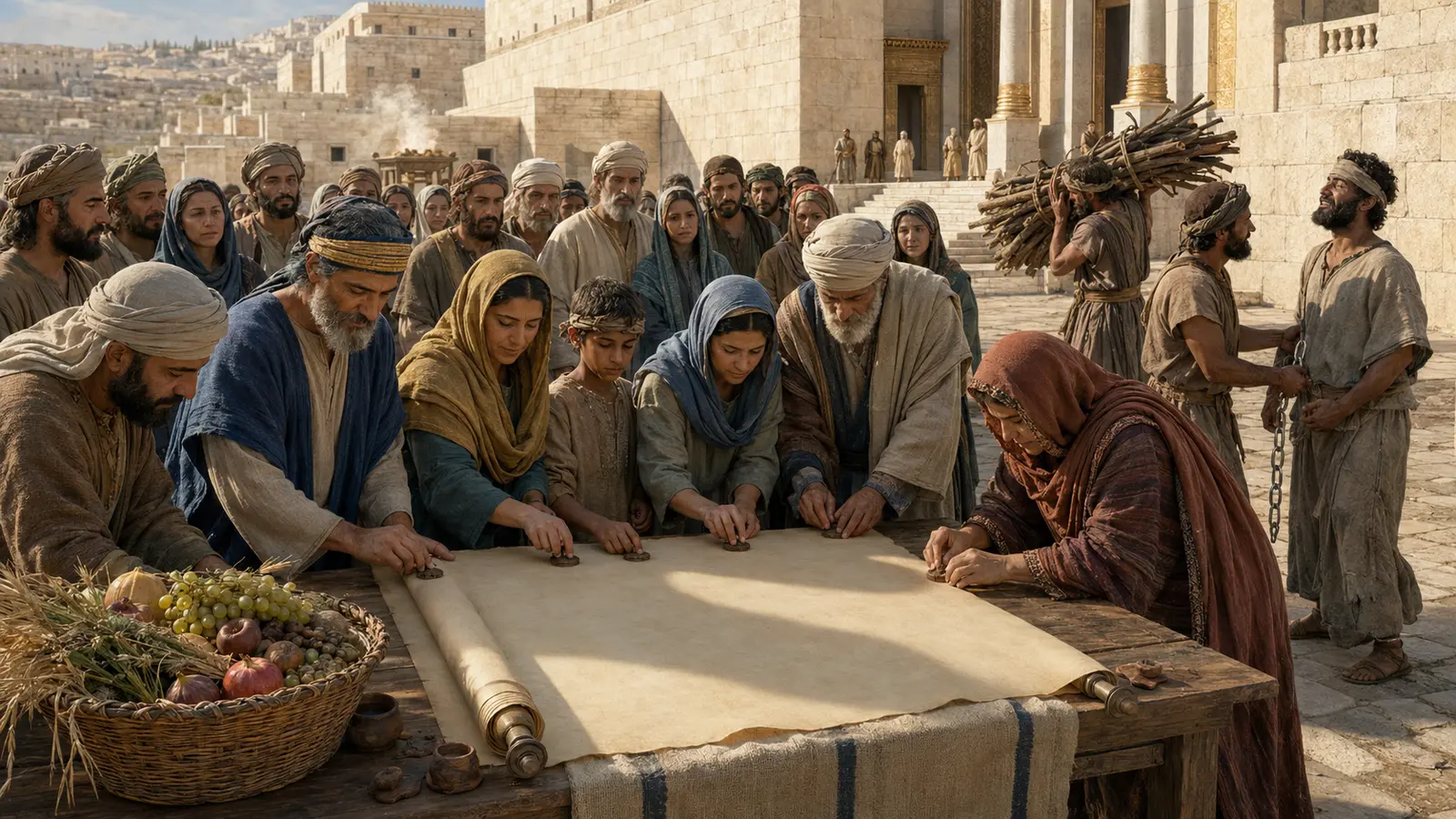
The people have wept, remembered, and confessed. Now they take the next trembling step: they sign their names. Repentance moves from lips to life, from prayer to pledge, from sorrow to Sabbath, from memory to money, from public worship to daily obedience. Yet ink can mark a covenant, but only God can write faithfulness on the heart.
01
Introduction
There is a kind of confession that remains beautiful but unfinished. It tells the truth, sheds tears, names sin, and remembers mercy—but never becomes a changed life. Nehemiah 10 refuses that shallow ending. After the great prayer of Nehemiah 9, the people make “a firm covenant in writing” [Neh. 9:38]. Their names are sealed. Their obligations are named. Their repentance becomes concrete.
This chapter is not dramatic in the way Nehemiah 4 or 6 is dramatic. No enemies are shouting. No swords are drawn. No wall is rising. But Nehemiah 10 contains a quieter drama: the struggle to let worship become obedience.
This chapter asks a searching question: What must change when God’s Word has been heard, sin has been confessed, and mercy has been remembered?
This text is about confession becoming embodied obedience, because covenant renewal is not complete until worship reshapes family, Sabbath, money, justice, and the house of God.
Nehemiah 10 teaches that renewal must become specific. It must enter marriage decisions, weekly rhythms, economic practices, temple support, offerings, and communal responsibility. Yet the chapter also leaves us with a sober ache. The people sign the covenant sincerely, but later chapters will show that human vows alone cannot rebuild the heart. The ink is real, but Israel still needs the Spirit who writes God’s law within.
02
Historical and Literary Context
Nehemiah 10 continues the covenant-renewal movement of Nehemiah 8–10. In chapter 8, the people gathered around the public reading of the Torah. They understood, wept, rejoiced, shared food, and celebrated the Feast of Booths. In chapter 9, they gathered again in fasting, sackcloth, and confession. They retold Israel’s long story: creation, Abraham, Exodus, Sinai, wilderness rebellion, land, prophets, judgment, and God’s enduring mercy.
Now confession becomes commitment. The chapter begins with a list of those who seal the written covenant [Neh. 10:1–27], then summarizes the wider community’s participation [10:28–29], and finally names concrete obligations [10:30–39]. The movement is important: names, community, oath, practices.
The content of the pledge centers on three broad areas: covenant identity, Sabbath economics, and temple support. The people commit not to intermarry with surrounding peoples [10:30], not to conduct trade on the Sabbath or holy days [10:31], to observe the sabbatical year and release debts [10:31], and to support the temple through taxes, wood offerings, firstfruits, firstborn offerings, and tithes [10:32–39].
Within Ezra–Nehemiah, these commitments answer the very struggles that have marked the returned community. Ezra confronted intermarriage in Ezra 9–10. Nehemiah confronted economic exploitation in Nehemiah 5. Later, Nehemiah 13 will show failures in Sabbath observance, temple support, and marriage faithfulness. Nehemiah 10 is therefore both hopeful and fragile. The people know what faithfulness requires, but knowing and signing are not the same as enduring transformation.
Theologically, this chapter shows that return from exile must become covenant life. The people are not restored merely by geography, walls, or ceremonies. They must become a community whose daily practices bear witness that they belong to the Lord.
03
Walking Through the Text
When Names Are Sealed Before God [Nehemiah 10:1–27]
The chapter opens with names. Nehemiah the governor is first, followed by priests, Levites, and leaders of the people [Neh. 10:1–27]. This list may feel like a slow doorway, but it matters. Covenant renewal is not anonymous. Real people take public responsibility before God.
The leaders seal the document, representing the wider community. Their names become visible signs of accountability. They are saying, in effect, “We stand under this Word. We accept this covenant obligation. We will not let confession remain only a prayer.”
This list also reminds us that leadership in God’s community must be covenantal before it is administrative. Leaders are not merely managers of a project. They are first servants under God’s command. Nehemiah’s name at the beginning is fitting. The man who prayed, wept, inspected, organized, resisted opposition, confronted injustice, and rebuilt the wall now stands under the same covenant as the people.
The wall did not place Nehemiah above obedience. Success did not exempt him from surrender.
When the Whole Community Enters the Oath [Nehemiah 10:28–29]
After the leaders’ names, the chapter widens: “The rest of the people, the priests, the Levites, the gatekeepers, the singers, the temple servants…” join with their brothers and enter into a curse and oath to walk in God’s Law [Neh. 10:28–29]. Men, women, sons, and daughters who have knowledge and understanding are included.
This echoes Nehemiah 8, where all who could understand gathered to hear the Law. Covenant renewal is not only for elites. It involves the worshiping body: priests, workers, singers, servants, households, and children who can understand.
The phrase “curse and oath” is serious. It recalls the covenant structure of Deuteronomy, where obedience and disobedience carry covenant consequences [Deut. 28–30]. The people are not merely making inspirational resolutions. They are placing themselves under the solemn obligations of the covenant.
The heart of the oath is “to walk in God’s Law.” Walking suggests embodied life. The Torah is not only to be read, explained, admired, or celebrated. It is to become a road under their feet. Scripture becomes covenant path.
When Covenant Identity Touches the Household [Nehemiah 10:30]
The first specific commitment concerns marriage: “We will not give our daughters to the peoples of the land or take their daughters for our sons” [Neh. 10:30]. This must be read carefully. The concern in Ezra–Nehemiah is not biological superiority or ethnic hatred. The deeper concern is covenant faithfulness and idolatrous assimilation.
Israel’s earlier story had shown how marriages tied to foreign gods could pull the community away from the Lord [Deut. 7:3–4; 1 Kgs. 11:1–8]. In the fragile post-exilic community, marriage decisions carried spiritual consequences for worship, children, inheritance, and identity.
Yet Ezra–Nehemiah also sits within the wider biblical story that includes Rahab, Ruth, and foreigners who join themselves to the Lord [Josh. 2; Ruth 1–4; Isa. 56:3–8]. Therefore, the issue is not the rejection of outsiders as outsiders, but the protection of covenant worship from compromise.
The household is the first named arena of obedience. Renewal must enter family formation, generational discipleship, and the loves that shape the future.
When Sabbath Resists the Marketplace [Nehemiah 10:31]
The second commitment concerns Sabbath and holy days. If the peoples of the land bring goods or grain to sell on the Sabbath, the people pledge not to buy [Neh. 10:31]. They also commit to forego crops in the seventh year and release debts.
Here covenant renewal enters economics. Sabbath is not merely private rest. It is public resistance to a world where buying and selling never stop. To keep Sabbath is to say that Israel’s life is governed by God’s rhythm, not by endless production and consumption.
The seventh-year practice points back to sabbatical instructions in the Torah [Exod. 23:10–11; Lev. 25:1–7; Deut. 15:1–2]. Land, debt, labor, and mercy all belong under God’s rule. The people are pledging that restoration will not be measured only by rebuilt walls, but by reordered time and economic justice.
This is especially meaningful after Nehemiah 5, where debt and exploitation wounded the poor. Sabbath and debt release are not decorative rituals. They protect the community from becoming another Egypt.
When Worship Requires Shared Support [Nehemiah 10:32–34]
The people then obligate themselves to give a yearly contribution for the service of the house of God [Neh. 10:32–33]. This will support the bread of the Presence, regular grain offerings, burnt offerings, Sabbaths, new moons, appointed feasts, holy things, sin offerings, and the work of the temple.
The temple cannot function on emotion alone. Worship requires material faithfulness. Lamps need oil. Priests need provision. Offerings require resources. Sacred rhythms need communal support.
They also cast lots for the wood offering [10:34]. This may seem small, but it is deeply practical. The altar fire required wood. Without wood, sacrifices stop. Without ordinary provisions, public worship collapses.
Nehemiah 10 dignifies the practical side of worship. Someone must bring wood. Someone must give silver. Someone must organize. Someone must sustain the rhythms that keep the community centered on God.
When Firstfruits Teach the Heart to Put God First [Nehemiah 10:35–39]
The final section emphasizes firstfruits, firstborn offerings, and tithes. The people pledge to bring the firstfruits of the ground and trees, the firstborn of sons and livestock, and the tithes of the land to support the Levites and temple service [Neh. 10:35–39].
Firstfruits are theology in agricultural form. They declare that the harvest is gift before it is possession. The first and best belong to God because all things come from him. Giving becomes a practice of memory: “We are not self-made. We live by mercy.”
The Levites, in turn, are to bring a tithe of the tithes to the house of God [10:38]. The structure of giving includes accountability. Everyone, including religious servants, stands under ordered faithfulness.
The chapter ends with a strong statement: “We will not neglect the house of our God” [10:39]. This is the summary heartbeat of the pledge. The returned community knows that neglect of worship leads to spiritual decay. The temple stands, but its service must be sustained.
And yet the ending is bittersweet. Later, Nehemiah will find the house of God neglected [Neh. 13:10–11]. The vow is right, but the heart remains weak. The chapter’s final sentence becomes both promise and warning.
04
Theological Reflection
Renewal Must Become Specific
Nehemiah 10 refuses vague spirituality. The people do not merely say, “We will do better.” They name concrete areas: marriage, Sabbath, debt, offerings, wood, firstfruits, tithes, and temple support.
This teaches us that repentance becomes real when it becomes particular. General devotion must become shaped habits. Love for God must enter calendar, wallet, family, table, and community responsibilities.
Covenant Obedience Is Communal
The chapter emphasizes leaders, priests, Levites, gatekeepers, singers, temple servants, men, women, sons, and daughters. The whole community stands under the Word. Faithfulness is not outsourced to clergy.
God forms a people, not isolated religious consumers. Everyone has a place in sustaining covenant life.
Worship and Justice Belong Together
The commitments to Sabbath, debt release, and temple support show that worship cannot be separated from economic life. The God who receives offerings also cares about debt, rest, labor, and the poor.
A community that sings but exploits has not understood covenant. A community that gives offerings but ignores Sabbath mercy has not understood restoration. Nehemiah 10 binds worship to justice and justice to worship.
Human Vows Reveal the Need for a New Heart
Nehemiah 10 is sincere and necessary, but it is not final. The people sign the covenant, but by Nehemiah 13 many of these very commitments are broken. This does not make the pledge meaningless. It reveals the limitation of external reform.
The chapter creates longing for the new covenant promised by Jeremiah and Ezekiel, where God writes his law on the heart and gives his Spirit so that obedience flows from inward renewal [Jer. 31:31–34; Ezek. 36:26–27]. The people put ink on parchment; God must put faithfulness in the heart.
05
Life Application
Make repentance specific. Do not stop with “Lord, forgive me.” Ask what concrete practice must change.
Let Scripture shape your household. Covenant faithfulness must touch relationships, marriage, parenting, discipleship, and family habits.
Recover Sabbath resistance. Refuse to let the marketplace define your whole life. Practice rest, worship, mercy, and trust.
Address debt and economic mercy. Ask whether your financial practices reflect redemption or deepen bondage.
Support the worshiping community. Do not neglect the practical needs that sustain ministry, teaching, worship, and care.
Give first, not leftovers. Firstfruits train the heart to remember that everything begins as gift.
Ask God for more than vows. Make commitments, but also pray for the Spirit to write obedience deeper than willpower.
06
Reflection Questions
1. What confession in your life needs to become a specific act of obedience?
2. Where does your household need clearer covenant formation and spiritual direction?
3. How is Sabbath shaping—or not shaping—your weekly rhythm and economic choices?
4. Are there financial habits in your life that reflect fear, greed, neglect, or mercy?
5. What would it mean for you to say honestly, “We will not neglect the house of our God”?
07
Response Prayer
Lord God of covenant mercy, we have heard your Word, we have confessed our sin, and now we ask for grace to walk in your ways.
Do not let our repentance remain only words. Let it enter our homes, our calendars, our money, our Sabbath, our generosity, and our worship.
Teach us to give you firstfruits, not leftovers. Teach us to rest as people who trust you. Teach us to practice justice with the poor, faithfulness in our families, and responsibility in your house.
Forgive us for vows made quickly and forgotten quietly. Forgive us for signing with our lips while withholding our hearts.
Write your law within us. Give us your Spirit. Make obedience not merely ink on paper, but love alive in the heart.
Through Jesus Christ, the faithful covenant-keeper, the true temple, and the Lord who makes his people new, Amen.
08
Window into What Comes Next
Nehemiah 10 ends with a vow: “We will not neglect the house of our God.” The people have pledged themselves to covenant-shaped life. But a city needs more than vows; it needs people willing to inhabit its calling.
In Nehemiah 11, the focus shifts to repopulating Jerusalem. Some will live in the holy city by lot, and others will willingly offer themselves. The covenant must now take up residence in streets, homes, neighborhoods, and daily life.
The movement continues: confession becomes covenant, covenant becomes practice, and practice must become embodied community.
The people have signed their names. Now they must live inside the promise.
09
Bibliography
Boda, Mark J. Praying the Tradition: The Origin and Use of Tradition in Nehemiah 9. Berlin: de Gruyter, 1999.
Clines, David J. A. Ezra, Nehemiah, Esther. New Century Bible Commentary. Grand Rapids: Eerdmans, 1984.
Kidner, Derek. Ezra and Nehemiah. Tyndale Old Testament Commentaries. Downers Grove: InterVarsity Press, 1979.
Throntveit, Mark A. Ezra-Nehemiah. Interpretation. Louisville: John Knox Press, 1992.
Williamson, H. G. M. Ezra, Nehemiah. Word Biblical Commentary 16. Waco: Word Books, 1985.
Williamson, H. G. M. Ezra and Nehemiah. Old Testament Guides. Sheffield: JSOT Press, 1987.
Yamauchi, Edwin M. “Ezra-Nehemiah.” In The Expositor’s Bible Commentary, revised edition. Grand Rapids: Zondervan, 2010.
Be the first to leave a comment.