

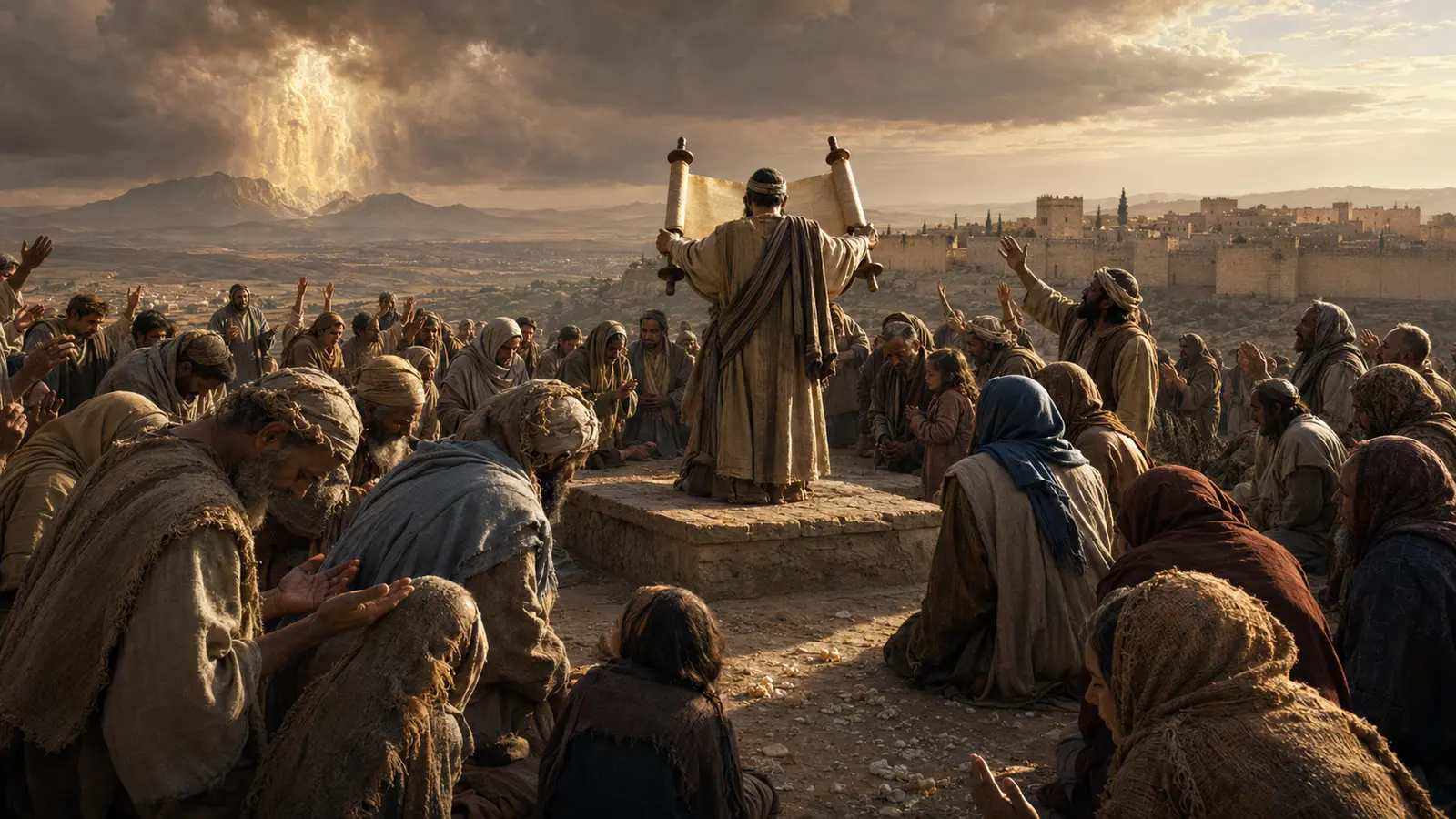
The people stand with dust on their heads and Scripture in their ears. They do not begin confession by staring only at their failure. They begin by remembering the God who created, called, delivered, fed, forgave, warned, gathered, and remained faithful when his people did not. Their sin is real, but mercy has the longer memory.
01
Introduction
There are moments when a community must stop pretending and tell the truth. Not the truth in fragments. Not the truth shaped to protect reputation. Not the truth that blames ancestors while excusing the present. The full truth. The long truth. The truth of God’s goodness and human rebellion standing side by side.
Nehemiah 9 comes after the joy of Nehemiah 8. The people have heard the Law, understood it, wept, rejoiced, shared food, and celebrated the Feast of Booths. But joy has not removed the need for confession. The Word that strengthened them now leads them deeper. They gather with fasting, sackcloth, and earth on their heads. They read Scripture again. Then they confess—not only personal sin, but the long covenant failure of their people.
This chapter asks a searching question: How do God’s people confess sin without losing hope?
This text is about joy becoming truthful confession, because lasting renewal requires a people to remember both the mercy of God and the rebellion of the human heart.
Nehemiah 9 is one of the Bible’s great historical prayers. It retells Israel’s story from creation, Abraham, Exodus, Sinai, wilderness, land, judges, kings, prophets, exile, and present distress. But this is not history for curiosity. It is history as worship. It is memory turned into repentance. It is theology on its knees.
02
Historical and Literary Context
Nehemiah 9 belongs to the spiritual-renewal movement of Nehemiah 8–10. In chapter 8, Ezra read the Law publicly, the Levites gave the sense, and the people responded with both tears and holy joy. They then celebrated the Feast of Booths, remembering God’s wilderness provision. Now, on the twenty-fourth day of the same month, the people gather again for confession [Neh. 9:1].
The timing matters. The seventh month was filled with sacred remembrance [Lev. 23]. The people have reenacted part of Israel’s wilderness story through the Feast of Booths. Now they interpret their present condition through the whole covenant story. They are back in the land, but not fully free. They live under Persian rule. The land produces fruit, but much of its benefit goes to foreign kings [Neh. 9:36–37]. Return has happened, but exile’s shadow still lies across their life.
Literarily, the chapter has two main parts. Verses 1–5 describe the assembly: fasting, separation, reading the Law, confession, worship, and the Levites calling the people to bless the Lord. Verses 6–37 contain the long prayer, moving through Israel’s history and repeatedly contrasting God’s faithfulness with Israel’s unfaithfulness. Verse 38 then forms the transition toward the covenant pledge of chapter 10.
The prayer is deeply scriptural. It echoes Genesis, Exodus, Numbers, Deuteronomy, Joshua, Judges, Kings, Chronicles, and the prophets. The people are learning to see themselves inside the biblical story. Their confession is not vague guilt; it is covenant memory.
Within the larger Ezra–Nehemiah narrative, this chapter reveals the book’s central ache. God has brought his people home, but their hearts still need rebuilding. Walls can be finished. Festivals can be celebrated. But unless the people face the old pattern of rebellion, their restoration remains fragile.
03
Walking Through the Text
When Joy Leads to Honest Mourning [Nehemiah 9:1–3]
The people gather with fasting, sackcloth, and earth on their heads [Neh. 9:1]. These are outward signs of grief, humility, and repentance. The joy of chapter 8 was not shallow celebration. It has opened the door to deeper truth.
The Israelites separate themselves from foreigners and stand confessing their sins and the iniquities of their fathers [9:2]. This separation should be read within the covenant concerns of Ezra–Nehemiah, where identity, worship, and obedience are under pressure. The point is not ethnic pride but covenant clarity. The people are asking who they are before God and what faithfulness now requires.
They spend a quarter of the day reading from the Book of the Law and another quarter confessing and worshiping [9:3]. Scripture and confession belong together. The Word reveals the truth; confession answers the truth. Worship prevents confession from collapsing into despair, because the God who exposes sin is also the God whose mercy sustains the story.
When Worship Begins with the Creator [Nehemiah 9:4–6]
The Levites call the people to stand and bless the Lord from everlasting to everlasting [Neh. 9:5]. Before they rehearse Israel’s sin, they bless God’s name. This is important. Biblical confession begins not with self-hatred but with worship.
The prayer opens with creation: “You are the LORD, you alone. You have made heaven, the heaven of heavens, with all their host, the earth and all that is on it” [9:6]. The God of Israel is not a tribal deity trapped in one city. He is Creator of heaven and earth. The heavenly hosts worship him. All life depends on him.
This opening places Israel’s story inside the larger story of creation. The God who called Abraham is the God who made all things. The God who brought exiles home is the God who sustains the cosmos. Confession is therefore made before the Lord of everything.
When Covenant Begins with Grace [Nehemiah 9:7–8]
The prayer moves from creation to Abraham. God chose Abram, brought him out of Ur, gave him the name Abraham, found his heart faithful, and made a covenant to give the land to his offspring [Neh. 9:7–8].
The emphasis is on God’s initiative. God chose. God brought. God named. God covenanted. God fulfilled. Israel’s story begins in grace before it ever becomes command. Covenant obedience is always a response to prior mercy.
The prayer says, “You have kept your promise, for you are righteous” [9:8]. God’s righteousness here means covenant faithfulness. He does what he said. He keeps the promise even when generations stumble. The people confess from inside a story held together by God’s reliability.
When Exodus Mercy Meets Wilderness Rebellion [Nehemiah 9:9–21]
The prayer then retells the Exodus. God saw affliction in Egypt, heard the cry at the Red Sea, performed signs against Pharaoh, divided the sea, and led his people by cloud and fire [Neh. 9:9–12]. The language echoes Israel’s foundational redemption story [Exod. 1–15].
Then comes Sinai. God came down, spoke from heaven, gave right rules, true laws, good statutes, commandments, Sabbath, and bread from heaven [Neh. 9:13–15]. The Law is not portrayed as a burden of death, but as good instruction from the Redeemer.
But Israel responded with pride, stiff necks, disobedience, forgetfulness, and a desire to return to slavery [9:16–17]. They made a golden calf and committed great blasphemies [9:18]. The prayer does not soften sin.
Yet the refrain of mercy shines: “But you are a God ready to forgive, gracious and merciful, slow to anger and abounding in steadfast love” [9:17]. Even after the calf, God did not forsake them. The pillar remained. The manna continued. Water flowed. Clothes did not wear out. Feet did not swell [9:19–21].
This is the heart of the chapter: human rebellion is stubborn, but divine mercy is more stubborn still.
When Gifted Land Becomes Forgotten Grace [Nehemiah 9:22–31]
The prayer continues into conquest and settlement. God gave kingdoms, peoples, land, multiplied children like the stars, and brought them into a rich inheritance [Neh. 9:22–25]. They captured fortified cities, enjoyed houses full of good things, cisterns, vineyards, olive orchards, and fruit trees. They ate, were filled, became fat, and delighted in God’s great goodness [9:25].
But abundance became forgetfulness. “Nevertheless, they were disobedient and rebelled against you” [9:26]. They cast God’s law behind their backs and killed the prophets who warned them. The result was oppression by enemies [9:27].
The cycle resembles Judges: rebellion, oppression, crying out, deliverance, relapse [9:27–28]. God delivered them many times according to his mercies, yet they repeatedly returned to evil. The prayer names the tragedy of grace received but not cherished.
God warned them by the Spirit through the prophets [9:30]. This is a beautiful and sobering phrase. The prophetic word was not merely human criticism; it was the Spirit pleading with the people. Yet they would not listen. So God gave them into the hands of the peoples of the lands [9:30]. Still, in great mercy, he did not make an end of them [9:31].
Judgment came, but mercy preserved a remnant.
When the Present Stands Under the Weight of the Past [Nehemiah 9:32–37]
The prayer now turns to the present: “Now, therefore, our God, the great, the mighty, and the awesome God, who keeps covenant and steadfast love…” [Neh. 9:32]. This echoes Nehemiah’s own opening prayer [Neh. 1:5]. The people ask God not to let all the hardship seem little—the hardship that has come upon kings, princes, priests, prophets, fathers, and all the people [9:32].
They confess that God has been righteous in all that has come upon them: “for you have dealt faithfully and we have acted wickedly” [9:33]. This is one of the clearest statements of covenant confession in the Bible. They do not accuse God of injustice. They admit that their own kings, leaders, priests, and fathers did not keep the Law [9:34].
Then comes the painful present reality: “Behold, we are slaves this day” [9:36]. They are in the land, but not sovereign in the land. The fruit of the land goes to the kings whom God has set over them because of their sins [9:37]. They are in great distress.
This is the ache of Ezra–Nehemiah. Return has happened, but it is not the full prophetic hope. The people are home, but still under foreign rule. The city has walls, but the deeper freedom has not fully arrived. The story longs for a greater redemption.
When Confession Moves Toward Covenant Commitment [Nehemiah 9:38]
The chapter ends with a decision: “Because of all this we make a firm covenant in writing” [Neh. 9:38]. Confession is not meant to evaporate into emotion. It moves toward concrete commitment.
The leaders, Levites, and priests set their seals. The people will soon pledge specific obedience in chapter 10. Whether their obedience will endure is another question, but the movement is right: Scripture leads to confession; confession leads to covenant commitment.
True repentance asks, “What must change now?”
04
Theological Reflection
Confession Must Be Rooted in God’s Character
Nehemiah 9 does not begin with Israel’s failure but with God’s glory. God is Creator, covenant-maker, redeemer, law-giver, provider, forgiver, sustainer, and faithful judge. This protects confession from despair.
If we confess sin without seeing God’s mercy, we may collapse. If we speak of mercy without confessing sin, we remain shallow. Biblical confession holds both together.
The Bible Gives Us Memory for Repentance
The prayer teaches the people how to remember. They do not interpret their present only through emotion or politics. They interpret it through Scripture. Genesis, Exodus, Sinai, wilderness, land, prophets, and exile all become the grammar of their confession.
God’s people need biblical memory. Without it, we misread both our pain and our blessings. With it, we learn to say: God has been faithful; we have often been stiff-necked; mercy is our only hope.
Sin Is Repeated, but Mercy Is Deeper
The chapter repeatedly says, “they rebelled,” “they acted presumptuously,” “they were disobedient.” But it also says, “you did not forsake them,” “you gave your good Spirit,” “you heard,” “you delivered,” “you are gracious and merciful.”
The point is not to minimize sin. The point is to magnify the patience of God. The Lord does not abandon his covenant purposes even when his people wander. This prepares us to see the fullness of mercy in Christ, who enters Israel’s story as the faithful one and bears covenant failure in order to bring deeper renewal.
Return Is Not Enough Without Heart Transformation
Nehemiah 9 names the central wound of Ezra–Nehemiah. The people are back in the land but still in distress. They have walls, but they remain servants under foreign kings. They have Scripture, but they need obedience. They have confession, but they need transformed hearts.
This longing points toward the promises of Jeremiah and Ezekiel: a new covenant, a new heart, a new Spirit, and God’s law written within [Jer. 31:31–34; Ezek. 36:26–27]. The chapter leaves us praying for renewal deeper than public vows.
05
Life Application
Let Scripture teach you how to confess. Do not confess only from emotion. Let God’s Word name sin, mercy, covenant, and hope.
Begin with God’s character. Honest repentance becomes possible when you remember that God is gracious, merciful, slow to anger, and abounding in steadfast love.
Tell the long truth. Confess not only isolated actions but patterns, histories, habits, and repeated refusals to listen.
Include yourself in the story. Avoid confession that blames only past generations or other people. Learn to say, “We have sinned.”
Let mercy lead to change. Confession should move toward concrete obedience, repaired relationships, restored justice, and renewed devotion.
Do not mistake return for freedom. You may be back in the right place outwardly while still needing deeper inward renewal.
Remember that God does not forsake his people. Even when discipline is real, mercy keeps the door of return open.
06
Reflection Questions
1. What part of your story needs to be retold in the light of God’s faithfulness rather than shame alone?
2. Where do you see repeated patterns of rebellion, forgetfulness, or spiritual stiffness in your life or community?
3. How has God shown mercy even when you or your community failed to listen?
4. Are you willing to confess “we have sinned,” or do you mostly confess the sins of others?
5. What concrete covenant commitment should grow out of your confession?
07
Response Prayer
Lord God of heaven, Creator of all things, Keeper of covenant mercy, we stand before you with open hands and truthful hearts.
You have been faithful. We have often been forgetful. You have given bread from heaven, and we have complained in the wilderness. You have spoken good words, and we have turned away our ears. You have sent warnings, and we have trusted our own desires.
Yet you did not forsake your people. You remained gracious and merciful, slow to anger, and abounding in steadfast love.
Teach us to remember rightly. Teach us to confess without hiding. Teach us to grieve without despair. Teach us to receive mercy without making peace with sin.
Write your Word deeper than memory. Write it on our hearts. By your Spirit, make us a people who do not only return to the land, or rebuild the walls, or sign the covenant, but love you with whole hearts and walk in your ways with joy.
Through Jesus Christ, the faithful Son, the true Israel, the mercy of God made flesh, Amen.
08
Window into What Comes Next
Nehemiah 9 ends with confession becoming commitment. The people have remembered the long story: creation, covenant, Exodus, wilderness, land, rebellion, judgment, mercy, and present distress. Now they will put their names to a written pledge.
In Nehemiah 10, repentance becomes specific. The people will commit themselves to Torah-shaped life: marriage faithfulness, Sabbath obedience, temple support, offerings, tithes, and covenant responsibility.
The movement continues: Scripture awakens understanding, understanding produces confession, confession leads to covenant, and covenant must become embodied obedience.
The question now becomes: Will the people live what they have prayed?
09
Bibliography
Boda, Mark J. Praying the Tradition: The Origin and Use of Tradition in Nehemiah 9. Berlin: de Gruyter, 1999.
Clines, David J. A. Ezra, Nehemiah, Esther. New Century Bible Commentary. Grand Rapids: Eerdmans, 1984.
Kidner, Derek. Ezra and Nehemiah. Tyndale Old Testament Commentaries. Downers Grove: InterVarsity Press, 1979.
Throntveit, Mark A. Ezra-Nehemiah. Interpretation. Louisville: John Knox Press, 1992.
Williamson, H. G. M. Ezra, Nehemiah. Word Biblical Commentary 16. Waco: Word Books, 1985.
Williamson, H. G. M. Ezra and Nehemiah. Old Testament Guides. Sheffield: JSOT Press, 1987.
Yamauchi, Edwin M. “Ezra-Nehemiah.” In The Expositor’s Bible Commentary, revised edition. Grand Rapids: Zondervan, 2010.
Be the first to leave a comment.