

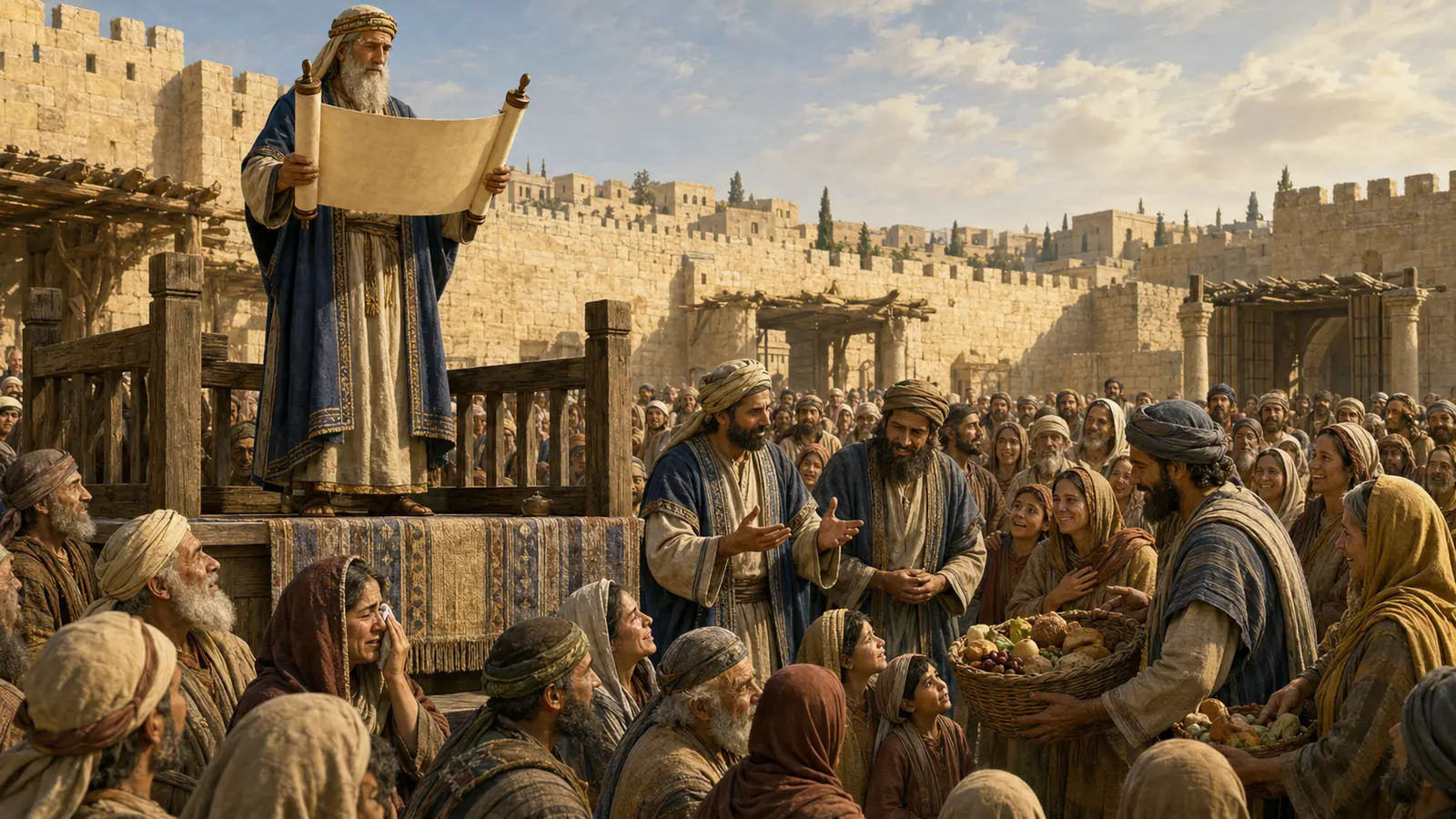
The wall is standing, the gates are guarded, and the city has recovered its outline. But now a deeper work begins. In the open square, the people gather not around stones, swords, or royal letters, but around the Book. The rebuilt city becomes a listening community, and the Word of God begins to rebuild what walls cannot touch.
01
Introduction
There comes a moment when the noise of construction must give way to the sound of Scripture. Hammers fall silent. Gates stand still. The people gather. Someone opens the Book. And suddenly the deepest rebuilding begins.
Nehemiah 8 is one of the great scenes of biblical renewal. The wall has been completed in Nehemiah 6. The city has been ordered and guarded in Nehemiah 7. Now the people assemble as one before the Water Gate and ask Ezra the scribe to bring the Book of the Law of Moses. This is not merely a public lecture. It is a covenant moment. A people who have returned from exile, rebuilt the wall, and recovered their city must now be re-formed by the voice of God.
This chapter asks a question that reaches every generation of God’s people: What good is a rebuilt wall if the Word of God does not rebuild the heart within it?
This text is about a rebuilt city becoming a listening people, because true restoration begins when God’s Word moves from the scroll into understanding, worship, repentance, joy, and embodied obedience.
Nehemiah 8 reminds us that God does not merely repair structures. He gathers people around his Word. He teaches them to listen, understand, weep, rejoice, obey, and celebrate. The wall has given Jerusalem boundaries, but Scripture gives the people identity. The gates protect the city, but the Torah opens the heart.
02
Historical and Literary Context
Nehemiah 8 stands at a major turning point in Ezra–Nehemiah. The earlier sections have focused on physical and social restoration: return from exile, rebuilding the temple, confronting opposition, rebuilding Jerusalem’s wall, and organizing the city. Now the narrative shifts toward spiritual renewal through public reading, interpretation, confession, covenant commitment, and worship [Neh. 8–10].
The chapter also brings Ezra back to the center. Ezra had arrived earlier as a priest and scribe skilled in the Law of Moses, committed to study, practice, and teach the Torah in Israel [Ezra 7:6, 10]. Nehemiah has rebuilt the wall; Ezra now opens the scroll. Together their ministries show that God’s people need both repaired communal life and renewed covenant instruction. Walls may protect the people from external danger, but Scripture forms them for faithful life with God.
The timing is important. The people gather on the first day of the seventh month [Neh. 8:2]. In Israel’s calendar, the seventh month was filled with sacred significance: the Feast of Trumpets, the Day of Atonement, and the Feast of Booths or Tabernacles [Lev. 23:23–43]. This means Nehemiah 8 is not a random assembly. It happens in a liturgical season of remembrance, repentance, and celebration.
Literarily, the chapter unfolds in five movements: the people gather and request the Book [8:1–3], Ezra reads and the people worship [8:4–6], the Levites explain the Law so the people understand [8:7–8], grief is turned toward holy joy [8:9–12], and the people discover and celebrate the Feast of Booths [8:13–18].
Within the larger Ezra–Nehemiah story, the chapter embodies both hope and incompleteness. It is hopeful because the people hunger for the Word and respond with reverence. It is incomplete because hearing must become obedience, and obedience must become lasting transformation. The chapter shines with renewal, but the ending of the book will later show that even powerful public moments need deeper heart change.
03
Walking Through the Text
When the People Gather as One [Nehemiah 8:1–3]
The chapter begins with unity: “All the people gathered as one man into the square before the Water Gate” [Neh. 8:1]. The phrase “as one man” is powerful. A people scattered by exile, weakened by opposition, divided by injustice, and stretched by rebuilding now stand together in one place.
They tell Ezra to bring the Book of the Law of Moses, which the Lord had commanded Israel [8:1]. Notice that the desire comes from the people. They ask for the Word. Renewal is stirring not only in the leader’s heart but in the assembly. Hunger for Scripture is itself a gift of grace.
Ezra brings the Law before men, women, and all who could understand [8:2]. This is a whole-community moment. The Word is not reserved for specialists. Men, women, and understanding children are gathered as hearers of the covenant. The people stand from early morning until midday while Ezra reads [8:3]. Their ears are attentive.
This is the first mark of renewal: not excitement, not noise, not religious display, but attentiveness. The returned community becomes a listening people.
When the Book Is Opened and the People Stand [Nehemiah 8:4–6]
Ezra stands on a wooden platform made for the purpose [Neh. 8:4]. Around him are named leaders, and before him is the gathered assembly. When he opens the Book, all the people stand [8:5]. Their posture becomes theology. They rise because God is speaking.
Ezra blesses the Lord, the great God, and the people answer, “Amen, Amen,” lifting up their hands [8:6]. Then they bow their heads and worship the Lord with their faces to the ground. The movement is beautiful: the Book is opened, the people stand, praise rises, hands lift, heads bow, faces touch the earth.
Scripture here does not produce casual observation. It produces worship. The people are not treating the Torah as information alone. They are encountering the covenant voice of the living God.
The scene echoes Sinai, where Israel gathered to hear God’s covenant instruction [Exod. 19–20]. But it also carries the sorrow of exile. This is a post-exilic Sinai in a broken but rebuilding city. The people stand again under the Word that had warned them, judged them, preserved them, and now calls them back.
When Understanding Becomes the Bridge to Obedience [Nehemiah 8:7–8]
The Levites move among the people and help them understand the Law [Neh. 8:7]. Verse 8 is one of the clearest biblical pictures of teaching ministry: “They read from the book, from the Law of God, clearly, and they gave the sense, so that the people understood the reading.”
Reading is not enough if people do not understand. Reverence is not enough if meaning remains hidden. The Word must be opened, explained, translated into understanding, and brought near to the life of the people.
This is not entertainment. It is faithful exposition. The teachers do not replace the text with their own ideas. They read the Book and give the sense. Their task is to let God’s Word be heard with clarity.
In a community rebuilding after exile, understanding is essential. The people need to know not only what God said, but how God’s instruction forms their worship, justice, Sabbath, family life, generosity, holiness, and public witness. The Word must travel from ears to minds, from minds to hearts, from hearts to habits.
When Weeping Meets Holy Joy [Nehemiah 8:9–12]
As the people hear the Law, they begin to weep [Neh. 8:9]. This response is understandable. Scripture exposes. The Law reveals the gap between God’s covenant calling and Israel’s actual life. The people hear the Word and feel the weight of their failure.
But Nehemiah, Ezra, and the Levites tell them, “This day is holy to the Lord your God; do not mourn or weep” [8:9]. They are not dismissing repentance. Later, in Nehemiah 9, the people will gather for confession. But this day is a holy festival day, and the appropriate response is joy.
Nehemiah says, “Go your way. Eat the fat and drink sweet wine and send portions to anyone who has nothing ready, for this day is holy to our Lord. And do not be grieved, for the joy of the Lord is your strength” [8:10].
This is not shallow happiness. It is covenant joy rooted in grace. The God whose Word exposes sin also welcomes his people into holy celebration. The day is holy; therefore, joy is not a distraction from holiness but part of it.
The command to send portions to those who have nothing prepared shows that joy must become generosity. No one is to celebrate alone while another goes without. The joy of the Lord creates a table wide enough for the vulnerable.
The people obey. They eat, drink, send portions, and rejoice greatly because they had understood the words declared to them [8:12]. Understanding leads not only to sorrow, but to joy. The Word wounds in order to heal; it convicts in order to restore.
When the Word Becomes Embodied Celebration [Nehemiah 8:13–18]
On the second day, the heads of fathers’ houses, priests, and Levites gather to study the words of the Law [Neh. 8:13]. They discover that Israel should dwell in booths during the feast of the seventh month [8:14]. So the people go out, gather branches, and make booths on roofs, courtyards, temple courts, squares, and gates [8:15–16].
The Feast of Booths remembered Israel’s wilderness journey, when God made his people dwell in temporary shelters after bringing them out of Egypt [Lev. 23:42–43]. For returned exiles, this feast carried deep meaning. Their ancestors had lived in booths after the Exodus; now they, too, are a people brought out of captivity, learning to live by God’s provision.
The chapter says that from the days of Joshua son of Nun to that day, the people had not celebrated in this way, and there was very great joy [Neh. 8:17]. The point is not that the feast had never been observed at all, but that this renewed, communal, Scripture-awakened observance had a unique fullness and force.
Day by day, Ezra reads from the Book of the Law, and they keep the feast seven days, with a solemn assembly on the eighth day [8:18]. The Word becomes rhythm. Scripture becomes calendar. Hearing becomes practice. The people do not merely admire the command; they embody it.
04
Theological Reflection
The Word Rebuilds What Walls Cannot
Nehemiah rebuilt the wall, but Ezra opens the scroll. Both are needed, but they do different kinds of work. Walls address vulnerability; the Word addresses identity, memory, sin, worship, and obedience.
A community can have order and still lack formation. It can have protection and still lack holiness. Nehemiah 8 shows that true restoration must move from structure to Scripture, from safety to surrender, from repaired gates to renewed hearts.
Understanding Is a Spiritual Necessity
The Levites read clearly and give the sense. This affirms the holy work of teaching. God’s Word is not meant to remain locked in sound without meaning. The people must understand.
For pastors, teachers, parents, and ministry leaders, this is a calling. Explain the Word faithfully. Bring clarity. Help people connect the text to worship and life. Do not use Scripture as decoration. Open it so the people can hear God.
Conviction and Joy Belong Together
The people weep, but they are also told to rejoice. Biblical renewal includes both. If there is only grief, the soul may collapse under condemnation. If there is only celebration, the conscience may never awaken. God’s Word does both: it cuts and heals, exposes and restores, humbles and strengthens.
“The joy of the Lord is your strength” does not mean ignoring sin. It means that God’s gracious delight, covenant mercy, and restoring presence give strength to repent, obey, and celebrate.
Obedience Is the Fruit of Hearing
The people discover the Feast of Booths and then celebrate it. This is the movement of true Scripture engagement: reading, understanding, response, obedience. The Word is not complete in us until it becomes embodied faithfulness.
This chapter points forward to the ministry of Jesus, who embodies the Torah’s faithful Israel, announces good news to the poor, gathers hearers around God’s kingdom, and teaches that the wise person hears his words and does them [Matt. 7:24–27]. It also points toward the Spirit, who writes God’s instruction not merely on scrolls but on hearts [Jer. 31:31–34; Ezek. 36:26–27].
05
Life Application
Gather around Scripture intentionally. Renewal begins when God’s people become attentive hearers again.
Honor both reading and explanation. Do not settle for religious sound without understanding. Seek the sense of the text.
Let the Word expose and heal. Tears may be part of renewal, but do not stop at grief. Let God’s mercy lead you into holy joy.
Make joy generous. Send portions to those who have nothing prepared. True celebration makes room for the needy.
Turn understanding into obedience. Ask not only, “What does this mean?” but also, “What must we now do?”
Recover holy rhythms. Scripture should shape calendars, meals, gatherings, rest, worship, and community practices.
Remember your wilderness story. Like Israel in booths, remember that life is sustained not by permanent shelters but by God’s faithful presence.
06
Reflection Questions
1. Are you living inside rebuilt structures while neglecting the Word that renews the heart?
2. When Scripture is opened, do you listen with attentiveness, defensiveness, boredom, or hunger?
3. Where has God’s Word recently brought conviction, and how might that grief become faithful joy?
4. Who needs to receive “a portion” from your celebration—food, encouragement, hospitality, or practical care?
5. What truth from Scripture needs to move from understanding into embodied obedience this week?
07
Response Prayer
Lord God of heaven, Speaker of covenant mercy, open the Book among us again.
Make us a listening people. Give us ears that are attentive, hearts that are humble, and minds that seek understanding.
Where your Word exposes our sin, do not let us run away. Where it brings tears, do not let us drown in despair. Where it announces mercy, teach us to rejoice with holy strength.
Let the joy of the Lord become our courage. Let our tables become generous. Let our worship become obedient. Let our calendars, homes, habits, and communities be shaped by your instruction.
Build in us what walls cannot build. Write your Word upon our hearts. Form us into a people whose lives become an open square where your voice is heard, your mercy is received, and your joy is shared.
Through Jesus Christ, the living Word, the faithful Israelite, the true temple, and the Lord who gathers his people into joy, Amen.
08
Window into What Comes Next
Nehemiah 8 ends with great joy, Scripture reading, and the celebration of the Feast of Booths. But joy does not erase the need for confession. In Nehemiah 9, the people gather again—this time with fasting, sackcloth, and earth on their heads. The Word that brought joy will now lead them into a long prayer of historical confession.
The movement continues: the scroll opens, understanding awakens, joy strengthens, obedience begins, and confession deepens the work of renewal.
The people have celebrated God’s mercy. Next, they will tell the truth about their sin.
09
Bibliography
Boda, Mark J. Praying the Tradition: The Origin and Use of Tradition in Nehemiah 9. Berlin: de Gruyter, 1999.
Clines, David J. A. Ezra, Nehemiah, Esther. New Century Bible Commentary. Grand Rapids: Eerdmans, 1984.
Kidner, Derek. Ezra and Nehemiah. Tyndale Old Testament Commentaries. Downers Grove: InterVarsity Press, 1979.
Throntveit, Mark A. Ezra-Nehemiah. Interpretation. Louisville: John Knox Press, 1992.
Williamson, H. G. M. Ezra, Nehemiah. Word Biblical Commentary 16. Waco: Word Books, 1985.
Williamson, H. G. M. Ezra and Nehemiah. Old Testament Guides. Sheffield: JSOT Press, 1987.
Yamauchi, Edwin M. “Ezra-Nehemiah.” In The Expositor’s Bible Commentary, revised edition. Grand Rapids: Zondervan, 2010.
Be the first to leave a comment.