

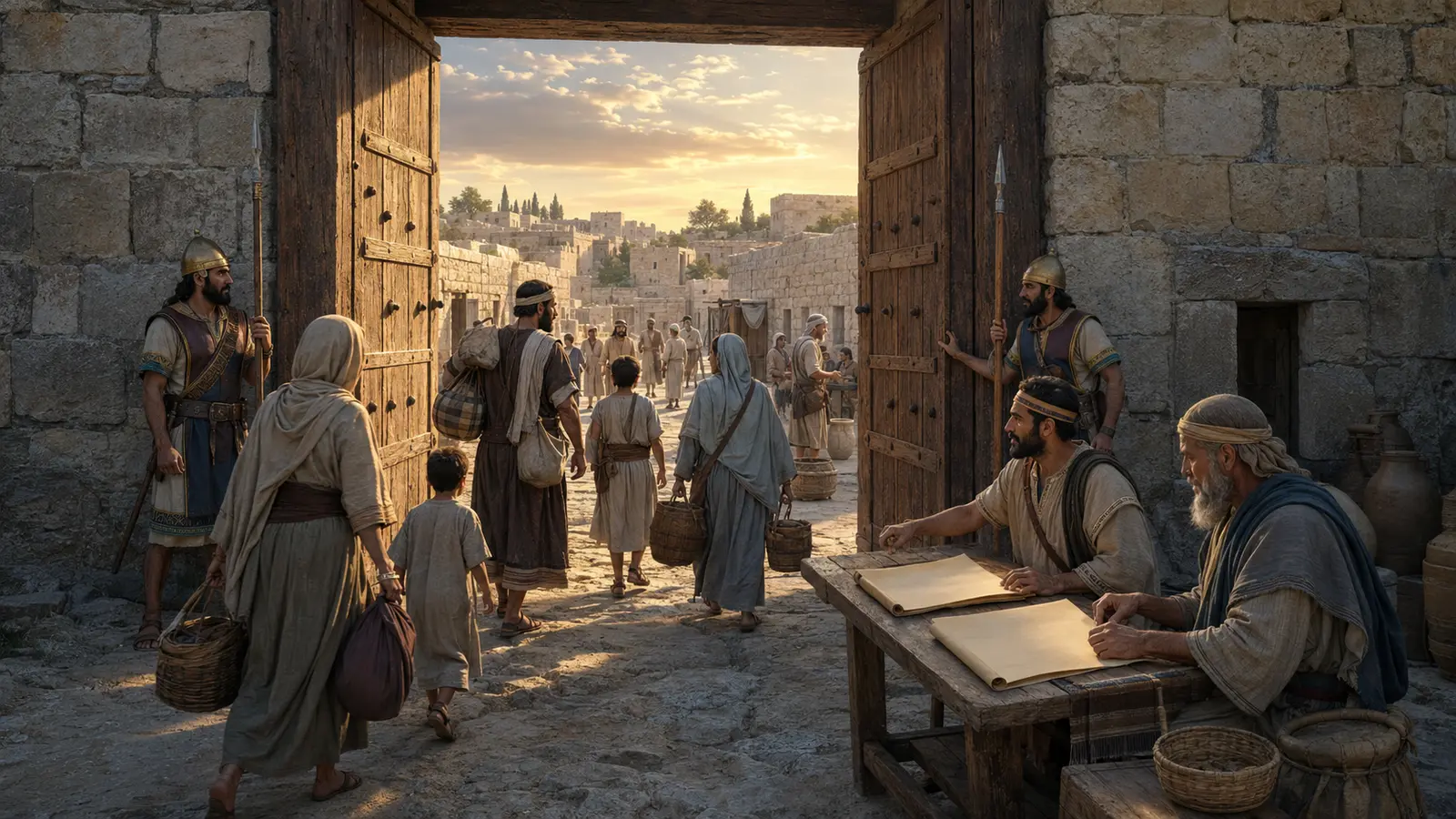
The wall is finished, but the work is not over. Gates can be hung in their place, guards can stand in the morning light, singers can prepare their praise, and Levites can take their posts—but a city is not truly restored until the people remember who they are before God. The stones have been gathered; now the names must be gathered too.
01
Introduction
There is a quiet danger after success. When the wall is finished, the heart may assume the story is complete. The crisis has passed. The enemies have been humbled. The city has gates again. The workers can breathe.
But Nehemiah 7 teaches us that completion is not the same as restoration. A finished wall is only the beginning of a reordered life. The city now needs guardians, worshipers, leaders, residents, genealogies, and a renewed sense of covenant identity. Jerusalem has been protected from outside shame; now it must be filled with a people who know who they are and how they belong.
This chapter asks a deep question: What kind of people must live inside the walls God has helped us rebuild?
This text is about completed walls becoming covenant community, because God’s restoration does not end with structures but moves toward ordered worship, remembered identity, and faithful belonging.
Nehemiah 7 may look like administration and genealogy, but it is more than ancient paperwork. It is the slow work of rebuilding a people’s memory. The gates are set, but the city is still thinly populated. The wall stands, but the community must be gathered. The work of stone now becomes the work of names.
02
Historical and Literary Context
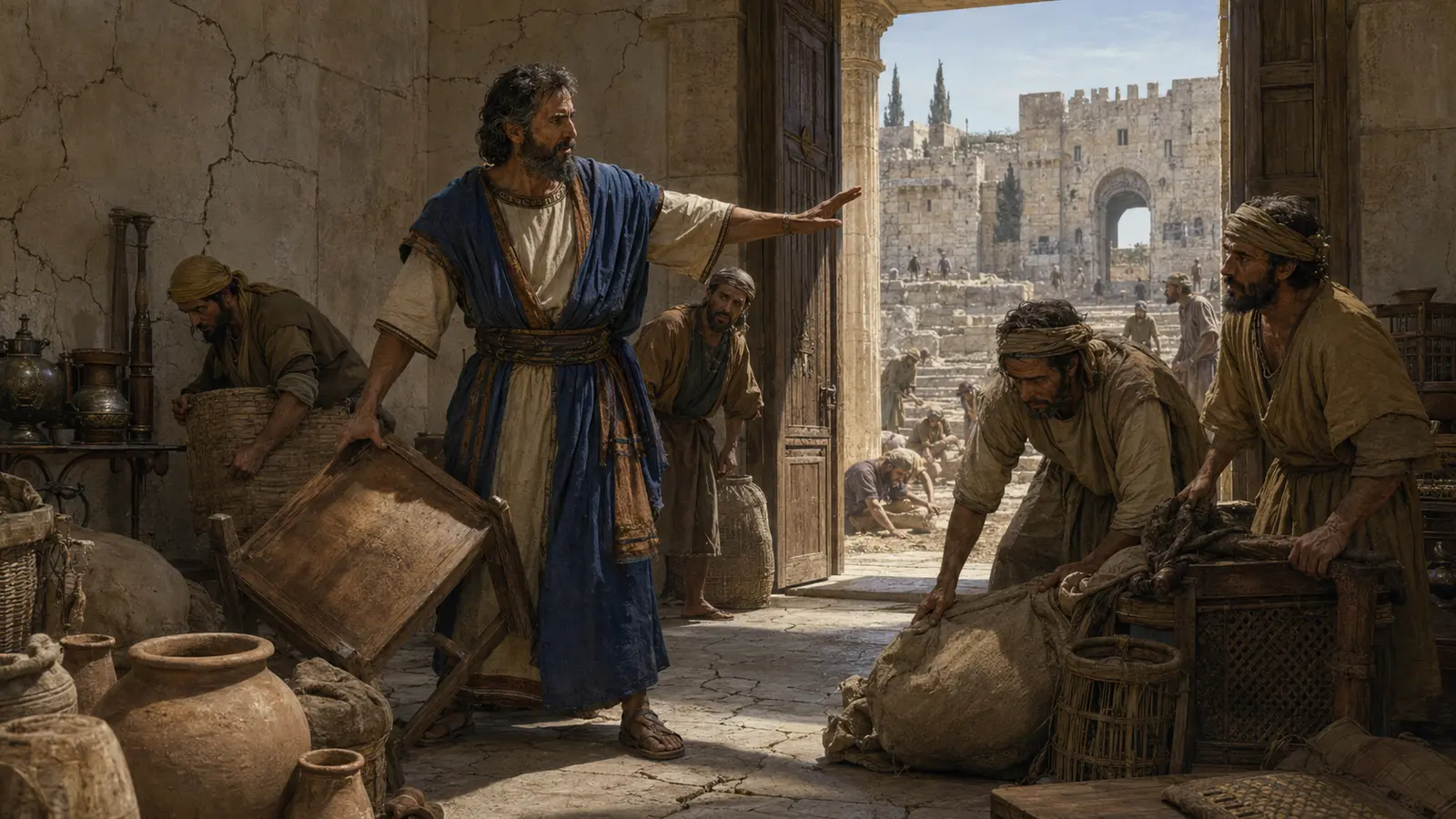
Nehemiah 7 comes after the dramatic completion of the wall in Nehemiah 6. The enemies perceived that the work had been accomplished with God’s help [Neh. 6:16]. Yet the closing verses of chapter 6 also warned that compromise remained within the community, especially through Tobiah’s connections with the nobles of Judah [Neh. 6:17–19]. The wall was finished, but the people still needed vigilance and reform.
Chapter 7 forms a transition. It closes the wall-building narrative and prepares for the Torah-centered renewal of Nehemiah 8–10. The chapter begins with practical arrangements: gatekeepers, singers, Levites, leadership appointments, and security instructions [7:1–4]. Then Nehemiah is moved by God to assemble the nobles, officials, and people by genealogy [7:5]. This leads to a long register of those who first returned from exile [7:6–73], a list closely parallel to Ezra 2.
The list may feel slow to modern readers, but in the world of Ezra–Nehemiah it serves a crucial theological purpose. The returned community is not an accidental crowd. They are connected to the earlier return. Their identity is rooted in memory, ancestry, priestly legitimacy, temple service, and covenant continuity. The people must know that they belong to the story of God’s mercy.
At the same time, the chapter carries the tension of partial restoration. Jerusalem is “wide and large,” but “the people within it were few, and no houses had been rebuilt” [Neh. 7:4]. The city has structure without fullness. It has walls without enough inhabitants. It has gates, but needs life inside them. This image captures the deeper theology of Ezra–Nehemiah: outward restoration is real, yet incomplete.
Nehemiah 7 therefore stands like a doorway. Behind it is the labor of rebuilding the wall. Ahead of it is the public reading of Scripture, confession, covenant renewal, and the continuing struggle to become a holy people.
03
Walking Through the Text
When Gates Need Guardians and Worshipers [Nehemiah 7:1]
The chapter begins: “Now when the wall had been built and I had set up the doors, and the gatekeepers, the singers, and the Levites had been appointed” [Neh. 7:1]. The sentence is simple, but the order matters.
The doors are set in the gates. The wall is no longer only a line of stones; it is functional. But immediately Nehemiah appoints gatekeepers, singers, and Levites. Security and worship stand together. The city needs guarded entrances, but it also needs ordered praise and priestly service.
This pairing reminds us that biblical restoration is never merely defensive. Jerusalem is not rebuilt simply to keep enemies out. It is rebuilt so that worship may be protected, communal life may be ordered, and the people may live as those who belong to the Lord.
Gatekeepers in Israel’s story guarded sacred and civic thresholds. Singers led the people in praise. Levites served in temple-related responsibilities. Their appointment signals that the completed wall must now serve a worshiping community. Protection without worship becomes fear. Worship without ordered life becomes fragile. Jerusalem needs both.
When Leadership Requires Faithfulness and Fear of God [Nehemiah 7:2]
Nehemiah appoints Hanani, his brother, and Hananiah, the governor of the castle, over Jerusalem. Hanani had brought the original report about Jerusalem’s distress [Neh. 1:2–3]. Now he is entrusted with leadership in the repaired city. The one who helped awaken the burden now helps guard the result.
Hananiah is described as “a more faithful and God-fearing man than many” [Neh. 7:2]. This description is central. Nehemiah does not choose leaders merely because they are available, impressive, wealthy, or connected. He values faithfulness and the fear of God.
The fear of God has already appeared in Nehemiah 5, where it restrained Nehemiah from exploiting the people as previous governors had done [Neh. 5:15]. Here it becomes a leadership qualification. A rebuilt city needs leaders whose hearts are governed by reverence. Skills matter, but character matters more. Power in the hands of someone without the fear of God quickly becomes danger inside the gates.
The wall can be completed in fifty-two days, but trustworthy leadership must be formed over time. Nehemiah knows that the city’s future depends not only on strong stone but on faithful stewards.
When the City Must Learn Watchfulness [Nehemiah 7:3–4]
Nehemiah gives instructions that the gates of Jerusalem should not be opened until the sun is hot, and that the doors should be shut and barred while guards are still standing [Neh. 7:3]. Residents are appointed as guards, some at their posts and some in front of their own homes.
The instructions are practical. The city remains vulnerable. Gates are entry points for both life and danger. Jerusalem must not assume that completed walls remove the need for vigilance.
The detail about people guarding near their homes recalls the pattern of chapter 3, where many repaired sections near their own houses. Again, responsibility becomes local. Those who live inside the city must help guard the life of the city.
Verse 4 gives the problem: “The city was wide and large, but the people within it were few, and no houses had been rebuilt.” This is one of the most poignant images in the chapter. Jerusalem has space but lacks fullness. It has boundaries but lacks density. It has walls but needs households.
This is restoration in its unfinished form. A repaired city without people is like a body with bones but little breath. The wall has removed one layer of shame, but the city still needs habitation, worship, families, justice, and Scripture-shaped life.
When God Puts Genealogy into the Heart [Nehemiah 7:5]
Nehemiah then says, “Then my God put it into my heart to assemble the nobles and the officials and the people to be enrolled by genealogy” [Neh. 7:5]. This is a quiet but important moment. The next step is not merely administrative. Nehemiah sees it as prompted by God.
Genealogy may not sound spiritual to us, but for the returned exiles it mattered deeply. The exile had scattered families, disrupted inheritance, confused priestly claims, and shaken identity. To enroll the people by genealogy was to ask: Who are we? Where do we belong? How do we continue the story of God’s covenant mercy?
Nehemiah finds “the book of the genealogy of those who came up at the first” [7:5]. This connects the present moment to the earlier return under Zerubbabel. The people inside the rebuilt wall must remember that they stand in a stream of mercy that began before them.
The wall gives them a city. The genealogy gives them memory. Without memory, structures become empty. Without identity, people drift. God’s restoration gathers not only stones but names.
When the Returned Exiles Are Named Again [Nehemiah 7:6–69]
The long list begins with those who came up from captivity after being taken into exile by Nebuchadnezzar king of Babylon [Neh. 7:6]. This sentence frames the entire register as a story of judgment and mercy. The people were carried away. Now they have returned.
The list includes leaders, families, towns, priests, Levites, singers, gatekeepers, temple servants, and descendants of Solomon’s servants [7:7–60]. It is not random. It shows that the restored community includes ordinary families, geographic roots, worship personnel, and temple service. The people are not only residents; they are a covenant community organized around worship and memory.
Some names are tied to families. Others are tied to towns. This dual structure suggests that identity is both familial and geographical. The exile had torn people from land and inheritance. The return begins to reconnect names with place.
The repeated listing of temple personnel also reminds us that worship remains central. Jerusalem is not merely a capital city. It is the city of the temple, the place where God’s name is remembered. Gatekeepers, singers, Levites, and servants all bear witness that restored life must be ordered around God’s presence.
For modern readers, the list may feel distant. But in a wounded community, names matter. To be named is to be remembered. To be counted is to be included. To be enrolled is to stand again among the people whose story God has not abandoned.
When Some Claims Must Wait for Discernment [Nehemiah 7:61–65]
Not everyone can prove their ancestral houses. Some return from Tel-melah, Tel-harsha, Cherub, Addon, and Immer, but cannot show whether their families belong to Israel [Neh. 7:61]. Some priests also cannot find their names in the genealogical records and are excluded from the priesthood as unclean [7:63–64].
This is a difficult moment. The text is concerned with priestly legitimacy, especially because priests served at the altar and in the temple. The governor tells them not to eat of the most holy food until a priest arises with Urim and Thummim [7:65]. In other words, the matter is not handled carelessly. It awaits divine clarification.
This shows that restoration requires both mercy and order. The returned community must be welcoming to the remnant, but it must also guard the holiness of worship. Identity is not casual. Priestly service is not self-appointed.
Yet the unresolved waiting also reveals the limits of the community’s present restoration. Some questions cannot be fully settled. The tools of discernment are incomplete. The people are back, but not all clarity has returned. Again, Ezra–Nehemiah lets us feel the ache of an unfinished story.
When Generosity Supports the Rebuilt Community [Nehemiah 7:66–73]
The register concludes with numbers for the whole assembly, servants, singers, horses, mules, camels, and donkeys [Neh. 7:66–69]. Then some leaders and people give generously to the work [7:70–72]. The chapter ends with priests, Levites, gatekeepers, singers, some of the people, temple servants, and all Israel dwelling in their towns. When the seventh month comes, the people are in their towns [7:73].
This ending prepares directly for the public reading of the Law in chapter 8. The people are gathered by identity and placed in readiness. The seventh month is significant in Israel’s worship calendar, associated with holy assemblies and festivals [Lev. 23:23–43]. The stage is set for Scripture to speak.
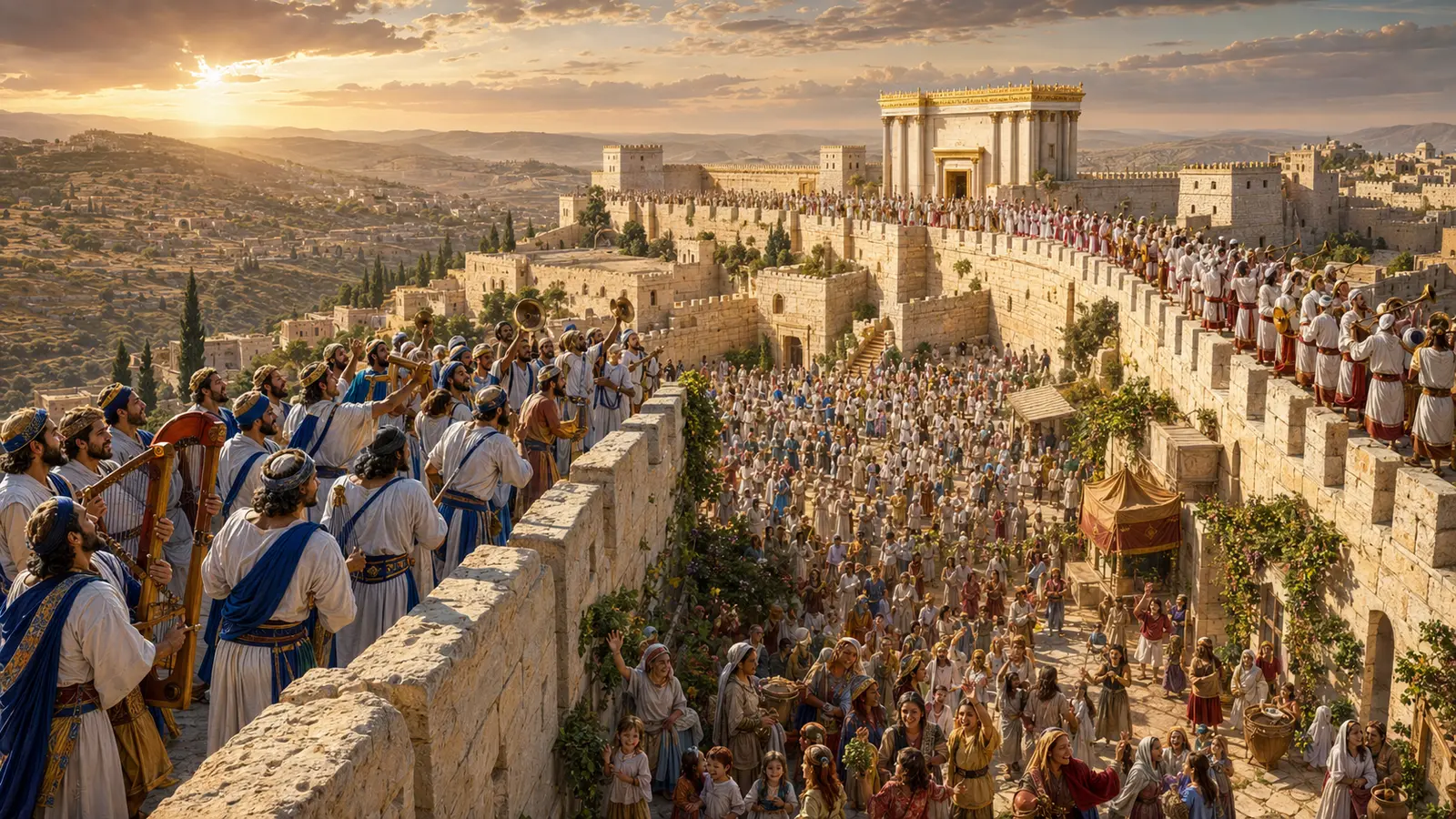
The movement is beautiful. Walls lead to gates. Gates require guards. Guards require leaders. Leaders gather the people. The people remember their names. The remembered community becomes ready to hear the Word.
04
Theological Reflection
Completion Must Become Formation
Nehemiah 7 teaches that finishing a project is not the same as forming a people. The wall is completed in chapter 6, but chapter 7 immediately turns toward order, leadership, watchfulness, identity, and worship.
This matters for every generation. A church can finish a building and still need discipleship. A family can restore stability and still need spiritual formation. A ministry can launch successfully and still need character. Completion must become formation, or success becomes hollow.
God Cares About Names
The long genealogy reminds us that God’s people are not an anonymous mass. Names matter to God. Families matter. Histories matter. Wounded communities need to be remembered and gathered.
Scripture often uses lists to teach that God works through real people in real time. In a world where exile erases identity, God’s mercy writes names again. The list becomes an act of holy memory.
Leadership Must Be Governed by the Fear of God
Hananiah is chosen because he is faithful and fears God. This is not decorative language. It is the foundation of trustworthy leadership. The fear of God protects communities from leaders who use power without reverence.
Nehemiah 5 showed what happens when nobles and officials exploit the poor. Nehemiah 7 answers by placing responsibility in the hands of those whose character is shaped by reverence. The rebuilt city needs leaders who tremble before God more than they hunger for control.
Walls Need Watchmen, but Watchmen Need the Word
The chapter begins with guards and ends by preparing for the reading of Scripture. This is deeply theological. A community needs protection, but protection alone cannot create holiness. Watchmen can guard gates, but only God’s Word can reform hearts.
Nehemiah 7 therefore points forward. The city is ready, but not yet renewed. The people are gathered, but they still need to hear. The genealogy prepares the assembly; the scroll will soon awaken it.
05
Life Application
Do not stop after the wall is finished. After a breakthrough, ask what formation, order, and obedience must follow.
Choose leaders by character, not charisma only. Faithfulness and the fear of God are safer foundations than talent without reverence.
Guard the gates wisely. Every restored life needs boundaries, accountability, and watchfulness.
Take responsibility near your own house. The health of the whole community depends on local faithfulness.
Remember names, not just numbers. Ministry is not statistics alone. God gathers real people with stories, wounds, families, and callings.
Let identity be rooted in God’s mercy. The returned exiles were people brought back by grace. We too must remember that belonging begins with God’s redeeming initiative.
Prepare the community to hear Scripture. Structures, systems, and leadership should lead people toward the Word of God, not away from it.
06
Reflection Questions
1. What “wall” has God helped you rebuild, and what formation must now follow?
2. Are the gates of your life guarded wisely, or are they open carelessly to old dangers?
3. What kind of leaders do you trust most—gifted leaders, powerful leaders, or faithful leaders who fear God?
4. Who needs to be remembered by name in your community, rather than treated like a number?
5. How can your present structures better prepare people to hear and obey God’s Word?
07
Response Prayer
Lord God of heaven, Keeper of names, Builder of cities, Gatherer of exiles, teach us what to do after the wall is finished.
Do not let us mistake completion for maturity. Do not let our gates stand without wisdom, or our systems grow without worship, or our leadership rise without the fear of your name.
Make us faithful guardians of what you have restored. Teach us to remember the people you have gathered. Give us leaders whose hearts tremble before you, servants whose hands are ready, and communities whose life is ordered toward your presence.
Write our names in mercy. Heal the shame of exile. Fill the empty spaces within our walls. And prepare us to stand together under your Word, so that the city you rebuild around us may become the people you renew within us.
Through Jesus Christ, the true Shepherd of the flock, the cornerstone of the living temple, and the one who calls his sheep by name, Amen.
08
Window into What Comes Next
Nehemiah 7 ends with the people settled in their towns as the seventh month arrives. The wall stands. The gates are guarded. The community has been counted. Now the great turning point comes: the people gather as one man in the square before the Water Gate, and Ezra opens the Book of the Law.
The movement continues: completed walls lead to ordered community, ordered community gathers for Scripture, and Scripture awakens the heart of the people.
In Nehemiah 8, the stones grow quiet—and the scroll begins to speak.
09
Bibliography
Boda, Mark J. Praying the Tradition: The Origin and Use of Tradition in Nehemiah 9. Berlin: de Gruyter, 1999.
Clines, David J. A. Ezra, Nehemiah, Esther. New Century Bible Commentary. Grand Rapids: Eerdmans, 1984.
Kidner, Derek. Ezra and Nehemiah. Tyndale Old Testament Commentaries. Downers Grove: InterVarsity Press, 1979.
Throntveit, Mark A. Ezra-Nehemiah. Interpretation. Louisville: John Knox Press, 1992.
Williamson, H. G. M. Ezra, Nehemiah. Word Biblical Commentary 16. Waco: Word Books, 1985.
Williamson, H. G. M. Ezra and Nehemiah. Old Testament Guides. Sheffield: JSOT Press, 1987.
Yamauchi, Edwin M. “Ezra-Nehemiah.” In The Expositor’s Bible Commentary, revised edition. Grand Rapids: Zondervan, 2010.
Be the first to leave a comment.