

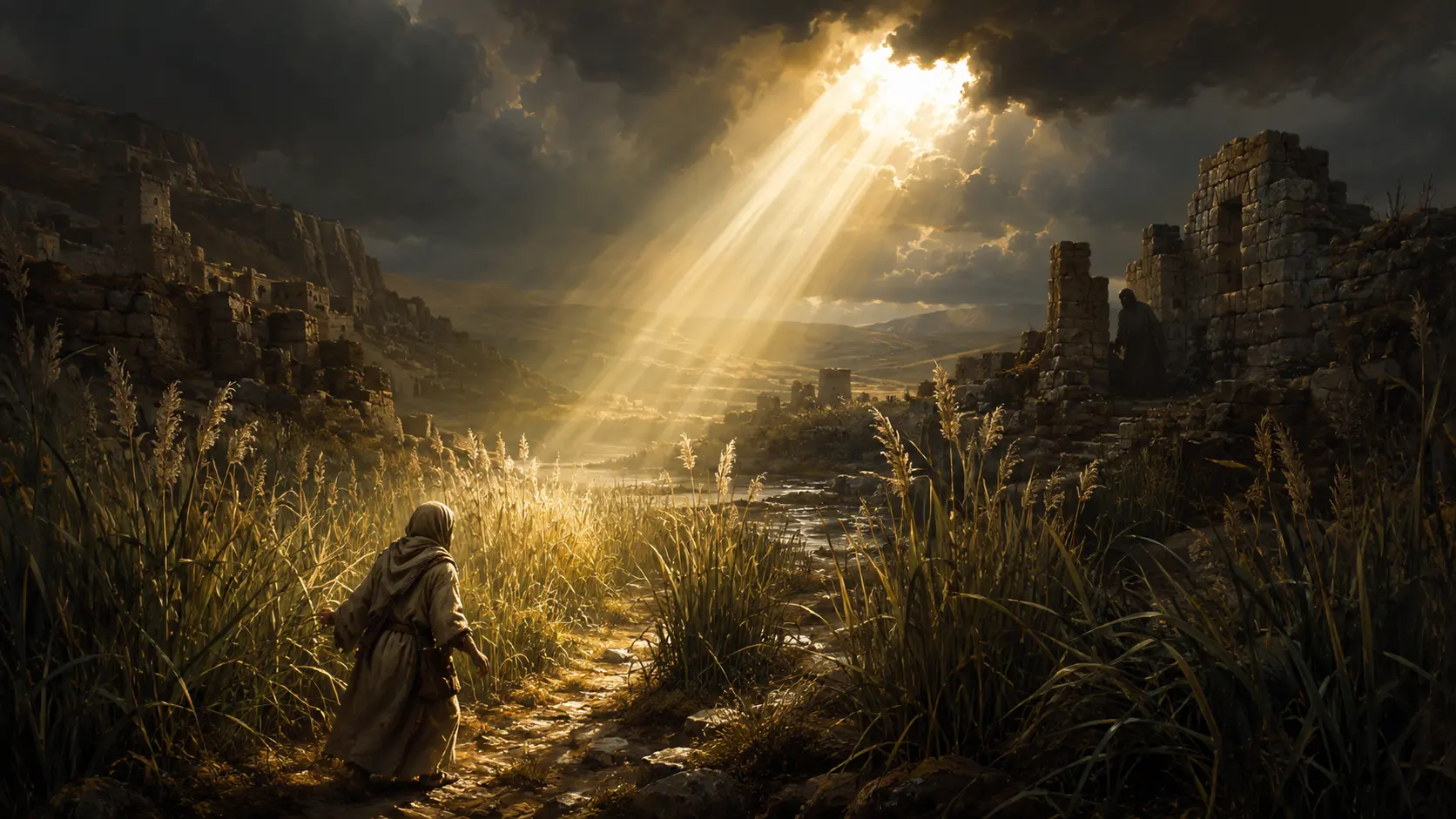
When the Oppressor Thinks No One Is Watching Why, Yahweh, do you stand far away? Why do you hide yourself in times of trouble? The victim sees a lion in the thicket. Faith learns to look for the King who still sees.
01
1.0 Introduction: What Do We Do When God Seems Absent?
Some suffering carries a second wound: the sense that God is far away. Psalm 10 begins there: “Why, Yahweh, do you stand far away? Why do you hide yourself in times of trouble?” It is the cry of people who can see predators and victims but cannot yet see God acting.
Psalm 10 refuses easy answers. It does not tell the oppressed that their suffering is imaginary, and it does not conclude that God has disappeared. Instead, it names evil with disturbing precision and turns that description into prayer. Truthful prayer must call evil by its right name.
This text is about divine hiddenness becoming courageous appeal, because biblical faith does not deny the silence of heaven; it brings that silence before the King who sees what predators try to hide.
02
2.0 Historical and Literary Context: The Second Half of a Broken Alphabet
Psalm 10 is closely bound to Psalm 9. In Hebrew, the two share an incomplete acrostic pattern, and ancient Greek tradition treated them as one psalm. Psalm 9 praises Yahweh as the righteous Judge who remembers the afflicted; Psalm 10 asks why that same God appears hidden while the wicked flourish. Together, they hold confession and experience in tension.
Within Psalms 3–14, David and the afflicted are repeatedly threatened by enemies, liars, violent people, and arrogant rulers. Psalm 8 has celebrated God’s purpose to rule through weak humanity. Psalms 9–10 now ask what that royal purpose means when the weak are hunted. The deeper question is whether the King will act for those being crushed.
The poem moves from complaint (v. 1), to exposure of the wicked (vv. 2–11), to petition (vv. 12–15), and finally to renewed confession (vv. 16–18). It travels from “Why are you far away?” to “Yahweh is King forever and ever.”
03
3.0 Walking Through the Text
04
3.1 Psalm 10:1–6 — When Arrogance Becomes a Worldview
The wicked “hunts down the weak.” Vulnerability becomes an opportunity. He boasts about his cravings, blesses greed, and treats Yahweh with contempt. Verse 4 exposes the theology beneath the behavior: “In his pride the wicked does not seek him; in all his thoughts there is no room for God.”
This is practical atheism: living as though God will never call anyone to account. The thought returns in verses 11 and 13: “God has forgotten,” “he covers his face,” and “you will not call me to account.” If there is no Judge, desire becomes law and power becomes permission.
Circumstances seem to confirm his belief, but Psalm 10 exposes the mistake: delayed judgment is not absent judgment.
05
3.2 Psalm 10:7–11 — When Violence Learns to Hide
The poem moves into the shadows. The oppressor’s mouth is filled with curses, lies, threats, trouble, and evil. Violence begins in speech before it reaches the body.
Then come predatory images. He waits in ambush, watches the helpless, lurks like a lion, catches the poor, and drags victims into his net. The victim is no longer treated as a neighbor bearing God’s image but as prey to be captured, exploited, or silenced.
The wicked believes secrecy protects him. His creed is simple: “God has forgotten; he covers his face and never sees.” Evil grows bold when people convince themselves that suffering can be hidden from God.
06
3.3 Psalm 10:12–15 — When Lament Calls God to Rise
Now the psalmist prays: “Arise, Yahweh! Lift up your hand, O God. Do not forget the helpless.” The prayer directly answers the wicked person’s claim that God forgets.
Verse 14 becomes the turning point: “But you, God, see the trouble of the afflicted; you consider their grief and take it in hand.” The wicked says, “He does not see.” Faith replies, “But you do see.”
God’s seeing is not passive. In Exodus, God sees Israel’s misery, hears their cry, knows their suffering, and comes down to deliver (Exod. 3:7–8). Here, too, the helpless entrust themselves to God because he is “the helper of the fatherless.”
“Break the arm of the wicked” is vivid but purposeful. The arm represents capacity and power. The psalmist asks God to dismantle the power by which the oppressor keeps harming others. Biblical justice is not private vengeance; it is the ending of power that devours the vulnerable.
07
3.4 Psalm 10:16–18 — When the Hidden King Becomes the Final Reality
Then comes the confession: “Yahweh is King forever and ever.” Prayer restores scale. Predators may dominate for a season, but they do not own history.
The King hears “the desire of the afflicted,” strengthens their heart, and inclines his ear. God does not only judge evil; he steadies people who have been made afraid.
The final goal is “that mere earthly mortals will never again strike terror.” God’s justice returns the tyrant to his proper size: dust, not deity. Yahweh alone is King.
08
4.0 Theological Reflection
First, lament can speak honestly about divine hiddenness without abandoning faith. Scripture preserves the question “Why are you far away?” Faith does not pretend God feels near when he does not; it refuses to make that feeling the final truth.
Second, oppression has a theology. The wicked person assumes unaccountability: “God will not see.” Abuse survives where perpetrators expect secrecy, immunity, or forgetfulness. Psalm 10 answers with the God who sees, remembers, hears, and acts.
Third, God’s kingship is good news for the vulnerable. “Yahweh is King” means the orphan has a helper, the afflicted have a listener, and terror does not receive the last word.
Fourth, judgment belongs to love’s defense of the weak. A God who never confronts predators would not be more compassionate. The psalm asks God to restrain destructive power so that the vulnerable can live without terror.
09
5.0 Canonical and Christological Horizon
Psalm 10 belongs to a long biblical story. Yahweh sees Hagar in the wilderness (Gen. 16:13), hears Israel under Pharaoh (Exod. 2:23–25), and commands care for widow, orphan, immigrant, and poor. The prophets insist that worship without justice is rebellion (Isa. 1:10–17; Amos 5:21–24).
Jesus enters this story announcing good news to the poor and release to the oppressed (Luke 4:18–19). He draws near to people hidden by shame, confronts leaders who exploit the vulnerable, and teaches that what is done to “the least of these” matters before the King (Matt. 25:31–46).
At the cross, Jesus enters the place where God seems absent and violent power appears triumphant. Resurrection declares that violence and death do not own the final verdict.
For the church, waiting for justice cannot mean indifference. The people of the risen King are called to become communities where hidden suffering is heard, predatory power is confronted, victims are protected, and frightened hearts are strengthened. The final horizon is new creation, where terror ends and God dwells with his people (Rev. 21:1–5).
10
6.0 Life Application
1. Bring God’s apparent absence into prayer. Do not censor the question “Why?” Honest lament can be faithful worship.
2. Recognize predatory patterns. Pay attention to secrecy, intimidation, manipulation, and systems that isolate the vulnerable.
3. Do not confuse delayed consequences with divine approval. Evil may prosper temporarily without becoming ultimately secure.
4. Become a community that notices hidden suffering. Ask who is afraid to speak and whose story is easiest to ignore.
5. Seek justice that restrains harm. Protection may require boundaries, reporting, accountability, discipline, and lawful intervention—not merely private prayer.
6. Strengthen frightened hearts. Offer presence, listening, advocacy, and practical help.
7. Remember the size of human power. No oppressor is ultimate. Yahweh alone is King forever.
11
7.0 Reflection Questions
1. Where have I interpreted God’s silence as evidence that he does not see?
2. What suffering around me remains hidden because someone lacks a safe place to speak?
3. Have I used position, speech, money, influence, or secrecy in ways that made another person feel trapped?
4. What concrete action could restrain harm or strengthen an afflicted person this week?
5. How does the kingship of Jesus reshape my fear of powerful people and my responsibility toward the powerless?
12
8.0 Response Prayer
Yahweh, when you seem far away, keep us from believing that you are blind. See those hunted in secret places. Hear those whose voices have been silenced. Expose the lie that power answers to no one. Break the strength of what destroys, protect the orphaned and oppressed, and strengthen frightened hearts. Make your church a place where hidden wounds can come into the light without being crushed again. Teach us to trust the crucified and risen King until terror is no more. Amen.
13
9.0 Window into What Comes Next
Psalm 10 ends with Yahweh as King and with the hope that mere mortals will no longer terrorize the weak. Psalm 11 immediately tests that confession. What happens when the foundations appear to collapse and fearful voices tell the righteous to flee? The King who seemed hidden in Psalm 10 will be seen again—enthroned in his holy temple, examining the whole human scene.
14
10.0 Bibliography
BibleProject. The Book of Psalms: Study Notes. Portland, OR: BibleProject, 2020.
Goldingay, John. Psalms, Volume 1: Psalms 1–41. Baker Commentary on the Old Testament Wisdom and Psalms. Grand Rapids: Baker Academic, 2006.
Kidner, Derek. Psalms 1–72. Kidner Classic Commentaries. Downers Grove, IL: IVP Academic, 2008.
Wright, N. T. How God Became King: The Forgotten Story of the Gospels. New York: HarperOne, 2012.

Be the first to leave a comment.