

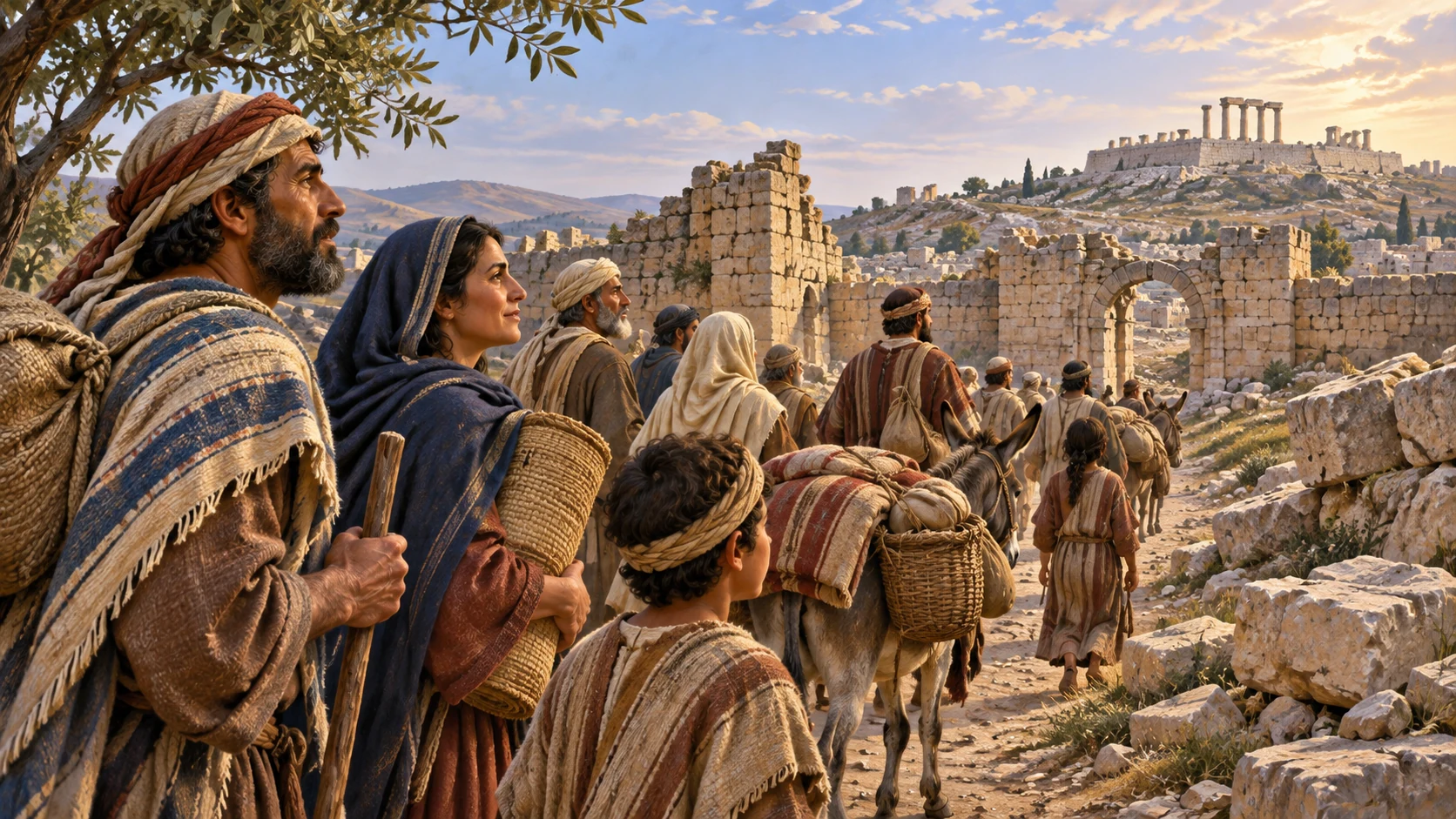
How does returning to Jerusalem open a journey of worship, learning, and renewal?
Opening passages
Read Ezra 1:1–4; 3:10–13; 7:10. Permission to return, the sounds of worship, and a commitment to learning mark the journey. The article offers exposition rather than a fabricated Bible translation.
Introduction: A Key in the Door, a Journey in the Heart
A family may return home after years away and still face a leaking roof, an untended garden, and relationships needing patient repair. A key opens a door; rebuilding ordinary life requires time. Return brings hope alongside responsibility.
Ezra opens the way toward Jerusalem after Babylonian exile. Temple vessels return, family names receive attention, and an altar rises among ruins. The story concerns people alongside stone. How can worship, justice, and covenant faithfulness shape a community after the collapse of an earlier world?
The Maisha Kamili series follows all ten chapters. The introduction supplies a reading framework, historical orientation, and questions for careful study. Visual guides connect the movements without concealing difficult passages.
Setting: Judah within the Persian Empire
Ezra and Nehemiah circulated as a united work in ancient Hebrew tradition. Reading the books together connects temple, Torah, city, and covenant life. The books’ names do not settle every question of authorship; lists, documents, prayers, and leadership accounts form the narrative.
Cyrus of Persia permits return and rebuilding of God’s house in Ezra 1. Judah remains within an empire. Permission to return does not establish complete political independence. Royal documents can support construction or obstruct construction; God’s faithfulness operates within the constraints of foreign rule.
The guide uses the conventional chronology: Cyrus’s permission around 538 BCE, temple completion in 516/515 BCE, and Ezra’s arrival around 458 BCE under Artaxerxes I. Some chronological relationships between Ezra and Nehemiah remain debated. A reading framework provides orientation without claiming certainty over every historical question.
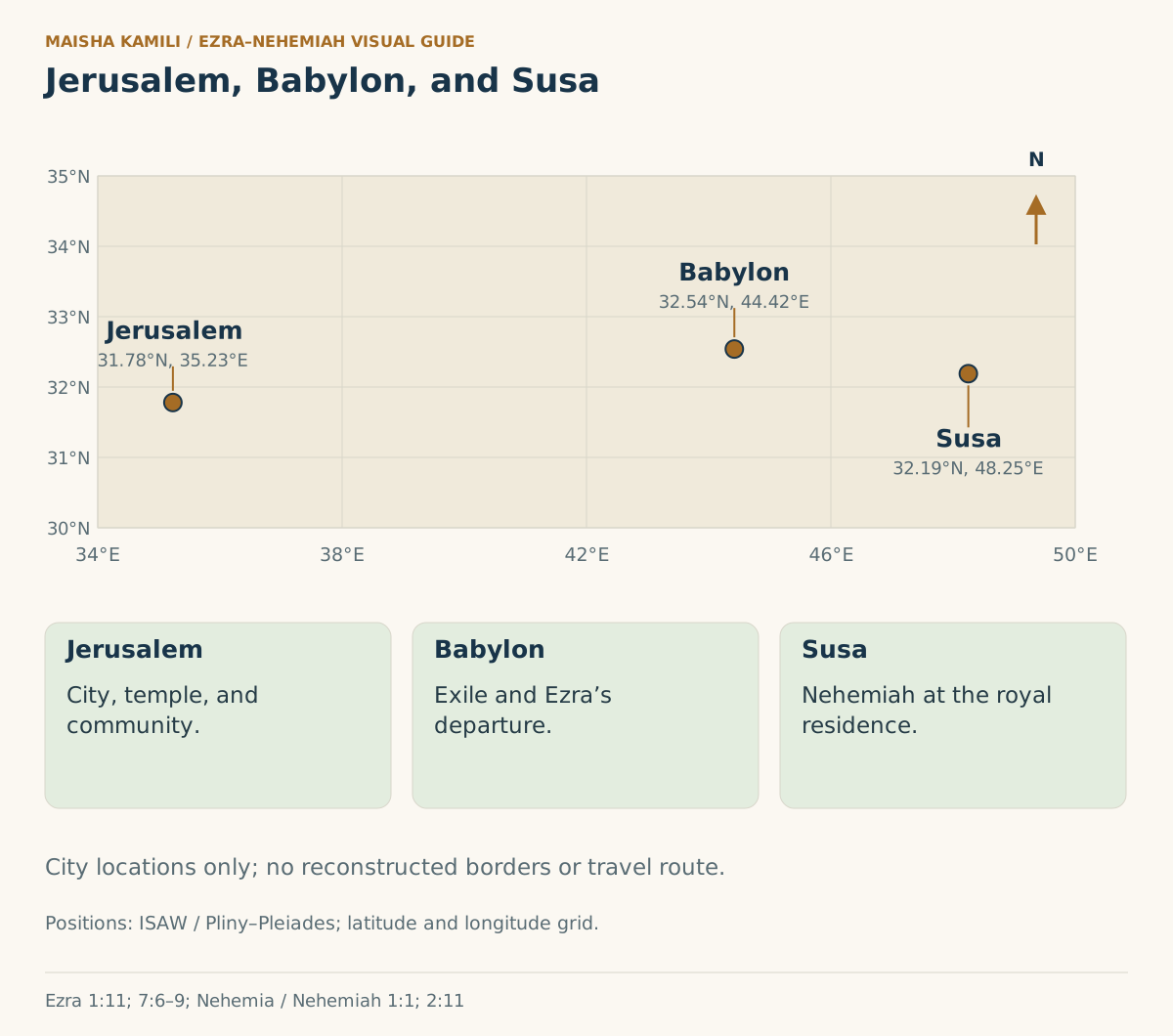
Visual reflection: How does regional distance deepen understanding of the community’s journey?
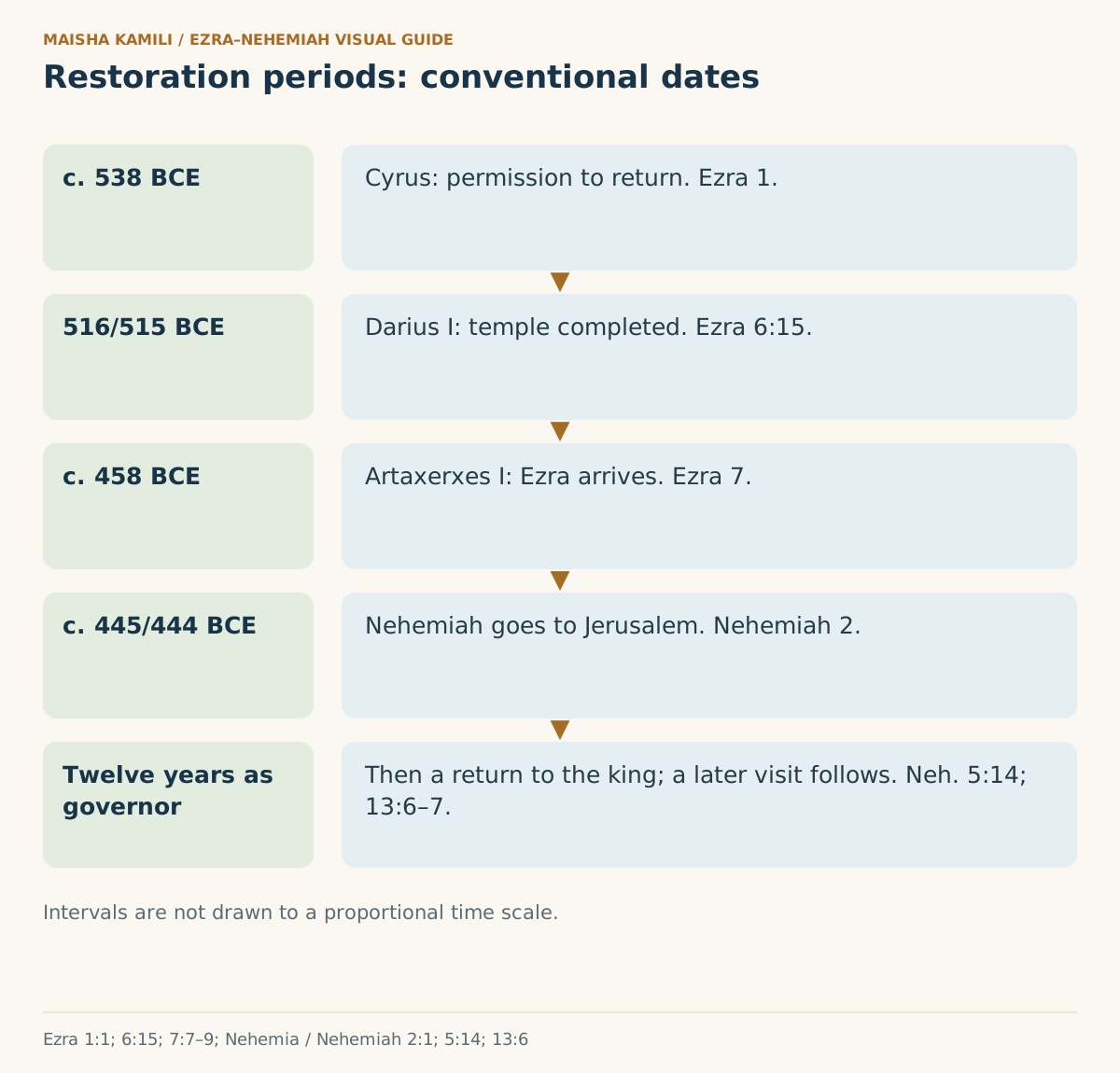
Visual reflection: How do the long intervals between restoration’s stages illuminate patience?
A Reading Map of Ten Chapters
Ezra 1–2 introduces permission, temple vessels, and the returning community. Chapter 3 places the altar before a completed temple and joins celebration to tears. Chapters 4–6 present opposition, the ministry of Haggai and Zechariah, documentary exchanges, temple completion, and Passover.
Chapters 7–8 bring Ezra the scribe into view: studying, practicing, and teaching Torah; gathering travelers; fasting; making the journey; weighing and delivering entrusted treasure. Chapters 9–10 confront a crisis involving marriage, identity, and covenant. The closing pages require more care than a simple success slogan.
Chapter 4 needs particular attention. Ezra 4:6–23 includes accusations under Ahasuerus and Artaxerxes; verse 24 returns to Darius’s period. The arrangement traces continuing opposition through later documents. Verse order therefore differs from a straightforward sequence of Persian reigns.
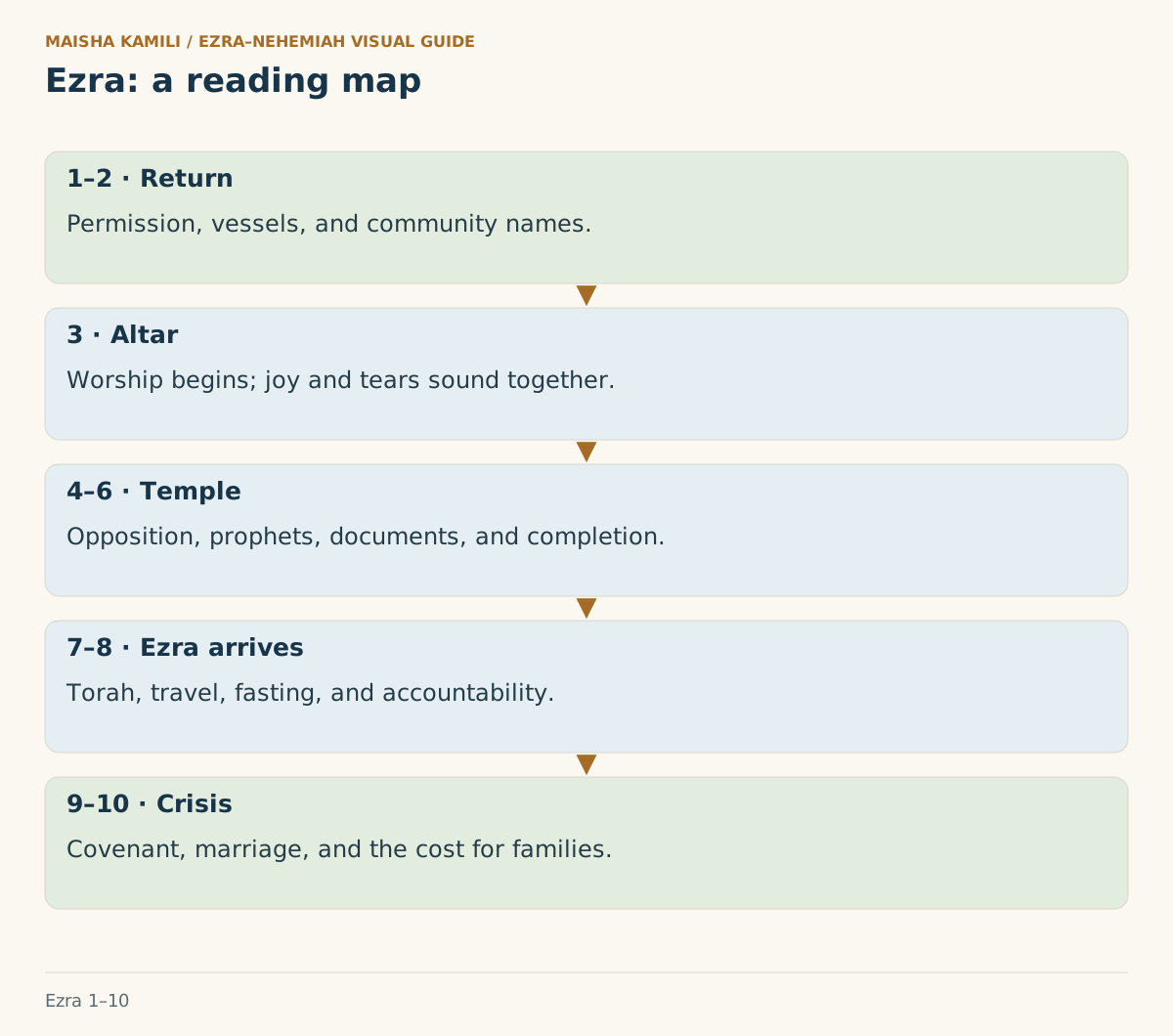
Visual reflection: How does the narrative change between Ezra 6 and 7?
People and Worship: Names before Buildings
Sheshbazzar receives temple vessels; Zerubbabel and the priest Jeshua lead rebuilding and worship (Ezra 1:8; 3:2; 5:14–16). Haggai and Zechariah encourage renewed work. Ezra arrives later as priest and scribe. Distinguishing the ministries avoids placing Ezra at the beginning of every event.
Long lists preserve a community of families, responsibilities, and forms of service. In chapter 3, celebration does not silence the older generation’s tears. Renewed worship carries memory alongside expectation. God’s work cannot be measured through a single emotional response.
A Difficult Passage: Covenant and the Cost for Families
Ezra 9–10 uses severe language about marriages with neighboring peoples, abominations, and danger to the covenant community. The text includes the removal of wives and children. The narrative supplies no individual account of every woman’s faith; the cost for families deserves acknowledgment.
Ruth the Moabite and Rahab prevent a simple equation between nationality and faithfulness within Scripture’s wider story (Ruth 1:16–17; Joshua 6:25). Christian pastoral guidance must also attend to 1 Corinthians 7:12–16 before turning Ezra into an instruction to dissolve marriages across differences of faith. Context, dignity, and safety belong within responsible interpretation.
A Christian Horizon: God’s House and God’s People
Ezra 7:10 joins study, practice, and teaching. The sequence describes leadership formed by Scripture before public instruction. A completed temple still requires faithful people.
John 2:19–22 connects temple language with Jesus’ body and resurrection. Ephesians 2:11–22 pictures Jews and Gentiles becoming God’s household in Christ. Christian reading looks toward divine presence and a renewed community while respecting Judah’s particular postexilic setting.
The return narrative therefore reaches beyond enthusiasm for a building project. Worship, accountable leadership, patient teaching, and care for neighbors belong to the work of rebuilding life.
Life Application
- Read in sequence. Pair a chapter with the corresponding study; identify the speaker and period before drawing a present application.
- Join learning to practice. Select a concrete act of faithfulness through Ezra 7:10 before preparing a teaching outline.
- Protect family dignity. Include the cost for wives and children within discussions of Ezra 9–10, alongside the covenant concerns.
Reflection Questions
- How does permission to return differ from completed restoration?
- How can tears alongside joy in Ezra 3 shape communal listening?
- How does Ezra 4 complicate a straightforward chronology?
- How can study, practice, and teaching remain connected in ministry?
- How does reading the whole biblical canon deepen responsibility toward families?
Response Prayer
God of mercy, open space for hope after loss. Let Scripture shape learning, decisions, and service. Lord Jesus Christ, form a community of truth, justice, and compassion. Holy Spirit, nurture faithfulness in ordinary work. Amen.
A Window toward Chapter One
Begin with the Ezra 1 study. Follow the chapter links through chapter ten and the conclusion, then read Nehemiah as the continuing journey of the community.
Bibliography
- The Bible. Ezra 1–10; Ruth 1; Joshua 6:25; John 2:19–22; Ephesians 2:11–22; 1 Corinthians 7:12–16.
- World English Bible, Classic. Ezra. Public-domain Scripture; the article provides commentary.
- United States Conference of Catholic Bishops. Introduction to Ezra. Literary structure and Persian royal names.
- Crossway. Chronology of Ezra. A conventional dating framework; resources differ between 516 and 515 BCE for temple completion.
Be the first to leave a comment.