

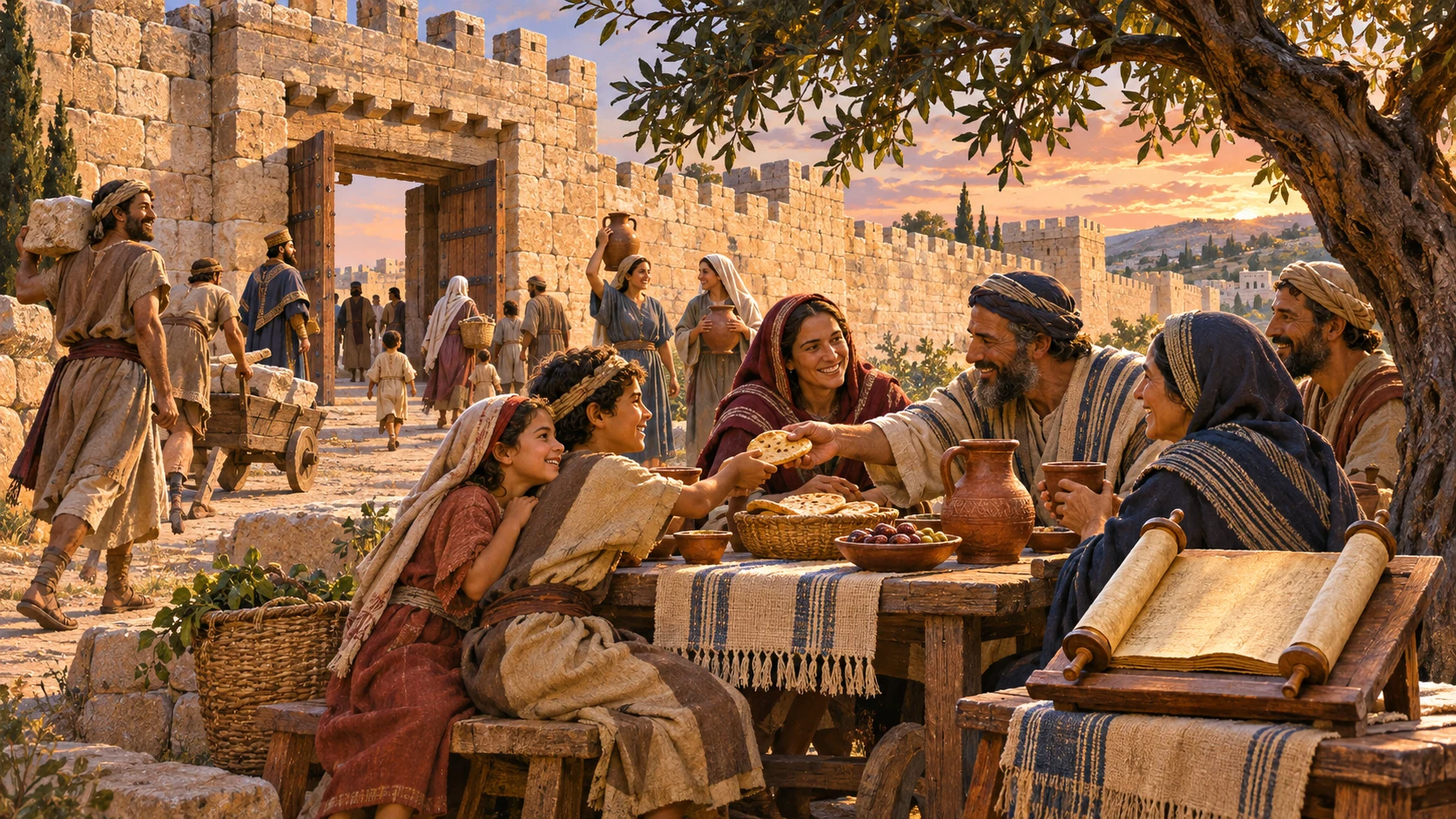
Why do covenant commitments require more than celebration and signatures?
Opening passages
Read Nehemiah 9:36–37; 10:30–39; 12:43; 13:10–22. Communal hope lives between celebration, covenant responsibility, and the continuing need for reform.
Introduction: After the Choirs Fall Silent
Celebration may carry across a neighborhood, while the following morning returns familiar questions. Will a worker receive payment? Will bread reach a hungry household? Will worship find room within a trading calendar? Celebration gives thanks; ordinary life reveals the continuity of commitment.
Nehemiah 12 places choirs upon the wall and joy within the city. Chapter thirteen follows with problems involving temple support, Sabbath trading, and covenant loyalty. The ending honors actual achievement while widening the question toward lives still requiring renewal.
Prayer Put on Working Shoes
Nehemiah began by hearing, weeping, confessing, and praying (1:1–11). The royal request involved time, letters, and resources (2:1–9). Assessment preceded the communal invitation. Prayer directed informed work rather than enthusiasm detached from actual conditions.
Chapter three preserves workers’ names and wall sections. Shared service needs room for artisans, families, and less prominent participants. The wall in 6:15 was completed in fifty-two days; teaching and covenant formation continued beyond fifty-two days.
Justice Belonged within Rebuilding
The cry in Nehemiah 5 exposed hunger, mortgaged property, debt, and enslaved children. Nehemiah demanded an end to exploitation and the return of property. Celebrating the wall cannot remove the internal cry from any assessment of success.
The governor’s conduct in 5:14–19 also raises questions concerning privilege. Authority can burden a community or support communal life. Leadership’s faithfulness becomes visible through resources, food, and responsibility reaching actual households.
Scripture, Memory, and the Table
Chapter eight joins reading, explanation, and shared food. Chapter nine remembers creation, Abraham’s call, exodus, land, rebellion, and mercy. God’s history provides a mirror for communal confession.
Nevertheless, 9:36–37 acknowledges subjection within a fruitful land. Geographic return has not ended every form of bondage. Confession opens attention toward actual conditions alongside hope resting in divine mercy.
Chapter ten carries concrete promises. Covenant relationships, Sabbath rest and trading limits, the seventh year, debt, and temple support enter ordinary life. Covenant reaches money, time, work, and the next generation.
Chapter Thirteen: Commitments under Pressure
The promise to support God’s house faces misuse of a room and neglect of Levites (13:4–14). The Sabbath promise faces trade at the gates (13:15–22). Relationships and the children’s language renew questions concerning covenant loyalty (13:23–29).
Comparing chapters ten and thirteen reveals a gap between signatures and enduring fidelity. The comparison gives Sabbath substantial weight: time dedicated to God and limits upon commerce require practice after the ink dries.
Nehemiah’s actions also need evaluation. Beating and pulling out hair in 13:25 provide no model for parenting or spiritual leadership. Mark 10:42–45 and 1 Peter 5:2–3 place service and example before domination. A reforming intention cannot remove the need for safety and dignity.
Covenant Hope and the Horizon of Christ
Nehemiah’s final prayers place the work before God. The book reveals reform’s importance alongside the fragility of changes depending upon effort and supervision alone. Jeremiah 31:31–34 and Ezekiel 36:26–27, within distinct prophetic settings, announce covenant renewal and a new heart. The connection belongs to a wider canonical reading rather than a hidden quotation inside Nehemiah.
In Christ, Ephesians 2:11–22 pictures Jews and Gentiles forming God’s household. Revelation 21 portrays a city filled with God’s presence and nations walking in divine light. Protection, worship, justice, and welcome open toward new creation. The church is called to offer a foretaste through present service.
The concluding vision therefore reaches beyond keeping a monument intact. A community can give thanks for finished work while continuing the patient task of learning, repentance, rest, and love.
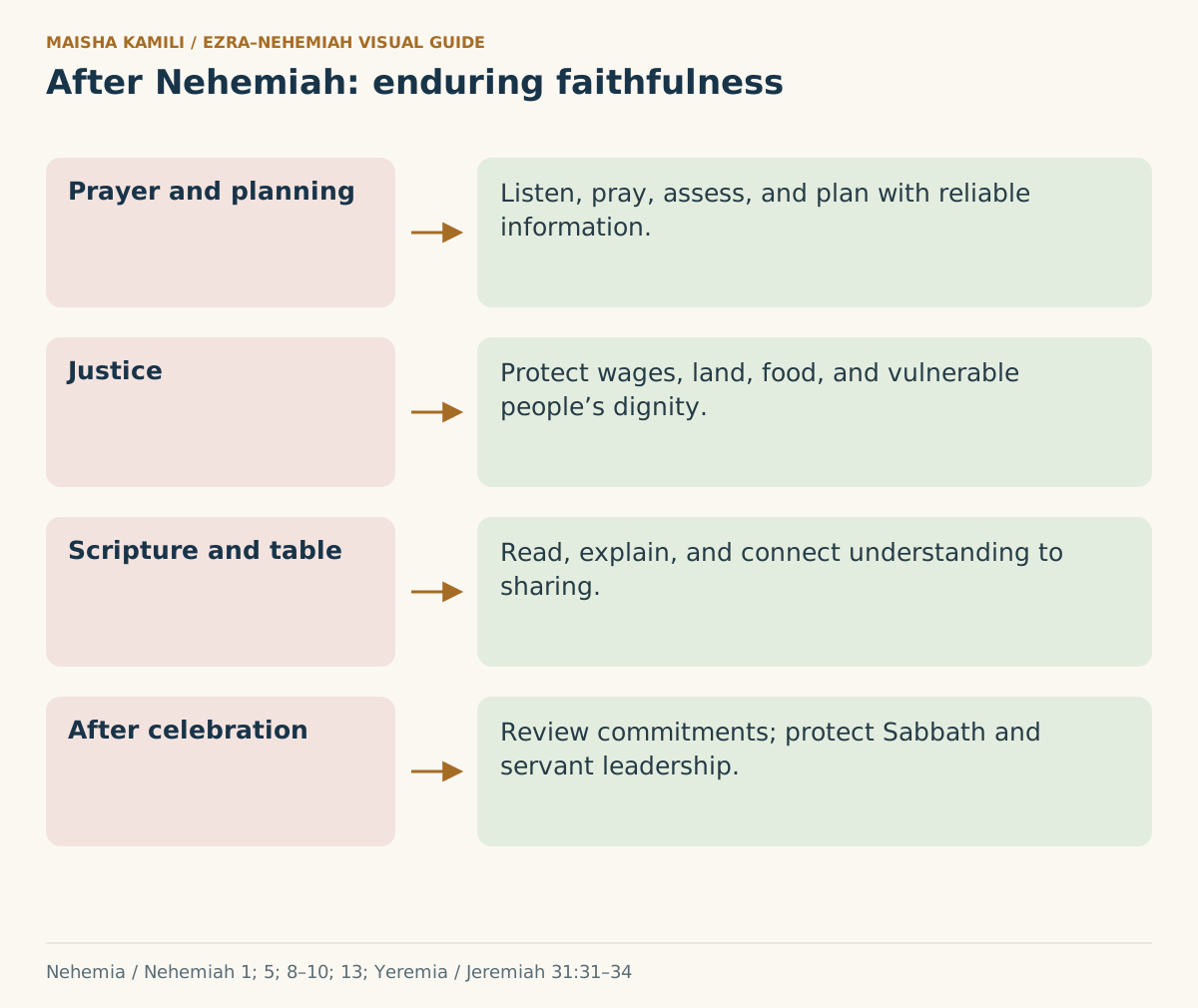
Visual reflection: How can one commitment receive a practical action and review?
Life Application
- Review promises after celebration. Choose one ministry commitment and set a review date one month later.
- Hear the cry within the project. Examine wages, debt, and vulnerable households before assessing success.
- Protect worship and dignity. Plan Sabbath rest and compassionate service; reject force and humiliation as leadership methods.
Reflection Questions
- How can prayer and planning remain connected?
- How does Nehemiah 5 reshape the measure of success?
- How does comparing chapters ten and thirteen expose gaps in practice?
- How can servant leadership preserve dignity during necessary correction?
- How can hope for a new heart nourish everyday faithfulness?
Response Prayer
God of covenant, let gratitude continue after the choirs fall silent. Let Scripture shape money and time. Jesus Christ, let Jesus’ service illuminate leadership. Holy Spirit, nurture justice, compassionate rest, and enduring faithfulness. Amen.
A Window toward Rereading
Return to the Nehemiah introduction for the reading map. Compare the ending with the Ezra conclusion: construction must open toward renewed communal life.
Bibliography
- The Bible. Nehemiah 1–13; Jeremiah 31:31–34; Ezekiel 36:26–27; Mark 10:42–45; Ephesians 2:11–22; 1 Peter 5:2–3; Revelation 21.
- World English Bible, Classic. Nehemiah 5, 10, 12, 13. Public-domain Scripture.
- United States Conference of Catholic Bishops. Introduction to Nehemiah. Structure and governorship.

Be the first to leave a comment.