

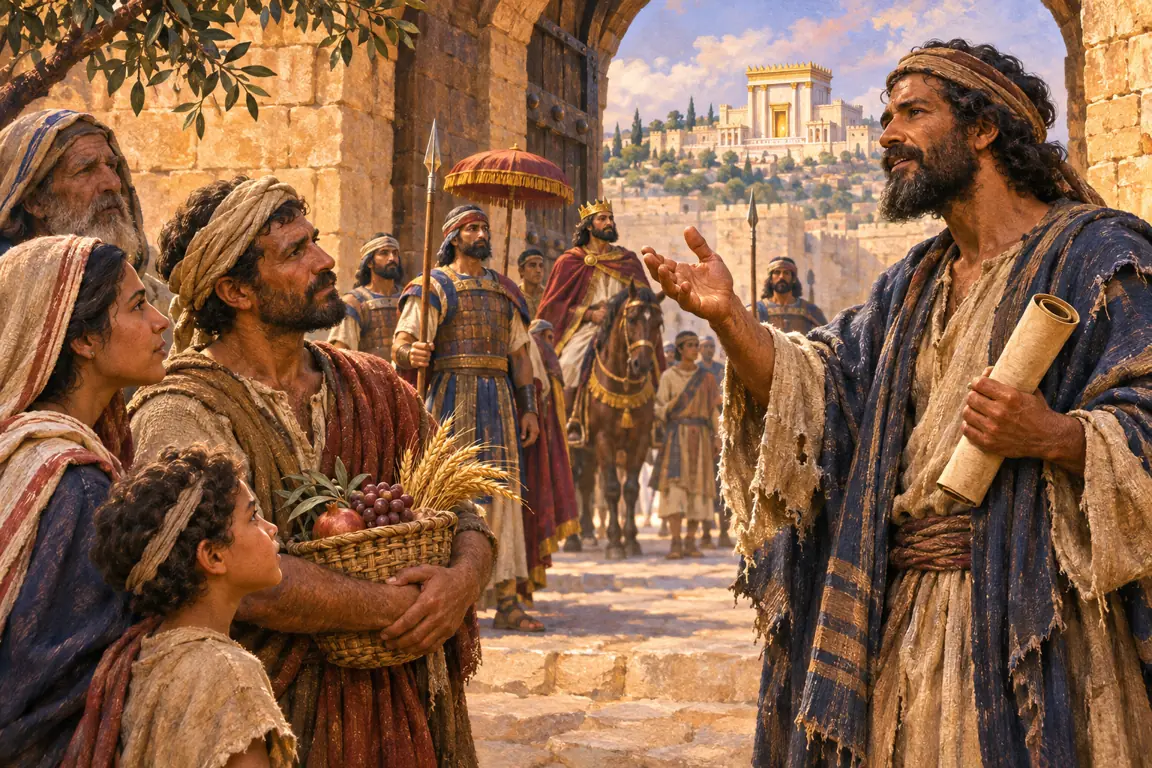
Why can a temple covered in gold fail to establish a kingdom’s faithfulness?
Reading guide
Reading the kings through covenant, prophetic witness, justice, and the hope of David's faithful Son
On the hill, a building glitters with gold. In the valley, a farmer waits for rain. At the palace, a king counts horses and treaties. At the city gate, a prophet asks about justice.
Crowns pass from head to head. Altars rise and fall. People celebrate, weep, and are carried from home. Yet one question keeps returning: Will the person on the throne listen to the word of the LORD?
- Key passages:
- 1 Kings 2:1–4; 8:22–53; 11:9–13; 2 Kings 17:7–23; 25:27–30.
- Guiding question:
- When a nation possesses wealth, armies, a temple, and capable leaders, what actually shows that the nation is walking in God's ways?
- Central claim:
- First and Second Kings tell the story of a crown entrusted with serving God's covenant but repeatedly turned toward serving itself, while God continues to speak through Torah and the prophets and preserves the hope of a faithful King.
Introduction — The Throne Must Never Become an Altar
Powerful leaders are compelling. Roads open. Buildings rise. Distinguished visitors arrive. Crowds cheer. In the bright light of such achievements, questions of faithfulness can seem impolite, almost ungrateful. A community may think, If everything appears to be moving forward, why ask troubling questions?
First and Second Kings refuse that bargain. The narrative begins with an aging David and a struggle over succession (1 Kgs. 1). Solomon receives wisdom and extraordinary resources and builds the temple (1 Kgs. 3–8). Yet the long journey ends among the ruins of Jerusalem, with the temple burned and families displaced (2 Kgs. 25). Between the beginning's splendor and the ending's ashes, the narrator asks a question that belongs not only in a royal palace but also in every congregation, household, and institution: Can a people possess the signs of success while losing the habit of listening to God?
These books were not assembled merely to let readers rank kings from favorite to least favorite. They interpret public life in the presence of the LORD. Rulers are assessed by worship, responsiveness to the word of God, and the treatment of the people—not simply by wealth, influence, or monuments. In the Hebrew Bible, Kings belongs among the Former Prophets. The history of the monarchy is viewed from within the demands and promises of covenant (Brueggemann 2000, 1–5).
The collection is called Kings, but its deepest subject is the LORD who rules over rulers, sees the vulnerable, and refuses to let his word become palace property. Therefore, this journey requires more than memorizing dates and names. It calls us to hear the voice that many rulers preferred not to hear.
Historical and Literary Setting — One Story, Two Wounded Kingdoms
In the Hebrew tradition, First and Second Kings constitute a single extended narrative. The division into two books in modern Bibles should not conceal the flow of the story. It traces the end of David's reign, Solomon's kingdom, the political split into Israel and Judah, the northern kingdom's fall, and Judah's exile. It closes with a small change in the circumstances of Jehoiachin, the imprisoned Davidic king in Babylon (2 Kgs. 25:27–30).
The main events span approximately the tenth to the sixth centuries BCE. Samaria fell to Assyria around 722/721 BCE, while Jerusalem was destroyed by Babylon around 587/586 BCE. The exact dating of particular reigns and the counting systems used by ancient sources remain matters of historical study. Faithful reading need not pretend that every chronological question has an undisputed answer (Provan 1995, introduction; Brueggemann 2000, 4–5).
Kings does not attempt to report every event of every reign. Sometimes decades pass in a few verses, while a large section pauses to follow Elijah, Elisha, and other prophetic voices. The narrator refers to other royal records, such as the annals of Israel and Judah, which are no longer independently available to us (1 Kgs. 14:19, 29). Such decisions about narrative space disclose the book's concerns: not every event celebrated by a palace is the event that matters most before God.
Torah provides the measuring rod. Deuteronomy 17:14–20 places the king under God's instruction and warns against accumulating horses, excessive wealth, and royal arrangements that divert the heart from covenant loyalty. Deuteronomy 6:4–5 calls for wholehearted love of the LORD; Deuteronomy 12 directs covenant worship; Deuteronomy 28–30 explains the seriousness of disobedience, exile, and renewed turning to God. God's promise to David (2 Sam. 7:12–16) stands alongside these requirements, never as an excuse to ignore them.
Kings therefore concerns more than good rulers and bad rulers. It asks us to view the throne, the temple, public finance, labor, foreign alliances, and ordinary households as places where a nation's spiritual commitments become visible. The narrator understands political realities, but refuses to grant political calculation the final word (Brueggemann 2000, 1–5).
Following the Story — From Gold to Exile
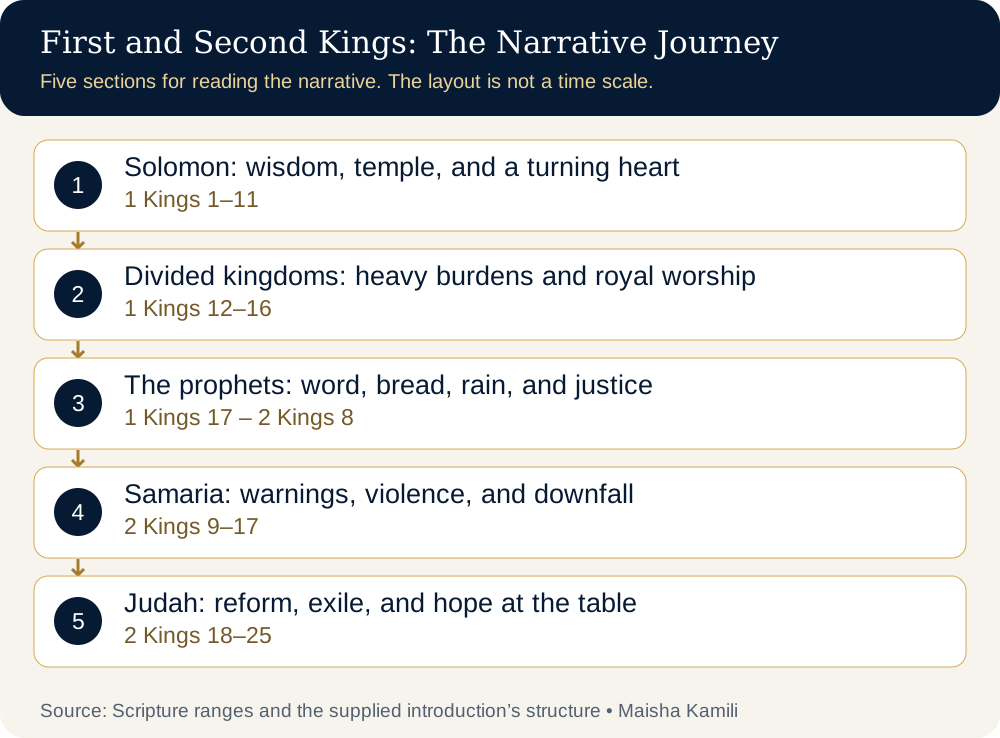
Solomon: When Wisdom Shines and Gold Grows Heavy (1 Kings 1–11)
The opening is unsettled. Adonijah attempts to secure the succession, while Bathsheba and Nathan intervene on Solomon's behalf (1 Kgs. 1). As David approaches death, David calls Solomon to walk in the LORD's ways and keep the commands of Moses (1 Kgs. 2:1–4). Readers receive the standard of kingship before seeing the achievements of kingship.
Solomon asks for a listening heart capable of administering justice (1 Kgs. 3:9). The judgment involving two women and one child shows what wisdom should mean for vulnerable people (3:16–28). The temple is built, and Solomon's dedication prayer invites Israel and even foreigners to call upon the LORD (1 Kgs. 8:27–43). The temple is a gift of presence, forgiveness, and welcome to the nations. It is not a religious possession by which one nation can confine God.
But the shadows lengthen. Great building programs require labor and governmental organization (1 Kgs. 5; 9:15–23). Horses and gold multiply (1 Kgs. 10:14–29). Finally, Solomon's heart turns toward other gods (1 Kgs. 11:1–13). Deuteronomy 17 has already taught the reader to recognize the danger. A king's wisdom cannot rescue a king who no longer listens.
The Kingdom Divides: When People Become a Burden to Be Managed (1 Kings 12–16)
Rehoboam refuses the people's request for relief from heavy labor and royal demands (1 Kgs. 12:1–14). The kingdom divides into Israel in the north and Judah in the south. The rupture expresses the judgment announced over Solomon (1 Kgs. 11:29–39), but it also takes concrete form in economic policy and the language of arrogant leadership.
Fearing that worship in Jerusalem will draw his subjects back toward David's house, Jeroboam establishes worship centers in Bethel and Dan, using images of golden calves (1 Kgs. 12:26–33). Fear of losing authority now shapes the nation's worship. Later kings repeatedly follow what the narrative calls Jeroboam's sin. The coups and killings of 1 Kings 15–16 reveal that a throne kept at any price never becomes genuinely secure.
The Prophets Stand in the Road: Bread, Rain, and Justice (1 Kings 17–2 Kings 8)
While royal courts contest power, Elijah appears and announces drought (1 Kgs. 17:1). Yet divine power is not confined to dramatic confrontation. God feeds the widow of Zarephath and restores her child (1 Kgs. 17:8–24). Carmel exposes the contest between the LORD and Baal (1 Kgs. 18), while Horeb teaches Elijah that God's work cannot be measured by noise and spectacle alone (1 Kgs. 19).
In Naboth's vineyard, Ahab and Jezebel manipulate royal and civic authority to seize a neighbor's inheritance (1 Kgs. 21). False worship and injustice meet on the same piece of land. Elisha, meanwhile, enters the lives of widows, children, hungry families, sick people, and foreigners—including Naaman of Aram (2 Kgs. 4–5). The prophets do not confront kings because they want to occupy the throne; they bear witness that human lives matter before God.
Samaria Falls: When a Rejected Word Becomes a Verdict (2 Kings 9–17)
Jehu executes judgment upon Ahab's house amid great violence (2 Kgs. 9–10), but he does not depart from the northern kingdom's corrupt worship system (2 Kgs. 10:28–31). Replacing one set of rulers does not necessarily heal the habits of a nation.
Assyria ultimately captures Samaria (2 Kgs. 17:1–6). The narrator interrupts the account of international politics to name covenant causes: worship of rival gods, resistance to prophetic warnings, and abandonment of the LORD's instruction (17:7–23). This is the biblical narrator's theological interpretation of the disaster; Assyria's campaign also has its own recognizable imperial and military history. The passage must not become permission to declare every modern victim of war or displacement guilty of causing that suffering.
Judah's Final Years: Reform, Fire, and a Place at the Table (2 Kings 18–25)
Hezekiah trusts the LORD in the face of Assyrian threats and undertakes religious reform (2 Kgs. 18–19). Manasseh then revives corrupt worship and is associated with the shedding of innocent blood (2 Kgs. 21:1–16). When Josiah hears the rediscovered book of the law, he humbles himself and reforms public worship (2 Kgs. 22–23). Nevertheless, external reform cannot immediately erase the consequences of generations of covenant failure.
Babylon conquers Judah. The temple burns and Jerusalem is ruined (2 Kgs. 24–25). Yet the final paragraph describes Jehoiachin, a king of David's line, released from prison and granted a place at the Babylonian king's table (25:27–30). The nation has not yet returned home. The promise has not been fulfilled in full. But this small act of dignity leaves the question of hope open. Even when the land is lost, God's story has not ended.
Four Theological Keys — Measuring the Crown by the Word
Torah: The King Must Listen Before He Rules
Wearing a crown does not turn personal preference into divine law. David charges Solomon to obey God's instruction (1 Kgs. 2:2–4); Josiah hears the covenant book and tears his robes (2 Kgs. 22:11). Here is the distance between leadership that seeks applause and leadership that accepts correction. Torah keeps the community from being treated as the private property of its rulers (Deut. 17:14–20).
Temple: God's Presence Is Not a License for Injustice
The temple is a place of prayer, forgiveness, and hospitality to foreigners (1 Kgs. 8:27–53). But a house of worship cannot substitute for a listening heart. When the sanctuary is linked with idols and oppression, the splendid building itself testifies against those who think religious prestige is enough (1 Kgs. 9:6–9; 2 Kgs. 21:4–7; 25:8–9). God cannot be bought by impressive ceremonies.
Prophets: Truth Must Not Be Owned by the Palace
Nathan, Ahijah, Elijah, Micaiah, Elisha, Isaiah, and Huldah demonstrate that no ruler possesses the LORD's word (1 Kgs. 1; 11; 17–22; 2 Kgs. 3–8; 19; 22). Sometimes prophetic speech announces judgment; sometimes it becomes bread for a widow, healing for a foreigner, or hope for a besieged city. Prophetic faithfulness is not measured by the volume of public applause but by truthfulness and its fruit.
Idols and Injustice: What Happens at an Altar Reaches the Fields
Idolatry does not remain inside a shrine. Jeroboam reshapes worship to secure political control (1 Kgs. 12:26–33); Ahab takes Naboth's land (1 Kgs. 21); Manasseh defiles the temple and fills Jerusalem with blood (2 Kgs. 21:1–16). In different ways, the stories show that what leaders worship affects how leaders treat their neighbors. At the same time, Scripture does not authorize us to label every present-day calamity a specific divine punishment.
For Christian readers, these themes point toward Jesus Christ. Jesus is David's Son who serves rather than exploits (Mark 10:42–45), follows the Father's will (John 5:19), announces good news to those pushed to the margins (Luke 4:16–21), and presents himself as the meeting place with God in a new and climactic way (John 2:19–22). Reading toward Jesus does not skip Israel's history. It follows the promise, warning, and hope until their larger purpose comes into view (Leithart 2006, introduction).
Reading and Living the Story — Seven Practices
- Read every king under covenant. When the narrator evaluates a ruler, compare the king's choices with Deuteronomy 6, 12, and 17. Notice where outward success and inward fidelity diverge.
- Trace who bears the cost of policy. In 1 Kings 5 and 12, ask who carries the labor burden. In 1 Kings 21, ask who loses the vineyard. In 2 Kings 24–25, ask who is driven from home.
- Bring worship into conversation with neighbor-love. After reading 1 Kings 8, ask whether the community's worship is matched by hospitality, forgiveness, and accountable use of money.
- Do not rush to blame victims. Distinguish royal choices, imperial violence, and the lives of ordinary people. Let the text move readers toward compassion, not toward fresh accusations against people in grief.
- Carry each chapter's question into the next. Watch for the fulfillment of a prophetic word, the return of an earlier warning, or a tension the next chapter deepens.
- Read together. In a study group, ask one person to tell the story, another to trace the Torah connections, and another to raise questions about justice and public life.
- Give obedience a practical shape. Each week, choose a real act: repay a debt, listen to an overlooked person, correct a financial practice, or apologize to someone harmed by an abuse of authority.
Five Questions for Reflection
- What kinds of success in a family, church, or institution can conceal a failure to listen to God's word?
- Which episode in Kings most clearly connects worship with justice for people who have little power?
- How does Solomon's temple express God's nearness, and how does the destruction of the temple expose the danger of religious self-reliance?
- Does our community make room for people who speak uncomfortable truths about powerful decisions?
- How does God's promise to David direct Christian hope toward Jesus without diminishing the real losses suffered by exiled people?
Response Prayer — Teach Us to Listen Before We Build
LORD, God of covenant and God of ordinary people,
As we begin this journey through Kings, keep us from staring at gold until we stop seeing tears. Teach us to look beyond palace gates, to hear the cries of widows, the prayers of foreigners, and the voices of those carrying the burdens of government. Open our ears to your word before we praise visible achievements.
Help us distinguish true wisdom from clever ways of protecting ourselves. Deliver us from worship that decorates altars while wounding neighbors. Give us courage to receive correction, even when correction comes from someone without a title. Shape hearts that desire justice more than applause.
When we reach Jerusalem's ashes, keep us from despair and from easy explanations that trivialize suffering. Lead us to Jesus Christ, David's Son, whose kingship brings life through self-giving love. Let your word become a lamp for our steps and a blessing to our communities.
Amen.
Window into the First Chapter — A Crown Seeks an Heir
Read next: Analysis of 1 Kings 1 — A Trumpet Above the Banquet.
The journey begins not in a glittering temple but in the chamber of an aging king. David no longer has his former strength; Adonijah attempts to crown himself; Bathsheba and Nathan appeal to the royal promise; Solomon waits. From the opening chapter, readers must distinguish between seizing authority and receiving responsibility before God.
Carry this question forward: What makes leadership legitimate—the power to announce oneself, a network of influential friends, or faithfulness to God's promises and instruction?
This article opens the full study of 47 chapters across the two books (22 in First Kings and 25 in Second Kings). Each chapter belongs to one unfolding narrative, moving from a throne filled with promise to a prisoner's surprising place at a table.
Bibliography — SBL Author–Date
- BibleProject. n.d. The Books of Kings. BibleProject Guide.
- Brueggemann, Walter. 2000. 1 & 2 Kings. Smyth & Helwys Bible Commentary. Macon, GA: Smyth & Helwys.
- Leithart, Peter J. 2006. 1 & 2 Kings. Brazos Theological Commentary on the Bible. Grand Rapids: Brazos Press.
- Provan, Iain W. 1995. 1 and 2 Kings. New International Biblical Commentary 7. Peabody, MA: Hendrickson. Also issued in the Understanding the Bible Commentary Series.
- Wright, N. T. 1996. Jesus and the Victory of God. Christian Origins and the Question of God 2. Minneapolis: Fortress Press.
Reading note
Editorial note: The primary foundation is the biblical text of First and Second Kings, read alongside the project resources by Brueggemann, Provan, Leithart, and BibleProject. The connections with Jesus represent a Christian canonical reading; they are not claims that every passage in Kings names Jesus directly.
Be the first to leave a comment.