

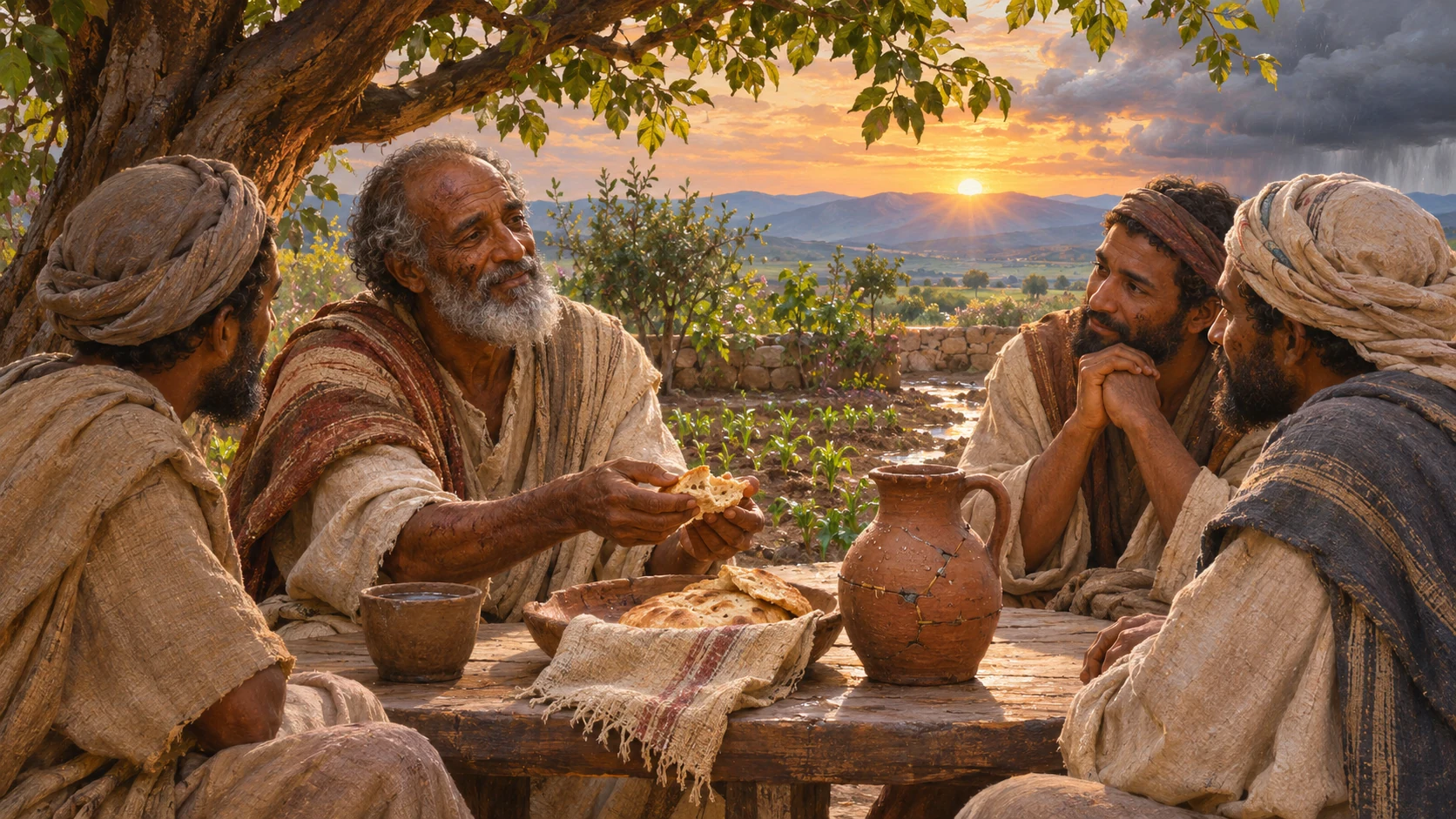
How can the table in Job 42 teach compassionate care without turning restoration into a promise of wealth?
Opening passages
Read Job 42:1–17 and James 5:11. The ending joins encounter with God, correction of speech, intercession, and renewed community. The message extends beyond increased possessions.
Introduction: After Thunder, Voices at a Table
The journey opens with messengers of catastrophe and a collapsed household. The journey closes with relatives and acquaintances eating with Job, offering consolation and bringing gifts. The table in Job 42:11 belongs to the ending’s substance rather than decoration after a spiritual lesson. Bread, presence, and practical support become a language of restoration.
Yet a table does not erase graves. Later children are no replacement for children lost. Doubled livestock does not reduce bereavement to a balanced account. Job’s generous ending deserves reverent reading beside readers still living with unresolved pain.
The series conclusion gathers the movement of all forty-two chapters. The journey begins with worship beyond purchased benefits and leads toward humble wisdom, compassionate speech, and hope beyond hurried explanation.
The Opening Question Was Never the Price of Blessing
The accuser challenged Job’s faithfulness within a protective hedge (Job 1:9–11). If worship amounts to a transaction, removing benefits should end fidelity. The narrator and the Lord, however, affirmed Job’s integrity before the friends began debating.
Consequently, restored possessions do not establish hidden wrongdoing as the cause of the disasters. Reading the ending as payment for a successful technique would reinstate the principle challenged by the book. Closing grace is no purchase price for prayer, and human suffering supplies no license for a community to judge every wounded person.
Lament Was Not the End of Faith
Job cursed the day of birth in chapter 3, sought an arbiter in chapter 9, named a heavenly witness in chapter 16, and confessed a living vindicator in chapter 19. Prayer formed no straight line of a single emotion; prayer carried fear, anger, hope, and bewilderment.
The book does not make every declaration by Job correct. Job acknowledges speaking without adequate understanding (42:3). Nevertheless, the rebuke of the friends distinguishes honest engagement before God from religious accusation assigning unproved guilt. Faith can receive correction without being silenced.
Creation Widens the Room of Questions
In Job 38–39, God speaks of earth’s foundations, the sea, dawn, rain, stars, and wild creatures. The questions provide no transcript of the heavenly council. The questions correct claims to understand the governance of the world through the pain of a single event alone.
Rain refreshing uninhabited ground reveals care beyond human usefulness (38:25–27). Wild animals need not serve a farm to belong within sustained creation. Job receives an invitation into wider wisdom rather than a declaration of human worthlessness.
Behemoth and Leviathan in chapters 40–41 intensify the picture of limited human control. The descriptions employ powerful poetry, and the creatures’ identities remain debated. The illustrations therefore make neither a scientific identification of dinosaurs nor an automatic equation of either creature with Satan.
Encounter with God and the Correction of Speech
Job 42:1–6 presents an acknowledgment of limited knowledge and change arising from encounter with God. Verse 6 is difficult to translate: interpreters differ over rejection, repentance, and a changed stance concerning dust and ashes. Linguistic difficulty deserves acknowledgment rather than a slogan for winning an argument.
Two elements remain clear in the sequence: Job admits speaking beyond understanding, and God rebukes the friends for wrongful speech (42:3, 7–8). Correcting Job does not turn the friends’ accusations into truth. God never declares the children’s deaths a penalty for Job’s secret oppression.
Intercession in 42:8–10 draws Job from isolation into renewed relational responsibility. Prayer constructs no machine for acquiring property. The narrative places intercession and restoration within grace rather than offering a spiritual technique for controlling God.
Gift, Community, and Remembered Tears
Job 42:12 records livestock doubled from the opening: sheep, camels, yokes of oxen, and female donkeys. Job 42:13 names seven sons and three daughters rather than a doubled number of children. The narrative’s numbers deserve accuracy without treating children as units of property.
The daughters’ names and inheritance alongside the brothers receive attention in the ending (42:14–15). Family, dignity, time, and ordinary life return within the horizon of grace. The later family does not announce the insignificance of the earlier bereavement.
Relatives bring consolation together with gifts (42:11). For a contemporary community, hope can take practical form through food, transport for care, attentive listening, and consensual assistance. Loving action remains possible without claiming knowledge of every reason for suffering.
From Job’s Perseverance toward New Creation
James 5:11 directs attention toward Job’s perseverance and the Lord’s compassion. Biblical perseverance is no suppression of questions for an appearance of strength. Perseverance can continue bringing life before God while communal care and justice remain essential.
The sinless Jesus suffered without suffering proving Jesus guilty (1 Peter 2:22–24). The cross reveals God’s love within a wounded world; resurrection opens hope beyond renewed present success. A Christian connection first respects Job’s voice within the book of Job.
Revelation 21:1–5 places the end of death and tears within God’s renewal of creation. Until the promise’s fulfillment, the church is called beside the ashes, toward humble truthfulness and bread upon a table. Hope needs no hurried explanation before beginning to serve.
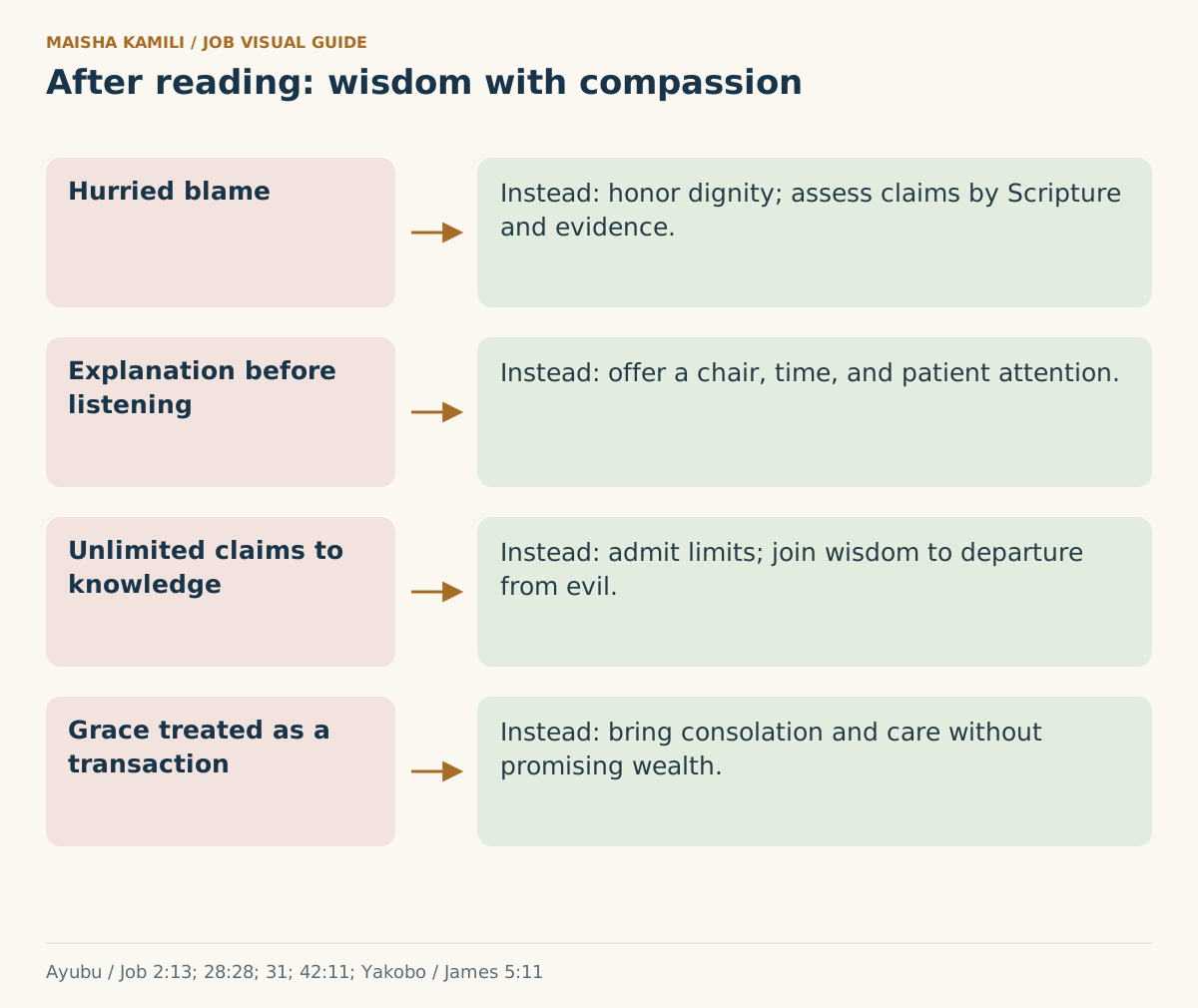
Visual reflection: How can listening, justice, or service begin after completing the series?
Life Application
- Reconsider a hurried claim. Examine an assertion about suffering and guilt through Job 1:1; 2:3; 42:7–8. Acknowledge harmful speech where appropriate.
- Give consolation practical form. With consent, arrange one useful act of care for a grieving person or household within seven days.
- Continue reading in hope. Revisit a difficult chapter; place textual observation, interpretation, and a question in separate columns before an unhurried discussion.
Reflection Questions
- How does the book prevent reading the ending as a formula for doubled wealth?
- How does correcting Job’s speech differ from accepting the friends’ accusations?
- How can the table in Job 42:11 shape a church’s ministry?
- How can resurrection hope change care for grief without removing room for lament?
- How can listening, justice, or practical assistance begin after completing the series?
Response Prayer
God of compassion, grant humble speech before the mystery of suffering. Let faith find room for lament without abandoning hope.
Lord Jesus Christ, let the light of cross and resurrection bring courage for love. Holy Spirit, form a church with listening chairs, helpful hands, and tables of welcome. Amen.
The Journey Continues
Return to the book introduction for the chapter map, or revisit the Job 42 study. The book may close; the work of listening, justice, and hope continues.
Bibliography
- The Bible. Job 1–42; James 5:11; 1 Peter 2:22–24; Revelation 21:1–5.
- World English Bible, Classic edition. Job 42. Public-domain Scripture; the article’s exposition is commentary.
- United States Conference of Catholic Bishops. “Job 42,” notes on 42:6–8. Translation difficulties and silence concerning Elihu.
- BibleProject. “Job.” A guide consulted for comparison of wisdom and suffering themes. Accessed 6 November 2026.


Be the first to leave a comment.