


How does Job’s integrity before calamity reshape the reading of suffering, lament, and divine wisdom?
Opening passages
Read Job 1:1; 2:3; 28:28. Job’s integrity is established before the account of suffering. At the end of the wisdom poem, reverence for the Lord and turning from evil stand at the center of a wise life.
Introduction: A Seat beside Suffering
A visitor can enter a hospital room carrying many explanations, while the bedside first needs a listening chair. A bereaved household, a prisoner carrying public shame, or a parent awaiting difficult news may need attentive presence before a theological argument. Pain deserves room before pain receives an explanation.
The book of Job draws a chair beside an ash heap. Job loses possessions, children, and health; visiting friends eventually attempt to explain the disasters. The book reaches beyond the cause of a single event: can worship endure without profit, and can human speech about divine justice avoid making sufferers into defendants?
The Maisha Kamili series follows all 42 chapters. The introduction supplies a reading map; illustrations within the studies locate individual chapters along the journey. A reading map keeps the book’s distinct voices audible without closing the book’s difficult questions.
Setting: Background Requiring Humility
Job lives in Uz, outside the usual setting of Israel’s national narratives (Job 1:1–3). Lamentations 4:21 associates Uz with Edom, but Job’s precise home remains unlocated. A place-name supplies no warrant for a confident modern map pin or an exact travel route.
The book names neither an author nor a precise date of composition. Family organization, livestock, and sacrifice evoke an ancient setting; the story’s setting and the time of literary composition remain separate questions. Limited background details concentrate attention on humanity before God.
Job belongs to wisdom literature. Prose frames the opening and ending; poetry, lament, and disputation fill much of the center. Courtroom, mining, and sea imagery require literary attention before being treated as scientific description or God’s final verdict.
A Reading Map for 42 Chapters
Job 1–2: readers hear the accuser’s challenge and witness calamity; Job receives no report of the heavenly council. Job 3: a birth lament opens the poetic section. The difference between the reader’s knowledge and Job’s knowledge is essential for following the debate.
Job 4–27: Eliphaz, Bildad, and Zophar debate with Job. The first two cycles follow a recognizable pattern; the third cycle becomes shortened and uneven. The wisdom poem in Job 28 places a limit on obtaining wisdom through power or wealth.
Job 29–31: remembered honor, present humiliation, and an oath of integrity form Job’s final defense. Job 32–37: Elihu speaks. Job 38:1–42:6: the Lord answers from the whirlwind and Job responds. Job 42:7–17: judgment concerning the speeches, intercession, consolation, and restoration close the narrative.
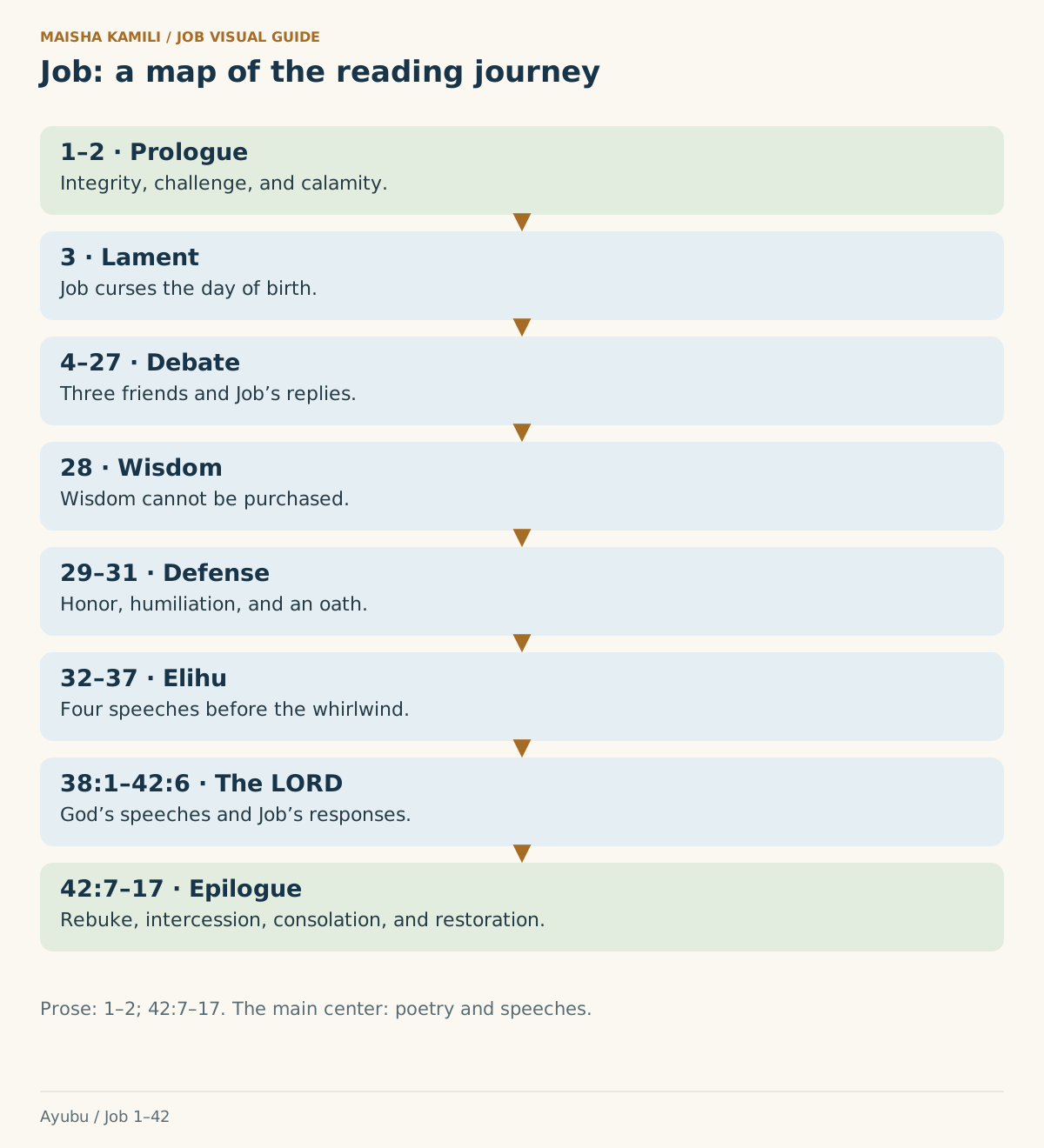
Visual reflection: How does a change of speaker or literary form alter the reading?
Distinct Voices: Listening before Quoting
The narrator establishes Job’s integrity at the beginning. The friends treat suffering as evidence of guilt. Job rejects the accusations and sometimes speaks beyond Job’s knowledge of God. Scripture preserves a debate; the preservation of a speech does not endorse every character’s claim.
Eliphaz appeals to experience, Bildad to inherited wisdom, and Zophar to stern warning, yet each speech deserves close attention. Elihu also requires contextual reading rather than automatic identification with God’s voice. Elihu is not named in the rebuke of Job 42:7–9; the closing silence supplies no certificate endorsing every statement.
Before using a verse for pastoral care or preaching, identify the speaker, addressee, context, and the book’s final evaluation. A friend’s pronouncement about punishment may belong to an argument challenged by the narrative.
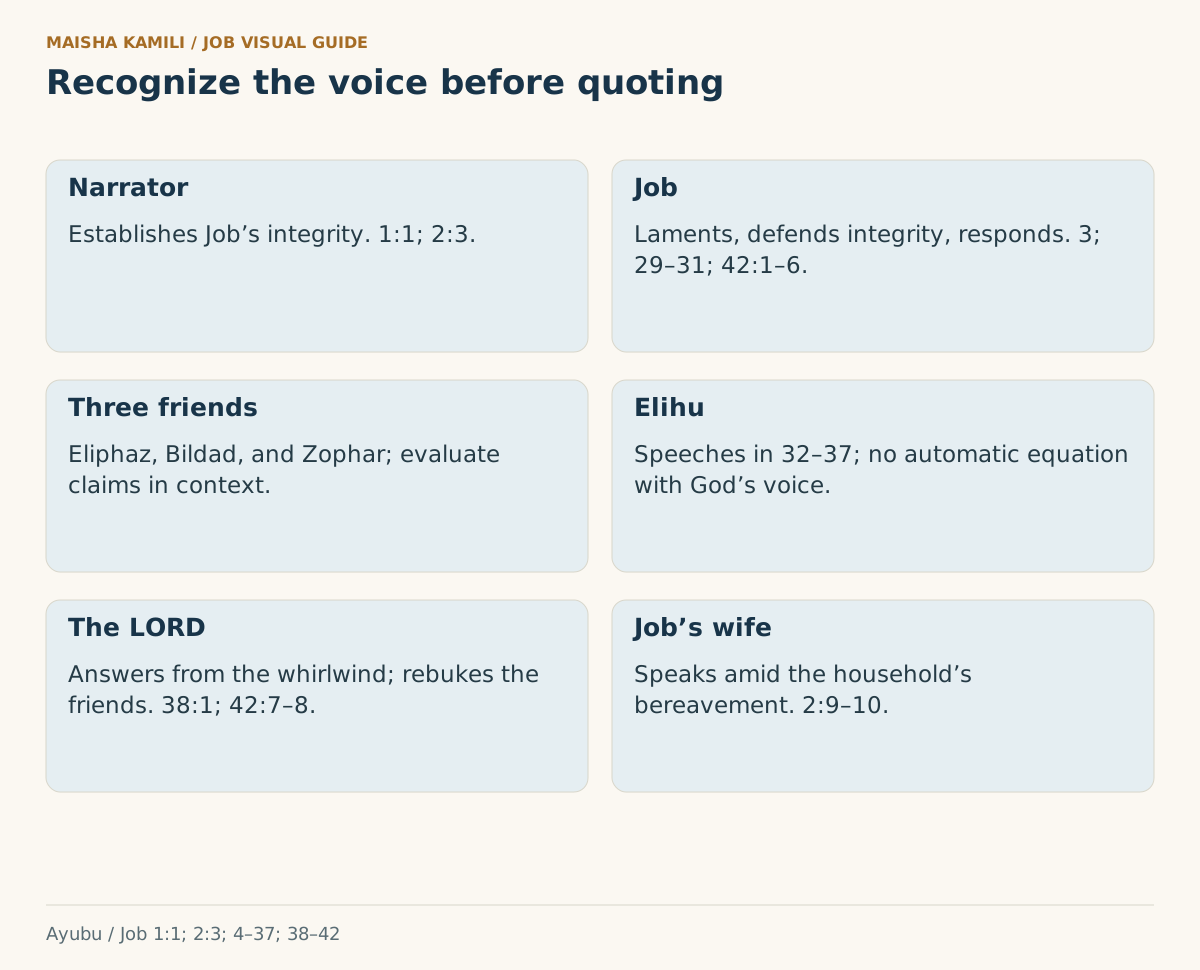
Visual reflection: How does identifying the speaker change the pastoral use of a verse?
Wisdom, Lament, and Justice
The friends’ error does not consist in believing God is just. The error emerges when a moral principle becomes a verdict over every event: a sufferer must have committed hidden wrongdoing. Job 1:1 and 2:3 have already blocked the easy inference.
Job 3 makes room for lament, while Job 28:28 joins wisdom to reverence for the Lord and departure from evil. Job 31 brings eyes, money, labor, strangers, and vulnerable neighbors into the discussion of integrity. Divine wisdom does not release humanity from responsibility for justice.
In Job 38–41, the Creator reveals a world of order and untamed life beyond human management. Rain falls even on uninhabited land (38:25–27). God’s answer exposes the limits of Job’s knowledge without endorsing allegations of secret wickedness.
A Christian Horizon without Forced Meanings
James 5:11 remembers Job’s perseverance together with the Lord’s compassion. Job’s perseverance was no questionless silence. The narrative preserves crying, debate, and waiting while challenging worship measured solely by benefits.
In Christian reading, the suffering of the sinless Jesus overturns the assumption of suffering as automatic punishment for personal wrongdoing (1 Peter 2:22–24). Cross and resurrection open a horizon of hope. Job 19:25–27 also contains interpretive difficulties deserving attention within the original context; the longing for a living vindicator should not become a simple diagram of every detail concerning life after death.
Revelation 21:1–5 places the end of tears and death within new creation. Christian hope makes neither the ash heap unreal nor Job’s restored fortunes a contract promising wealth to every believer.
Life Application
- Begin with the full passage. Read one section of the book map and the corresponding study; record the speaker’s name before selecting a verse for use.
- Make room for listening. In a safe conversation, ask about the sufferer’s actual need before offering a reason for suffering.
- Join wisdom to justice. Choose one faithful action concerning work, money, or a neighbor in the light of Job 31. Necessary healthcare or protection should not be delayed by religious explanations.
Reflection Questions
- How does Job’s integrity at the opening change the interpretation of calamity?
- How does the gap between the reader’s knowledge and Job’s knowledge caution against confident explanations of suffering?
- How can the friends’ speeches be distinguished from God’s closing evaluation?
- How can reverence for the Lord and departure from evil shape ordinary decisions?
- How can a church make a listening chair part of a ministry of hope?
Response Prayer
God of wisdom, grant patient hearing in the presence of pain. Let faithful speech bring room for truth and hope rather than stones upon a wound.
Lord Jesus Christ, let the compassion of the cross and the light of resurrection guide reading, listening, and justice. Holy Spirit, form a community of love, integrity, and courage beside the grieving. Amen.
Reading Window: Entering Chapter One
The journey begins with Job’s integrity before the protective hedge falls. Read the Job 1 study; follow the chapter links through chapter 42 and the series conclusion.
Bibliography
- The Bible. Job 1–42; Lamentations 4:21; James 5:11; 1 Peter 2:22–24; Revelation 21:1–5.
- World English Bible, Classic edition. Job. Public-domain English Scripture; the article’s exposition is commentary rather than a quotation of the translation.
- BibleProject. “Job.” A reading guide consulted for comparison of structure and themes. Accessed 6 November 2026.
- United States Conference of Catholic Bishops. “Job 42,” notes on 42:6–8. Translation difficulties and the closing evaluation of the friends.


Be the first to leave a comment.