


How does thanksgiving change how we enter God’s presence and welcome others?
01
Overview
When the whole earth is invited to rejoice before the God who made us, claims us, and remains faithful through every generation
Key text — Psalm 100:3–5 (thematic study rendering): Recognize that the LORD is God. He made us, and we belong to him: we are his people, the flock he shepherds. Enter his gates with thanksgiving and his courts with praise. For the LORD is good; his steadfast love endures forever, and his faithfulness continues through every generation.
There are doors through which we enter cautiously. We wonder whether we are expected, whether we belong, whether someone will question our presence. Other doors open onto a welcome so generous that the fear of being a stranger begins to loosen its grip.
Psalm 100 pictures the latter: gates opening, a congregation singing, and an invitation that reaches beyond the people already gathered. Yet it is more than a song about feeling welcome. Its joy rests on a demanding confession: the LORD is God, and our lives belong to him. The God who invites the earth to sing is not a distant spectator. He is the Maker, Shepherd, and faithful Lord of his people.
The psalm is only five verses long. Its vision is as wide as the world, and its promise as long as the generations.
02
1.0 Introduction
Psalm 100 concludes a remarkable sequence of praise in Book Four of the Psalter (especially Pss. 93; 95–100). Psalm 95 invited worshipers to sing but warned against hardened hearts. Psalm 96 asked the nations to announce God's glory. Psalm 97 joined divine kingship to righteousness. Psalm 98 imagined rivers and mountains joining the song. Psalm 99 urged the people to bow before the King who is holy and just. Now Psalm 100 gathers these movements into a brief, radiant invitation: come before the LORD with joy, acknowledge who he is, and praise him for who he has always been.
Its pattern is unusually clear:
- Verses 1–3: An invitation to joyful worship, followed by the reason for worship: the LORD alone is God; he made and shepherds his people. - Verses 4–5: A renewed invitation to enter with thanksgiving, followed by the deeper ground of confidence: God's goodness, steadfast love, and faithfulness outlast every generation.
John Goldingay notices the poem's two parallel movements—an invitation followed by the reason for it—and observes that the summons is addressed to the whole earth even though the declaration of belonging recalls Israel's particular story (Goldingay 2008, Psalm 100, “Interpretation”). Derek Kidner describes it as a joyful summit of the surrounding kingship psalms, whose alternating celebrations and solemn warnings have now led to thanksgiving (Kidner 2014, 388–90).
Central message: Worship becomes both truthful and joyful when we recognize that we are not self-made or self-owned. Our Creator has dealt faithfully with his people and calls the whole world to acknowledge his goodness. Thanksgiving is the fitting response to that gift—and faithful service is its continuing shape.
03
2.0 Historical and Literary Context
The heading identifies Psalm 100 as a psalm for thanksgiving (Hebrew mizmor letodah). The noun todah can describe thanksgiving, public acknowledgment of God's deeds, and, in certain contexts, a thanksgiving offering (Lev. 7:12–15). The title could reflect liturgical use connected with such an offering. But the poem does not describe a sacrifice or specify a particular festival; therefore, its origin cannot be tied confidently to one ritual occasion. Goldingay stresses that its essential character is a summons to praise, even if it was later used with thank offerings (Goldingay 2008, “Heading”).
Nor does the text identify an author or date. References to gates and courts (v. 4) evoke the sanctuary and the language of communal worship, but they do not by themselves prove that the psalm was composed for one procession through Jerusalem's temple. The image is larger than its architectural setting: the whole earth is invited to approach the God Israel has known.
This is especially significant in Book Four (Pss. 90–106). Psalm 89 ended with a painful question about the apparently broken Davidic monarchy. Psalm 90 redirected attention to the eternal God who has been his people's dwelling place through generations. As Book Four progresses, confidence does not depend on a visible earthly throne. It depends on the LORD's own kingship and covenant fidelity. Psalm 100 adds a joyful conclusion to that response: God's reign is good news not only for Israel but for every people.
The psalm's compact arrangement also connects it to its neighbors. Its opening cry recalls Psalm 98:4; the sheep metaphor recalls Psalm 95:7; the invitation to all peoples echoes Psalm 96; and its confession of divine goodness echoes the repeated witness that God's steadfast love endures (Pss. 106:1; 107:1; 118:1; 136:1). The cluster need not have been composed all at once for its placement to create a powerful literary conversation.
A final distinction matters. The invitation is universal, while the confession that God made “us” and shepherds “his people” can refer in its first setting to God's formation of Israel as a covenant people (Deut. 32:6; Isa. 43:1; 44:2). This is not a denial that God made all humanity. It recognizes that the poem announces the LORD's identity to the world by recalling what he has done in Israel's history. The story is particular; the invitation is open to all.
04
3.0 Walking Through the Text
3.1 Psalm 100:1 — A royal shout from the whole earth
The opening summons calls all the earth to raise a joyful shout to the LORD. The verb suggests more than quiet approval. Similar cries accompany royal acclamation and collective celebration (Pss. 47:1; 66:1; 95:1; 98:4–6). This is worship with a public voice: the King is worthy of a response that can be heard.
Yet the psalm does not make loudness a measure of holiness. A congregation does not become more faithful simply because it is noisier, nor is a quiet worshiper less devoted. The command describes a fitting communal recognition of the King, not a competition in emotional intensity.
The most startling phrase is “all the earth.” Israel's worship becomes an invitation rather than a possession guarded against outsiders. The LORD is not the deity of one territory alone. His sovereignty extends to the world, and the world is asked to know him. This does not mean the psalm has already described how every people will respond; it announces the scope of the invitation.
For communities divided by language, nationality, class, or ethnicity, this opening is searching. Do our songs proclaim the God of all peoples while our practices imply that only people like us truly belong?
3.2 Psalm 100:2 — Serving joyfully and entering his presence
The next line joins three expressions: serve the LORD with gladness, come before him, and do so with singing. The Hebrew verb often translated “serve” (ʿabad) is broader than performance during a worship service. It may describe the service of a subject to a king, labor, or devotion to God. Kidner draws out the link between worship and daily service; Goldingay insists that serving God calls for the whole self, not merely the feelings of an hour (Kidner 2014, 389; Goldingay 2008, on vv. 1–3).
There is a wonderful paradox here. Serving an earthly master may evoke compulsion, but the LORD's people are summoned to glad service. The psalm is not inviting an audience to applaud a performance while remaining uninvolved. It calls for the joy of recognizing to whom our life is devoted.
Gladness is an invitation, not an instrument of pressure. Psalm 100 belongs to the same Psalter that preserves Psalm 88's unanswered lament, Psalm 90's grief over mortality, and Psalm 94's protest against injustice. A person entering worship with bereavement, exhaustion, or unanswered prayer should not be told that sorrow disqualifies them from praise. Corporate worship can carry those who cannot yet sing. The Lord who receives joyful songs also receives tears (Ps. 56:8).
Joy is not the denial of pain. It is the recognition that pain is not the whole story of the God before whom we stand.
3.3 Psalm 100:3 — Know that the LORD is God
The third verse gives the first reason for praise: “Know that the LORD is God.” The command is not a call to accumulate religious information. In biblical usage, knowing God involves acknowledging his identity and living in response to it. The confession recalls Israel's foundational claim that the LORD, not the alternatives people worship, is God (Deut. 4:35, 39; 1 Kgs. 18:39).
Next comes a textual difficulty worth noticing. The consonants represented in the Hebrew manuscript tradition allow two closely related readings:
- “He made us, and we are his”—following the traditional oral reading and many modern translations. - “He made us, and not we ourselves”—reflecting the written reading found in some Hebrew textual witnesses and in older translations.
The difference arises because the Hebrew expressions for “his” (lô) and “not” (lōʾ) sound alike. Both make good theological sense. We do not bring ourselves into existence, and we belong to the One who made us. Many commentators, including Kidner, prefer “we are his” because it flows naturally into the words that follow: his people, the sheep of his pasture (Kidner 2014, 389–90). The manuscript distinction deserves to be explained rather than concealed.
The phrase “he made us” can include the creation of human life. Yet the immediately following reference to his people also recalls God's formation of Israel through calling and deliverance (Exod. 19:4–6; Deut. 32:6). Goldingay emphasizes that Israel's story is the immediate source of the psalm's claim even though all the world is called to acknowledge Israel's God (Goldingay 2008, on vv. 1–3).
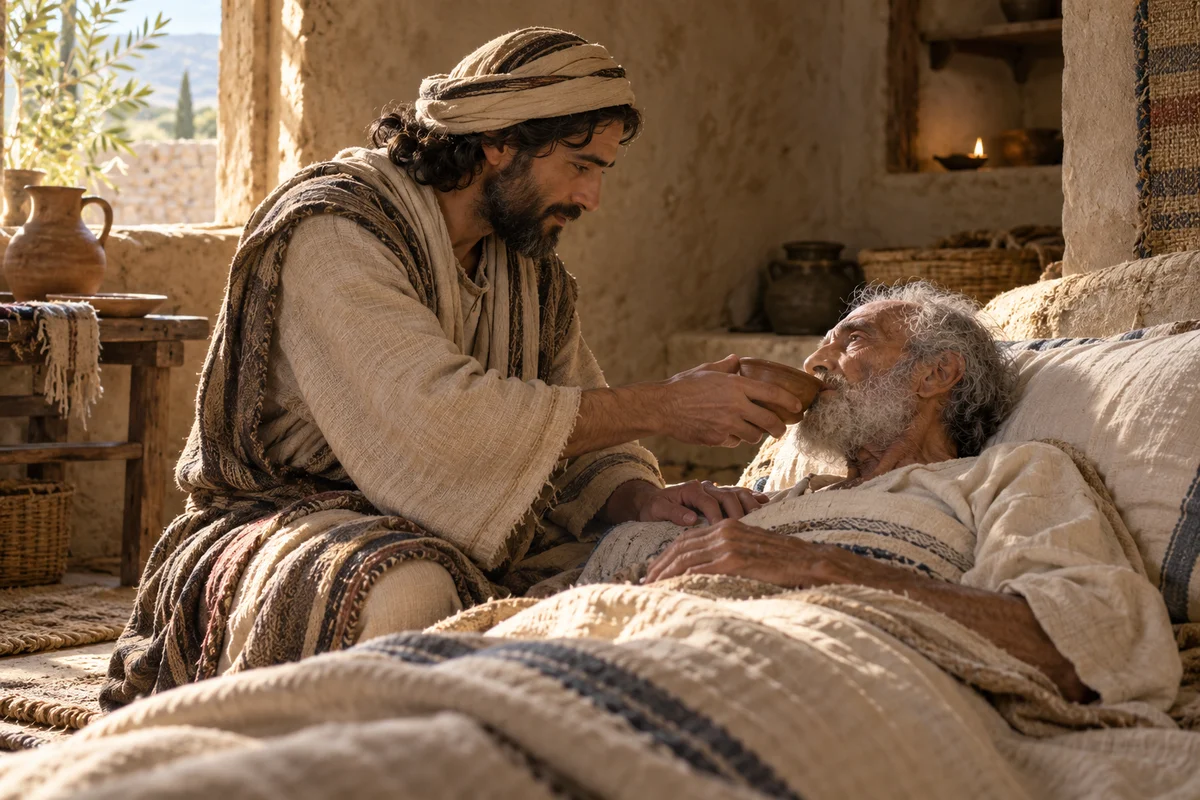
The closing metaphor is intimate: we are the sheep of his pasture. Sheep are neither self-sustaining nor owners of the land on which they graze. They live by the shepherd's provision and protection (Ps. 23; Ezek. 34). This is dependence without humiliation. To belong to a faithful shepherd is not to lose dignity but to receive care.
The confession also exposes modern illusions of absolute self-sufficiency. We do make decisions, develop abilities, and carry responsibilities. Yet our breath, our neighbors, the earth's resources, and the possibility of tomorrow remain gifts. We are responsible stewards precisely because we are not ultimate owners.
3.4 Psalm 100:4 — Gates open to thanksgiving
The psalm now repeats the invitation, but the scene becomes architectural: enter his gates with thanksgiving and his courts with praise. These are the entrances to God's house, not a stage from which human performers display their importance. The worshiper comes to honor the One whose presence makes the gathering meaningful.
The word often rendered thanksgiving has the sense of acknowledging God and declaring what he has done. Goldingay notes that thanksgiving should not turn inward so that my grateful mood becomes the central subject; the point is to tell the truth about God (Goldingay 2008, on vv. 4–5). This transforms gratitude into testimony: the congregation names the Giver and remembers his deeds.
Such praise can be specific. Rather than merely repeating “God is good,” a community can testify that the Lord gave courage through loss, corrected an injustice, sustained a family, or brought people once estranged into reconciliation. Honest testimony must avoid exaggeration. It should never imply that those who still suffer have failed to pray or believe.
The gates and courts should also provoke a pastoral question: Who is allowed to approach in our gatherings? In the original setting, sanctuary worship had real boundaries and its own rules; the universal address does not erase that history. Nevertheless, the psalm's wide invitation confronts religious communities whenever wealth, disability, ethnicity, social reputation, or another human distinction becomes an unwarranted barrier to welcome.
3.5 Psalm 100:5 — The reason the song can last
The final verse offers three descriptions of the LORD: he is good, his steadfast love lasts forever, and his faithfulness continues through all generations.
The word commonly translated steadfast love (Hebrew ḥesed) points to devoted, reliable, covenant-shaped kindness. It is not a passing mood. Faithfulness (Hebrew ʾĕmûnâ) carries the sense of dependability and truthfulness. Together they tell us that God's character can be trusted beyond the limits of a single moment (Exod. 34:6–7; Lam. 3:22–23).
The psalm began with the breadth of the whole earth and ends with the length of generation after generation. The worshiping community is never made up of one age group alone. Children receive a story they did not begin; older people bear witness to grace they did not exhaust. Gratitude becomes an inheritance passed on through teaching, memory, justice, and shared life.
The claim that God is good is not proved by saying that every experience is good. Israel's own Scriptures protest hunger, violence, exile, and delayed justice. Psalm 100 stands beside those laments, not above them as a correction that silences them. Its confession is that even when circumstances change, the character of the LORD is not exhausted by the present crisis.
That is why the poem can end without a list of new demands: God's goodness itself is enough reason to keep speaking his praise.
05
4.0 Theological Reflection
4.1 Worship begins with God's identity, not our performance
Two commands organize the whole psalm: come and know. The community comes because the LORD is God. This reverses the temptation to make worship a display of human excellence. Music, preaching, prayer, and beauty can be gifts; none becomes the center. God is the one addressed, acknowledged, and served.
This also gives worship its ethical horizon. If serving God includes the whole self, a church cannot celebrate the Shepherd while neglecting his sheep. Songs and sermons become inconsistent when leaders abuse power, workers are exploited, or the wounded are ignored (Isa. 1:10–17; Amos 5:21–24). Psalm 100's gladness is not an escape from the demands of Psalm 99's justice.
4.2 Belonging is a gift before it is an achievement
“He made us, and we are his” resists two opposite distortions. Pride imagines that our value is entirely self-produced; despair imagines that we have no worth unless we achieve enough. The psalm offers a different foundation. Life is received, and belonging is grounded in the faithful God who calls and cares for his people.
This does not mean every human being is automatically described in every covenantal sense by Israel's title “his people.” The biblical story moves from Israel's particular calling toward God's purpose to bless all nations (Gen. 12:1–3; Isa. 49:6). Psalm 100 holds those horizons together: the earth is invited, and Israel's story remains the testimony that gives the invitation content.
4.3 Gratitude is memory turned toward faithfulness
Biblical thanksgiving does not stop at a pleasant emotional state. It remembers whose gifts sustain life and turns that knowledge outward. A congregation can sing of God's provision while learning to provide for the hungry; it can praise God's patience while practicing patience in marriage, family, and leadership. Gratitude becomes credible when it shapes how we treat others (Col. 3:12–17).
The psalm is not a formula guaranteeing material prosperity for the thankful. Its promises concern God's character. His steadfast love is no transaction, and gratitude is not a technique for purchasing divine favors.
4.4 Generations may change without exhausting God's faithfulness
The last line extends the psalm beyond the lifespan of any worshiper. Institutions rise and fall; styles of music change; communities migrate; people pass away. God's faithfulness is not confined to a single generation's preferred forms. This invites humility among elders and patience among the young. The task is not to preserve every habit unchanged but to hand on truthful witness to the Lord who remains good.
06
5.0 Canonical and Christological Horizon
First, the Shepherd theme belongs to Israel's larger story. Psalm 23 speaks of the LORD guiding an individual; Psalm 95:7 names Israel as the people of his pasture; Ezekiel 34 denounces leaders who feed themselves instead of the flock and promises that God himself will seek his scattered sheep. Psalm 100's shepherd is therefore a figure of care but also a rebuke to negligent authority.
Second, Christians hear this imagery in Jesus. In John 10:11–18 Jesus calls himself the good shepherd who knows his sheep and gives his life for them. That claim develops Israel's shepherd language in a Christological direction. It does not erase the psalm's first meaning, which is a call to acknowledge the LORD and rejoice in his covenant care.
Third, the invitation to all the earth finds a New Testament horizon. The good news about Jesus crosses ethnic boundaries, and people formerly described as far off are welcomed into God's household (Eph. 2:11–22; 3:6). Revelation 7:9–12 envisions worshipers from every nation, people, and language praising God together. This is a fulfillment-shaped reading of Psalm 100's world-embracing summons, not a claim that the ancient poet explicitly described every detail of the church.
Fourth, access to God's presence gains new significance. The imagery of entering gates and courts belongs first to Israel's sanctuary worship. Hebrews 10:19–22 uses the saving work of Jesus to encourage believers to approach God with confidence. The New Testament is not inviting Christians to boast that they possess a more impressive building. The accent falls on gracious access to the God whom no building can contain (1 Kgs. 8:27).
Finally, Psalm 100's enduring praise anticipates the healed creation depicted in Revelation 21–22. God's goodness is not a private comfort divorced from the world. The biblical hope is that God will dwell with humanity and make all things new. Thanksgiving today is a small rehearsal for that future, while the church continues to serve in the world's real suffering.
07
6.0 Life Application
- Start worship with recognition rather than self-assessment. Before worrying whether the sermon or music will satisfy you, ask: What is true about the Lord we have come to honor? Prepare the heart to listen as well as sing.
- Make room for the whole earth. Notice who is absent or treated as an outsider in a congregation. Create meaningful welcome across language, culture, age, disability, and economic difference. Hospitality is more than offering a seat; it is making room for another person's voice and dignity.
- Connect Sunday or Sabbath singing with weekday service. The psalm says serve the LORD. Let prayer and praise lead to truthful business practices, responsible leadership, care for the vulnerable, and justice in the home. Worship without such continuity is incomplete.
- Practice truthful thanksgiving. Name a concrete grace without pretending that all is well. You might say: “We are grieving, but someone stayed with us”; or “The problem is unresolved, but God has given strength for today.” Honesty protects gratitude from becoming religious performance.
- Hand on the story to another generation. Invite an older believer to tell a story of God's provision; ask younger people what faithfulness looks like in the difficulties they face. Share Scripture, service, and honest memories—not merely nostalgia for how things used to be.
- Remember whose flock people are. Pastors, elders, parents, and teachers are caretakers, not owners. Speak and lead in ways that reflect the Shepherd's patience, protection, and accountability (Ezek. 34; John 10).
08
7.0 Reflection Questions
- How does the command to worship “all the earth” challenge the boundaries—visible or invisible—of our congregation?
- What changes when I understand myself not simply as a person who has achieved things, but as someone made and cared for by God?
- In what ways might “serve the LORD with gladness” reshape my work, household, leadership, and treatment of others?
- How can a church practice sincere thanksgiving without silencing members who are grieving or waiting for answers?
- What specific witness to God's goodness and faithfulness should our generation pass to the next?
09
8.0 Response Prayer
LORD our God, you are good, and your faithfulness outlasts the years we can count. Forgive us when we use worship to display ourselves or claim your people as our possessions. Teach us to rejoice without pretending that pain is absent, and to give thanks by telling the truth about your care. Open our hearts to neighbors we have kept at the gate. Make our service on ordinary days consistent with the praise we offer together. Shepherd your people—children, elders, those who are strong, and those who can scarcely sing. Let the coming generation find in us an honest witness to your steadfast love. Through Jesus Christ our good Shepherd, amen.
10
9.0 Window into What Comes Next
Psalm 100 ends with the gates open and the worshiping people declaring that the LORD is good. Psalm 101 takes a strikingly different form. Its speaker, associated with David in the heading, promises to walk with integrity, reject deceit, and practice justice within his household and the city. The sequence matters. If Psalm 100 calls us to serve the LORD with gladness, Psalm 101 asks what that service looks like when someone must make decisions, appoint helpers, judge misconduct, and exercise power.
The movement is from the public song of thanksgiving to the private and public habits of integrity. What we celebrate about God's character must become visible in the character of those who lead and belong to his people.
11
10.0 Bibliography
- Scripture: Psalm 100; Psalms 23; 47; 89–99; 101; 106:1; 136:1; Genesis 12:1–3; Exodus 19:4–6; 34:6–7; Leviticus 7:12–15; Deuteronomy 4:35, 39; 32:6; 1 Kings 8:27; 18:39; Isaiah 1:10–17; 43:1; 44:2; 49:6; Ezekiel 34; John 10:11–18; Romans 12:1; Ephesians 2:11–22; 3:6; Colossians 3:12–17; Hebrews 10:19–22; Revelation 7:9–12; 21–22. The key text is an original thematic study rendering, not a quotation attributed to a specific Bible edition.
- BibleProject. n.d. The Book of Psalms: Study Notes. Project resource on the Psalter's structure, Book Four, and biblical hopes for God's reign.
- Goldingay, John. 2008. Psalms, Volume 3: Psalms 90–150. Baker Commentary on the Old Testament Wisdom and Psalms. Grand Rapids, MI: Baker Academic. Commentary on Psalm 100, “Summons to All the Earth.”
- Kidner, Derek. 2014. Psalms 73–150. Kidner Classic Commentaries. Downers Grove, IL: InterVarsity Press. Originally published 1975. Commentary on Psalm 100, “Into his courts,” pp. 388–90.

Be the first to leave a comment.