

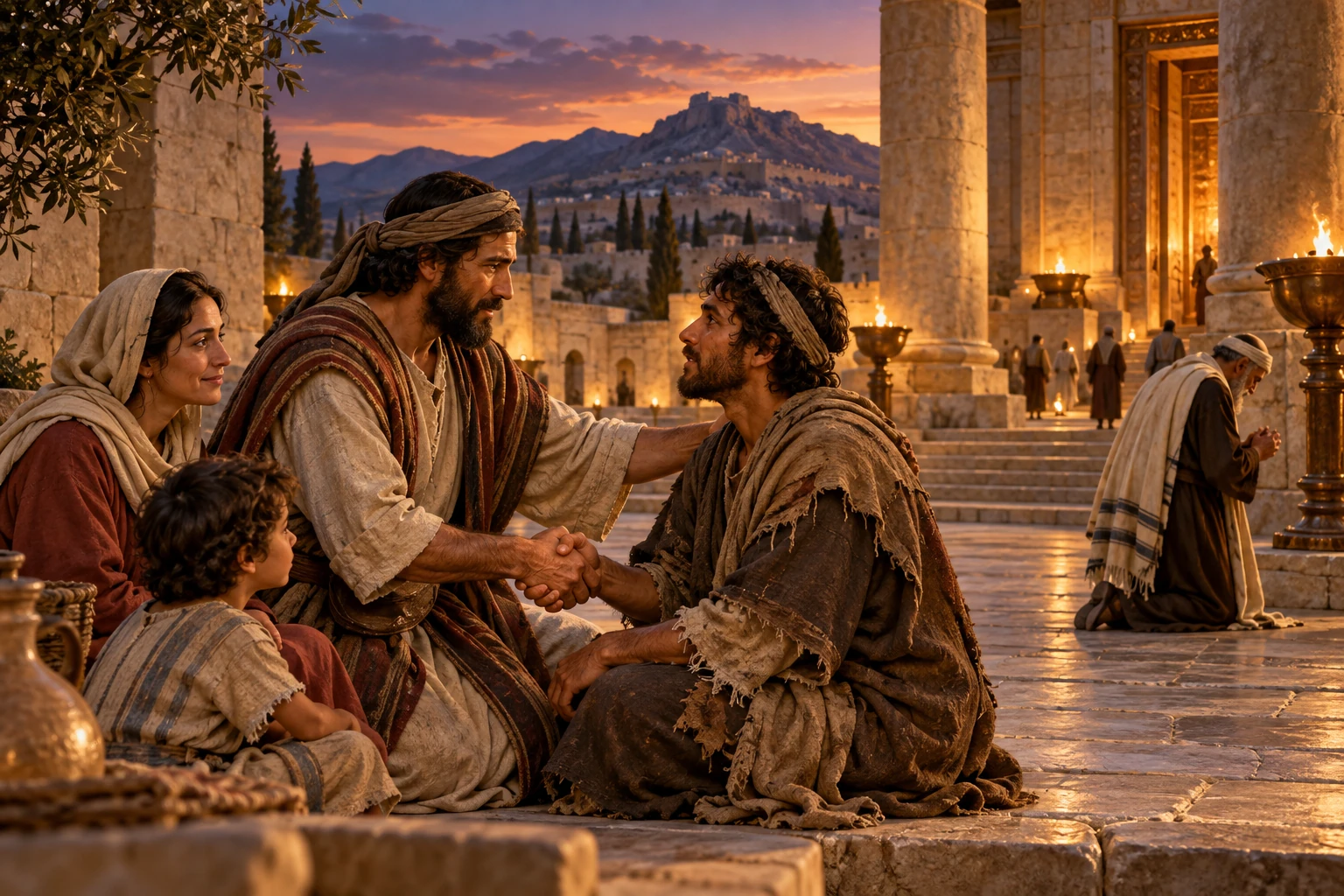
How does the holy God bring together closeness, forgiveness and accountability?
01
Overview
The God who rules with justice, answers prayer, and refuses to separate forgiveness from truth
Key text — Psalm 99:4, 9 (study rendering): The mighty King loves justice; you have established what is right and have acted with justice and righteousness among Jacob's people. Exalt the LORD our God and worship at his holy mountain, for the LORD our God is holy.
A kingdom may command obedience through fear. A religious leader may demand reverence through status. A community may build an impressive place of worship and still neglect the people who live beside it. What, then, makes God's throne different?
Psalm 99 answers by joining three realities that human beings often separate: majesty, justice, and relationship. The King before whom nations tremble is the King who establishes what is right. The God whose holiness cannot be reduced to human standards is the God who answered Moses, Aaron, and Samuel when they called. And the One who forgives does not pretend that wrongdoing has no consequences.
The psalm invites us to worship. But it also asks whether the lives of those who worship bear any resemblance to the King they praise.
02
1.0 Introduction
Psalm 99 belongs to the cluster of songs celebrating the LORD's kingship (especially Pss. 93; 95–100). Psalm 98 ended with seas, rivers, and mountains rejoicing because God comes to govern the earth rightly. Psalm 99 begins with a different response: the peoples tremble. The shift is not a contradiction. The arrival of a perfectly righteous King gives the oppressed reason for joy and makes every human claim to unrestricted power answerable to him.
The psalm unfolds in three related movements:
- Verses 1–3 — The holy name: The LORD reigns above the cherubim, is exalted over the peoples, and is worthy of reverent praise. - Verses 4–5 — The holy dwelling: The King's power serves justice and equity. His people are called to bow before him at his footstool. - Verses 6–9 — The holy God who speaks and answers: Moses, Aaron, and Samuel recall a history of prayer, divine response, instruction, forgiveness, and accountability.
The language of holiness recurs in verses 3, 5, and 9. It sounds like a refrain, but its objects and phrasing vary: God's name, the worship setting associated with his footstool, and finally the LORD our God himself. Goldingay notes that this is a more intricate poetic design than simply repeating an identical chorus (Goldingay 2008, Psalm 99, “Interpretation”).
Central message: The LORD's holiness is not detached from human life. His unrivaled authority establishes justice; his presence invites worship; his gracious dealings with his people join answered prayer and forgiveness to a serious demand for faithfulness.
03
2.0 Historical and Literary Context
Psalm 99 stands in Book Four of the Psalter (Pss. 90–106). After Psalm 89's anguished questions concerning the Davidic throne, Book Four repeatedly returns to a more enduring foundation: the LORD himself reigns. Psalm 90 identifies God as his people's dwelling place across generations. Psalms 93 and 96–99 celebrate divine sovereignty with different emphases—stability, world-embracing praise, awe, saving action, and holiness.
The Hebrew Masoretic Text of Psalm 99 has no authorial heading. Some ancient witnesses associate it with David, but this does not settle its date or authorship. Scholars have suggested settings before, during, or after the Babylonian exile; none can be established confidently. Goldingay emphasizes the lack of a clear consensus about when this psalm was composed (Goldingay 2008, “Interpretation”). The poem itself directs readers to Israel's earlier story rather than offering clues to one identifiable royal ceremony.
The imagery is nevertheless concrete. God is described as enthroned above the cherubim—winged figures associated with the ark of the covenant and the innermost sanctuary (Exod. 25:18–22; 1 Sam. 4:4; 2 Sam. 6:2). The LORD reigns from Zion, the center of Israel's worship, yet his authority extends above all peoples (vv. 1–2). A God whose presence is known in a particular place is not therefore limited to that place (compare 1 Kgs. 8:27; Isa. 66:1).
Psalm 99 also draws heavily on the exodus and wilderness traditions. The appearance of Moses and Aaron, God's speaking through a cloud, and the combination of mercy and judgment all echo Exodus and Numbers (Exod. 19; 32–34; Num. 12; 20). Samuel adds the period when Israel was learning how to live as God's people amid the emergence of human monarchy (1 Sam. 7; 8–12). This is not an abstract meditation on sacredness. It is a reading of God's holiness through the history of a real community.
Kidner titles the psalm “Holy is he!” and describes a change of atmosphere from the unrestrained celebration of Psalm 98 to a more chastened awe. The same King produces both responses: delight in his goodness and reverence before his glory (Kidner 2014, 386–88).
04
3.0 Walking Through the Text
3.1 Psalm 99:1 — A throne above the cherubim
The psalm opens with a royal declaration: the LORD reigns. The nations tremble; the earth shakes. Biblical language of trembling can express both fear and astonishment in the presence of divine power. It should not be reduced to panic or to the terror imposed by an arbitrary tyrant. This King is later identified by his love of justice (v. 4).
The throne is described in an arresting way: God sits enthroned upon or above the cherubim. Cherubim are not the playful infants common in later decorative art. In Israel's sanctuary imagery they signify the majesty and mystery of God's presence (Exod. 25:18–22; Ezek. 1; 10). The ark associated with this imagery was a sign of divine presence, not a container able to imprison God. Israel's Scriptures also warn that possessing a sacred object does not guarantee God's approval of human behavior (1 Sam. 4).
Goldingay connects the trembling nations with the exodus victory and the extension of divine kingship into the land (compare Exod. 15:14–18). Kidner reads the proclamation in relation to the LORD's climactic appearing. These horizons need not cancel one another: Israel's remembered deliverance discloses the King's identity, while worship anticipates the fuller recognition of his rule (Goldingay 2008, Psalm 99:1; Kidner 2014, 386–87).
There is a warning here for those who wield religious power. The throne belongs to God, not to the person who speaks loudest in God's name. Pastors, kings, elders, and institutions can bear witness to divine authority; none can take its place.
3.2 Psalm 99:2–3 — Great in Zion, exalted over every people
The LORD is described as great in Zion and exalted above all the peoples. These two statements belong together. Zion names the place where Israel knew God's covenant presence. But Israel cannot claim that its God is merely a local ruler competing with the gods or rulers of neighboring nations. His authority is universal.
The peoples are summoned to praise God's great and awesome name. In biblical usage the divine name is not a magical word that guarantees success when pronounced. It signifies God's disclosed identity and character—the LORD who has bound himself to his people and made himself known in action (Exod. 3:13–15; 34:5–7).
The verse concludes with the announcement “He is holy” or a closely related grammatical rendering. Holiness signifies God's distinctive identity, otherness, and glory. It certainly includes moral purity; but it is larger than a code of ethical behavior. The Creator is not one more creature at the top of a hierarchy. Yet God's difference does not mean distance without relationship. This holy God chooses to be known.
The psalm's first surprise is therefore that divine transcendence and covenant nearness occur in the same breath. He is over the peoples and great in Zion.
3.3 Psalm 99:4 — When royal power loves justice
Verse 4 brings the poem to its moral center. The wording of its opening Hebrew clause is difficult and translated differently: some versions emphasize “the King's strength loves justice”; others address a mighty King who loves justice. Goldingay proposes a punctuation and grouping that associates part of the phrase with verse 3. Despite these differences, the thrust is unmistakable: the King's power is inseparable from his commitment to justice (Goldingay 2008, Psalm 99:3–4; Kidner 2014, 387 n. 39).
God has established equity and worked justice and righteousness in Jacob. Equity is more than treating everyone identically while ignoring actual harm. It involves honest judgment, moral straightness, and fairness in the community. Righteousness is not limited to a private virtue; God's people are to live in relationships shaped by what is right (Deut. 16:18–20; Ps. 72:1–4; Isa. 1:16–17).
That the psalm names Jacob matters. The community praising justice is first accountable for justice within itself. It is easy to condemn corruption among outsiders while overlooking dishonest financial management, favoritism, mistreatment of workers, and abuse of vulnerable members inside religious institutions.
The holier the King we praise, the less room we have to excuse injustice in his name. A church is not made holy simply by its songs, garments, or ceremonies. Its decisions must be brought under the measure of the King whose strength loves justice.
3.4 Psalm 99:5 — Bow before his footstool
The congregation is commanded to exalt the LORD our God and bow down at his footstool. The two gestures appear opposite—lifting God high and lowering oneself—but they express the same truth: God is God, and worshipers are not.
The “footstool” has several related biblical associations. The earth may be called God's footstool (Isa. 66:1); the ark and sanctuary can also be connected with the place of God's feet (1 Chr. 28:2; Ps. 132:7). The specific image here naturally recalls Zion and the sanctuary. The phrase calls people to worship the LORD in relation to his holy dwelling, not to treat a physical object as itself a deity.
A textual nuance deserves attention: translations vary between “it is holy”, referring naturally to the footstool or place, and “he is holy,” referring to God. Goldingay favors the former in this verse, seeing a poetic movement from holy name to holy place to holy God; many familiar English renderings use the latter. Neither reading changes the central principle that sacred places derive their significance from God's presence, not from any independent power of their own.
Reverence, then, is not the worship of architecture. It is the humble recognition that the God who cannot be contained chooses to meet his people.
3.5 Psalm 99:6 — Moses, Aaron, and Samuel: people who called, and were answered
The psalm unexpectedly changes direction, naming Moses, Aaron, and Samuel. The cosmic King is now remembered through particular human relationships. All three were central to Israel's life, and all are associated with appealing to God on behalf of others (Exod. 32:11–14, 30–32; 1 Sam. 7:5–9; 12:19–23; Jer. 15:1).
The wording places Moses and Aaron in connection with priests, and Samuel among those who call upon God's name. This does not mean all three occupied precisely the same office. Aaron belonged to Israel's priestly line; Moses exercised priest-like and mediating functions without belonging to Aaron's later hereditary priesthood; Samuel combined prophetic leadership and acts of intercession. Goldingay notes the grammatical question of whether the description “among his priests” should be applied to both Moses and Aaron or more particularly to Aaron (Goldingay 2008, Psalm 99:6).
The important claim comes at the end: they called to the LORD, and he answered them. God's holiness does not make him inaccessible. He is not manipulated by prayer, but he is not indifferent to it either. These figures become witnesses that the covenant God listens and responds.
3.6 Psalm 99:7 — A voice from the pillar of cloud
The LORD spoke to them in the pillar of cloud. During Israel's wilderness journey, the cloud was a sign of God's presence, guidance, and sometimes revelation (Exod. 13:21–22; 33:9–11; Num. 12:5; Deut. 31:15). The verse gathers those memories into one picture of a God who does not only receive prayer; he speaks.
We should not force the sentence to claim that Samuel personally received revelation from the exact wilderness cloud in the same way as Moses. The psalm remembers a history of God's dealings with representative leaders. Samuel belongs in that story because he too heard and transmitted God's word (1 Sam. 3:1–21).
The verse adds that they kept God's testimonies and the decree he gave them. Biblical hearing does not end when an individual claims a spiritual experience. It must become a life of fidelity. The relationship moves in both directions: they call and God answers; God speaks and they are called to obey.
This pairing protects worship from two distortions. Prayer is not a way of ordering God to endorse our ambitions, and obedience is not a way of earning the right to be heard. Both belong to a covenant relationship initiated by grace and ordered by God's truthful word.
3.7 Psalm 99:8 — The startling union of forgiveness and accountability
This may be the most demanding verse in the psalm. The people address the LORD directly: You answered them. You were a forgiving God to them, yet one who dealt with their wrongful deeds.
The Hebrew term translated “forgiving” is linked with the idea of bearing or carrying. Goldingay observes that forgiveness involves taking up the burden and cost of wrongdoing rather than treating it as though nothing happened. The corresponding verb describing God's response to wrongdoing is strong; it does not make discipline disappear (Goldingay 2008, Psalm 99:8).
Who is forgiven and disciplined? The immediate context points to Moses, Aaron, and Samuel as the leaders just mentioned. Some interpreters understand the words more broadly in relation to the people whom those leaders represented. The Old Testament offers examples of both corporate mercy and real consequences. Moses intercedes after Israel's rebellion, yet the wilderness generation still faces judgment (Exod. 32–34; Num. 14). Moses and Aaron themselves are denied entry into the land after their failure at Meribah (Num. 20:7–13). The psalm need not assign an identical failing or penalty to all three named leaders.
The apparent paradox is intentional. Forgiveness restores the possibility of relationship; it does not necessarily erase the damage caused by an action or remove every consequence. Conversely, divine discipline does not automatically mean that God has abandoned the person being corrected. The two realities belong together in God's covenant dealings (Exod. 34:6–7; Heb. 12:5–11).
This matters pastorally. A wrongdoer may genuinely repent and receive forgiveness, while still needing to tell the truth, make restitution, accept limits on authority, or face lawful consequences. A victim should never be pressured to abandon safety or accountability in the name of grace. Psalm 99 refuses both vindictive harshness and cheap pardon.
3.8 Psalm 99:9 — The holy mountain and the final word
The conclusion repeats and deepens verse 5: exalt the LORD our God; worship at his holy mountain; for the LORD our God is holy. Zion is now called his holy mountain. The focus moves from the place where people bow to the identity of the One before whom they bow.
Notice also the repeated possessive: our God. The final statement is not merely “God is holy” in a remote philosophical sense. It is “the LORD our God is holy.” The exalted King has entered covenant relationship with a people who know his answers, commands, mercy, and correction.
Kidner draws attention to the warmth of that closing phrase. The LORD's holiness remains undiminished, yet the psalm ends with the wonder that he is genuinely our God (Kidner 2014, 387–88).
05
4.0 Theological Reflection
4.1 Holiness is greater than religious atmosphere
Smoke, music, solemnity, fine architecture, and sacred language can help communities recognize God's transcendence. None proves that God approves of everything taking place there. Psalm 99 defines holiness by reference to God's identity, character, and action: his majestic authority, the justice he establishes, and the truthful relationship he maintains with his people.
A congregation may have stirring worship and still need repentance. Reverence is not the opposite of moral examination; reverence requires it (Isa. 1:11–17; Amos 5:21–24).
4.2 Divine power is accountable to no higher standard because it is itself righteous
Human rulers often ask the weak to trust that great power will eventually be used well. Psalm 99 offers a different picture: justice is not an optional restraint that a powerful God occasionally chooses. The LORD's strength loves justice (v. 4). The biblical portrait binds authority to moral faithfulness.
Those who lead families, institutions, congregations, or nations are not God; therefore their decisions must be transparent, open to correction, and answerable to others. Claims of divine calling never cancel the obligation to protect the vulnerable or investigate credible wrongdoing (Mic. 6:8; Mark 10:42–45).
4.3 The holy God is not silent or indifferent
Moses, Aaron, and Samuel represent something more than impressive religious biographies. They embody dialogue. They call; God answers. God speaks; his people must listen. Holiness therefore does not imply a cold distance where prayer and obedience are meaningless.
That does not mean everyone will receive the kind of visible revelation described in Israel's foundational history. It means the God revealed in that history is both sovereign and personal. Believers today may pray honestly without claiming that every private impression is identical to God's authoritative word (Ps. 95:7–11; 1 John 4:1).
4.4 Forgiveness and justice are not enemies
The juxtaposition in verse 8 may unsettle both the person seeking mercy and the person demanding consequences. Yet it preserves a vital distinction: the removal of guilt before God and the restoration of damaged relationships are not always completed in the same moment. A forgiven person may still need to repair what can be repaired; trust may need time and accountable conduct to grow.
Equally, communities must not deny that grace can reach serious wrongdoers. Justice requires truth and protection; mercy refuses the claim that anyone is beyond God's power to call to repentance. The LORD does not surrender one of these commitments to preserve the other.
4.5 Worship forms a community under the King
The psalm commands people to exalt God, lower themselves, and remember his dealings. This is a school of humility. We worship poorly when we use worship to exalt our own institution, ethnicity, preacher, choir, or social class. We worship faithfully when reverence for God produces honest stewardship, careful listening, impartial decisions, and generous hospitality.
The movement from God's throne (vv. 1–3) to justice in Jacob (v. 4) means that what we sing about God's kingship should be visible in how we treat one another.
06
5.0 Canonical and Christological Horizon
The language of holiness stretches across Scripture. At Sinai, God's presence among Israel is both gift and demanding responsibility (Exod. 19:4–6). God's self-description combines compassion, steadfast love, faithfulness, forgiveness, and refusal to disregard guilt (Exod. 34:6–7). Isaiah's vision calls attention to the threefold cry of divine holiness, yet it also ends with a cleansed messenger sent into a troubled society (Isa. 6:1–8). Psalm 99 belongs to this biblical portrait: holiness is majestic, merciful, and morally serious.
The three named intercessors provide another connection. Moses pleads for a rebellious people (Exod. 32:11–14); Samuel prays amid Israel's troubled choice of kingship (1 Sam. 12:19–23). Their prayers do not turn them into flawless saviors. They show how God works through imperfect servants without ceasing to be King. Jeremiah later names Moses and Samuel together as outstanding figures of intercession (Jer. 15:1).
The New Testament invites Christians to see the fuller story of divine kingship in Jesus, Israel's Messiah. Jesus proclaims God's reign, refuses domination as the model of leadership, and identifies true greatness with serving others (Mark 1:14–15; 10:42–45). In his teaching, justice, mercy, and faithfulness belong together rather than competing for attention (Matt. 23:23). His ministry brings God's holiness into contact with people whom society had treated as untouchable, not to excuse evil but to restore persons.
The cross and resurrection bring forgiveness and justice into the Christian confession at a deeper level. God does not declare that wrongdoing is insignificant; through Christ, Christians believe, God acts to confront sin and open the way to reconciliation (Rom. 3:21–26; 2 Cor. 5:18–21). The risen Christ is also described as one who continues to intercede (Heb. 7:25). This is a canonical and Christological reading, not a claim that the original poet was directly naming Jesus in Psalm 99.
Hebrews 12:18–24 contrasts the awe of Sinai with the community's approach to heavenly Zion through Jesus, yet the chapter also insists that worship must remain reverent (Heb. 12:28–29). The New Testament does not set love against holiness or grace against ethical transformation (1 Pet. 1:15–16). Revelation's worship scenes similarly hold together the holiness of the enthroned God and the redeeming work of the Lamb (Rev. 4–5).
Christians should not use these connections to erase the psalm's Israelite setting or to replace the LORD's historical relationship with Israel with an invented Christian past. Rather, Christian faith understands itself as welcomed into the larger story of Israel's holy God, whose reign and purposes reach the nations (Rom. 11:17–24).
07
6.0 Life Application
- Let reverence examine your conduct. Before celebrating a powerful worship experience, ask whether your decisions this week have been honest, fair, and kind. Holiness must reach the office, marketplace, home, and church meeting.
- Measure leadership by justice, not spectacle. When evaluating spiritual or civic authority, look beyond impressive language and public success. Is power being used to protect people, acknowledge mistakes, and make equitable decisions (v. 4)?
- Pray as someone willing to listen. Bring needs to God with confidence, but also open Scripture and your conduct to examination. Moses, Aaron, and Samuel teach us that calling and listening belong together (vv. 6–7).
- Do not confuse forgiveness with the absence of consequences. Where harm has occurred, pursue truthful confession, appropriate restitution, protection of those harmed, and responsible accountability. Grace is not a reason to conceal abuse (v. 8).
- Make space for awe without silencing joy. Quiet prayer, thoughtful confession, shared praise, and acts of service can all express reverence. Worship need not be cold to be holy, nor reckless to be joyful.
- Refuse to possess God. Zion's significance comes from the LORD who is exalted over all peoples. Welcome believers of different backgrounds and remember that no institution can claim a monopoly over God's presence (vv. 2, 9).
08
7.0 Reflection Questions
- How does Psalm 99 deepen or correct the exuberant celebration of the King in Psalm 98?
- What is the difference between fearing an arbitrary ruler and standing in reverent awe before a King whose power loves justice?
- How does verse 4 challenge the ways authority is exercised in our churches, families, workplaces, and public institutions?
- Why does the psalm move from God's throne and holy place to the particular lives of Moses, Aaron, and Samuel?
- In what ways can forgiveness and accountability coexist without reducing one to the other (v. 8)?
- What does it mean to call the transcendent King “our God” without claiming to control or own him?
- How might the life and intercession of Jesus enlarge a Christian reading of Psalm 99 while leaving its first Israelite meaning intact?
09
8.0 Response Prayer
Holy LORD, our King, you are exalted above the peoples, yet you have not remained far from those who call your name. Your greatness is beyond our measure; your justice is not for sale.
Forgive us when we use holy words to defend unholy actions. When we admire power more than truth, turn our eyes toward the King who loves justice. When we bow in worship, teach us also to rise and treat our neighbors rightly.
You heard Moses, Aaron, and Samuel. Teach us to pray with open hearts and to listen when your word corrects us. Where we have done wrong, give us courage to confess. Where others have been harmed, give us courage to protect them and pursue what is right. Let mercy never become an excuse for hiding the truth.
Through Jesus Christ, who serves and intercedes, make us a people whose worship bears the marks of your holiness, compassion, and faithfulness. May our communities be places of reverence without fear, accountability without cruelty, and grace without denial.
For you are holy, and you are our God. Amen.
10
9.0 Window into What Comes Next
Psalm 99 ends with worship on the holy mountain. After proclaiming the LORD's kingship, honoring his justice, and remembering the prayers of Israel's leaders, the congregation is called to bow before the God who is truly holy. Awe has been given moral substance: this King is both righteous and merciful.
Psalm 100 opens the doors wider. All the earth is summoned to make a joyful noise, serve the LORD with gladness, and enter his gates with thanksgiving. It declares that the LORD made his people, that they belong to him, and that his steadfast love endures through generations.
These psalms complete one another. Psalm 99 guards celebration from becoming shallow; Psalm 100 guards reverence from becoming joyless. Together they invite worshipers to approach the holy King with humility, gratitude, and lives shaped by his goodness.
11
10.0 Bibliography
- Scripture: Psalm 99; Psalms 18, 47, 72, 89–100, 132; Exodus 3:13–15; 13:21–22; 15:14–18; 19; 25:18–22; 32–34; Numbers 12; 14; 20:7–13; Deuteronomy 16:18–20; 31:15; 1 Samuel 3–4; 7–12; 1 Kings 8:27; 1 Chronicles 28:2; Isaiah 1:11–17; 6; 66:1; Jeremiah 15:1; Micah 6:8; Amos 5:21–24; Mark 1:14–15; 10:42–45; Matthew 23:23; Romans 3:21–26; 11:17–24; 2 Corinthians 5:18–21; Hebrews 7:25; 12:18–29; 1 Peter 1:15–16; 1 John 4:1; Revelation 4–5. The key text is a study rendering, not a verbatim quotation from a named modern translation.
- BibleProject. n.d. The Book of Psalms: Study Notes. Project resource on the Psalter's five-book arrangement and Book Four.
- Goldingay, John. 2008. Psalms, Volume 3: Psalms 90–150. Baker Commentary on the Old Testament Wisdom and Psalms. Grand Rapids, MI: Baker Academic. Commentary on Psalm 99, “Holy Name, Holy Place, Holy God.”
- Kidner, Derek. 2014. Psalms 73–150. Kidner Classic Commentaries. Downers Grove, IL: InterVarsity Press. Originally published 1975. Commentary on Psalm 99, “Holy is he!,” pp. 386–88.
Be the first to leave a comment.