


Fear, betrayal, and the burden God is willing to carry
01
1.0 Introduction: The Pain of Being Betrayed by Someone Close
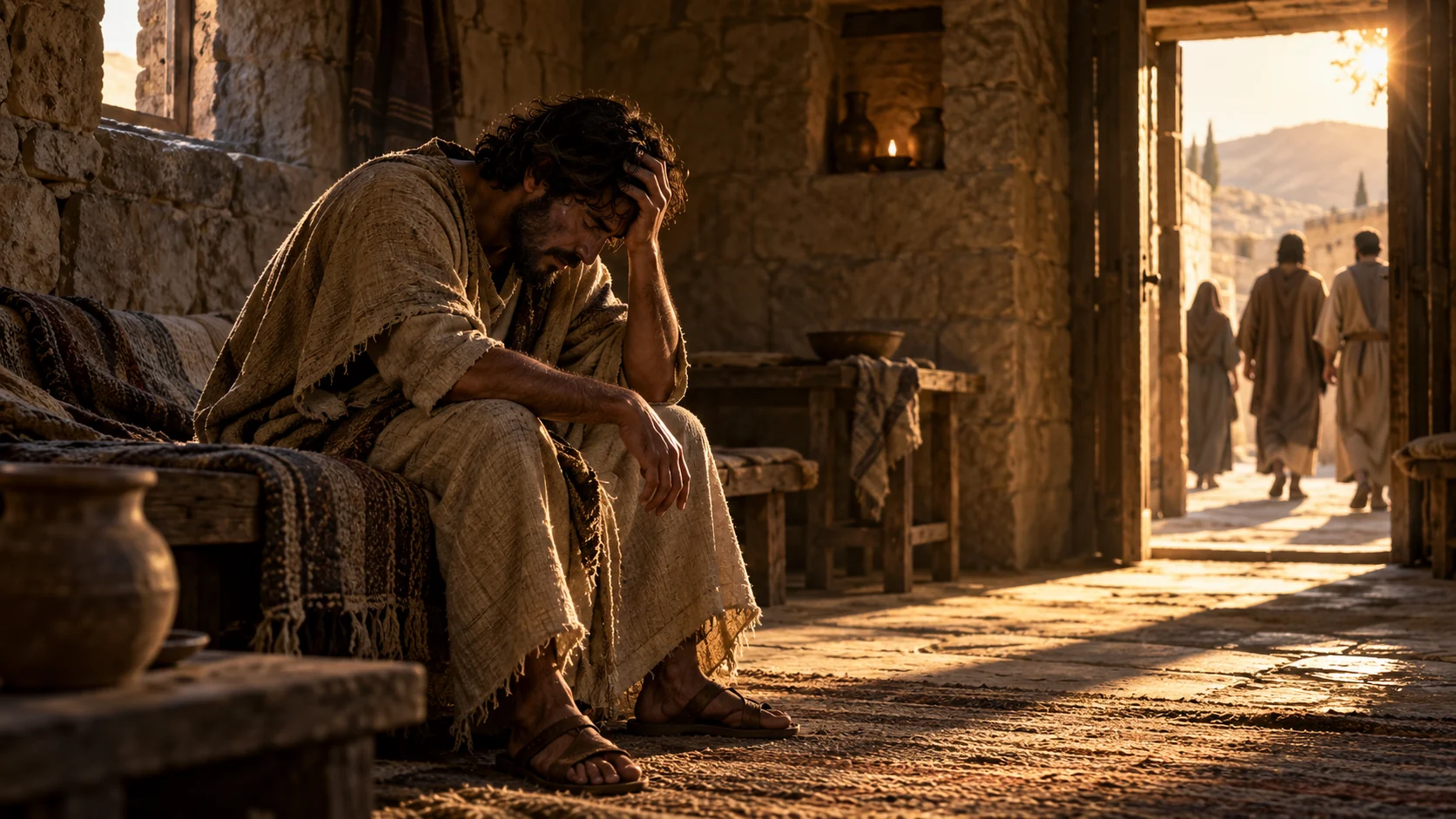
Some enemies stand outside the gate. Others once walked beside us into the house of God. Psalm 55 is a prayer for the wound that comes wearing a familiar face.
Psalm 55 is not a calm prayer.
It begins with agitation, moves through fear, dreams of escape, anger at a violent city, grief over betrayal, repeated prayer, and finally a call to cast one’s burden on Yahweh.
The psalm does not move in a straight line because pain like this rarely does.
At first, the trouble sounds like ordinary persecution: enemies are pressing in, violence surrounds the psalmist, fear enters his body. Then the deepest wound is named:
“It is not an enemy who taunts me... but it is you, a man, my equal, my companion, my familiar friend” (Ps. 55:12–13).
That changes everything.
A stranger can hurt us.
A trusted friend can rearrange the inside of us.
The betrayal becomes sharper because the relationship once included worship: “We used to take sweet counsel together; within God’s house we walked in the throng” (v. 14).
Psalm 55 gives us language for that kind of pain.
This psalm is about what to do when betrayal fractures trust: tell God the truth, refuse to let vengeance become your master, and place the weight of the wound into the hands of the One who can sustain you.
02
2.0 Historical and Literary Context
Psalm 55 belongs to Book Two of the Psalter (Pss. 42–72). Unlike several nearby psalms, its heading does not identify a specific event in David’s life.
Because of the language of betrayal, many readers have naturally thought of the rebellion of Absalom and the treachery of Ahithophel (2 Sam. 15–17). That setting fits some features of the psalm, but the text itself does not name either man. It is better to let the psalm speak broadly enough to reach many forms of betrayal.
Goldingay describes this psalm as a prayer that teaches people how to “throw things at Yahweh”: fear, complaint, anger, grief, and the desire for justice are not hidden. They are brought into prayer.
The poem moves through several emotional landscapes.
Verses 1–8 describe inner distress and the desire to flee like a dove. Verses 9–11 widen the view to a city filled with violence and deceit. Verses 12–15 uncover the intimate betrayal at the heart of the lament. Verses 16–19 turn toward repeated prayer and confidence that God hears. Verses 20–21 return to the treacherous friend. Verses 22–23 finally call the sufferer to cast the burden on Yahweh and entrust judgment to God.
The psalm keeps circling the wound.
But each circle moves a little closer to trust.
03
3.0 Walking Through the Text
04
3.1 “Give Ear to My Prayer” — Distress That Cannot Sit Still (vv. 1–5)
The psalm opens with urgency:
“Give ear to my prayer, O God, and hide not yourself from my plea for mercy.”
The psalmist is restless.
His complaint is noisy. His heart is in anguish. Fear, trembling, and horror overwhelm him.
Goldingay notes that the language of fear is almost physical. Terror comes from outside and settles inside. The person is surrounded and occupied by fear at the same time.
This is important because biblical prayer does not demand emotional tidiness before approaching God.
The psalmist does not calm himself first and then pray.
He prays because he cannot calm himself.
05
3.2 “Oh, That I Had Wings Like a Dove” — The Desire to Escape (vv. 6–8)
“And I say, ‘Oh, that I had wings like a dove! I would fly away and be at rest.’”
There are moments when faith does not feel heroic.
It wants distance.
The psalmist imagines flying away to the wilderness, finding shelter from the storm.
Goldingay observes that the image moves from bird to human being. The dove can disappear into a cleft. The person wants somewhere far away to lodge.
The city, which should be safe, has become dangerous.
The wilderness, which should be dangerous, now looks safe.
Betrayal can do that. It can reverse the map.
The familiar place becomes threatening.
Distance begins to feel like mercy.
Psalm 55 does not shame that impulse.
It lets the wish be spoken.
06
3.3 Violence in the City — When the Environment Becomes Unsafe (vv. 9–11)
The psalmist then looks outward.
Violence and strife move around the city walls. Harm and trouble live inside. Oppression and deceit do not leave the public square.
This is more than one bad relationship.
The social world itself feels corrupted.
The city becomes a picture of a place where trust has broken down.
People can survive one enemy.
It is harder to live when the whole environment feels unpredictable.
Psalm 55 allows personal betrayal and public disorder to belong in the same prayer because they often feed each other.
Broken trust in private life can make the whole world feel dangerous.
07
3.4 “But It Is You” — The Wound at the Center (vv. 12–14)
Then the psalm stops circling.
“For it is not an enemy who taunts me... but it is you.”
This is the center of the pain.
The betrayer is described as an equal, a companion, a familiar friend.
The relationship once included fellowship and worship.
“Together we would enjoy fellowship; in the house of God we would walk in the throng.”
That detail makes the betrayal heavier.
This was not simply a business relationship.
They had shared sacred space.
They had walked together where God was worshiped.
The wound is therefore emotional, social, and spiritual.
When betrayal comes through someone who prayed with us, worshiped with us, served with us, or carried our confidence, the damage can reach into our relationship with God.
Psalm 55 does not minimize that.
It names it.
08
3.5 Anger That Goes to God (v. 15)
The prayer for judgment in verse 15 is severe.
The psalmist wants the violent to be brought down suddenly.
This is not easy language.
But the important movement is where the anger goes.
It goes to God.
The psalmist does not pretend he has no rage.
Neither does the psalm require him to act out every impulse.
Prayer becomes the place where vengeance is transferred out of the wounded person’s hands.
That does not make the desire for justice disappear.
It gives it a judge.
09
3.6 “Evening and Morning and at Noon” — Prayer That Returns Again and Again (vv. 16–19)
“But I call to God, and Yahweh will save me.”
The psalm turns.
“Evening and morning and at noon I utter my complaint and moan, and he hears my voice.”
The rhythm matters.
The wound has not vanished, but prayer becomes a daily pattern around it.
Morning.
Noon.
Evening.
The betrayed person keeps returning to God.
Not because the pain is gone.
Because God keeps listening.
The psalmist then speaks of God redeeming his life and bringing him to safety.
Trust does not erase agitation in one moment.
Sometimes it grows by repetition.
We bring the same burden again because the burden is still heavy.
10
3.7 Smooth Words, a Violent Heart (vv. 20–21)
The psalm returns one more time to the betrayer.
“He stretched out his hand against his friends; he violated his covenant.”
The betrayal is described as covenant-breaking.
That word matters.
This is not merely disappointment.
Trust had been pledged.
Then comes one of the sharpest descriptions in the psalm:
“His speech was smooth as butter, yet war was in his heart; his words were softer than oil, yet they were drawn swords.”
The danger is not open hostility.
It is violence wrapped in gentleness.
This is why betrayal can be so disorienting.
The mouth says peace.
The heart prepares war.
The victim begins to doubt not only the other person but his own ability to read reality.
Psalm 55 gives language to that confusion.
11
3.8 “Cast Your Burden on Yahweh” — The Weight Does Not Have to Stay in Your Hands (vv. 22–23)
Then comes the line for which the psalm is most remembered:
“Cast your burden on Yahweh, and he will sustain you.”
The Hebrew image carries the sense of what has been placed upon you, what you have been given to carry.
This is not advice to pretend the burden is small.
It is permission to transfer its weight.
God may not immediately remove the situation.
But he can sustain the person carrying it.
The line does not say, “Nothing bad will happen.”
It says the righteous will not be abandoned to collapse.
The psalm ends with judgment entrusted to God and a personal confession:
“But I will trust in you.”
That is the final movement.
Not: “I understand everything.”
Not: “I feel no pain.”
Not: “The betrayer has apologized.”
But:
“I will trust in you.”
12
4.0 Theological Reflection
13
Betrayal Is a Covenant Wound
Psalm 55 shows why betrayal hurts differently from ordinary hostility.
The wound is created by broken trust.
The closer the relationship, the deeper the fracture can go.
The psalm gives sacred permission to grieve that loss honestly.
14
Escape Is Sometimes the First Honest Desire
The wish for wings is not mocked.
Sometimes the first thing a wounded person wants is distance.
That can be wisdom, not cowardice.
There are situations where safety requires leaving, creating boundaries, seeking help, or refusing continued access to someone harmful.
Psalm 55 does not demand proximity to danger as proof of forgiveness.
15
Prayer Can Hold Anger Without Becoming Violence
The psalm is fierce.
But its fierceness is prayed.
This is one of lament’s gifts.
Prayer gives anger somewhere to go besides the body of another person.
We can tell God what we want to happen and still leave final judgment with him.
16
God’s Sustaining Is Sometimes the Answer Before Resolution
“Cast your burden on Yahweh, and he will sustain you.”
The promise is not that every betrayer will quickly change or every broken relationship will be restored.
The promise is that God can carry the one who has been wounded.
Sustaining grace often comes before visible resolution.
17
5.0 Canonical and Christological Horizon
The betrayal language of Psalm 55 resonates across the biblical story.
David knew the pain of divided loyalties and treachery within his own circle.
Jesus knew it more deeply still.
Judas did not approach him as a distant enemy. He had shared meals, roads, ministry, and community with him. His betrayal was marked by a kiss (Luke 22:47–48).
The words of peace and the act of violence came together.
Jesus also knew the desire for another way. In Gethsemane he prayed that, if possible, the cup might pass from him (Matt. 26:39). The wish to escape suffering is not foreign to faithful prayer.
Yet Jesus entrusted himself to the Father.
He did not deny evil.
He did not become evil in return.
At the cross, betrayal, false testimony, violence, and abandoned trust gather around him. In resurrection, God declares that none of them has the final word.
The New Testament later echoes Psalm 55:22 when Peter urges believers to cast their anxieties on God because he cares for them (1 Pet. 5:7).
The burden can be transferred because the wounded person is not carrying life alone.
18
6.0 Life Application
1. Name betrayal for what it is. Do not reduce a covenant wound to “miscommunication” if trust was knowingly violated.
2. Do not shame yourself for wanting distance. Safety, boundaries, and time away can be wise responses to a harmful relationship.
3. Bring anger to God before acting on it. Prayer gives pain a language and can keep rage from becoming retaliation.
4. Notice when smooth speech and harmful behavior do not match. Do not let gentle words erase a pattern of manipulation or violence.
5. Pray repeatedly if the wound keeps returning. Evening, morning, and noon may be necessary because grief does not obey a schedule.
6. Cast the burden, not the truth. Giving the weight to God does not mean denying what happened. It means refusing to carry the whole moral universe on your shoulders.
7. Let trust in God grow even if trust in a person cannot yet be restored. Reconciliation, where possible, requires truth, repentance, safety, and time. Faith does not require pretending these are already present.
19
7.0 Reflection Questions
1. Is there a betrayal I have minimized because I thought faith required me to move on quickly?
2. What part of me is still wishing for “wings” to escape?
3. Where do I need a healthy boundary rather than more access?
4. Have I been carrying anger alone instead of bringing it honestly to God?
5. What burden do I need to place into God’s hands today?
6. Can I say, even without resolution, “But I will trust in you”?
20
8.0 Response Prayer
God who hears evening, morning, and noon, receive the noise inside me.
You know the wound that comes from strangers. You also know the deeper wound that comes from a friend.
Where trust has been broken, do not let me lose myself.
Give me wisdom about distance. Give me courage about truth. Keep anger from turning me into what hurt me.
I place this burden on you.
Carry what I cannot carry well. Sustain me where I am tired. Guard me where I am vulnerable.
And when words are smooth but hearts are violent, give me clear eyes.
I do not understand everything. The story is not finished.
But I will trust in you.
Amen.
21
9.0 Window into What Comes Next
Psalm 55 is the prayer of someone wounded by betrayal.
Psalm 56 moves into another kind of fear: being hunted by people who can physically harm you.
The emotional landscape shifts from treachery within the circle to danger pressing from outside.
Yet one line will carry forward:
“When I am afraid, I will trust in you.”
Psalm 55 ends there already.
Not with the disappearance of fear.
With trust inside it.
22
10.0 Bibliography
Goldingay, John. Psalms, Volume 2: Psalms 42–89. Baker Commentary on the Old Testament Wisdom and Psalms. Grand Rapids: Baker Academic, 2007.
Kidner, Derek. Psalms 1–72. Kidner Classic Commentaries. Downers Grove, IL: IVP Academic, 2008.
BibleProject. The Book of Psalms: Study Notes.
BibleProject. “The Book of Psalms.” Old Testament Overview Guide.

Be the first to leave a comment.