

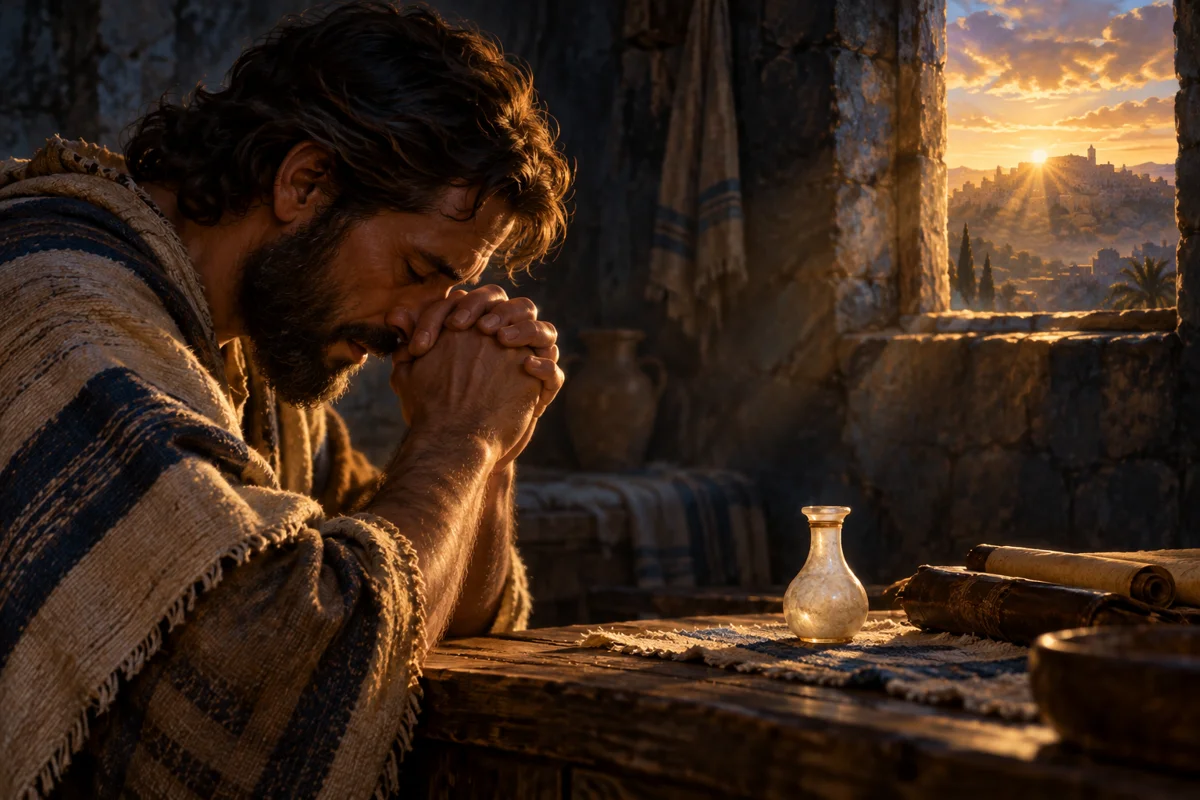
Being hunted, being remembered, and learning to trust while afraid
01
1.0 Introduction: “When I Am Afraid”
Faith is not always the absence of fear. Sometimes it is what the heart does while fear is still present. Psalm 56 teaches us to trust God without pretending that danger is unreal.
Psalm 56 begins in pressure.
Its heading places David in Gath, among the Philistines, at a moment when he had fled Saul only to find himself exposed in enemy territory (1 Sam. 21:10–15). The man who had killed Goliath now stood in Goliath’s city.
That is a strange place to feel safe.
The psalm opens with the sense of being hunted: enemies press in, watch his steps, and look for his life. Yet in the middle of that danger comes one of the most memorable confessions in the Psalter:
“When I am afraid, I put my trust in you” (Ps. 56:3).
The sentence matters because it does not say, “I am never afraid.”
Fear is admitted.
Trust is chosen inside it.
Psalm 56 does not ask us to become emotionally invulnerable before we can call ourselves faithful. It shows a hunted person learning where to place the weight of fear.
Psalm 56 is about trust that grows inside fear: God hears, remembers, records tears, keeps his word, and can be trusted even when human beings still threaten.
02
2.0 Historical and Literary Context
Psalm 56 belongs to Book Two of the Psalter (Pss. 42–72). The heading associates it with David’s seizure by the Philistines at Gath.
That background fits the emotional world of the poem. David is surrounded by hostile people. He is watched, pursued, and misrepresented. The danger is not vague.
The psalm has a repeating rhythm. Verses 1–2 describe the threat. Verses 3–4 answer with trust. Verses 5–7 return to the enemies. Verse 8 turns toward God’s attention to David’s pain. Verses 9–11 repeat the language of trust. Verses 12–13 close with vows, thanksgiving, and the hope of walking before God in the light of life.
Goldingay gives the psalm a fitting title: “Fear of Humanity, Trust in God.”
That is the tension of the whole poem.
Human beings are frightening.
God is trustworthy.
The psalm refuses to deny either side.
03
3.0 Walking Through the Text
04
3.1 “All Day Long” — Fear That Does Not Leave Quickly (vv. 1–2)
“Be gracious to me, O God, for man tramples on me; all day long an attacker oppresses me.”
The phrase “all day long” appears again in verse 2.
This is not a brief scare.
The pressure is repeated.
Enemies keep watching.
Threat becomes atmosphere.
Anyone who has lived under sustained conflict knows the difference between one frightening event and the exhaustion of waiting for the next one.
Psalm 56 begins there.
David does not first ask for courage.
He asks for grace.
Fear has made him needy, and he is willing to say so.
05
3.2 “When I Am Afraid, I Trust” — Faith Without Pretending (vv. 3–4)
“When I am afraid, I put my trust in you.”
This is one of the clearest descriptions of biblical trust.
Fear and faith are present in the same sentence.
Trust is not denial.
It is direction.
Fear asks, “What can they do to me?”
Faith asks, “Who is God in this?”
The next line gives the answer:
“In God, whose word I praise, in God I trust; I shall not be afraid. What can flesh do to me?”
The psalmist begins with fear, then places God’s word against it.
The danger has not necessarily changed.
The scale has.
“Flesh” can wound.
It is still flesh.
God’s word remains larger than the threat.
06
3.3 Watched Steps and Twisted Intentions (vv. 5–7)
The enemies return to view.
They harass or distort the psalmist’s words. Their thoughts are aimed at harm. They gather, hide, and watch his steps.
This is the exhausting side of persecution.
You begin to feel observed.
A movement is noticed.
A sentence is used against you.
Ordinary life becomes tactical.
The psalm does not romanticize this.
David asks God to act against those who seek his life.
Again, the judgment is taken to God rather than privately executed.
The victim refuses to pretend the threat is harmless.
But he also refuses to become his own final judge.
07
3.4 “Put My Tears in Your Bottle” — Pain Is Not Lost (v. 8)
Then comes one of the tenderest images in the Psalter:
“You have kept count of my tossings; put my tears in your bottle. Are they not in your book?”
The image changes everything.
The enemies are counting David’s steps.
God is counting David’s tears.
Those are very different kinds of attention.
Human watchers look for vulnerability to exploit.
God notices pain in order to remember.
The bottle image is poetic, but its meaning is plain: suffering is not wasted because it is seen.
Tears that feel private are not invisible.
The psalmist believes they are kept before God like a record.
Pain has entered heaven’s memory.
08
3.5 “This I Know: God Is for Me” — Knowledge Born in Prayer (vv. 9–11)
“Then my enemies will turn back in the day when I call. This I know, that God is for me.”
The confidence is striking.
Not because the enemies have vanished.
Because prayer has changed what David knows.
“This I know.”
That sentence is stronger than the circumstance.
Then the earlier refrain returns:
“In God, whose word I praise, in Yahweh, whose word I praise, in God I trust; I shall not be afraid. What can man do to me?”
The repetition is not filler.
It is formation.
Fear returns, so trust must be spoken again.
Sometimes the soul learns by repetition.
We say again what remains true because fear has been speaking all day.
09
3.6 Vows, Thanksgiving, and the Light of Life (vv. 12–13)
“I must perform my vows to you, O God; I will render thank offerings to you.”
The psalm is already leaning toward worship.
David imagines rescue so concretely that he is preparing the thanksgiving.
Then comes the reason:
“For you have delivered my soul from death, yes, my feet from falling, that I may walk before God in the light of life.”
The destination of rescue is not merely survival.
It is walking before God.
The psalm began with enemies watching David’s steps.
It ends with God preserving those steps so David can walk in his presence.
That is a beautiful reversal.
Human beings watch his feet in order to trap him.
God keeps his feet from falling.
The goal is life lived before God, in light rather than fear.
10
4.0 Theological Reflection
11
Faith Can Coexist with Fear
Psalm 56 does not say that fear proves weak faith.
The psalmist fears and trusts.
The point is not whether fear arrives.
The point is where fear sends us.
Faith means directing fear toward God instead of letting fear become god.
12
God’s Word Gives Fear a Larger Horizon
The refrain repeatedly praises God’s word.
Trust is not built on mood.
It is built on what God has said and who God has shown himself to be.
That matters when emotions are unstable.
Fear may be loud.
The word of God gives the heart something steadier than volume.
13
God Remembers Suffering
The tears in the bottle are not sentimental decoration.
They express a theology of divine attention.
God does not only see victories.
He sees wandering, sleeplessness, exhaustion, and grief.
Nothing about the sufferer’s pain is beneath his notice.
14
Rescue Is for Walking, Not Merely Escaping
The closing verse gives salvation a purpose.
God preserves life so the person may “walk before God.”
Deliverance is not only escape from enemies.
It is restoration to faithful life.
Grace returns our feet to the road.
15
5.0 Canonical and Christological Horizon
Psalm 56 belongs to the biblical story of the righteous sufferer who trusts God while surrounded by enemies.
Jesus enters that story fully.
He knows what it is to be watched, questioned, plotted against, and handed over. His words are repeatedly scrutinized by people looking for a basis to accuse him (Mark 3:2; 12:13; Luke 11:53–54).
Yet Jesus lives before the Father.
He entrusts himself to God even when human beings exercise real power over his body.
At the cross, “What can man do to me?” receives a sobering answer.
Human beings can do terrible things.
They can wound.
They can mock.
They can kill.
But resurrection gives the psalm’s question its final horizon.
Human violence does not possess the last word over life.
The God who remembers tears is also the God who raises the dead.
And the New Testament continues the pattern of trust inside fear. Faith is not the claim that suffering cannot happen. It is the conviction that suffering cannot separate the faithful from the God who keeps them (Rom. 8:35–39).
16
6.0 Life Application
1. Name fear honestly. “When I am afraid” is a faithful sentence. You do not need to hide fear in order to trust God.
2. Turn fear into direction. Ask not only, “What am I afraid of?” but also, “Where will I place this fear?”
3. Repeat truth when pressure repeats. If fear speaks “all day long,” you may need to speak trust more than once.
4. Do not mistake being watched by people for being forgotten by God. Human attention may feel threatening. God’s attention is different: he sees tears and remembers.
5. Let God hold the record. You do not need to prove every wound to everyone. The psalm gives comfort to the person whose pain is known by God even when others do not understand it.
6. Prepare to thank God before the story is over. Hope can begin forming praise before the final answer is visible.
7. Ask what rescue is for. God’s aim is not merely to get you out of trouble, but to restore your walk before him.
17
7.0 Reflection Questions
1. What fear has been speaking to me “all day long”?
2. What would it mean to say, honestly, “When I am afraid, I will trust in you”?
3. Which promise or word of God do I need to place beside my fear?
4. Where have I felt watched, misunderstood, or hunted?
5. What tears do I need to believe God has seen?
6. If God preserves my feet from falling, where is he inviting me to walk next?
18
8.0 Response Prayer
God who sees every wandering step, be gracious to me when fear presses in.
I will not pretend that I am never afraid.
When I am afraid, teach me to trust you.
When people watch my steps, remind me that you see my tears.
When words are used against me, anchor me in your word.
Keep what I cannot explain. Remember what I cannot repair. Guard my life from collapsing under fear.
And when you bring me through, do more than return me to safety.
Set my feet again on the road before you, in the light of life.
Amen.
19
9.0 Window into What Comes Next
Psalm 56 trusts God while danger presses from outside.
Psalm 57 will take us into a cave.
There the language changes from “When I am afraid” to taking refuge under the shadow of God’s wings.
The hunted person is still waiting.
But the song begins to rise before the morning does.
20
10.0 Bibliography
Goldingay, John. Psalms, Volume 2: Psalms 42–89. Baker Commentary on the Old Testament Wisdom and Psalms. Grand Rapids: Baker Academic, 2007.
Kidner, Derek. Psalms 1–72. Kidner Classic Commentaries. Downers Grove, IL: IVP Academic, 2008.
BibleProject. The Book of Psalms: Study Notes.
BibleProject. “The Book of Psalms.” Old Testament Overview Guide.

Be the first to leave a comment.