

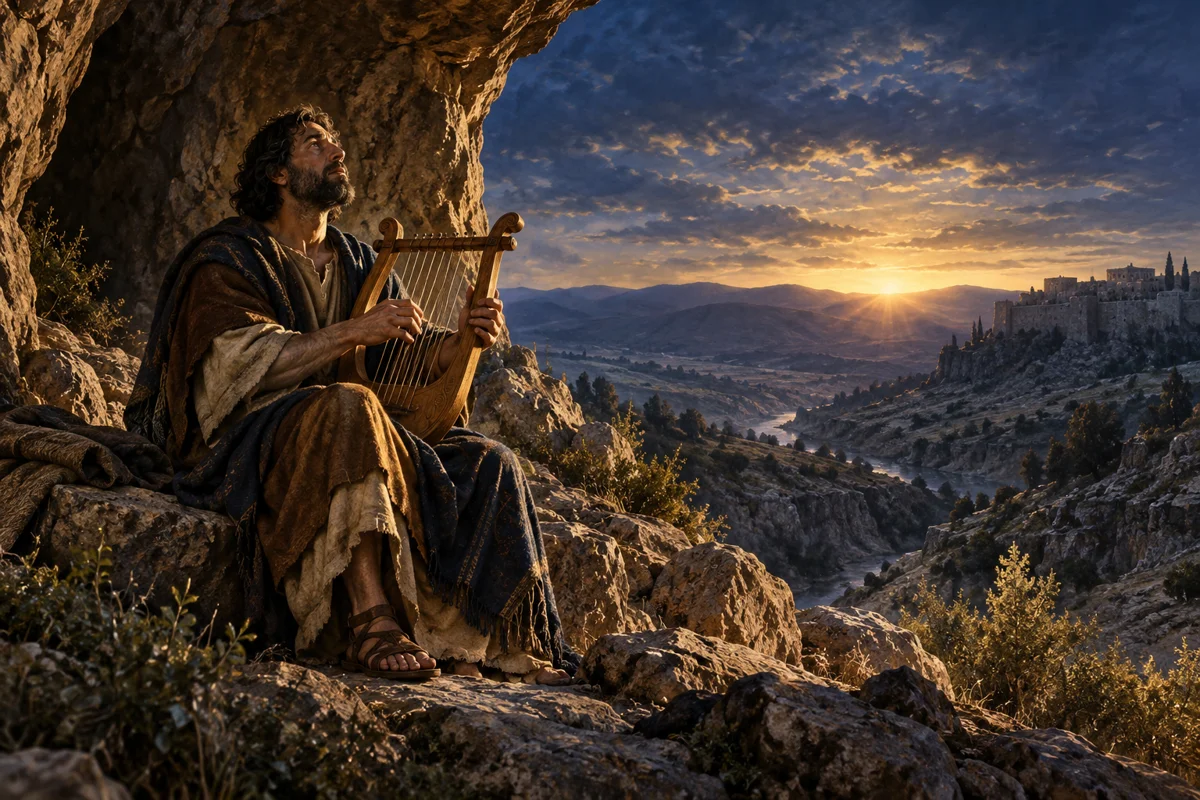
Refuge, danger, and a heart made steady in God
01
1.0 Introduction: When the Cave Becomes a Sanctuary
The cave is dark. The danger has not passed. Yet before sunrise, praise begins.
Psalm 57 is a song from hiding.
Its heading places David in a cave while fleeing Saul. The exact cave may be linked with the scenes in 1 Samuel 22 or 24, but the spiritual setting is clear enough: David is under threat, outnumbered, and dependent on God.
The psalm opens with urgency:
“Be merciful to me, O God, be merciful to me, for in you my soul takes refuge” (Ps. 57:1).
The cave may be shelter for the body.
God is shelter for the life.
David then reaches for one of the Psalter’s most tender images: “In the shadow of your wings I will take refuge, till the storms of destruction pass by.”
The language is striking. The man hiding among rocks imagines himself hidden under wings.
The danger is still real. Lions surround him. Nets are laid. A pit has been dug.
Yet by the middle of the psalm, something changes.
“My heart is steadfast, O God, my heart is steadfast.”
And before morning arrives, David says, “I will awake the dawn.”
Psalm 57 is about refuge becoming praise, because trust in God can steady the heart before circumstances have fully changed.
02
2.0 Historical and Literary Context
Psalm 57 belongs to Book Two of the Psalter (Pss. 42–72). Its heading connects it with David’s flight from Saul into a cave.
Goldingay notes that Psalm 57 has strong links with Psalm 56. Both begin with a plea for grace. Both assume a hunted life. Both move from danger toward confidence. Psalm 57, however, develops the movement further: it begins under wings and ends by waking the dawn.
The psalm falls naturally into two halves, each ending with the same refrain:
“Be exalted, O God, above the heavens! Let your glory be over all the earth!” (vv. 5, 11).
Verses 1–5 focus on refuge and deliverance in the middle of attack. Verses 6–11 move from the enemy’s trap to a steadfast heart, music, thanksgiving, and God’s glory among the nations.
The second half does not pretend the first half never happened.
It grows out of it.
03
3.0 Walking Through the Text
04
3.1 Under the Shadow of Wings — Refuge Until the Storm Passes (vv. 1–3)
“Be merciful to me, O God, be merciful to me.”
The repetition tells us something about the pressure.
David does not polish the prayer.
He repeats what he needs.
Then comes the image:
“In the shadow of your wings I will take refuge until the storms of destruction pass by.”
The language recalls a bird sheltering its young. In a cave, David sees more than stone overhead. He sees divine covering.
The refuge is not permanent withdrawal from life.
It is “until” the danger passes.
That word matters.
There are seasons for hiding.
There are seasons for emerging.
Faith sometimes looks like staying under the wings until the storm has spent its force.
Verse 2 then lifts the prayer upward:
“I cry out to God Most High, to God who fulfills his purpose for me.”
The God who shelters is also the God who completes.
David’s life has not slipped out of God’s hands just because the path now runs through a cave.
Verse 3 reaches toward heaven itself: God sends help, covenant love, and faithfulness.
The rescue comes from above the scene that feels closed in.
05
3.2 Among Lions — When Words Become Teeth and Swords (v. 4)
“My soul is in the midst of lions.”
The language is violent.
The enemies are described as devouring people. Their teeth are spears and arrows; their tongues are sharp swords.
As in nearby psalms, speech is not harmless.
Words can stalk.
Words can wound.
Words can become part of a machinery of destruction.
David is not surrounded by literal animals. He is surrounded by humans acting predator-like.
The image tells us what fear feels like from inside.
You do not merely feel opposed.
You feel hunted.
06
3.3 “Be Exalted Above the Heavens” — Praise Bigger Than the Cave (v. 5)
Then the psalm suddenly looks away from David.
“Be exalted, O God, above the heavens! Let your glory be over all the earth!”
The prayer widens dramatically.
The cave is still there.
Saul is still there.
The danger is still there.
But David’s vision has moved beyond all of them.
This refrain prevents the psalm from shrinking into survival alone.
David wants rescue, yes.
But he wants something larger: God’s glory over all the earth.
The hunted life is placed inside the purposes of the King of heaven.
07
3.4 The Net and the Pit — Evil Falling into Its Own Trap (v. 6)
“They set a net for my steps; my soul was bowed down.”
The enemy’s strategy is pictured as a trap.
David’s steps are watched.
His life is pressed low.
A pit is dug before him.
Then comes the reversal:
“They dug a pit in my way, but they have fallen into it themselves.”
The psalm does not celebrate human cleverness.
David does not say he outsmarted them.
The reversal belongs to the moral order of God.
The trapper is trapped.
The violence aimed outward circles back.
The point is not that this always happens immediately.
The point is that evil does not own the future.
08
3.5 “My Heart Is Steadfast” — Stability Before Escape (v. 7)
“My heart is steadfast, O God, my heart is steadfast.”
This may be the emotional center of the psalm.
The cave has not necessarily opened.
The enemies have not necessarily disappeared.
But the heart has found a place to stand.
Steadfastness here is not personality strength.
It is the result of refuge.
The person under God’s wings becomes steady enough to sing.
“I will sing and make melody.”
The song comes before full resolution.
That is one of Psalm 57’s deepest gifts.
Praise does not always wait until the morning.
Sometimes praise is what keeps us through the night.
09
3.6 “Awake, My Glory” — Calling the Self Back to Life (v. 8)
“Awake, my glory! Awake, O harp and lyre! I will awake the dawn.”
The line is full of movement.
David calls his own inner life to wake up.
Then he calls the instruments.
Then he speaks to the dawn as if he will rise before it does.
This is bold hope.
He will not merely wait passively for morning.
He will meet it singing.
In the darkness of the cave, David begins to act as though daylight belongs to God.
That is not denial.
It is resistance.
The night does not get to decide what kind of person he will become.
10
3.7 Praise Among the Nations — From Cave to Cosmos (vv. 9–11)
“I will give thanks to you, O Lord, among the peoples; I will sing praises to you among the nations.”
The horizon expands again.
The psalm began with one hunted man.
It ends among peoples and nations.
Why?
“For your steadfast love is great to the heavens, your faithfulness to the clouds.”
God’s covenant love is too large to remain private.
The cave becomes a place from which worldwide praise is imagined.
Then the refrain returns:
“Be exalted, O God, above the heavens! Let your glory be over all the earth!”
The same line now sounds fuller.
At verse 5, it was a plea from danger.
At verse 11, it is almost a declaration.
The situation may not yet be fully changed.
But the singer has changed.
11
4.0 Theological Reflection
12
Refuge Is Relational
Psalm 57 does not treat refuge mainly as geography.
A cave can protect for a while.
God is the deeper shelter.
Biblical refuge means trusting the character of God while waiting for the storm to pass.
13
Steadfastness Can Come Before Resolution
“My heart is steadfast” appears before the story is visibly finished.
This matters pastorally.
We often assume peace can come only after circumstances improve.
Psalm 57 shows another possibility: the heart can become steady while the cave is still dark.
14
Praise Can Resist Fear
David does not sing because danger was imaginary.
He sings because danger is not ultimate.
Praise becomes a way of refusing to let the enemy define the whole world.
The lions are real.
So is heaven.
15
God’s Glory Is Larger Than Personal Survival
The repeated refrain lifts the psalm beyond self-preservation.
David asks for rescue, but his deepest horizon is God’s glory over all the earth.
Faith matures when “save me” and “be exalted” can live in the same prayer.
16
5.0 Canonical and Christological Horizon
The image of refuge under God’s wings reaches across Scripture.
Ruth seeks refuge under the wings of the God of Israel (Ruth 2:12). Other psalms return to the same picture of shelter and trust.
Jesus later uses wing imagery when lamenting over Jerusalem: he longed to gather the city’s children as a hen gathers her brood under her wings (Matt. 23:37).
That gives Psalm 57 a tender Christological echo.
The One in whom refuge is sought is also the One who longs to gather the vulnerable.
Jesus also knows the path from night toward dawn.
He enters betrayal, arrest, violence, and the darkness of death.
The resurrection comes at morning.
The New Testament does not erase the cave.
It announces that the cave is not the end.
Psalm 57’s line, “I will awake the dawn,” finds its fullest horizon in the God who brings life out of death and turns mourning toward praise.
17
6.0 Life Application
1. Take refuge without shame. There are seasons when wisdom means staying under shelter until danger passes.
2. Do not confuse hiding with abandoning faith. David is in a cave and still praying. Sometimes retreat is part of survival.
3. Name predatory speech for what it is. Words can behave like teeth, arrows, and swords.
4. Ask for a steadfast heart before asking for an easy path. Stability inside may come before change outside.
5. Sing before everything is solved. Praise can be an act of resistance against fear.
6. Let your prayers grow larger than your crisis. Ask not only for rescue, but also that God’s glory be seen through the way he sustains and delivers.
7. Look for dawn. The night may be real, but it is not permanent.
18
7.0 Reflection Questions
1. What “cave” am I in right now?
2. Where do I need to stop feeling ashamed of seeking refuge?
3. Which words or voices have felt like teeth, arrows, or swords to me?
4. What would a “steadfast heart” look like before my situation changes?
5. What song, prayer, or act of worship could help me “wake the dawn”?
6. How can my prayer move from “save me” toward “be exalted over all the earth”?
19
8.0 Response Prayer
Merciful God, I take refuge under your wings.
The storm is real. The night is real. The voices around me can feel like lions.
But you are higher than the cave.
Send your steadfast love and faithfulness. Keep my feet from the net. Keep my heart from collapsing under fear.
Make my heart steadfast.
Wake what has gone quiet inside me. Put a song back in my mouth.
And before the dawn arrives, teach me to praise you as though the morning already belongs to you.
Be exalted above the heavens, O God. Let your glory be over all the earth.
Amen.
20
9.0 Window into What Comes Next
Psalm 57 ends with praise rising from a place of danger.
Psalm 58 turns outward again.
The question is no longer only, “Will God rescue the hunted?” but also, “What will God do about rulers and judges who twist justice itself?”
The cave opens toward the courtroom.
And the Psalter asks whether those who hold power will use it rightly.
21
10.0 Bibliography
Goldingay, John. Psalms, Volume 2: Psalms 42–89. Baker Commentary on the Old Testament Wisdom and Psalms. Grand Rapids: Baker Academic, 2007.
Kidner, Derek. Psalms 1–72. Kidner Classic Commentaries. Downers Grove, IL: IVP Academic, 2008.
BibleProject. The Book of Psalms: Study Notes.
BibleProject. “The Book of Psalms.” Old Testament Overview Guide.
Be the first to leave a comment.