

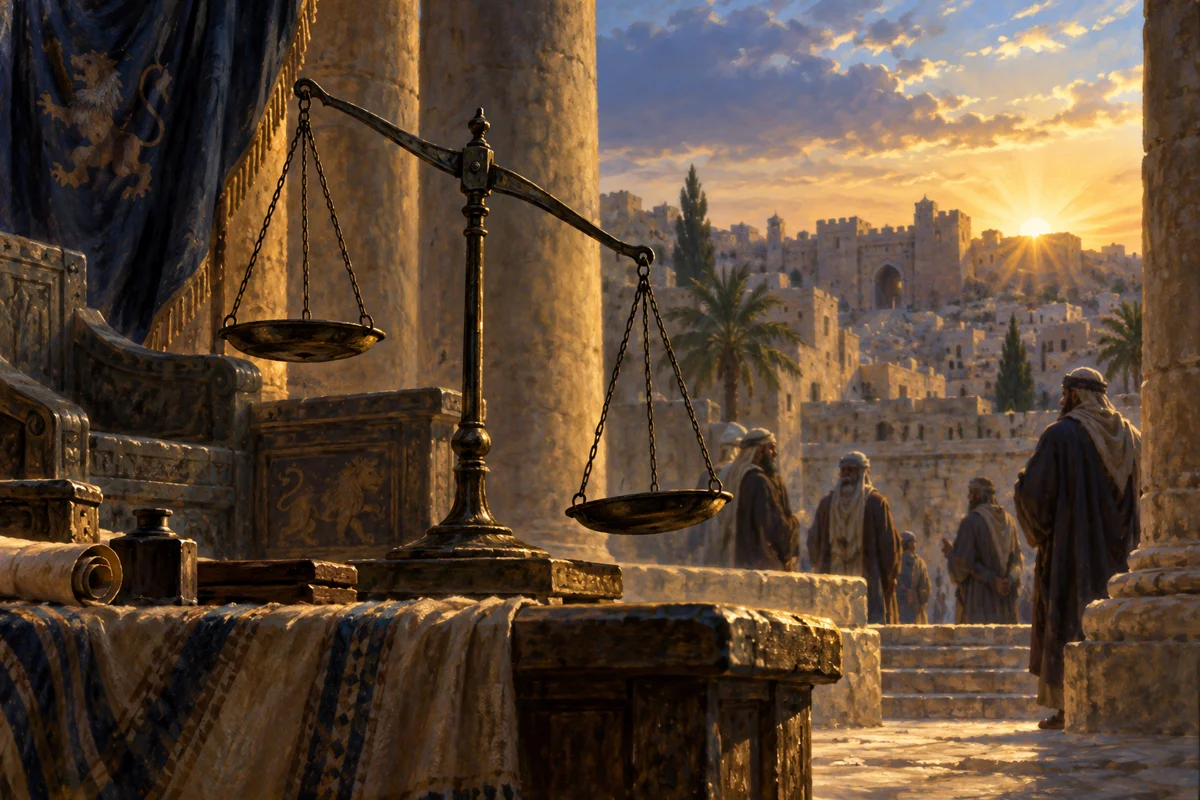
Corrupt power, fierce prayer, and the God who still judges the earth
01
1.0 Introduction: What Happens When Power Stops Serving Justice?
Justice can be wounded by the very hands meant to protect it. Psalm 58 refuses to call that normal. It asks God to break the power of those who make violence look lawful.
Some psalms begin with enemies at the door.
Psalm 58 begins nearer the bench.
Its opening question is aimed at those who are supposed to judge:
“Do you indeed decree what is right, you gods? Do you judge the children of man uprightly?” (Ps. 58:1).
The Hebrew of the first line is difficult, and interpreters have understood the addressees in several ways: rulers, judges, powerful ones, or heavenly beings charged with responsibility under God. Goldingay prefers “gods,” taking the psalm as a challenge to powers that have failed in their calling. Whatever precise identification we choose, the function is clear: those who should uphold justice are accused of producing violence instead.
Verse 2 answers the opening question:
“No, in your hearts you devise wrongs; your hands deal out violence on earth.”
This is not mere administrative failure.
It is corruption with intention behind it.
The psalm then becomes fierce. It compares the wicked to venomous snakes that refuse to listen. It asks God to break their teeth. It imagines them disappearing like water, a snail, or a life that never reaches the sun.
The language is disturbing because the injustice is disturbing.
Psalm 58 is about the collapse of justice under corrupt power, the right of the oppressed to cry for God’s intervention, and the hope that evil will not remain permanently enthroned.
02
2.0 Historical and Literary Context
Psalm 58 belongs to Book Two of the Psalter (Pss. 42–72). It follows Psalm 57, where David seeks refuge from those hunting him. Psalm 58 widens the field. The concern is no longer only the safety of one threatened person, but the failure of systems and powers that should restrain violence.
Goldingay’s title for the psalm is telling: “The Gods Must and Will Fulfill Their Responsibility.” His reading emphasizes responsibility. Injustice does not simply happen like bad weather. It is often produced by people and powers who choose it.
The poem moves in three broad stages.
Verses 1–5 accuse corrupt powers and describe their deep resistance to truth. Verses 6–9 ask God to disable and remove their destructive power. Verses 10–11 end with confidence that justice will become visible and that people will say, in effect, “Surely there is a God who judges on earth.”
The final line is the theological destination of the whole poem.
The world may look abandoned to violence.
Psalm 58 says it is not.
03
3.0 Walking Through the Text
04
3.1 “Do You Judge Uprightly?” — The Courtroom Is on Trial (vv. 1–2)
The psalm begins with questions.
“Do you indeed speak righteousness? Do you judge uprightly?”
Those who judge are themselves being judged.
The irony is deliberate.
People who hold authority usually ask questions of others. Psalm 58 turns the questions back on them.
Verse 2 exposes what is underneath:
“In your hearts you devise wrongs; your hands deal out violence on earth.”
The heart plans.
The hands distribute.
Injustice moves from intention to institution.
That is why corruption at the level of power is so dangerous. A private sin can wound one relationship. A corrupt judge, ruler, court, or system can multiply harm across many lives.
Psalm 58 refuses to hide structural evil behind official language.
Violence can wear robes.
05
3.2 Poison in the Bloodstream — Evil That Refuses Correction (vv. 3–5)
The psalm then turns to the wicked more broadly.
“The wicked are estranged from the womb; they go astray from birth, speaking lies.”
The language is poetic and sweeping. It does not mean infants consciously practice deceit. It portrays wickedness as deeply rooted, not accidental or superficial.
Then comes the snake image:
“They have venom like the venom of a serpent, like the deaf adder that stops its ear.”
The problem is not only that poison exists.
The snake refuses to listen.
Even the skilled charmer cannot move it.
The image points to moral resistance. Corrupt power can become so practiced in self-protection that truth itself is treated as a threat.
Warnings are ignored.
Victims are dismissed.
Correction becomes impossible because listening has stopped.
06
3.3 “Break Their Teeth” — A Prayer to Disable Harm (v. 6)
“O God, break the teeth in their mouths; tear out the fangs of the young lions, O Yahweh!”
This is the psalm’s only direct address to God.
And it is violent language.
Yet notice what the image asks for: disable the power to devour.
The teeth belong to predators.
The prayer is not “make me a stronger lion.”
It is “stop the lions from biting.”
This is an important distinction when reading imprecatory prayer.
The psalmist wants destructive power neutralized.
For people who have lived under oppression, that is not a trivial desire.
It is the longing to wake up in a world where those who prey on others can no longer do so.
07
3.4 Water, Arrows, Snails, and Unborn Life — Images of Disappearing Power (vv. 7–9)
The imagery now comes rapidly.
May the wicked vanish like water that runs away.
May their arrows lose their force.
May they be like a snail that dissolves as it moves.
May they be like a stillborn child that never sees the sun.
Before the cooking pot can even feel the heat of thorns, may the storm sweep them away.
These are not calm metaphors.
They are images of sudden disappearance.
The oppressed person looks at entrenched power and asks God to make it temporary.
The force of the poetry is not mainly about enjoying suffering.
It is about wanting violent power to lose its future.
What now appears permanent must become brief.
What now seems untouchable must become fragile.
The psalm reaches for extreme images because ordinary language can feel too weak in the face of extreme injustice.
08
3.5 “The Righteous Will Rejoice” — The Difficult Joy of Redress (v. 10)
“The righteous will rejoice when he sees the vengeance; he will bathe his feet in the blood of the wicked.”
This is one of the hardest lines in the psalm.
It should not be softened.
But it should be read carefully.
Goldingay notes that the faithful see the redress; they do not carry it out. The action belongs to God.
The image of feet in blood is hyperbolic battlefield language. It pictures complete and irreversible defeat of those who have been shedding the blood of the faithful.
The joy is therefore the joy of justice finally becoming visible.
For someone who has watched cruelty go unanswered for years, the end of oppression can feel like sunrise.
The psalm gives voice to that relief.
09
3.6 “Surely There Is a God Who Judges” — The Last Word (v. 11)
Then comes the conclusion:
“Surely there is a reward for the righteous; surely there is a God who judges on earth.”
This is the psalm’s central confession.
The final concern is not revenge for its own sake.
It is whether the moral order of the world means anything.
If judges can corrupt justice forever, if violence can rule without answer, then the world begins to look godless.
Psalm 58 prays until that appearance is broken.
Justice will become visible.
And when it does, people will say:
God has not abandoned the earth.
10
4.0 Theological Reflection
11
Power Is a Vocation Before It Is a Privilege
Psalm 58 assumes that those who judge have a responsibility.
Authority is not self-justifying.
It exists for justice.
When power protects itself instead of the vulnerable, it has betrayed its calling.
12
Injustice Is Often Made, Not Merely Found
Goldingay stresses that injustice is not simply an impersonal feature of life.
Hearts devise it.
Hands distribute it.
Systems can embody it.
That means repentance must sometimes be larger than individual regret. Practices, structures, and institutions may also need to change.
13
Fierce Prayer Can Be Morally Serious
Psalm 58’s language is severe because the wrong is severe.
Comfortable readers may recoil from the imagery.
Victims of violent injustice may hear something else: at last, a prayer that does not minimize what happened.
The psalm teaches us to bring the desire for evil to end into God’s presence rather than turning that desire into private vengeance.
14
God’s Judgment Is Good News for the Oppressed
Judgment is frightening when we imagine ourselves only as defendants.
It is hopeful when we have been denied justice.
The God who judges is the God who refuses to let predatory power define reality forever.
15
5.0 Canonical and Christological Horizon
Psalm 58 belongs to a wider biblical concern about failed rulers and corrupt judges.
The prophets repeatedly condemn leaders who take bribes, neglect the poor, and twist justice (Isa. 1:23; Mic. 3:1–3, 9–11). Psalm 82 likewise pictures God calling unjust powers to account.
The New Testament continues that concern.
Jesus condemns leaders who burden others while neglecting justice, mercy, and faithfulness (Matt. 23:23–24).
Yet the canonical story also complicates our reading.
At the cross, Jesus becomes the victim of distorted judgment. False testimony, political calculation, and manipulated procedure converge against him.
The Judge of all is judged unjustly.
But resurrection overturns that verdict.
The New Testament therefore does not answer Psalm 58 by denying judgment. It places final judgment in the hands of the risen Christ, who exposes evil and also bears judgment in himself.
The cross prevents us from praying Psalm 58 self-righteously.
The resurrection prevents us from praying it hopelessly.
16
6.0 Life Application
1. Ask what power is for. Whether in a family, church, workplace, court, or institution, authority should protect what is right, not merely protect itself.
2. Pay attention when people in power stop listening. The deaf-serpent image warns against systems that become immune to correction.
3. Pray for harmful power to be disabled. “Break their teeth” can become a prayer that exploitation, abuse, intimidation, and corruption lose their ability to injure.
4. Do not sanitize injustice for the sake of politeness. Biblical lament sometimes needs strong language because weak language can hide strong evil.
5. Leave final vengeance with God. The righteous in Psalm 58 witness redress; they are not told to become agents of bloodshed.
6. Examine your own use of power. The psalm is dangerous if we only use it against “them.” Any of us can become deaf to correction when influence grows.
7. Hold onto the final confession. There is a God who judges on earth. Evil may be organized, protected, and delayed in answering, but it is not eternal.
17
7.0 Reflection Questions
1. Where have I seen authority used to protect itself rather than serve justice?
2. When have I become resistant to correction?
3. What form of harmful power do I need to ask God to disable?
4. Do I secretly want justice, or do I mainly want my side to win?
5. How does the cross challenge my self-righteousness while still allowing me to pray for judgment?
6. What would it mean for me to live today as though God truly judges the earth?
18
8.0 Response Prayer
God of justice, you see what happens when power forgets its purpose.
Where rulers, leaders, systems, or strong people use their strength to wound, do not let violence hide behind respectable words.
Break the teeth of what devours. Silence the poison that refuses correction. Bring down what survives by crushing the weak.
And search me too.
Show me where I have stopped listening, where I have used influence for myself, where I have wanted judgment without humility.
Keep vengeance out of my hands. Keep justice alive in my prayers.
Let the oppressed see that you have not forgotten the earth.
And let our lives bear witness:
There is a God who judges with truth.
Amen.
19
9.0 Window into What Comes Next
Psalm 58 asks God to confront corrupt power.
Psalm 59 returns to a more personal scene of danger.
Enemies surround the house.
They watch through the night.
And the prayer becomes urgent again.
But one truth carries forward: the God who judges injustice is also the God who becomes a fortress for the hunted.
20
10.0 Bibliography
Goldingay, John. Psalms, Volume 2: Psalms 42–89. Baker Commentary on the Old Testament Wisdom and Psalms. Grand Rapids: Baker Academic, 2007.
Kidner, Derek. Psalms 1–72. Kidner Classic Commentaries. Downers Grove, IL: IVP Academic, 2008.
BibleProject. The Book of Psalms: Study Notes.
BibleProject. “The Book of Psalms.” Old Testament Overview Guide.
Be the first to leave a comment.