

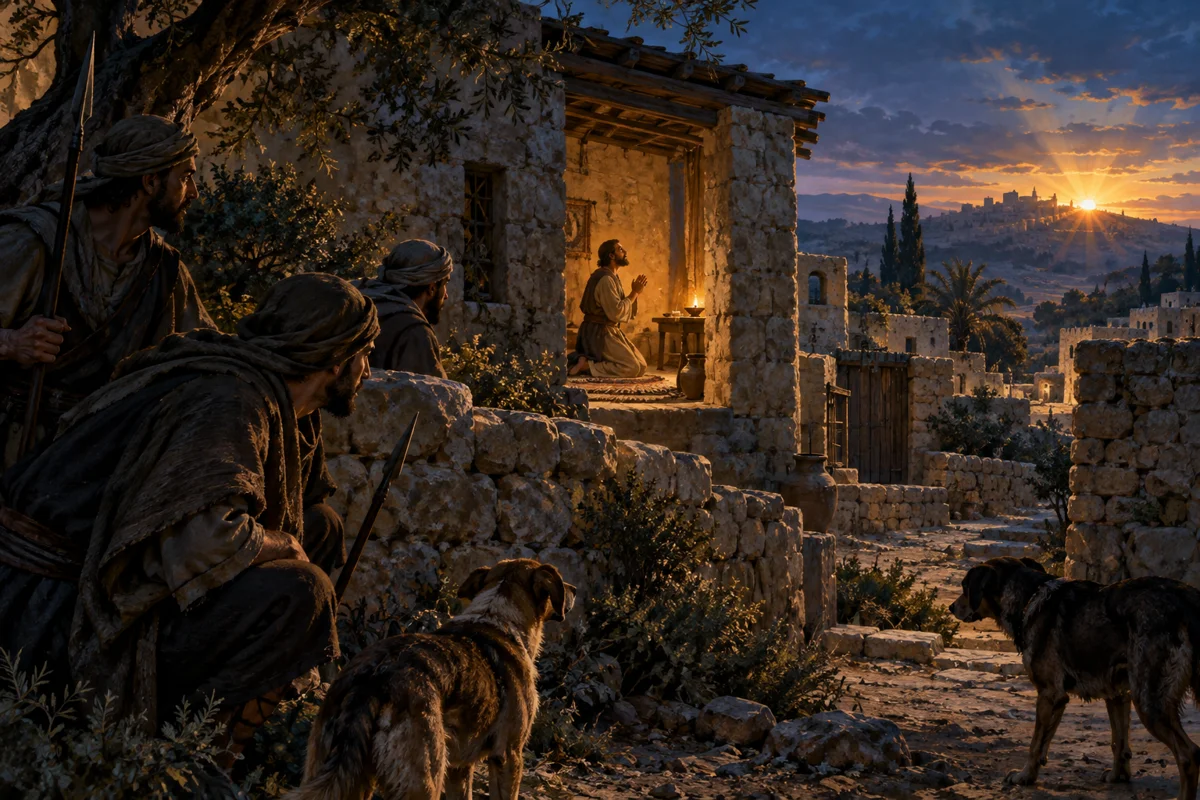
Threat, vigilance, and the God who becomes a fortress
01
1.0 Introduction: When Danger Comes to the House
Some nights are quiet. Others feel watched. Psalm 59 teaches the hunted person to wait for God until morning.
Psalm 59 begins with enemies close enough to watch the house.
Its heading connects the prayer with the episode in which Saul sent men to guard David’s home and kill him (1 Sam. 19:11–17). Michal helped David escape through a window, but the emotional world of the psalm stays with the night before escape: armed men outside, danger circling, no easy path out.
The psalm opens with urgency:
“Deliver me from my enemies, O my God; protect me from those who rise up against me” (Ps. 59:1).
This is not distant hostility.
The attackers lie in wait for his life.
They organize themselves.
They return at evening like scavenging dogs prowling through the city.
Yet the psalm does not remain trapped in the night.
Again and again, another image appears:
“God is my fortress.”
And by the end, David says:
“I will sing of your strength; I will sing aloud of your steadfast love in the morning” (v. 16).
The night belongs to the prowling dogs.
The morning belongs to praise.
Psalm 59 is about learning to pray under threat until fear is reoriented by the conviction that God is stronger, nearer, and more enduring than those who surround us.
02
2.0 Historical and Literary Context
Psalm 59 belongs to Book Two of the Psalter (Pss. 42–72). The heading places it in a specific Davidic crisis: Saul sends men to watch David’s house in order to kill him.
Goldingay calls the psalm “How to Pray in Terror.” That description fits its intensity. The prayer does not move once from fear to peace and stay there. It circles between danger and confidence.
The psalm has several movements.
Verses 1–4a plead for rescue and insist that David has not caused the attack. Verses 4b–7 intensify the plea and describe the attackers like dogs roaming at night. Verses 8–10 answer with confidence in God’s strength and covenant love. Verses 11–15 return to judgment and again picture the enemies prowling the city. Verses 16–17 close with song at morning.
This repeated movement matters.
The threat keeps returning.
So trust keeps returning too.
03
3.0 Walking Through the Text
04
3.1 “Deliver Me” — Prayer Under Immediate Threat (vv. 1–4a)
“Deliver me from my enemies, O my God.”
The psalm begins with imperatives.
Deliver.
Protect.
Save.
The repetition reflects urgency.
David is not asking for vague spiritual comfort. He wants real rescue from real danger.
He says the attackers “lie in wait for my life” and describes them as strong.
Goldingay notes the significance of that word. Strength is often an attribute of God in the Psalms. Here it belongs, temporarily, to the attackers.
That heightens the crisis.
David is outmatched.
But that is precisely why prayer matters.
The psalm does not begin with the strength of David.
It begins with the strength of the enemy and turns toward the strength of God.
05
3.2 “Not for My Sin” — The Cry of the Wrongly Targeted (vv. 3c–4)
David insists:
“Not for my transgression, nor for my sin, O Yahweh.”
This is not a claim of absolute sinlessness.
It is a claim that this particular attack is not deserved.
That distinction matters.
Biblical lament gives language to people who have been falsely accused, targeted, or hunted without just cause.
There are times when repentance is needed.
There are also times when what is needed is vindication.
Psalm 59 makes room for both realities by refusing to confuse suffering with guilt.
06
3.3 “Awake to Meet Me” — Asking God to Notice and Act (vv. 4b–5)
“Awake, come to meet me, and see!”
The language is bold.
God is not literally asleep.
The prayer speaks from the experience of delay.
When danger is immediate and God’s intervention is not yet visible, it can feel as though heaven is silent.
So the psalmist says:
Wake up.
Look.
Act.
This is not irreverence.
It is covenant speech.
The believer is speaking to the God whose character gives him reason to expect justice.
07
3.4 Dogs at Evening — Threat That Keeps Circling (vv. 6–7)
“They return at evening, snarling like dogs and prowling about the city.”
The image is memorable.
These are not household pets.
They are scavenging dogs, restless, hungry, roaming.
The attackers are portrayed as a pack.
Their mouths are loud.
Their lips are like swords.
And they say, in effect:
“Who hears?”
That is the theology beneath their violence.
They assume no one is listening.
No one will call them to account.
But the next verse answers them.
08
3.5 “But You, Yahweh, Laugh” — God Is Not Intimidated (vv. 8–10)
“But you, O Yahweh, laugh at them.”
The contrast is sudden.
The enemies are loud.
God is not impressed.
Psalm 2 uses similar imagery when rebellious rulers rage against God and his anointed. Their power looks large from earth.
From heaven, it is not ultimate.
Then David says:
“O my Strength, I will watch for you, for God is my fortress.”
This is a major shift.
Earlier the attackers were “strong.”
Now David names God as “my Strength.”
The vocabulary has been reclaimed.
The enemies may possess force.
God is the source of security.
And the next verse adds covenant love:
“My God in his steadfast love will meet me.”
The hunted person is not waiting for an abstract power.
He is waiting for the God committed to him.
09
3.6 Judgment That Teaches — “Do Not Kill Them Yet” (vv. 11–13)
One of the psalm’s more unusual requests is:
“Do not kill them, lest my people forget.”
David does not merely want the enemies removed.
He wants their downfall to become a lesson.
Their pride, lies, and destructive speech should be exposed in a way that teaches the community something about God’s rule.
Then comes the larger purpose:
“Let them know that God rules over Jacob to the ends of the earth.”
The crisis is personal, but the theology is global.
God’s rule over one threatened life points toward his rule over the whole earth.
Justice is meant to reveal kingship.
10
3.7 The Dogs Return — But Their Hunger Does Not Rule the Story (vv. 14–15)
The dog image returns.
Again they prowl in the evening.
Again they search for food.
Again they growl.
The repetition is realistic.
Problems do not always disappear after one declaration of faith.
Sometimes the same fear comes back at sundown.
The psalm does not treat that as failure.
It simply returns again to God.
Trust is not always a straight line.
Sometimes it is a path worn by repeated footsteps.
11
3.8 “But I Will Sing in the Morning” — The Night Does Not Get the Last Word (vv. 16–17)
Then comes the ending:
“But I will sing of your strength; I will sing aloud of your steadfast love in the morning.”
The contrast with the dogs is powerful.
They roam at evening.
David sings in the morning.
They depend on appetite.
David depends on covenant love.
They circle the city.
God becomes a fortress.
The psalm closes:
“O my Strength, I will sing praises to you, for you, O God, are my fortress, the God who shows me steadfast love.”
The last word is not attack.
It is belonging.
12
4.0 Theological Reflection
13
God Is a Fortress Before the Danger Is Gone
David calls God a fortress while enemies are still present.
The name comes before visible resolution.
Faith often works like that.
We learn where safety is before we fully experience the escape.
14
The Psalms Give Language to Innocent Suffering
Psalm 59 refuses the lazy idea that suffering always proves guilt.
Sometimes people suffer because others are violent, jealous, corrupt, or afraid.
The psalm gives the wrongly targeted person permission to say:
“This is not because I caused it.”
15
Violent Speech Reveals a Theology
The attackers speak as though no one hears.
That is more than arrogance.
It is practical atheism.
To harm others without fear of accountability is to live as though heaven is deaf.
Psalm 59 answers:
God hears.
16
Morning Praise Is an Act of Hope
The psalm does not deny the night.
It outlasts it.
Morning becomes a theological image: danger may circle for a season, but God’s steadfast love gives the faithful another horizon.
17
5.0 Canonical and Christological Horizon
Psalm 59 belongs to the larger biblical story of God’s anointed being hunted by corrupt power.
David is targeted by Saul.
Jesus too is watched by people looking for an opportunity to seize and kill him. The Gospels repeatedly show leaders plotting, spying, and waiting for the right moment.
Like David, Jesus is surrounded by hostility that presents itself as legitimate authority.
Yet Jesus entrusts himself to the Father.
At the cross, the forces of violence appear to have succeeded.
But resurrection turns night into morning.
That gives Psalm 59 a deep Christian resonance.
The God who is fortress is not merely the God who prevents death.
He is the God who can bring life beyond death.
The morning song therefore reaches beyond one escape from danger.
It points toward the greater dawn in which death itself loses its claim.
18
6.0 Life Application
1. Pray specifically when danger feels specific. Psalm 59 names enemies, speech, plotting, fear, and timing. Honest prayer need not stay vague.
2. Do not assume suffering proves guilt. Examine yourself truthfully, but do not accept false blame merely because you are under pressure.
3. Remember that God hears what violent people assume no one hears. Hidden plans are not hidden from him.
4. Call God your fortress before the situation is resolved. Faith often names God’s character before circumstances catch up.
5. Expect fear to return sometimes. The dogs come back in the poem. Repeated fear may require repeated trust.
6. Ask for justice that reveals truth. Pray not only for enemies to stop, but for lies, pride, and corruption to be exposed.
7. Keep a place for morning praise. Do not let the night write the final sentence.
19
7.0 Reflection Questions
1. What “night” am I living through at present?
2. Where do I feel watched, opposed, or misunderstood?
3. Have I wrongly assumed that suffering means I must be guilty?
4. What does it mean for me to call God “my fortress” before anything changes?
5. Which fear keeps returning like the dogs at evening?
6. What would morning praise sound like in my present situation?
20
8.0 Response Prayer
God my fortress, deliver me from what I cannot control.
You see what waits in the dark. You hear what is spoken in secret.
Where I am falsely accused, keep me truthful.
Where I am afraid, keep me from panic.
Where others use strength against me, remind me that you are my Strength.
Do not let the night define my future.
Meet me with your steadfast love.
And when morning comes, put a song in my mouth.
You are my fortress. You are my refuge in trouble. You are the God who remains committed to me.
Amen.
21
9.0 Window into What Comes Next
Psalm 59 ends with the confidence that God rules and becomes a fortress for the hunted.
Psalm 60 will open in a different mood.
There the crisis is national rather than personal.
The people feel as though God has rejected them.
The question becomes:
How do you pray when defeat seems to contradict what God once promised?
22
10.0 Bibliography
Goldingay, John. Psalms, Volume 2: Psalms 42–89. Baker Commentary on the Old Testament Wisdom and Psalms. Grand Rapids: Baker Academic, 2007.
Kidner, Derek. Psalms 1–72. Kidner Classic Commentaries. Downers Grove, IL: IVP Academic, 2008.
BibleProject. The Book of Psalms: Study Notes.
BibleProject. “The Book of Psalms.” Old Testament Overview Guide.
Be the first to leave a comment.