

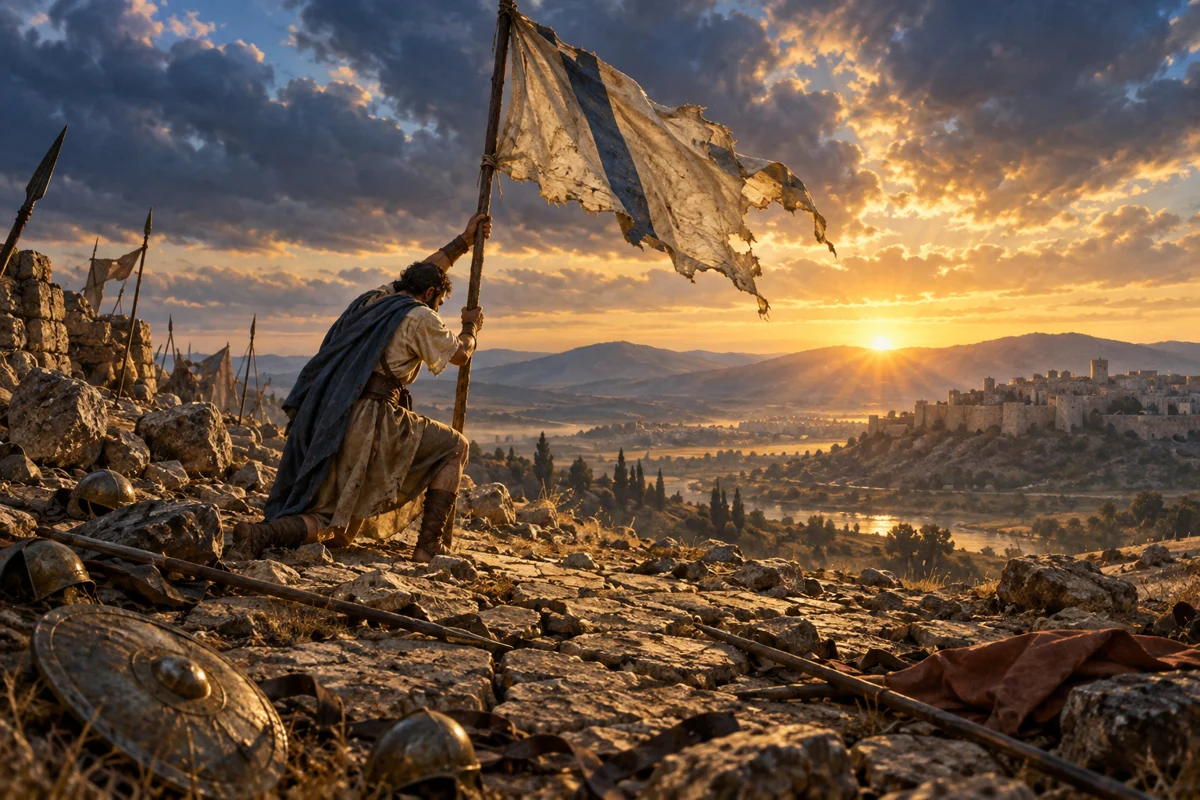
Rupture, remembered words, and courage after collapse
01
1.0 Introduction: “You Have Rejected Us”
Sometimes faith is tested not by silence, but by the memory of what God once said. Psalm 60 asks what to do when present defeat seems to contradict past promise.
Psalm 60 begins in shock.
“O God, you have rejected us, broken our defenses; you have been angry; restore us!” (Ps. 60:1).
The language is national rather than merely personal. The land has been shaken. The people stagger as though they have drunk strong wine. The battle has gone badly enough that the whole community feels torn open.
What makes the prayer especially painful is that these are not people who have forgotten God. The psalm calls them those who revere him and “your beloved” (vv. 4–5).
So the question underneath the lament is difficult:
How can people who belong to God experience a defeat that feels like rejection?
The psalm does not answer by pretending the defeat was small.
Nor does it abandon the earlier word of God.
Instead, it brings the present disaster into conversation with what God has already promised.
Psalm 60 is about faith after collapse: naming defeat honestly, remembering God’s prior word, and refusing to trust human strength as the final source of rescue.
02
2.0 Historical and Literary Context
Psalm 60 belongs to Book Two of the Psalter (Pss. 42–72). Its heading connects it with David’s wars against Aram and Edom and with Joab’s victory in the Valley of Salt. The exact relation between the heading and the poem is difficult to reconstruct, and the psalm itself sounds as though Israel has suffered a serious military setback.
Goldingay therefore focuses less on reconstructing one precise battle and more on the psalm’s clear spiritual situation: the community has been defeated, feels abandoned by God, and reaches back to a divine word spoken earlier.
The psalm moves in three broad stages.
Verses 1–5 are protest and plea. Verses 6–8 quote or recall God’s own declaration about Israel’s land and surrounding nations. Verses 9–12 return to the present crisis, confess the uselessness of merely human rescue, and end with confidence:
“With God we shall do valiantly.”
The striking feature is the middle section.
The answer to present collapse is not a new promise.
It is an old word remembered again.
03
3.0 Walking Through the Text
04
3.1 “You Have Rejected Us” — When Defeat Feels Theological (vv. 1–3)
“O God, you have rejected us.”
The psalm does not begin by blaming military strategy, poor leadership, bad timing, or enemy strength.
It addresses God.
That may sound severe, but it reflects the covenant worldview of the Psalms. Israel’s life is bound to God. So defeat cannot be discussed as though God were irrelevant.
“You have broken us.”
“You have been angry.”
“You have made the land quake.”
“You have made your people see hard things.”
This is the language of a community whose world has lost stability.
The land itself becomes an image of their condition: cracked, shaken, needing repair.
Then comes the image of wine:
“You have made us drink wine that made us stagger.”
Defeat has disoriented them.
They cannot stand straight.
This is what communal trauma feels like. The familiar ground no longer feels firm.
05
3.2 The Banner of a Retreating People (v. 4)
“You have set up a banner for those who fear you, that they may flee to it from the bow.”
The verse is difficult, and translations differ.
Goldingay takes the banner as a place of retreat in the face of arrows, creating a painful irony. A banner should usually rally soldiers for advance and victory.
Here it gathers frightened people who are fleeing.
The image captures the humiliation.
These are not people celebrating conquest.
They are trying to survive.
Yet even here the psalm names them as “those who fear you.”
Defeat has not erased their identity.
That matters.
A bad season is not always proof that God’s people have ceased to be his people.
06
3.3 “Save Your Beloved” — Identity Becomes the Basis of Prayer (v. 5)
“That your beloved ones may be delivered, give salvation by your right hand and answer us.”
The prayer deepens.
The people appeal to relationship.
They are “your beloved.”
That is not arrogance.
It is covenant language.
The plea is essentially:
Act because of who we are to you.
The right hand of God, elsewhere a symbol of power and victory, is summoned again.
The people who cannot steady themselves ask God to stretch out the hand that can.
07
3.4 “God Has Spoken” — Remembering the Word in the Middle of Defeat (vv. 6–8)
Then the psalm changes voice:
“God has spoken in his holiness.”
This is the hinge.
The present says, “We are defeated.”
The remembered word says, “The land is mine.”
Shechem.
Succoth.
Gilead.
Manasseh.
Ephraim.
Judah.
Then Moab, Edom, and Philistia.
The geography becomes theology.
God names the land as his possession and the nations around it as subject to his rule.
The point is not ethnic boasting.
The point is divine kingship.
The defeat has made the world look as though someone else owns the map.
God’s word says otherwise.
That is why remembering becomes an act of faith.
08
3.5 The Word Does Not Remove the Problem (vv. 9–10)
After recalling God’s declaration, the psalm does something surprising.
It returns to protest.
“Who will bring me to the fortified city? Who will lead me to Edom?”
Then:
“Have you not rejected us, O God? You do not go forth, O God, with our armies.”
The remembered promise has not erased the contradiction.
This is crucial.
Biblical faith does not require us to force circumstances into a quick resolution.
The people can remember God’s word and still say:
But look at what is happening now.
That tension is part of mature faith.
We do not choose between promise and pain.
We bring them into the same prayer.
09
3.6 “Human Help Is Vain” — The Collapse of False Security (v. 11)
“Oh, grant us help against the foe, for vain is the salvation of man!”
The psalm has reached clarity.
Human help is not denied entirely. Armies still march. Leaders still act.
But human power cannot carry the weight of ultimate trust.
“Vain” here means empty, insubstantial, unable to save in the deepest sense.
Defeat has stripped away an illusion.
The people may have had God’s promise and still trusted too much in visible strength.
Now they know better.
10
3.7 “With God We Shall Do Valiantly” — Courage Without Self-Reliance (v. 12)
The psalm ends:
“With God we shall do valiantly; it is he who will tread down our foes.”
This is not a return to bravado.
The grammar of faith has changed.
Not:
We are strong.
But:
With God.
Not:
We will crush them because we are superior.
But:
He will act.
The people rise from defeat with courage, but not with illusion.
That is a different kind of strength.
11
4.0 Theological Reflection
12
Defeat Can Become a Crisis of Interpretation
Psalm 60 is not only about losing a battle.
It is about what defeat seems to say about God.
That is why the prayer is so intense.
When circumstances appear to contradict promise, the deepest struggle is often interpretive:
What does this mean?
The psalm does not answer too quickly.
13
Remembering God’s Word Is an Act of Resistance
The middle of Psalm 60 is a remembered declaration.
The people return to what God said before.
Memory becomes resistance against despair.
The present is real.
It is not the whole story.
14
Covenant Identity Survives Hard Seasons
The people call themselves those who fear God and his beloved even while speaking of rejection.
That tension matters.
Experiencing God’s discipline, delay, or apparent absence does not automatically erase covenant belonging.
15
Human Strength Must Be Relativized
The final confession is not anti-human effort.
It is anti-idolatry.
Human action has a place.
Human salvation does not.
“With God” becomes the difference between courage and self-reliance.
16
5.0 Canonical and Christological Horizon
Psalm 60 participates in a larger biblical pattern.
Israel repeatedly faces moments when present reality appears to contradict earlier promise.
Abraham receives a promise and waits.
Israel leaves Egypt only to find the sea ahead and Pharaoh behind.
David is anointed and then hunted.
The exile later creates an even deeper version of Psalm 60’s question: if God promised David a kingdom, what does Jerusalem’s fall mean?
The New Testament brings this tension to its sharpest point at the cross.
Jesus is proclaimed Messiah, Son, and King.
Then he is rejected, humiliated, and killed.
For a moment, the promise appears defeated.
Resurrection does not deny the cross.
It interprets it.
God’s promise is not broken by apparent collapse.
It passes through it.
Psalm 60 therefore prepares readers for a faith that can hold promise and defeat together long enough for God to reveal what neither circumstance nor memory can explain by itself.
17
6.0 Life Application
1. Name defeat honestly. Do not call collapse “victory” merely to sound faithful.
2. Ask what the crisis is making you believe about God. Sometimes the deepest wound is the story we begin telling ourselves about his absence.
3. Return to what God has actually said. Memory can steady faith when the present is unstable.
4. Do not force the tension to disappear too quickly. You can trust the promise and still lament the contradiction.
5. Let hard seasons expose false sources of security. Human strength, money, reputation, strategy, and influence cannot bear the weight of salvation.
6. Pray from covenant identity. “Your beloved” is a stronger starting point than “our performance.”
7. Move forward with God, not merely for God. The final confidence of the psalm is relational: “With God we shall do valiantly.”
18
7.0 Reflection Questions
1. What present situation feels like a contradiction of something I believed God had promised?
2. What has this defeat made me think about God?
3. Which word of God do I need to remember without using it to deny present pain?
4. Where have I trusted human strength too deeply?
5. What does it mean for me to pray as one of God’s beloved?
6. What courageous next step could I take “with God” rather than in self-reliance?
19
8.0 Response Prayer
God of the promise, sometimes the ground under us feels broken.
We have known defeat. We have felt shaken. We have wondered whether you have turned away.
Do not let us lie about the pain.
But do not let the pain erase your word.
Remind us of what you have spoken. Remind us who we are to you.
Strip away the confidence we place in human strength alone.
Give us help where our own help is empty.
And when we rise again, keep us from pride.
Let our courage have only this foundation:
With you, we will walk forward.
Amen.
20
9.0 Window into What Comes Next
Psalm 60 ends with a people recovering courage through the remembered word of God.
Psalm 61 will become more personal and quiet.
The battlefield gives way to distance.
The cry will come “from the end of the earth,” from a heart that feels faint.
And the prayer will ask to be led to a rock higher than the self.
21
10.0 Bibliography
Goldingay, John. Psalms, Volume 2: Psalms 42–89. Baker Commentary on the Old Testament Wisdom and Psalms. Grand Rapids: Baker Academic, 2007.
Kidner, Derek. Psalms 1–72. Kidner Classic Commentaries. Downers Grove, IL: IVP Academic, 2008.
BibleProject. The Book of Psalms: Study Notes.
BibleProject. “The Book of Psalms.” Old Testament Overview Guide.
Be the first to leave a comment.