


“From the end of the earth I call to you when my heart is faint. Lead me to the rock that is higher than I.”
01
A Study in Prayer, Refuge, Kingship, and the Nearness of God
Key Verse “From the end of the earth I call to you when my heart is faint. Lead me to the rock that is higher than I.” — Psalm 61:2
02
Big Idea
Psalm 61 is the prayer of someone who feels far away, worn down, and exposed, yet remembers that distance from a sacred place is not distance from God.
The psalm begins at “the end of the earth,” with a heart running out of strength. It ends with praise offered “day by day.” Between those two places stands a sequence of images: rock, refuge, strong tower, tent, and wings. Each image says the same thing from a different angle: when our strength cannot carry us, God himself becomes the place where we can stand.
Psalm 61 also widens from one person’s distress to a prayer for the king. The life of the worshiper and the future of God’s people belong together. Personal rescue is not the end of the story; God’s faithfulness is meant to sustain a people, preserve righteous rule, and produce ongoing praise.
03
1. Where Psalm 61 Sits in the Psalms
Psalm 61 belongs to Book Two of the Psalms (Psalms 42–72). This section begins with longing for God’s presence and Zion in Psalms 42–43 and moves toward the hope of a righteous Davidic king whose reign brings blessing beyond Israel in Psalm 72.
Psalm 61 fits naturally into that movement. It combines three major themes: longing for God’s presence, trust in God as refuge, and prayer for the Davidic king.
The psalm is traditionally linked with David, though it does not identify a specific historical event. It could fit a time when David was far from Jerusalem because of war, flight, or political crisis. The exact setting, however, is less important than the spiritual geography: the worshiper feels far away, but he discovers that God is not.
John Goldingay describes Psalm 61 as standing somewhere between petition and thanksgiving—a psalm of trust or confidence. It begins with need, remembers previous deliverance, moves into confidence, prays for the king, and finishes with praise.
04
2. The Movement of the Psalm
Psalm 61 can be followed in four movements.
Verses 1–3 — A Cry From Far Away
The psalmist asks God to hear him when his strength is failing.
Verses 4–5 — Confidence in God’s Shelter
Rock and tower become tent and wings. The God who rescues is also the God with whom the worshiper longs to dwell.
Verses 6–7 — Prayer for the King
The horizon widens. The psalmist asks that the king’s life and reign be preserved under God’s covenant faithfulness.
Verse 8 — A Life of Praise
Rescue becomes worship. The answer to prayer is meant to shape ordinary life “day by day.”
The movement is therefore:
distress → refuge → presence → kingship → praise
05
WALKING THROUGH THE PSALM
06
3. “Hear My Cry” — Prayer Begins With Honest Need
Psalm 61:1
The psalm does not begin with an explanation. It begins with a cry.
The worshiper does not first solve his problem, organize his emotions, or prove that he deserves help. He simply asks God to listen and attend.
Biblical prayer often begins here. Faith is not pretending that the heart is strong. Faith is turning toward God precisely because the heart is not strong enough.
There are seasons when prayer is carefully composed. There are also seasons when prayer is little more than a cry. Psalm 61 tells us that both belong in God’s presence.
For Reflection
What have you been trying to carry silently that needs to become prayer?
07
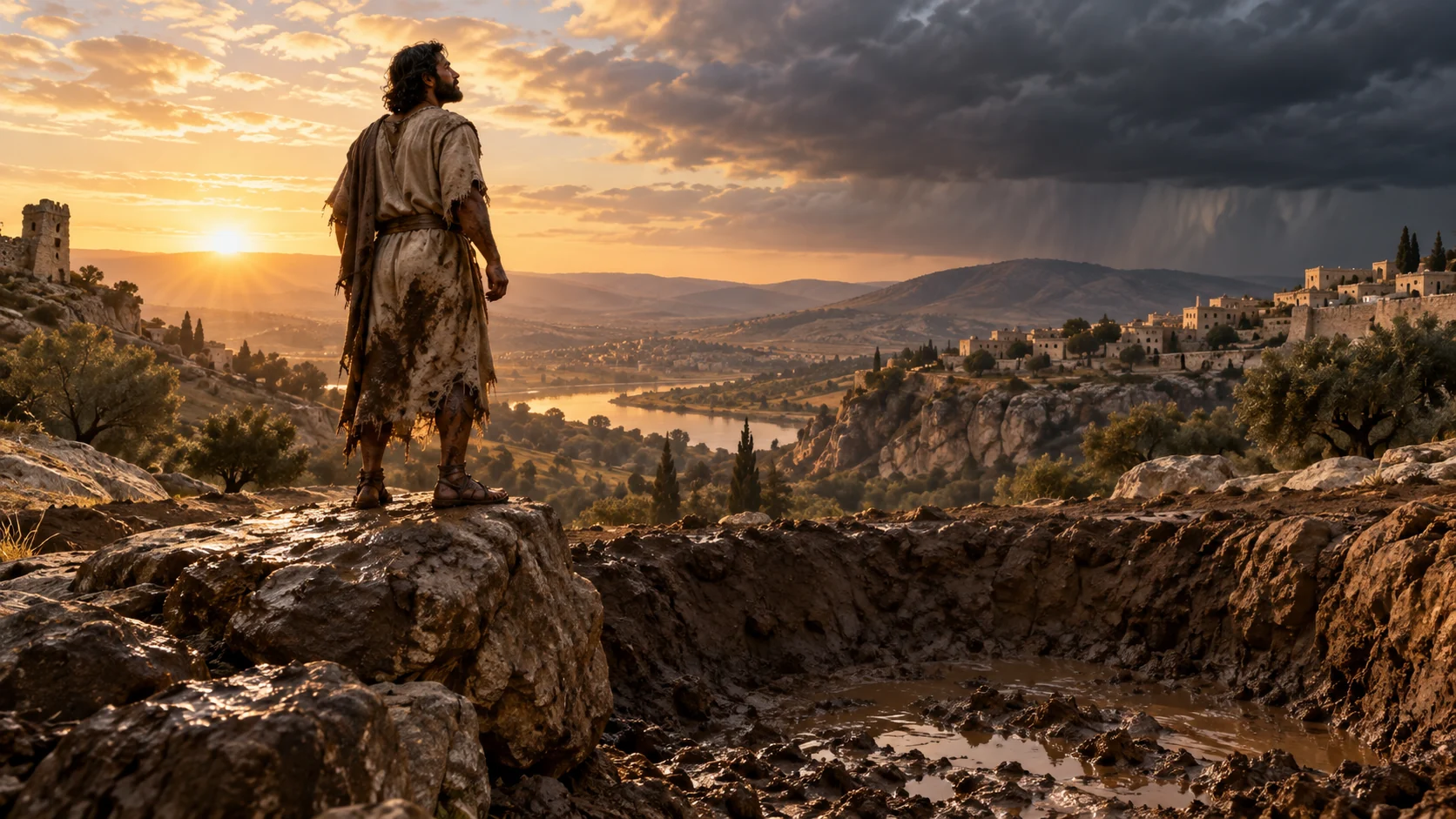
4. “From the End of the Earth” — When God Feels Far Away
Psalm 61:2a
The phrase “the end of the earth” can describe geographical distance. For a Davidic king, it could evoke being far from Jerusalem while traveling, fighting, or fleeing.
But geography quickly becomes theology.
Jerusalem and the sanctuary represented God’s covenant presence. To be far from Zion could therefore feel like being far from the place where heaven and earth met.
Yet the psalmist does something important:
He prays from there.
He does not wait until he gets back to Jerusalem.
He does not assume that God’s attention is limited by geography.
He discovers that the God whose presence was symbolized in the sanctuary can hear him beyond the sanctuary.
The distance is real. God’s nearness is more real.
This is one of Psalm 61’s deepest truths: prayer crosses the distance that we cannot cross ourselves.
The worshiper may be far from the temple, far from home, and far from strength, but he is not beyond the hearing of God.
08
5. “When My Heart Grows Faint” — More Than a Passing Emotion
Psalm 61:2b
The Hebrew expression behind “my heart is faint” suggests more than sadness. It can describe a person whose whole being is becoming exhausted under pressure.
The psalmist is not merely saying:
“I feel discouraged.”
He is closer to saying:
“I am running out of strength.”
That matters because Psalm 61 does not answer exhaustion with self-motivation. It does not say, “Reach deeper inside yourself.”
Instead, it turns outward:
“Lead me…”
The exhausted person does not need a speech about climbing harder. He needs someone to lead him somewhere he cannot reach alone.
09
6. “Lead Me to the Rock Higher Than I” — Salvation Beyond Our Reach
Psalm 61:2c–3
This is the center of the opening prayer.
The psalmist does not ask merely for a stronger version of himself. He asks to be led to something higher than himself.
That is the grammar of grace.
A drowning person does not need a philosophy of water. He needs solid ground.
A weary traveler does not need to become the mountain. He needs a rock on which to stand.
The next verse explains the image: God has been a refuge and a strong tower against the enemy.
The rock is not ultimately a place separate from God.
God himself is the refuge.
Past experience becomes the foundation of present prayer:
“Lead me now, because you have sheltered me before.”
Memory strengthens faith. The psalmist looks backward in order to pray forward.
A Spiritual Practice
When you are overwhelmed, name three moments in which God has already carried you.
Not every previous rescue guarantees that the next situation will unfold exactly as you want. But every remembered act of faithfulness teaches the heart where to turn.
10
7. Rock, Refuge, and Strong Tower
Psalm 61 gathers several images of protection.
The Rock
A high rock offers stability and a place beyond the reach of danger.
The Refuge
A refuge is a place to which the threatened person can flee.
The Strong Tower
A fortified tower represents security against an approaching enemy.
These are not three different kinds of salvation. They are three windows opening onto the same reality:
God is not only the giver of safety; God himself is the believer’s safety.
The Psalms return repeatedly to this theme (Psalms 18:2; 27:1–5; 46:1; 62:6–8).
Faith therefore means more than believing that God can change our circumstances. It means learning to take refuge in God even while the circumstances are still changing.
11
8. “Let Me Dwell in Your Tent Forever” — Rescue Becomes Presence
Psalm 61:4
The imagery now changes.
The psalmist moves from a high rock and a protective tower to God’s tent and the shelter of God’s wings.
The deepest desire of the psalm is becoming clear.
The worshiper does not merely want to escape the enemy.
He wants to live with God.
The language of God’s tent naturally evokes the sanctuary—the place of divine presence. The image of wings may also echo the protective wings associated with the cherubim in Israel’s sanctuary imagery.
Yet Psalm 61 refuses to imprison God inside the sanctuary building. The psalmist is far away and still speaks of dwelling beneath God’s wings.
The temple points to a reality larger than the temple:
God’s own presence is home.
This is why biblical salvation is never merely:
“Get me out of trouble.”
Its deeper cry is:
“Bring me near to you.”
Psalm 27:4–5 expresses the same longing. The worshiper wants to dwell in the house of Yahweh and to be hidden in God’s shelter in the day of trouble.
Refuge and presence belong together.
12
9. “You Have Heard My Vows” — Grace Produces Gratitude
Psalm 61:5
The language of vows reminds us that biblical prayer often included a promised response of thanksgiving.
The point is not that the worshiper purchases God’s rescue by making a bargain.
The movement is the opposite:
God acts → the worshiper gives thanks.
Grace gives birth to gratitude.
The verse also speaks about the “heritage” or “inheritance” of those who fear God’s name. The language may echo Israel’s land inheritance—the gift God entrusted to his people.
In a royal setting, this makes good sense. The king’s own safety is connected to the security and future of the people.
The prayer is therefore widening.
It began with:
“Hear me.”
It now includes:
“Preserve what you have given your people.”
Biblical faith continually moves us beyond the private self.
13
10. “Prolong the Life of the King” — From Personal Prayer to Kingdom Hope
Psalm 61:6–7
Suddenly the psalm speaks about the king.
Why?
Several interpretations are possible. An ordinary worshiper may be praying for the king. The king himself may be speaking of his royal office in the third person. Or these lines may have been used by later worshipers as an intercession for the Davidic king.
Whatever the precise explanation, one thing is clear: the psalm links the safety of the worshiper with the future of God’s covenant purposes through the king.
The prayer asks that the king receive length of days, remain before God, and be guarded by God’s steadfast love and faithfulness.
The language recalls God’s covenant with David in 2 Samuel 7, where God promises enduring kingship and covenant love to David’s house.
The king is not preserved merely so that one powerful man can survive. The king’s calling is tied to the well-being of God’s people and to God’s purposes in the world.
14
11. Psalm 61 and the Messiah
Psalm 61 should first be heard in its Old Testament setting as a prayer concerning the Davidic king. We do not need to turn every phrase immediately into a direct prediction about Jesus.
Yet the Psalms themselves create a larger royal hope.
Psalm 2 introduces the Psalter with God’s anointed king.
Psalm 72 closes Book Two with a vision of a righteous king whose reign brings justice to the poor and blessing to the nations.
Psalm 61, standing between them, asks that the Davidic king endure before God beneath the protection of steadfast love and faithfulness.
Then Israel’s history sharpens the question.
David died.
Solomon died.
Every Davidic king died.
Eventually Jerusalem fell and the monarchy disappeared.
Yet the promise to David remained.
So what happens to the prayer:
“May he be enthroned in God’s presence forever”?
For Christians, the unresolved royal hope reaches its fullest answer in Jesus, the Messiah, the Son of David.
His kingship is not preserved merely by an unusually long earthly life.
It passes through death into resurrection.
Peter announces this in Acts 2: God raised Jesus from the dead and exalted him as the promised Davidic Lord. Gabriel’s announcement to Mary carries the same royal hope:
“The Lord God will give him the throne of his father David … and of his kingdom there will be no end.” — Luke 1:32–33
Psalm 61 therefore travels farther than David could see.
The king asks for days added to his days.
The gospel announces a King whom death itself cannot remove from the throne.
The Christian reading does not erase David. It follows David’s prayer along the road the biblical story itself travels.
15
12. “Steadfast Love and Faithfulness” — The Guards at the King’s Door
Psalm 61:7
The psalm asks God’s covenant qualities to guard the king.
Many English translations render these words as steadfast love and faithfulness.
They describe God’s loyal commitment to his covenant and his reliability in keeping his word.
The picture is striking.
The king may have soldiers.
Jerusalem may have walls.
A palace may have guards.
But the psalm knows that the deepest security of God’s people rests somewhere else:
in the faithful character of God.
Human institutions matter, but they are not ultimate.
Armies fail.
Walls fall.
Kings die.
But God remains faithful to his covenant purposes.
This verse therefore also becomes a prayer for leadership today—not that leaders would become untouchable, but that they would live before God, accountable to him and shaped by the covenant virtues they themselves are called to embody.
16
13. “Then I Will Sing Praise … Day by Day” — The Destination of Deliverance
Psalm 61:8
The psalm begins with a cry.
It ends with a song.
But notice the phrase:
“day by day.”
The goal is not one dramatic worship service following one dramatic rescue.
The goal is a life whose ordinary rhythm becomes gratitude.
Psalm 61 teaches us a pattern:
Cry when overwhelmed. Remember when afraid. Take refuge when exposed. Seek God’s presence, not merely escape. Pray beyond yourself. Return to praise day by day.
Deliverance becomes discipleship.
The person who cried from the ends of the earth has not merely found safety.
He has rediscovered a way to live.
17
MAJOR THEOLOGICAL THEMES
18
1. God Is Near Even When We Are Far Away
Sacred places matter in Scripture, but God is never trapped inside them.
Psalm 61 gives words to believers who feel displaced—from home, from familiar routines, from community, or even from the felt nearness of God.
You can pray from “the end of the earth.”
There is no geography from which God cannot hear.
19
2. Weakness Can Become the Doorway to Prayer
The psalmist’s fainting heart is not evidence that faith has disappeared.
It becomes the reason he calls.
Biblical faith is not emotional invulnerability. It is learning where to turn when strength fails.
Sometimes faith sounds less like:
“I can handle this.”
and more like:
“Lead me.”
20
3. God Is More Than the Giver of Refuge
The deepest gift is not merely a safer circumstance.
God himself is rock, refuge, tower, tent, and shelter.
Salvation is ultimately communion with God.
The psalmist begins by wanting deliverance from danger but soon reveals that what he really longs for is to dwell in God’s presence.
21
4. Memory Nourishes Trust
Verse 3 looks backward:
“You have been a refuge to me.”
The past faithfulness of God becomes material for present prayer.
The psalmist does not deny present danger. He places present danger beside remembered grace.
Remembering is therefore one of faith’s most practical disciplines.
22
5. Personal Prayer Belongs to a Larger Kingdom Story
The psalm does not remain with “me.”
It moves toward the inheritance of God’s people and then toward the king.
God rescues individuals into a story larger than themselves.
The question therefore changes from:
“Will God protect me?”
to:
“How does my life belong to what God is doing among his people and in his world?”
23
6. God’s Covenant Faithfulness Is the Ground of Hope
The king is guarded by steadfast love and faithfulness.
Our ultimate confidence rests not in the durability of human power but in the character of God.
What God begins, human weakness cannot finally cancel.
24
7. Answered Prayer Should Become Daily Worship
The psalm ends not with self-congratulation but praise.
God’s gifts return to God as worship.
The rescue we receive today should become the faithfulness with which we live tomorrow.
25
CONNECTIONS ACROSS SCRIPTURE
26
God as Rock and Refuge
Psalm 61 belongs to a wider biblical picture of God as the Rock of his people. Moses calls Yahweh “the Rock” whose ways are just (Deuteronomy 32:4), while David calls him his rock, fortress, and deliverer (Psalm 18:2).
The same picture appears in Psalms 27 and 46, where God shelters his people in trouble. Psalm 62, immediately after Psalm 61, echoes the theme again: God alone is rock, salvation, fortress, and refuge (Psalm 62:6–8).
So the “rock higher than I” is not merely a better situation. The Rock is God himself. When life becomes unstable, faith rests not in predictable circumstances but in the God who remains firm.
27
Shelter Under God’s Wings
The image of God’s wings speaks of both protection and nearness. Ruth is described as having come to seek refuge under Yahweh’s wings (Ruth 2:12). The Psalms use the same picture repeatedly: the worshiper hides beneath God’s wings in danger and finds shelter in his faithful love (Psalms 17:8; 36:7; 57:1; 91:4).
Psalm 61 therefore asks for more than protection from trouble. The psalmist wants to be near God.
The God who is high enough to be the Rock is also close enough to gather his people beneath his wings.
28
The Davidic Covenant and the King
The prayer for the king in Psalm 61:6–7 reaches back to God’s promise to David in 2 Samuel 7:12–16. God promised that David’s house and kingdom would endure.
This royal hope continues through the Psalms. Psalm 2 speaks of God’s anointed king. Psalm 72 imagines a king who brings justice and blessing. Psalm 89 wrestles with the apparent failure of the Davidic monarchy, while Psalm 132 returns to God’s promise that David’s line would continue.
Psalm 61 therefore asks for more than a long life for one king. It asks whether God’s promise and kingdom purpose will endure through history.
29
Jesus and the Enduring Davidic Kingdom
The New Testament answers that question through Jesus.
Gabriel announces that Jesus will receive the throne of David and that his kingdom will have no end (Luke 1:32–33). Peter then explains that, unlike David, Jesus did not remain in the grave. God raised him from the dead and exalted him as Lord and Messiah (Acts 2:29–36).
Paul likewise connects Jesus with David and resurrection (Romans 1:3–4), while Revelation calls him “the Root and the Offspring of David” (Revelation 22:16).
Psalm 61 asks God to preserve the king.
The gospel announces something greater:
God raised the King.
The psalmist prayed that the king’s days would continue. In Jesus, the biblical story reaches a kingship that death itself cannot end.
30
DISCUSSION QUESTIONS
1. What does “the end of the earth” look like in human experience today? 2. How is a faint heart different from a faithless heart? 3. Why does the psalmist ask God to lead him to the rock rather than simply telling himself to climb? 4. Which image speaks most powerfully to you right now: rock, refuge, tower, tent, or wings? Why? 5. What past act of God’s faithfulness can you remember when present circumstances feel uncertain? 6. Why does the psalm move from personal distress to prayer for the king and the people? 7. What changes when we seek not only God’s help but God’s presence? 8. How does Jesus bring the Davidic hope of verses 6–7 to greater fulfillment? 9. What would it look like for gratitude to become a “day by day” practice rather than an occasional response? 10. Who around you is presently at “the end of the earth”—emotionally, spiritually, or physically—and how can you pray for them?
31
PERSONAL PRACTICE: PRAY PSALM 61 IN FOUR MOVEMENTS
Take a few quiet minutes and pray through these four movements.
1. Name the Distance
“God, I feel far away because…”
2. Name the Exhaustion
“My heart is overwhelmed by…”
3. Ask to Be Led
“Lead me to what I cannot reach by my own strength…”
4. Remember and Praise
“You have been my refuge when…”
Then finish by naming one concrete way you will praise, obey, serve, or give thanks today.
32
CLOSING PRAYER
God of the high rock, hear us when our voices rise from far away.
When our hearts grow faint, do not leave us to climb by strength we no longer have. Lead us to the rock higher than ourselves.
Be our refuge when life feels exposed, our strong tower when fear advances, our tent when we feel homeless, and the shelter of your wings when we need to be held near.
Keep us before you. Let your steadfast love and faithfulness guard our lives.
Teach us to pray not only for ourselves, but for your people, for those who lead, and for your kingdom of justice and peace.
And through Jesus, the risen Son of David, teach us to trust the King whose reign death cannot end.
Turn today’s cry into tomorrow’s song, and tomorrow’s song into faithful praise, day by day.
Amen.
Be the first to leave a comment.