

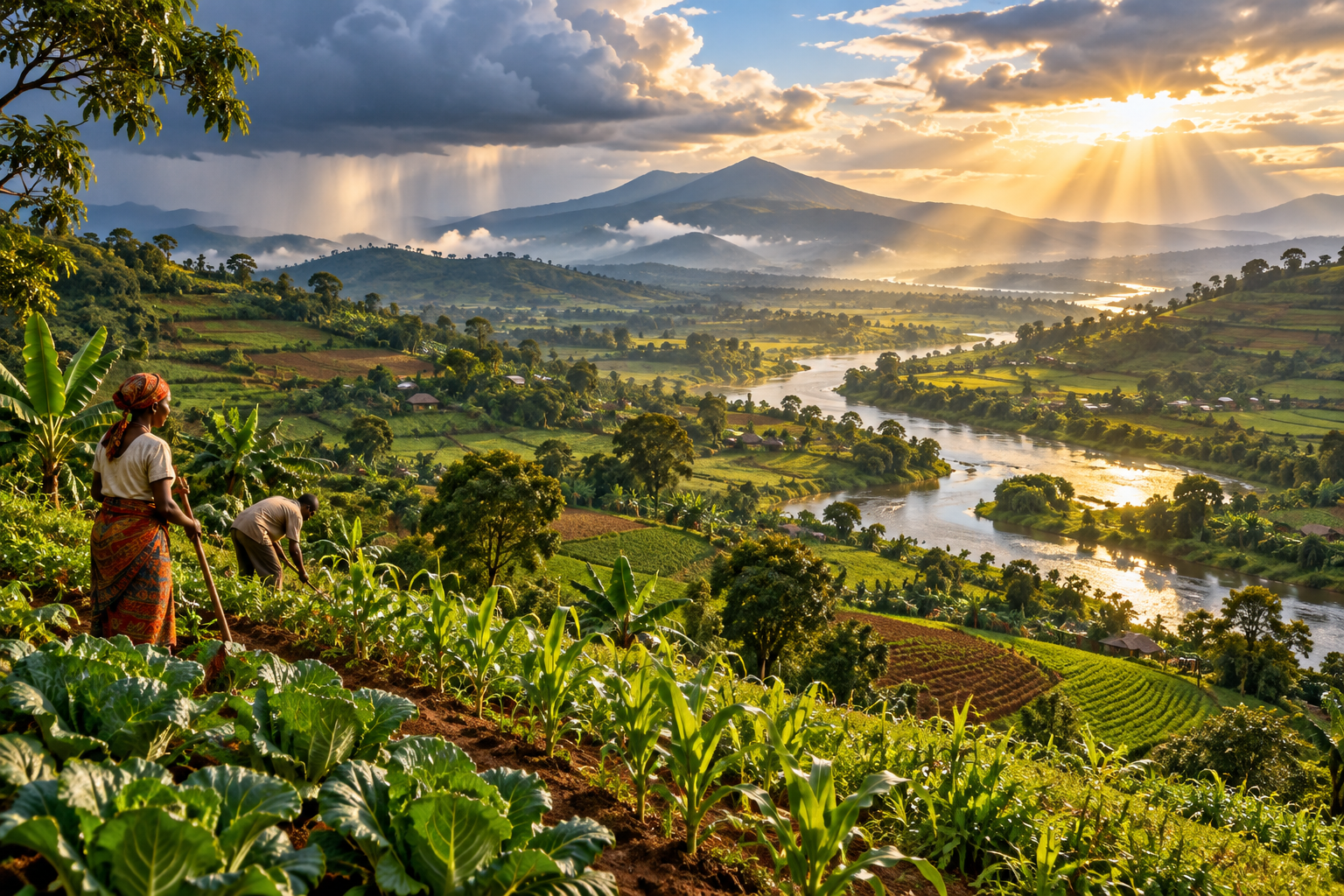
“You crown the year with your bounty; your wagon tracks overflow with abundance.”
01
A Study in Forgiveness, Prayer, Creation, Harvest, and the Generosity of God
Key Verse “You crown the year with your bounty; your wagon tracks overflow with abundance.” — Psalm 65:11
02
Big Idea
Psalm 65 begins in Zion and ends with the fields singing.
It moves from forgiven people standing in God’s presence, to the ends of the earth looking toward him, to mountains, seas, rain, pastures, flocks, and valleys joining a great song of praise.
The psalm holds together realities we often separate: worship and agriculture, forgiveness and harvest, Israel and the nations, prayer and rain, divine power and ordinary provision.
God is the One who hears prayer, forgives sins that overwhelm us, brings people near, stills seas and nations, waters the earth, prepares grain, and crowns the year with goodness.
Psalm 65 therefore teaches us to see the world sacramentally—not as divine in itself, but as creation continually receiving life from its Creator. Rain is not merely weather. Bread is not merely economics. Forgiveness is not merely an inward feeling. All are gifts flowing from the God whose generosity reaches from the sanctuary to the soil.
03
1. Psalm 65 in Book Two of the Psalms
Psalm 65 belongs to Book Two of the Psalms (Psalms 42–72). It follows a sequence of psalms filled with danger, enemies, longing, refuge, and trust.
Psalm 61 cried from far away.
Psalm 62 waited for God alone.
Psalm 63 thirsted for God in the wilderness.
Psalm 64 asked for protection from hidden plots.
Psalm 65 opens the windows.
The horizon becomes wide. Zion, the nations, mountains, seas, rain, fields, animals, and harvest all enter the song.
The psalm is traditionally connected with David and is called a “song.” Its exact festival setting is uncertain. It could fit one of Israel’s harvest festivals, when people came to worship, fulfill vows, remember God’s saving acts, and celebrate the fruitfulness of the land.
But Psalm 65 is more than a harvest hymn.
It celebrates God as Redeemer, Creator, King, and Provider.
04
2. The Movement of the Psalm
Psalm 65 can be followed in three broad movements.
Verses 1–4 — God of Grace
God hears prayer, forgives overwhelming sin, and brings people near to enjoy the goodness of his house.
Verses 5–8 — God of Power for the Whole World
God answers with awesome deeds, establishes the mountains, stills roaring seas and turbulent nations, and becomes the hope of the ends of the earth.
Verses 9–13 — God of Abundance
God visits the earth with rain, prepares grain, softens the soil, crowns the year with bounty, and causes the whole landscape to rejoice.
The movement is therefore:
forgiveness → nearness → deliverance → worldwide hope → rain → abundance → creation’s praise
05
WALKING THROUGH THE PSALM
06
3. “Praise Awaits You in Zion” — When Silence Becomes Worship
Psalm 65:1
The opening line is difficult to translate. It can be understood as praise waiting for God in Zion, but the Hebrew can also suggest something striking:
“Silence is praise to you.”
That idea connects naturally with Psalm 62, where waiting silently before God was an expression of trust.
There are moments when worship needs many words.
There are also moments when the right response to God is silence.
Not the silence of emptiness.
The silence of awe.
The silence of people who know that God has heard.
The silence of a heart resting before the One who does not need to be persuaded to care.
Psalm 65 will soon become full of sound—waves roar, nations stir, morning and evening rejoice, hills shout, valleys sing.
But the song begins in stillness.
Sometimes praise begins before the mouth opens.
07
4. “You Who Hear Prayer” — The God People Can Approach
Psalm 65:2
The first great confession of Psalm 65 is wonderfully simple:
God hears prayer.
That is why vows are fulfilled.
That is why worshipers come.
That is why the psalm can imagine “all flesh” approaching God.
Prayer assumes that the universe is not closed.
We are not speaking into emptiness.
At the center of reality is One who listens.
The psalm does not say every prayer receives the answer we expected or at the time we expected it. But it rests on something deeper: God is not indifferent to the voices of his creatures.
The God who waters the earth also listens to human cries.
08
5. “When Sins Overwhelm Us, You Forgive”
Psalm 65:3
The worshipers do not come to God because their lives are already in order.
They come carrying their failures.
The psalm says that transgressions or rebellious deeds are too strong for us.
That is an important confession.
Some problems can be repaired by greater effort.
Sin is deeper.
We cannot simply erase what we have done, undo every wound, or repair our relationship with God by pretending the problem is small.
But the verse does not end with human failure.
“You forgive them.”
God does what the worshiper cannot do.
The movement into God’s presence therefore begins not with human achievement but with divine mercy.
Before Psalm 65 celebrates rain falling on the ground, it celebrates grace falling on guilty people.
09
6. “Blessed Is the One You Choose and Bring Near”
Psalm 65:4
Forgiveness is not the end of grace.
God forgives in order to bring people near.
The worshiper speaks of being welcomed into God’s courts and satisfied with the goodness of God’s house.
The picture is almost that of a royal banquet.
The forgiven person does not remain outside the gate, barely tolerated.
He is welcomed in.
This is one of the great movements of biblical grace:
guilt → forgiveness → nearness → satisfaction
The deepest blessing is not simply receiving gifts from God.
It is being brought into God’s presence.
10
7. “You Answer Us With Awesome and Righteous Deeds”
Psalm 65:5
The psalm now moves outward.
The God who forgives also acts in history.
He answers with deeds that inspire awe and reveal his righteousness—his faithfulness in setting things right.
Israel knew this God through stories of rescue: exodus, deliverance, protection, return, and preservation.
The same God who deals with sin also deals with oppression and chaos.
Forgiveness and justice are not opposites in God.
They flow from the same faithful character.
God removes what separates people from him, and God confronts what destroys his world.
11
8. “The Hope of All the Ends of the Earth”
Psalm 65:5
Suddenly the psalm’s vision becomes global.
Israel’s God is described as the hope or confidence of the farthest places and distant seas.
This is remarkable.
The God worshiped in Zion is not a local deity confined to one mountain, one people, or one climate.
His faithfulness toward Israel reveals something about who he is for the whole world.
The God who saves one people is the Creator of all peoples.
The blessings centered in Zion are meant to open outward.
Psalm 65 therefore places Israel’s worship inside God’s larger purpose:
the nations are meant to discover that Israel’s God is worthy of their trust too.
12
9. The God Who Establishes Mountains and Stills Seas
Psalm 65:6–7
The psalm moves from history to creation.
God establishes the mountains by strength.
He stills the roaring seas.
In the biblical imagination, mountains can represent massive stability, while the sea often represents restless, threatening power.
Psalm 65 places both under God.
The mountains stand because God establishes them.
The seas are restrained because God rules them.
Creation is neither independent of God nor beyond his care.
The point is not merely that God made the world long ago.
The psalm pictures God as the One who continues to uphold and govern it.
The Creator is still involved with creation.
13
10. “The Roaring of the Seas … and the Tumult of the Nations”
Psalm 65:7
Then comes an unexpected parallel.
God stills:
the roaring seas,
the crashing waves,
the tumult of the nations.
Natural chaos and political chaos are placed side by side.
Empires can appear as uncontrollable as a stormy sea.
Crowds rage.
Armies move.
Nations boast.
Governments rise and fall.
Psalm 65 refuses to treat international power as ultimate.
The God who places boundaries on the sea also places boundaries on nations.
Human history may feel chaotic from within it.
But it is not outside God’s sovereignty.
14
11. “Morning and Evening Shout for Joy”
Psalm 65:8
The psalm looks from one horizon to another.
The places of sunrise and sunset rejoice.
East and west become a poetic way of saying:
the whole earth.
The God of Zion is praised from horizon to horizon.
Morning arrives because God is faithful.
Evening comes because the world is still being held.
The ordinary rhythm of a day becomes testimony.
Psalm 65 teaches us to see creation not merely as scenery but as a theater of God’s generosity.
Every sunrise says:
the world has been given another morning.
Every evening says:
God has carried creation through another day.
15
12. “You Visit the Earth and Water It”
Psalm 65:9–10
Now the camera moves downward—from mountains and seas to soil.
God visits the earth.
God waters it.
God enriches it.
God prepares grain.
God fills furrows.
God softens the ground with rain.
God blesses its growth.
The repeated “you” matters.
Ancient Israel lived in a world where harvest depended deeply on seasonal rain. A failed rainy season was not an inconvenience. It could mean hunger.
Psalm 65 therefore looks at rainfall with gratitude rather than entitlement.
The field does not make itself fruitful.
Human beings plow, sow, tend, and harvest.
But behind all human labor lies gift.
No farmer manufactures rain.
No seed germinates because of human command.
Psalm 65 leaves room for human work while insisting that fruitfulness finally comes from God.
16
13. “You Crown the Year With Your Bounty”
Psalm 65:11
This is one of the great harvest images in Scripture.
The year is pictured as wearing a crown of God’s goodness.
Season after season has moved toward this moment.
Rain has fallen.
Soil has softened.
Seed has grown.
Fields have ripened.
Now abundance becomes visible.
The harvest is the crown.
But the crown belongs to God’s generosity.
This teaches gratitude at a deep level.
The food on the table has a long history.
Behind the bread stand soil, seed, rain, sunlight, labor, animals, communities, and countless processes we did not invent.
Gratitude sees the chain of gift.
Psalm 65 looks at a full field and says:
God has been here.
17
14. The Wilderness Pastures Overflow
Psalm 65:12–13
The blessing reaches even places that normally look barren.
Wilderness pastures overflow.
Hills clothe themselves with joy.
Meadows dress in flocks.
Valleys wrap themselves in grain.
Then the poem gives creation a voice:
“They shout and sing together for joy.”
The landscape has become a congregation.
The hills wear joy like clothing.
The valleys sing.
The fields wave like worshipers.
This is more than poetic decoration.
Psalm 65 imagines fruitfulness itself as praise.
Creation glorifies God by becoming what God enables it to become.
A fruitful field praises God by bearing grain.
A flourishing pasture praises God by sustaining life.
And human beings join that praise by receiving the gift with gratitude, justice, and care.
18
MAJOR THEOLOGICAL THEMES
19
1. Grace Comes Before Abundance
Psalm 65 begins with forgiveness before it reaches harvest.
That order matters.
The deepest human poverty is not lack of food alone, but separation from God.
The first abundance celebrated is mercy.
20
2. God Hears Prayer
The psalm’s world is relational.
Creation is not a closed machine, and human beings are not alone inside it.
The Creator listens.
Prayer matters because God is personal.
21
3. Forgiveness Leads to Nearness
God does not merely remove guilt.
He brings people near and satisfies them with the goodness of his presence.
Salvation is not simply escape from judgment.
It is communion with God.
22
4. The God of Israel Is the God of the Whole Earth
Zion is the starting point of the song, not its boundary.
The psalm moves from the sanctuary to the ends of the earth.
God’s covenant faithfulness toward his people is meant to reveal his character to the nations.
23
5. God Rules Both Nature and History
The sea and the nations are placed together.
Weather and politics are not two unrelated worlds outside God’s concern.
The same Creator who governs waves is Lord over human power.
24
6. Ordinary Provision Is Theological
Rainfall, grain, pastures, flocks, and harvest are not spiritually trivial.
Psalm 65 refuses to divide life into “sacred” worship and “ordinary” food.
The God praised in the temple is the God encountered in the field.
25
7. Creation Is Called Into Praise
The psalm ends not with humans singing over creation but with creation itself singing.
The whole world is pictured as responsive to its Creator.
Human worship joins a larger chorus already moving through the earth.
26
CONNECTIONS ACROSS SCRIPTURE
27
Forgiveness and Coming Near
Psalm 65 begins with people whose sins overwhelm them, yet God forgives and brings them near.
That movement echoes the larger biblical story. Israel’s sacrificial system acknowledged that sin disrupts fellowship, yet God provides a way for people to remain in covenant relationship with him (Leviticus 16).
The New Testament develops this movement through Jesus. Hebrews speaks of believers drawing near to God with confidence because access has been opened through Christ (Hebrews 10:19–22).
The pattern remains:
God deals with sin so that people may come near.
28
God Over the Seas and the Nations
Psalm 65 places roaring seas beside turbulent nations. Similar imagery appears elsewhere in the Psalms and prophets, where political powers can resemble restless waters (Psalm 46:2–3, 6; Isaiah 17:12–13).
In the Gospels, Jesus stills a stormy sea (Mark 4:35–41). For Christian readers, that scene resonates with Old Testament portraits of Yahweh ruling the waters.
The biblical story consistently refuses to treat chaos—natural or political—as a rival sovereignty equal to God.
29
Rain, Harvest, and the Generosity of God
The Old Testament repeatedly presents rain and harvest as gifts of God (Deuteronomy 11:13–15; Joel 2:21–24).
Jesus likewise speaks of the Father sending sun and rain even upon the just and unjust (Matthew 5:45), while Paul tells non-Jewish hearers that God has not left himself without witness, giving rain, fruitful seasons, food, and gladness (Acts 14:17).
Psalm 65 belongs to this same biblical vision:
creation’s ordinary fruitfulness is evidence of extraordinary generosity.
30
From Zion to the Ends of the Earth
Psalm 65 begins in Zion but looks quickly toward all flesh and the ends of the earth.
That movement belongs to the biblical promise that God’s blessing through Abraham and Israel is meant ultimately for the nations (Genesis 12:1–3; Isaiah 2:2–4).
The New Testament continues that outward movement as the good news of Israel’s Messiah goes from Jerusalem toward the nations (Acts 1:8).
The God praised in one place intends to be known everywhere.
31
Creation Singing for Joy
Psalm 65 ends with fields and valleys singing.
Isaiah uses similar language when mountains and hills burst into song and trees clap their hands at God’s renewing work (Isaiah 55:12–13). Psalm 96 and Psalm 98 likewise invite seas, fields, rivers, and mountains to rejoice before Yahweh.
The New Testament gives this hope an even wider horizon when Paul pictures creation itself longing for liberation from decay (Romans 8:19–23).
Psalm 65’s singing landscape therefore points beyond one successful harvest toward the biblical hope of creation flourishing fully under God’s restoring rule.
32
DISCUSSION QUESTIONS
1. Why do you think Psalm 65 begins with forgiveness before speaking about creation and harvest? 2. What does the phrase “you who hear prayer” reveal about the kind of world the psalmist believes he lives in? 3. How are forgiveness and being brought near to God connected? 4. Why does the psalm move from Zion to “the ends of the earth”? 5. What do the roaring sea and the tumult of nations have in common in the psalm? 6. How can ordinary things such as rain, bread, farming, and seasons become part of worship? 7. What changes when we see harvest as gift rather than entitlement? 8. What might it mean for creation’s fruitfulness itself to be praise? 9. Where do you see God’s generosity in ordinary life that you often overlook? 10. How might gratitude to the Creator change the way we treat land, food, animals, and other people?
33
PERSONAL PRACTICE: PRAY PSALM 65 IN FOUR MOVEMENTS
1. Come With What Overwhelms You
“God, the sin, failure, or burden I cannot repair by myself is…”
2. Receive Nearness
“Thank you that your mercy does not leave me outside, but brings me near.”
3. Notice Provision
“Today I receive these ordinary gifts from you…”
4. Join Creation’s Praise
“Teach me to live fruitfully so that my life, like the fields of Psalm 65, becomes praise.”
Then spend a few moments thanking God for one ordinary gift you normally take for granted.
34
CLOSING PRAYER
God who hears prayer,
when our failures are stronger than we are, meet us with mercy.
Forgive what we cannot erase. Bring us near when we have wandered far. Satisfy us with the goodness of your presence.
God of the mountains and seas, still what is chaotic within us and restrain what is destructive around us.
God of the nations, teach rulers and peoples that power is not ultimate and that the earth belongs to you.
God of rain and soil, thank you for water, seed, food, animals, labor, and harvest.
Keep us from receiving your gifts without seeing the Giver.
Make us grateful rather than entitled, generous rather than grasping, and careful with the creation you continue to sustain.
Let our lives become fruitful.
And through Jesus, who brings sinners near and opens your blessing toward the nations, lead us toward the day when creation itself will rejoice in the fullness of your renewing rule.
May the hills be clothed with joy, the valleys sing, and our lives join their song.
Amen.
35
Sources Consulted
John Goldingay, Psalms, Volume 2: Psalms 42–89, especially “Psalm 65: Politics and Harvest, Israel and the World.”
Derek Kidner, Psalms 1–72, especially “Psalm 65: This Bounteous God.”
The biblical text of Psalm 65 and the related Scripture passages cited in the study.
Be the first to leave a comment.