
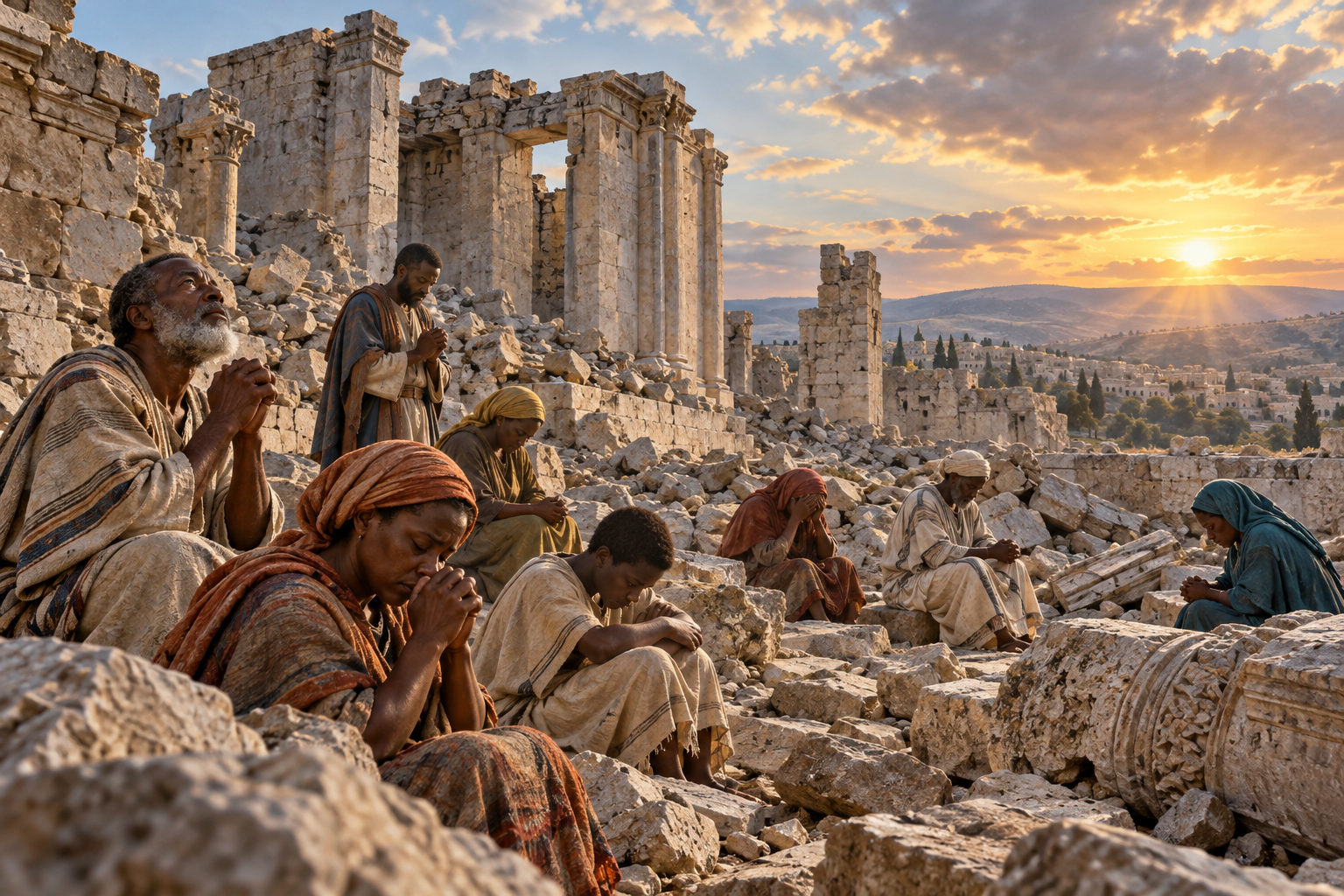
How do we pray when the house of worship lies in ruins and God seems silent?
01
Overview
Learning to pray when sacred places collapse and heaven seems silent
“For God is my King of old, working salvation in the midst of the earth.” Psalm 74:12 (KJV)
What happens when the place where you used to find courage becomes the place where you find ashes? When the songs stop, the doors are broken, and the people who once prayed together are scattered?
Psalm 74 begins among such ruins. It is not the complaint of one disappointed worshiper. It is the cry of a wounded people who can no longer make sense of what has happened to their sanctuary—or of God's apparent silence. Yet in the middle of the lament comes a remarkable confession: God is still King.
02
1.0 Introduction
A building can be destroyed in a day, but what it carried can take generations to rebuild: memories, trust, community, and the shared conviction that God is among his people.
Psalm 74 gives words to this kind of loss. Its speakers look at the desecrated sanctuary and ask why the God who redeemed Israel appears to have rejected the people he calls his own. They have no comforting sign, no prophetic explanation, and no timetable for deliverance.
The psalm does not solve the problem by pretending the destruction is small. It describes the violence, remembers God's works in creation and the exodus, and pleads for him to act in keeping with his covenant.
Its central message is that when everything associated with God's presence seems to have collapsed, the faithful response is neither denial nor despair. God's people may bring their ruins before him, remember his reign over creation and history, and ask him to defend the vulnerable and vindicate his name.
03
2.0 Historical and Literary Context
Psalm 74 is headed A Maskil of Asaph. The name Asaph connects it with the worship tradition also reflected in 1 Chronicles 25:1 and with the Asaph psalms, particularly Psalms 73–83. The heading associates the poem with that tradition; it does not by itself establish its author or date.
The devastating attack on Jerusalem and the temple by the Babylonians in 587/586 BC is the most likely historical setting. The destruction depicted in Psalm 74 closely resembles the grief of Lamentations 2. Derek Kidner connects the poem closely to that calamity, while John Goldingay notes that the poem does not explicitly name its attackers; alternative historical settings have been suggested (Kidner 2014, 293–94; Goldingay 2007, 422–24). The precise occasion remains uncertain, but the experience of desecration is unmistakable.
Its position within the Psalter deepens the impact. Psalm 72 prayed for a king whose justice would reach the poor and whose blessing would fill the earth. Psalm 73 asked why the wicked prosper and discovered a new perspective in God's sanctuary. Psalm 74 now describes that very sanctuary lying in ruins. The problem of injustice has moved from an individual's crisis of understanding to a whole community's crisis of hope. Book Three will continue wrestling with national catastrophe and God's covenant promises (BibleProject, The Book of Psalms: Study Notes, 14–15).
The poem moves in five broad stages:
1. Verses 1–3: Why has God apparently rejected his own flock? 2. Verses 4–9: What has the enemy done to the place of worship? 3. Verses 10–11: How long will God allow the mockery to continue? 4. Verses 12–17: What does Israel remember about God the King? 5. Verses 18–23: Will God remember his covenant and arise for his people?
One word-group echoes through the lament: forever, permanently, without end. The people fear that rejection and desecration will last forever. The psalm holds that fear against another reality: God's ancient reign and his enduring relationship with them (Goldingay 2007, 436–38).
04
3.0 Walking Through the Text
3.1 When God's flock feels abandoned
Psalm 74:1–3
The opening question is sharp: Why has God cast off his people? Why does his anger seem to burn against the sheep of his pasture?
Notice the language. The people do not say merely, “We have suffered.” They call themselves God's flock, God's congregation, and the people he redeemed. They point to Mount Zion, where God chose to dwell. Their appeal rests on an established relationship, not on a claim that they have earned rescue.
They also do not explicitly claim that Israel is innocent. The pain lies in the fear that judgment has become permanent. If God purchased and shepherded this people, has their history together truly reached its end?
“Remember,” they plead. In biblical prayer, remembrance means more than retrieving information. It asks God to act in a way consistent with what he has already promised and done. The worshipers call God to the ruins as one might lead a beloved family member through a damaged home: Look at what has happened here (Kidner 2014, 294; Goldingay 2007, 425–27).
3.2 When the enemy's noise replaces the songs of worship
Psalm 74:4–8
The poet turns from questions to evidence. Enemy cries fill the meeting place. Their emblems replace the signs of Israel's worship. Axes and hammers batter the carved woodwork. Fire completes the devastation.
The imagery of men chopping through a forest is especially bitter: the objects being hacked apart are not trees in a field but crafted ornamentation in the sanctuary. The building's beauty, designed to direct attention to the holiness of God, becomes material for the invaders' display of power (1 Kings 6:29; Kidner 2014, 295; Goldingay 2007, 427–29).
Verse 8 refers to places where God's people gathered. Older English versions sometimes render the term “synagogues,” but that is uncertain. It can refer more generally to meeting places or appointed assemblies; the verse should not be treated as a clear description of the later synagogue system (Kidner 2014, 296).
The injury is therefore bigger than the loss of a building. What is being attacked is the community's worship, shared memory, and public witness to God's name.
3.3 When there is no sign and no prophet
Psalm 74:9–11
Now the psalm names a second wound. The people see no sign of God's favor. There is no prophet to interpret what has happened. No one knows how long it will last.
The enemy's damage can be described. God's silence is harder to bear. Without a prophetic word, the people cannot tell whether the suffering is nearing its end. Their question is not a request for easy reassurance. They need a reason to hope.
“Why do you hold back your hand?” they ask. The right hand represents God's power to deliver; the poem pictures it as withdrawn rather than stretched out to save. The underlying confession is striking: they still believe God has the power to act. Otherwise there would be no reason to ask why he has not done so (Goldingay 2007, 429–30).
This is one reason lament belongs in worship. Believers may be most troubled by God's silence precisely because they trust his goodness and strength.
3.4 “Yet God”: the King is larger than the ruins
Psalm 74:12–17
The poem reaches its turning point with a change in voice and horizon: “For God is my King of old.”
The sanctuary remains ruined, but the worshiper looks beyond its broken walls. He remembers the God who once acted publicly to save. The sea was divided. Sea monsters were defeated. Leviathan's heads were crushed. Springs were opened and rivers restrained. Day and night, sun and seasons, all belong to their Creator.
The ancient imagery deserves careful reading. Leviathan and the sea monsters evoke the threatening powers of chaos in ancient Near Eastern poetry. Here those images are woven together with Israel's memory of God's victory at the sea (Exodus 14–15) and his sovereign ordering of creation (Genesis 1). The poet is not inviting speculation about the anatomy of a sea creature; he is declaring that no terrifying power escapes Yahweh's rule (Kidner 2014, 297–98; Goldingay 2007, 430–34).
The argument is not, God helped us once, so everything will quickly return to normal. It is stronger and more patient: the God who opened a path through waters and who governs the boundaries of the world remains King even when his people cannot see a path through their present crisis.
Day belongs to God; night does too. Israel's night of grief has not passed beyond the Creator's reach.
3.5 When the covenant becomes a plea for the powerless
Psalm 74:18–21
The final section begins with another call to remember. The enemy has not merely wounded Israel; it has insulted God's name.
Then comes a tender image: God's people are like a dove threatened by wild beasts. The contrast is deliberate. Those with weapons and power surround a vulnerable people who cannot protect themselves. The prayer asks God not to forget the life of the afflicted.
At its center stands the plea: “Have regard for the covenant” (v. 20). The psalm does not identify beyond doubt which covenant is principally intended. The Davidic covenant, the history of Israel's redemption, and the broader relationship between Yahweh and his people all provide relevant horizons. The point is not that God owes them a reward for flawless conduct, but that his commitments are not disposable (Goldingay 2007, 434–35).
Verse 21 names the oppressed, poor, and needy. The prayer that began with damaged sacred space now presses toward the fate of wounded human beings. God's honor and human dignity cannot be pulled apart. To ask God to vindicate his name is also to ask that the vulnerable have reason to praise again.
3.6 A prayer that ends without visible resolution
Psalm 74:22–23
“Arise, God, defend your cause.” The worshipers ask God to treat the enemy's arrogance as a challenge to his own justice and faithfulness.
And then the psalm stops.
No temple is rebuilt on the page. No heavenly voice explains the delay. No army retreats. The sound at the end is still the uproar of hostile people.
Goldingay observes that the poem's abrupt ending matches the absence of resolution in the community's experience (Goldingay 2007, 435–36). This matters for those who are still waiting. An unanswered lament is not an unfinished act of faith. Bringing the question to God is itself a real form of worship.
05
4.0 Theological Reflection
4.1 Sacred space matters, but God's reign is not confined to it
The temple mattered because it was associated with God's chosen dwelling and his name. Its loss was a theological wound, not simply a construction problem. Yet the psalm turns from the destroyed sanctuary to the God who rules the sea, the lights of heaven, and the seasons. No enemy can destroy the Creator's throne by destroying a building.
4.2 Covenant faith does not require pretending the pain is small
The community's questions are bold because its relationship with God is real. Lament is neither a denial of God's goodness nor permission for careless accusation. It is wounded faith asking God to show that his promises still stand.
4.3 God's honor is bound up with justice for the weak
The psalm refuses to separate God's reputation from the suffering of his people. A community cannot defend God's name by protecting religious appearances while ignoring people harmed by violence. True worship calls for truthful grief, protection for victims, and a longing for justice.
06
5.0 Canonical and Christological Horizon
Lamentations 2 and Psalm 79 stand beside Psalm 74 as witnesses to Israel's experience of national disaster. The exodus song of Exodus 15 provides the opposite scene: Israel celebrates the God who reigns after he has made a way through the sea. Psalm 74 brings the memory of that victory into a later time of apparent defeat.
Christians encounter a further temple horizon in Jesus. He weeps over Jerusalem and warns of the temple's destruction (Luke 19:41–44; Mark 13:1–2). In John 2:19–21, his body is described through temple imagery: it will be destroyed and raised. This is a Christian canonical connection, not a claim that Psalm 74 originally predicted Jesus or that Israel's grief may be set aside.
At the cross, the righteous sufferer is mocked and seemingly defeated. In the resurrection, God vindicates Jesus and begins the new creation (Acts 2:23–24; 1 Corinthians 15:20–26). For Christians, this strengthens the hope that violence and death will not have permanent rule.
Revelation 21:22–25 describes the final holy city without a separate temple building: God and the Lamb are its temple. The destination of biblical hope is not a world abandoned by God, but creation filled with God's presence. The prayer among ruins therefore points beyond repair alone, toward the renewal of God's dwelling with humanity.
07
6.0 Life Application
1. Tell the truth about what has been broken. Name a loss in your family, church, or community without dressing it up as a quick spiritual lesson. 2. Bring the silence into prayer. If you do not know why God has allowed something, say so. Resist the pressure to invent an explanation. 3. Remember with purpose. Read Exodus 14–15 or recall a genuine testimony of God's help. Turn memory into a request for faithfulness today, not a guarantee of instant relief. 4. Protect the vulnerable. Ask whose lives have been damaged by the crisis. Choose one responsible act of care, advocacy, or practical support. 5. Continue faithful worship while waiting. The psalm ends before the answer comes. Keep a rhythm of prayer, truthful conversation, and solidarity that does not depend on immediate closure.
08
7.0 Reflection Questions
1. Which loss has made the presence of God difficult for me to recognize? 2. What is the difference between honestly questioning God and deciding that he no longer cares? 3. How does remembering God's reign over creation expand my view of a present crisis? 4. Who is most vulnerable in the situation I am praying about, and what can I do for them? 5. What faithful step is possible even before I know how the story ends?
09
8.0 Response Prayer
God, our King from of old, we bring you the places where our songs have fallen silent, the memories we can scarcely touch, and the questions for which we have no answer.
Walk among our ruins. Do not let violence speak the final word about your name or about your people.
You divided the sea; you established day and night; you hold the boundaries and seasons of creation. Hold us also, when our world feels undone.
Remember your covenant. Protect the frail, the poor, and the wounded. Teach us to seek justice without losing compassion, and to keep praying when the answer has not yet come.
Through Jesus, crucified and risen, keep our hope alive until your presence fills the world made new. Amen.
10
9.0 Window into What Comes Next
Psalm 74 closes with the urgent request that God arise and defend his cause. Psalm 75 moves toward an answer: God is the Judge, and the time for judgment belongs to him. The people who asked How long? are invited to remember that apparent delay is not the surrender of divine authority.
Psalm 74 teaches us how to speak during God's silence. Psalm 75 will ask us to trust the One who judges in his own appointed time.
11
10.0 Bibliography
Scripture: The Holy Bible, King James Version, Psalm 74:12 (brief opening quotation). Other biblical references are indicated in the discussion. Psalm 74.
BibleProject. n.d. The Book of Psalms: Study Notes. Especially pp. 14–15. Supplied project material.
Goldingay, John. 2007. Psalms, Volume 2: Psalms 42–89. Baker Commentary on the Old Testament Wisdom and Psalms. Grand Rapids, MI: Baker Academic. Psalm 74, pp. 420–38.
Kidner, Derek. 2014. Psalms 73–150. Kidner Classic Commentaries. Downers Grove, IL: InterVarsity Press. First published 1975. Psalm 74, pp. 293–99.
Maisha-Kamili.com — Biblical studies for spiritual growth
Be the first to leave a comment.