

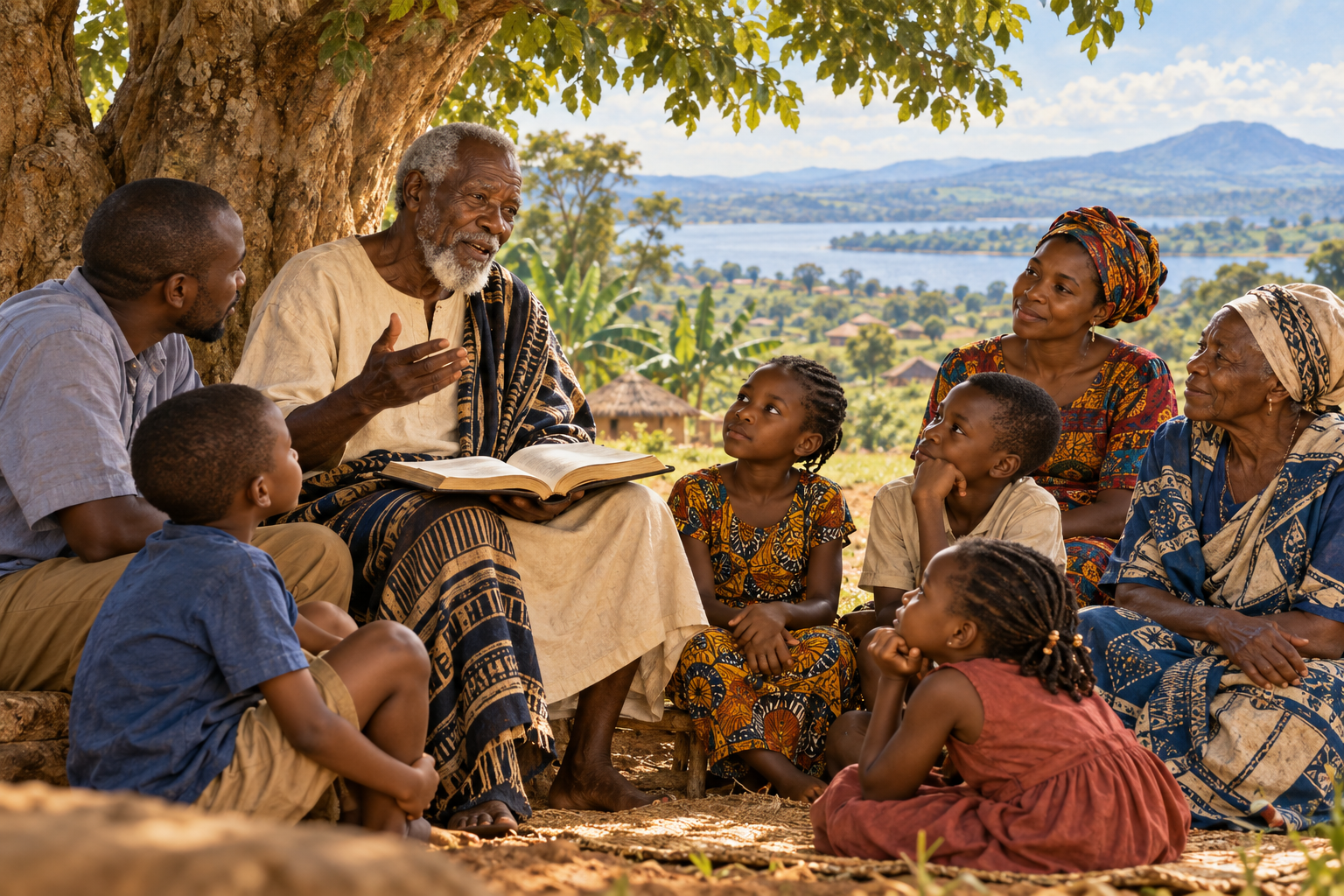
How can we tell the next generation of God’s faithfulness without hiding past failures?
01
Overview
Remembering God's mighty deeds, telling the truth about failure, and passing hope to those who come after us
Key text — Psalm 78:4, 7 (sense): Do not conceal God's deeds from the next generation. Tell them so that they may put their trust in God, remember his works, and keep his commands.
A child asks a question at the family table: “Why do we trust this God?” The adults have a choice. They can offer a few familiar religious phrases, describe an idealized past, or tell a story honest enough to include both God's faithfulness and their ancestors' failures. Psalm 78 asks for the third kind of storytelling.
Its seventy-two verses do more than recall Israel's past. They ask whether the people of God are willing to learn from it—and whether their children will inherit a living faith or only a collection of names and events.
02
1.0 Introduction
Communities do not usually forget their history all at once. They remember the victories and omit the warnings. They retell the miracles but leave out the stubbornness of those who witnessed them. Over time, the story becomes a monument to the community rather than a testimony to God's mercy.
Psalm 78 refuses such selective memory. It recalls the exodus, the wilderness, the land, the abandonment of Shiloh, and the unexpected choice of David. Again and again, God provides; again and again, the people mistrust him. Yet judgment does not have the final word. God's compassion interrupts the cycle, and his purposes continue when human faithfulness fails.
The psalm's opening explains why the story must be told: so that coming generations will trust God, not forget his works, and keep his commandments (vv. 6–8). In other words, this is not history for curiosity's sake. It is memory meant to form a people.
In Psalm 77, the distressed worshiper remembered God's wonders at the sea without receiving an immediate explanation for present suffering. Psalm 78 picks up those same wonders and turns outward. The question changes from How do I remember when I am afraid? to How do we teach remembrance so that the next generation may live faithfully? (Goldingay 2007, 482–84).
Central message: Faithful remembrance tells the whole story. It acknowledges God's mighty works, names human failure without excuses, receives his mercy with gratitude, and equips a new generation to trust and obey him.
03
2.0 Historical and Literary Context
The heading calls this a maskil associated with Asaph. The precise force of maskil is debated, but the poem clearly has an instructional purpose. Although it belongs to the Psalter, most of its words are not addressed to God. A teacher speaks to the people, using their shared history to call for wise living. John Goldingay aptly describes it as poetic exhortation rather than a simple recital of past events (Goldingay 2007, 478–81).
Psalm 78 belongs among the Asaph psalms in Book Three (Psalms 73–83). It shares their concerns with covenant faithfulness, national disaster, the presence of God, and the responsibilities of the community. Its parallels with Deuteronomy 6:4–9 and 32:1–43 are particularly important: Israel must receive the story, live by it, and pass it on.
The history moves from the wonders in Egypt and the sea to wilderness provision, settlement in the land, Shiloh, and the choice of Zion and David. But it does not follow a strict chronology. The wilderness is recalled, then the poet returns to the plagues of Egypt. The arrangement is theological and rhetorical: divine generosity is contrasted with persistent distrust; divine judgment is interrupted by compassion; and an apparently broken history reaches a new beginning (Goldingay 2007, 480–82).
One can trace seven movements:
1. Verses 1–8: The command to teach the next generation. 2. Verses 9–16: Ephraim's failure contrasted with remembered miracles. 3. Verses 17–31: Wilderness rebellion despite bread, water, and meat. 4. Verses 32–39: Unfaithful words met by astonishing divine compassion. 5. Verses 40–55: Israel's forgetfulness contrasted with liberation from Egypt. 6. Verses 56–64: Disloyalty in the land and the disaster at Shiloh. 7. Verses 65–72: A new beginning through God's choice of Judah, Zion, and David.
The final emphasis on Ephraim and Judah has led scholars to propose different dates—from the divided monarchy to later periods of reflection on David's dynasty. The psalm gives no reliable date. The rivalry between north and south is part of its language, but its moral warning is directed at all God's people, not at one tribe alone (Kidner 2014, 311–16; Goldingay 2007, 480–83).
04
3.0 Walking Through the Text
3.1 Tell the children the truth, so that they can trust God
Psalm 78:1–8
The opening sounds more like a wisdom teacher or prophet than a singer leading ordinary praise: Listen. Pay attention. I will open my mouth. The word often translated parable (mashal) can mean a meaningful saying or story; the reference to ancient mysteries suggests that Israel's familiar history contains lessons people have failed to understand. Jesus' teaching in parables will later be connected to this verse (Matthew 13:34–35).
The great responsibility falls on the generation now listening. Their ancestors told them what God did; they must not hide it from their own children. The pattern is not merely information received, information repeated. It is a call to understand and embody the message before passing it along.
Verses 7–8 identify the desired result: trust in God, remembrance of his actions, and obedience to his instruction. These are joined together. Remembering wonders without learning obedience produces spectators; insisting on obedience while concealing God's mercy produces fear without trust.
The negative example is equally clear. The next generation must not repeat the stubbornness of ancestors whose hearts and spirits were not faithful. The psalm insists on honesty. We do children no favor by pretending that the history of faith consists only of flawless heroes. We serve them better when we show how God's mercy meets people who have repeatedly failed (Kidner 2014, 311–12; Goldingay 2007, 484–87).
3.2 The failure of Ephraim is set against the wonders of deliverance
Psalm 78:9–16
The sons of Ephraim are portrayed as armed archers who turn back in battle. This has prompted different interpretations. It may evoke a remembered episode, but the psalm does not identify one. Kidner takes the image primarily as a metaphor for covenant disloyalty, especially because the next verses describe failure to keep God's covenant and refusal to remember his deeds. Ephraim, a prominent northern tribe, becomes a warning sign rather than a simple accusation about military cowardice (Kidner 2014, 312).
The contrast is deliberately painful. These are descendants of the people for whom God worked wonders in the region of Zoan in Egypt, divided the sea, guided them by cloud and fire, and brought water out of rock. The acts are recalled in condensed, poetic language, echoing Exodus 13–17.
The problem is not that God had never revealed his character. The problem is that the people allowed his acts to lose their claim upon their lives. Scripture's use of forgetting often describes more than a lapse of memory: people can know the facts and still live as though they were not true.
The reference to Ephraim must not become an excuse for Judah—or any later community—to congratulate itself. The whole psalm soon shows that rebellion was shared widely. Its warning belongs to every group tempted to confuse inherited privilege with present faithfulness.
3.3 A table in the wilderness cannot satisfy a heart determined to distrust
Psalm 78:17–31
The people continue to rebel even after receiving water in the desert. Their challenge concerns food: can God set a table in this wilderness? Can he provide bread and meat as well? The question sounds practical, but the narrative exposes a deeper posture: it is a test of God coming from a people already surrounded by evidence of his provision.
God gives manna—the food called bread from heaven—and brings quail in abundance (Exodus 16; Numbers 11). But the abundance does not heal the mistrust behind the demand. The psalm recalls judgment falling while food is still in their mouths.
This passage is easy to mishandle. It does not mean that hungry people should stop asking for food, that human needs are sinful, or that suffering proves someone has been greedy. The Exodus account repeatedly acknowledges real hunger and real need. Psalm 78 examines something more specific: contemptuous refusal to trust the God who is sustaining the people, even as they insist he owes them proof on their terms.
Kidner connects this episode with Jesus' discussion of manna in John 6. There, the crowd's desire for another sign becomes an opportunity for Jesus to teach about the Father who gives the true bread from heaven. The issue is not whether food matters; it is whether a gift brings its recipients to recognize and trust the giver (Kidner 2014, 312–14).
3.4 God meets shallow repentance with compassion that is anything but shallow
Psalm 78:32–39
This is the theological heart of the psalm. Even after everything they have witnessed, the people persist in sin. When judgment comes, they seek God. They recall that he is their rock and redeemer. But their words outpace their loyalty. The psalm says that they flatter him with their mouths while their hearts remain unstable; they do not remain true to his covenant.
This is not a condemnation of every imperfect prayer. People in distress often speak with an unsettled heart. The specific charge is a pattern of professed devotion that does not grow into fidelity. Hosea 6:1–6 confronts a similar gap between attractive religious words and enduring covenant love.
Then verse 38 interrupts the story with a word of grace: God is compassionate. He deals with iniquity and repeatedly restrains his anger instead of destroying the people. Verse 39 adds that he remembers their frailty; they are mortal, like a passing wind that does not return.
Notice the surprise: the people are told not to forget God's works, while God himself remembers their weakness. His remembrance does not erase their guilt; it leads him to respond with a mercy they have not earned. In this psalm divine compassion is not sentimental indifference to evil. It is the reason the story has not ended already (Goldingay 2007, 480–81; Kidner 2014, 314).
3.5 The plagues, the sea, and the land expose the tragedy of forgetfulness
Psalm 78:40–55
The psalm retraces Israel's history again, now beginning with its repeated provocations of God in the wilderness. Verse 42 names the decisive failure: they failed to remember the hand that redeemed them from oppression.
The poet then surveys the wonders in Egypt: waters turned to blood, destructive swarms, ruined crops, storm and hail, the death of the firstborn, and the flight from bondage. The psalm is selective, not a precise replay of the sequence in Exodus 7–12. It compresses the narrative to magnify the contrast between the God who rescues and the people who neglect his rescuing acts.
The language of judgment against Egypt is severe. These scenes belong to Israel's testimony about deliverance from slavery and must not be appropriated as a license to wish disaster on contemporary peoples. Nor should the reference to the displacement of nations in the land (v. 55) be turned into an open-ended authorization for modern conquest. The psalm is recounting its covenant story, not handing its readers permission to imitate every scene of ancient warfare.
In verses 52–53, the poet gives a tender counterimage: God leads his people like sheep, safely through the sea, while the waters overwhelm their pursuers. This recalls the final line of Psalm 77. The memory that sustained one troubled worshiper now becomes the story the whole congregation must pass on.
3.6 A holy place cannot protect a persistently unfaithful people
Psalm 78:56–64
Even after receiving a place to live, Israel repeats the same pattern. The people test God, reject his instruction, and turn toward other gods. The psalm compares them to an unreliable bow—a weapon that cannot deliver what it promises.
The result is described through the abandonment of the sanctuary at Shiloh, an earlier center of Israel's worship. The ark is captured, young men fall in battle, priests die, and the community loses its songs of celebration. The main narrative backdrop is 1 Samuel 4, including the deaths of Eli's sons and the capture of the ark by the Philistines (Kidner 2014, 315–16).
This is a devastating warning against treating religious institutions as guarantees of God's approval. Possessing sacred objects, a cherished history, or a recognized place of worship does not excuse injustice and disobedience. Jeremiah later holds up Shiloh as a warning to those who assume Jerusalem's temple cannot fall regardless of how they live (Jeremiah 7:12–15).
The psalm does not teach that every church disaster or personal loss is divine punishment. It recalls a particular covenant judgment in Israel's history. Its lasting warning is more careful—and more searching: religious confidence without covenant fidelity is dangerously hollow.
3.7 God begins again with a shepherd, not with the people's impressive record
Psalm 78:65–72
When everything appears lost, the poem takes an unexpected turn. In vivid poetic language, God rises like someone waking from sleep. This is a striking image, not a claim that God had literally been powerless or intoxicated. The movement announces renewed divine action after a season in which his people experienced defeat.
The story now contrasts the rejection of the leading northern center, represented by Ephraim, with God's choice of Judah, Zion, and David. The choice is not explained as Judah's flawless performance. The earlier verses have already undermined the idea that any tribe deserves to boast. God acts with surprising freedom and grace (Goldingay 2007, 510–16).
David is taken from following the sheep and entrusted with shepherding the people. The final verse names two dimensions of leadership: integrity of heart and skillfulness of hands. Neither is expendable. Sincere motives without competent action can leave people exposed; competence without integrity can turn a shepherd into an exploiter.
Yet David is not made into an infallible hero. The wider biblical story records his failures as well as his gifts (2 Samuel 11–12). The psalm closes at a hopeful moment; later generations must discover whether they will live up to the lesson. God's mercy has created a new opportunity, not removed the responsibility to be faithful.
05
4.0 Theological Reflection
4.1 Memory is an act of covenant faithfulness
Psalm 78 treats remembering as something people do, not merely something stored in the mind. We remember by retelling God's work, acknowledging our failures, and letting the story shape decisions. A congregation can recite biblical events and still forget them in the deeper sense if its practices contradict what it says it believes.
4.2 Miracles do not automatically produce trust
The Israelites witnessed wonders yet repeatedly doubted. No experience, however powerful, bypasses the slow formation of the heart. Faith grows as people learn to receive God's gifts with gratitude, to follow his instruction, and to trust his character when the next wilderness arrives.
4.3 Judgment is real, but God's compassion repeatedly interrupts ruin
The psalm refuses to minimize rebellion; it also refuses to portray God as eager simply to erase his people. Verse 38 stands between repeated failure and continued history. Divine mercy does not make repentance unnecessary. It makes renewed faithfulness possible.
4.4 Election is a calling to serve, not a warrant to despise others
The final choice of Zion and David cannot be separated from the initial demand for humility and obedience. If those who inherit the story treat other peoples as inferior, they have missed its lesson. The same warning applies to Christians who presume to replace Israel as though the church had no sins of its own (Romans 11:17–22; Goldingay 2007, 515–16).
4.5 The story's ending remains open to the next generation
The psalm stops with David at the beginning of his vocation. It does not supply a neat account of everything that follows. That is part of its force: the generation hearing it must now decide what kind of continuation its life will become.
06
5.0 Canonical and Christological Horizon
Psalm 78 belongs to a much larger biblical practice of telling the saving story. Deuteronomy calls parents to speak of God's instruction in ordinary life (Deuteronomy 6:4–9). Israel's festivals and testimonies remember liberation (Exodus 12:24–27). Later, the prophets warn that a people who forget redemption will mistake power or ritual for faithfulness.
The New Testament carries that pattern forward. Matthew 13:34–35 applies Psalm 78:2 to Jesus' teaching in parables: he opens familiar realities to reveal the often-missed purposes of God. John 6:30–35, 47–51 revisits the manna story and presents Jesus as the bread of life, given by the Father. First Corinthians 10:1–13 recalls Israel's wilderness experience to warn believers against presumption, idolatry, and distrust.
The closing image of David points further into the biblical story of kingship. David is the shepherd selected to care for God's people, yet David's own life exposes the limits of even a gifted human king. In the Gospels, Jesus names himself the good shepherd, whose care reaches the point of laying down his life for the sheep (John 10:11–18). His kingship is characterized not merely by power but by costly faithfulness.
This is a canonical and Christian theological connection, not a claim that the author of Psalm 78 supplied a detailed prediction of Jesus. Nor does it mean God has discarded Israel. The New Testament insists that Gentile believers are recipients of mercy and must not boast over Israel (Romans 11:17–29).
The biblical story moves toward God's dwelling with a healed creation (Revelation 21:1–5). Psalm 78 teaches what sort of people should live in anticipation of that future: people who remember mercy truthfully, refuse idolatry, protect the vulnerable, and practice the integrity of heart and skillful service expected of shepherds.
07
6.0 Life Application
1. Tell the whole story. When teaching children or new believers, include testimonies of deliverance and honest accounts of failure. Explain what was learned and what changed, without glamorizing wrongdoing or exposing another person's private story without consent. 2. Make remembrance a household rhythm. Choose a regular time to read one biblical episode, ask what it reveals about God, and discuss one way to live differently this week (Deuteronomy 6:6–9). 3. Distinguish a real question from contemptuous testing. Give people room to ask difficult questions about God. Then invite honest reflection on whether a repeated demand for proof is preventing them from responding to what they already know. 4. Make repentance more than words. Where there has been wrongdoing, confession should lead toward restitution, changed habits, and accountability. Beautiful religious speech cannot substitute for faithfulness (Psalm 78:36–37). 5. Evaluate leaders as shepherds. In church, home, and society, look for both integrity and practical competence. Ask whether leaders are protecting and nourishing those entrusted to them, especially the weak (Psalm 78:70–72). 6. Teach hope without claiming a flawless past. When an institution has failed, resist both denial and despair. Truthful memory can become the place where renewed responsibility begins.
08
7.0 Reflection Questions
1. What parts of our family's, church's, or community's story do we celebrate—and what warnings do we tend to leave out? 2. According to Psalm 78:7, what is the difference between knowing God's works and remembering them faithfully? 3. How does verse 38 challenge the idea that failure must be either excused or punished without mercy? 4. In what ways might religious success or long-standing institutions become false sources of security, as they did at Shiloh? 5. What would it look like to pass on a faith marked by trust, obedience, integrity, and compassion rather than by fear or inherited labels alone? 6. Where is God calling me to use both an honest heart and capable hands to care for others?
09
8.0 Response Prayer
God of Abraham, Isaac, and Jacob, You made a way through the sea, You fed your people in a barren place, And you remembered their weakness When they forgot your mercy.
Forgive us when we tell our story As though we have never wandered. Forgive us when we speak of your wonders Yet resist the life you ask us to live.
Give us truthful memories, Humble hearts, and faithful hands. Teach us to speak of your goodness Without hiding our failures.
Bless the children who are listening now, The young who are asking difficult questions, And those who fear they have received Too little hope from the generations before them.
Through Jesus Christ, the good shepherd, Make us a people who remember, A people who repent, And a people who pass on your mercy.
Amen.
10
9.0 Window into What Comes Next
Psalm 78 ends with the choice of Zion and David. But the next psalm will not allow us to imagine that the story is secure simply because a king and a holy city have been chosen.
Psalm 79 begins among the ruins: nations have invaded God's inheritance, Jerusalem has been devastated, and the people cry out over bloodshed and disgrace. The transition is deliberate and sobering. Memory of past rescue does not exempt a later generation from fresh suffering. The shepherd's story continues through crisis.
Psalm 78 asks, Will we remember and teach God's deeds? Psalm 79 asks, What shall we pray when the community that carries those memories lies broken? Read together, the psalms offer neither nostalgia nor denial, but a faith able to tell the truth and seek God again.
11
10.0 Bibliography
Scripture: Psalm 78; Exodus 12–17; Numbers 11; Deuteronomy 6 and 32; 1 Samuel 4–7, 16; 2 Samuel 7, 11–12; Jeremiah 7; Matthew 13:34–35; John 6 and 10; 1 Corinthians 10; Romans 11; Revelation 21. Biblical wording in this article is summarized or paraphrased unless a translation is expressly named.
BibleProject. n.d. The Book of Psalms: Study Notes. Project study resource, especially the discussion of Book Three and the Asaph collection.
Goldingay, John. 2007. Psalms. Volume 2: Psalms 42–89. Baker Commentary on the Old Testament Wisdom and Psalms. Grand Rapids: Baker Academic. Commentary on Psalm 78, 474–516.
Kidner, Derek. 2014. Psalms 73–150. Kidner Classic Commentaries. Downers Grove, IL: IVP. Originally published 1975. Commentary on Psalm 78, 310–316.
Be the first to leave a comment.