

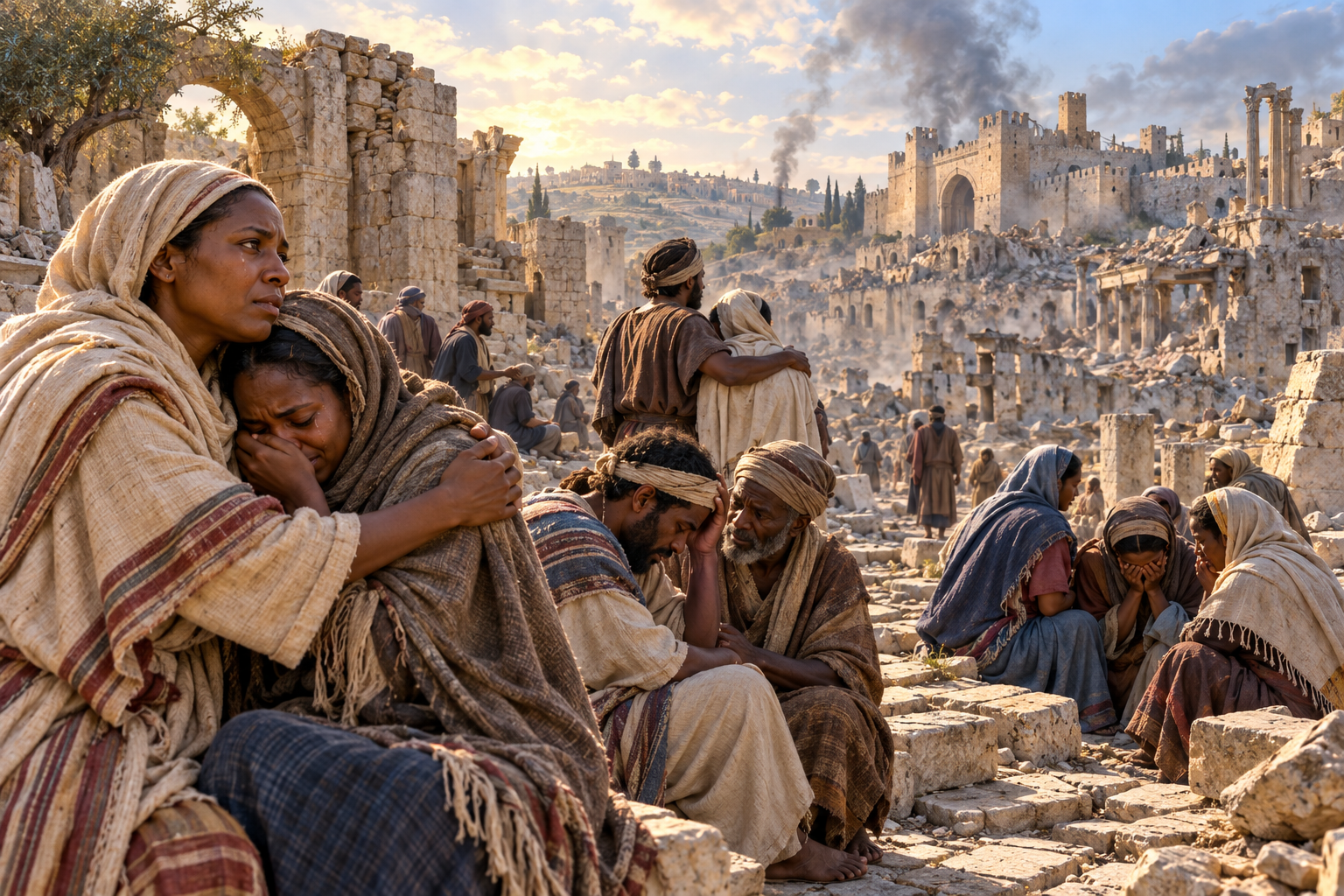
When violence shatters a community, how do we pray for mercy and justice without seeking revenge?
01
Overview
Praying for mercy and justice when violence has shattered a community
Key text — Psalm 79:8–9 (sense): Do not hold the sins of former generations against us. Let your compassion come quickly, for we have been brought very low. Help us, God our Savior, and forgive our sins for the honor of your name.
The streets are no longer safe. The place where people once gathered to worship has been violated. Families search for the dead, and some are unable even to give their loved ones a burial. Beyond the devastation come the voices of neighbors asking where the people's God has gone.
Psalm 79 begins there—not with an explanation, but with a cry that refuses to pretend this suffering is ordinary.
02
1.0 Introduction
What should God's people pray when their world has collapsed? Should they confess wrongdoing? Demand justice? Ask for compassion? Promise to praise God again? Psalm 79 does all four. It is a communal lament from a people who have lost security, dignity, and the familiar signs of God's presence.
The sequence of psalms makes the shock sharper. Psalm 78 closes with God's choice of Zion and of David, the shepherd called to lead with integrity and skill. Psalm 79 opens with foreigners invading God's inheritance, defiling his temple, and reducing Jerusalem to ruins. What had appeared to be the secure center of Israel's life is now a scene of disaster. The Psalter does not erase this contradiction. It places the confession of God's faithfulness beside a community's unbearable questions.
Unlike Psalm 77, where a solitary voice wrestles with the distance between past wonders and present pain, Psalm 79 speaks in the plural: we, us, our. The people suffer together, remember together, confess together, and seek a future together. Their prayer is both fiercely honest and deeply dependent on God's mercy.
Central message: When violence brings God's people low, faithful prayer neither denies the horror nor claims innocence too easily. It calls upon God to confront injustice, asks him to forgive and restore, and holds open the possibility that praise may yet be heard by another generation.
03
2.0 Historical and Literary Context
The heading associates the psalm with Asaph. It belongs to the Asaph collection within Book Three of the Psalter (Psalms 73–83), a section deeply concerned with covenant failure, the apparent triumph of evil, threatened worship, and God's authority over the nations. The title does not establish that the historical Asaph personally witnessed the event described.
The background most naturally evokes the Babylonian conquest of Jerusalem in 587/586 BCE (2 Kings 25; Jeremiah 39; 52; Lamentations). Invaders entered the sacred precincts, devastated the city, and left people dead and unburied. Derek Kidner reads Psalm 79, alongside Psalm 74, in the light of survivors of this catastrophe (Kidner 2014, 316–18). John Goldingay agrees that this is the clearest biblical parallel while noting that the psalm does not give a date, name the enemy, or explicitly state that the temple was burned. It may reflect the calamity itself, its long aftermath, or later worship shaped by that memory (Goldingay 2007, 517–20). Later generations could pray its words amid new violence; 1 Maccabees 7:17 applies Psalm 79:2–3 to a subsequent tragedy. That later use does not establish the psalm's original date.
The poem is a community lament. Its movement can be read in five broad stages:
1. Verses 1–4: The invasion, desecration, slaughter, and public shame are laid before God. 2. Verses 5–7: A question about the duration of God's anger becomes a plea for justice. 3. Verses 8–10a: The people confess their need for compassion, rescue, and forgiveness. 4. Verses 10b–12: They plead for the dead, the prisoners, and accountability for those who mock God. 5. Verse 13: The community anticipates thanksgiving that will be passed down through generations.
Goldingay notes that the psalm returns to petition three times (vv. 5–7; 8–10a; 10b–12), each time drawing together the suffering of the people and concern for the honor of God's name (Goldingay 2007, 518–19). This is not detached theology: familiar language from other biblical prayers gives devastated people words when they can scarcely find their own. The psalm has close affinities with Psalm 74, Jeremiah 10:25, and Lamentations 5.
04
3.0 Walking Through the Text
3.1 God's inheritance is invaded and his dwelling defiled
Psalm 79:1
The first words are addressed directly to God. The poet does not say only that our city has been attacked. He describes the land as your inheritance, the sanctuary as your holy temple, and Jerusalem as the place now made into ruins. The repeated reference to what belongs to God is a form of covenant appeal: Lord, see what has happened to the people and place associated with your name.
This language does not deny the real suffering of the inhabitants. Rather, it insists that violence against the community cannot be separated from a larger question: what does God's faithfulness mean when the place of worship has been overrun? The question becomes especially painful after Psalm 78's celebration of Zion as God's chosen dwelling.
The prophets had already warned that possession of a temple did not exempt Jerusalem from accountability (Jeremiah 7:1–15; Micah 3:12). The psalm therefore cannot be treated as proof that the people had done nothing wrong. Yet prophetic warnings do not make the invaders' cruelty good. God's people can recognize their failures and still name the violence committed against them as evil.
3.2 The dead are denied dignity; the living bear shame
Psalm 79:2–4
The next images are deliberately unbearable: bodies left exposed to birds and wild animals, blood poured out like water, and no one available to bury the dead. The horror is not merely the number of deaths. The dead have been treated as if their lives had no worth, while the survivors are denied the ordinary human work of mourning.
Kidner emphasizes the significance of burial as an expression of the value of a person and the solidarity of a community (Kidner 2014, 316–17). Goldingay similarly observes that the inability to recover and bury loved ones deepens grief because families cannot carry out the practices that acknowledge death and honor the departed (Goldingay 2007, 521–22).
Verse 4 adds another wound: neighboring peoples mock the defeated community. Shame follows violence. Victims are forced not only to endure loss but to hear others turn their loss into a joke or a theological argument against them.
This is an important pastoral distinction. The mockery of suffering people is another wrong; it is not evidence that they deserved the suffering. The psalm allows the wounded to describe public humiliation without accepting their enemies' verdict about their worth.
3.3 “How long?” becomes a plea for judgment
Psalm 79:5–7
At the center of the community's bewilderment is the question: How long, Lord? Will divine anger continue forever? Will covenant jealousy burn like a fire that consumes everything?
The people seem to recognize that their own unfaithfulness has contributed to the crisis. The image of God's jealous anger recalls the warnings against idolatry in Exodus 20:5 and Deuteronomy 4:23–24. But the question asks whether judgment must be endless. It is the language of people who believe God's purposes cannot consist solely of their destruction.
Then comes the difficult petition: the people ask God to pour out his wrath on nations that have refused to acknowledge him and that have devastated Jacob. The prayer echoes Jeremiah 10:25 and turns the earlier picture of blood being poured out into a demand that the aggressors be held accountable.
We should not soften the words into a harmless expression of disappointment. This is a prayer for divine judgment on violent powers. But neither should we remove it from the context of invaded homes, desecrated worship, bodies left unburied, and people mocked in their weakness. Goldingay argues that such prayers can express victims' demand for a moral order in which the powerful do not act with impunity (Goldingay 2007, 529–30).
The danger is to turn the prayer into a warrant for our own revenge—or to assume that any modern community can simply identify its national enemies with God's enemies. The psalm puts the cry before God's judgment; it does not grant readers a license to carry out indiscriminate retaliation.
3.4 Mercy is requested by people who do not claim to be faultless
Psalm 79:8–9
Here the tone changes. The community asks God not to remember the sins of earlier generations against them. Their appeal is urgent: let compassion come quickly, because we have sunk so low. Then the prayer becomes explicit: help us, rescue us, and forgive our sins for the glory of your name.
This is one of the most striking turns in the psalm. The speakers have asked God to confront their aggressors, yet they do not present themselves as morally flawless. They recognize that covenant failure belongs to their history and confess a continuing need for forgiveness. Goldingay highlights the significance of a communal lament in which the praying community acknowledges its own shortcomings while asking for renewal (Goldingay 2007, 525–26, 530).
The reference to the sins of former generations also needs careful reading. Scripture elsewhere recognizes that people can suffer consequences inherited from a damaged society while refusing to make children personally guilty for everything their ancestors did (Jeremiah 31:29–30; Ezekiel 18:1–20). Corporate confession must never become an excuse to tell victims that they are individually responsible for violence committed against them.
The basis of hope is not a claim that the people now deserve rescue. It is God's compassion and the honor of his name. They ask the God known for saving to act consistently with that character. Confession and appeal are not opposites: the people can ask for forgiveness precisely because they believe God is merciful.
3.5 “Where is their God?” is a question about God's reputation
Psalm 79:10
The taunt from the nations cuts deeply: Where is their God? To those who have witnessed the city's ruin, the community's worship looks powerless. In response, the psalm asks that justice for the shed blood become visible before those who mocked.
The emphasis on God's name is easy to misunderstand. It does not mean that God has an insecure reputation to defend at any cost. Rather, in biblical covenant language, God's name stands for his revealed character. A God who is known for rescuing the oppressed cannot be spoken of truthfully if their suffering is ignored as though it did not matter (Exodus 3:7–10; 34:6–7).
At the same time, the psalm's demand that justice become visible leaves an uncomfortable question for us: What would justice actually require? Not every angry demand identifies the right remedy. The lament invites God to judge rightly where human grief, limited knowledge, and desire for vindication may become tangled together.
The New Testament does not simply silence victims' longing for justice. Revelation 6:9–11 gives voice to those asking when their blood will be vindicated. But Christian readers must hear that cry alongside Jesus' call to love enemies and Paul's instruction not to repay evil for evil (Matthew 5:43–48; Romans 12:17–21). Entrusting judgment to God is different from appointing ourselves his executioners.
3.6 Let the cries of prisoners reach heaven
Psalm 79:11–12
The plea now turns to people who may be forgotten after the battle: captives who groan and those threatened with death. The community asks that their cries reach God's presence and that his strong arm preserve them. The language of God's arm recalls the Exodus, when enslaved Israelites cried out and God acted to deliver them (Exodus 2:23–25; 6:6).
The psalm does not treat prisoners as statistics. Their groaning is a prayer-worthy reality. The appeal to preserve those under sentence of death challenges a community to remember people whose suffering is easily hidden from public view. Whatever the precise situation of the original captives, their inclusion makes the lament larger than concern for buildings or national pride.
Verse 12 is severe: the community requests a sevenfold return upon neighbors who have insulted the Lord. The number seven intensifies the desire for a full reckoning; it should not be treated as a numerical formula that readers must copy. Goldingay notices that the immediate wording targets their scorn against God, even though the opening verses also describe violence and humiliation against the people (Goldingay 2007, 528–29).
Christian faith does not require pretending that cruelty is unimportant. It does require distinguishing the desire for justice from the desire to make others suffer simply because we have suffered. Jesus himself endured mockery and entrusted himself to the One who judges justly (1 Peter 2:21–23). His followers are called to seek protection, truth, accountability, and peace without reproducing the very cruelty they condemn.
3.7 A ruined community still imagines generations singing
Psalm 79:13
The final verse is an extraordinary ending to such a dark prayer. The speakers call themselves your people, the flock of your pasture and promise to thank God continually, telling his praise from one generation to the next.
No report of rebuilding has appeared. The prisoners have not yet been shown walking free. The dead have not returned. The circumstances described at the beginning remain painfully unresolved. Yet the people speak of a future in which they can tell their children and grandchildren what God has done.
The shepherd image recalls Psalm 78:52 and its closing picture of David the shepherd (78:70–72). It also reaches forward to Psalm 80, where the Shepherd of Israel will again be asked to listen and restore his people. Their hope rests not on the strength of their walls but on belonging to the God who shepherds them.
This is not premature celebration. It is a vow spoken within grief: If you restore us, the story will not end with the ruins.
05
4.0 Theological Reflection
4.1 Biblical faith makes room for grief that speaks plainly
The psalm does not ask the sufferers to call violence a blessing or to conceal the indignity of their dead. It gives them words for outrage, sorrow, and bewilderment. Honest lament can itself be an act of faith because it addresses the God whose mercy and justice are being sought.
4.2 Judgment and mercy are not competing divine personalities
The same prayer asks God to confront aggressors and forgive his own people. Both requests assume that evil matters and that restoration is still possible. Judgment without mercy could leave nothing but destruction; mercy without regard for victims could become indifference. Psalm 79 refuses either easy alternative.
4.3 Confession must be truthful, not a new burden placed on victims
The community acknowledges failures within its covenant history. This cannot be generalized into the claim that every catastrophe is God's punishment for identifiable sins. Nor may leaders pressure survivors of abuse or war to confess guilt for what perpetrators did. Faithful confession names real wrongdoing, including wrongdoing among our own people, while insisting on the dignity of those harmed.
4.4 God's name becomes known through compassion and justice
The repeated appeals for the sake of God's name connect worship to the treatment of human lives. Public religious prestige is not enough. A community that calls on the God of salvation must make room for mercy, especially toward those who are bereaved, displaced, imprisoned, or threatened.
4.5 Hope can be a promise before it becomes a feeling
The final declaration of praise is not proof that every question has been answered. It is the community's refusal to grant devastation the final word. The imagined testimony of another generation keeps hope alive without denying present wounds.
06
5.0 Canonical and Christological Horizon
Psalm 79 belongs beside Lamentations, where the fall of Jerusalem is remembered in images of hunger, terror, ruined streets, and unanswered questions. Jeremiah's warnings about judgment and Ezekiel's promise of renewal should be read together rather than used to silence one another (Jeremiah 7:1–15; Lamentations 1–5; Ezekiel 36:22–27). Daniel 9:4–19 and Nehemiah 1:4–11 likewise combine confession with an appeal to God's mercy and faithfulness.
The psalm also recalls the Exodus. The God who heard the groaning of slaves is asked again to hear the groans of captives (Exodus 2:23–25; Psalm 79:11). A community's hope for rescue is tied to who God has already shown himself to be.
For Christians, Jesus enters this history rather than dismissing its grief. He weeps over Jerusalem and speaks with sorrow about the city's coming devastation (Luke 19:41–44). He suffers violence and shame, and the cross exposes the injustice that can be carried out by both imperial power and compromised religious leadership. His prayer for his enemies (Luke 23:34) does not declare cruelty innocent. It reveals a surprising way of confronting evil without continuing its cycle.
Hebrews 12:24 contrasts the blood of Jesus with the blood of Abel. It speaks of a better word—one that opens the way to reconciliation. Yet the resurrection also announces that violence, injustice, and death will not reign forever (1 Corinthians 15:20–26). Revelation holds together the cry for justice (6:9–11) and the promise that God will wipe away tears and remove death itself (21:1–5).
This Christological reading is part of the Christian reception of Psalm 79, not a claim that its first singers consciously described Jesus' death. Nor does it cancel Israel's own history, grief, or hope. Christians read the psalm rightly when they resist using Israel's tragedy as evidence of God's permanent rejection of the Jewish people (Romans 11:17–29).
The biblical story does not resolve Psalm 79 by telling sufferers their pain was insignificant. It moves toward a future in which God's justice makes restoration possible and his presence heals what violence destroyed.
07
6.0 Life Application
1. Give grief a truthful voice. When disaster strikes, name the people harmed and the losses suffered. Do not hurry to an explanation before listening to those who grieve. 2. Honor the dead and accompany the living. Support dignified mourning, practical help for bereaved families, and respectful care where death has been mishandled or ignored. 3. Confess responsibly. In a family, church, or institution, acknowledge genuine failures and seek repair. Never assign victims blame for the wrongs done to them. 4. Turn anger into a search for justice, not revenge. Pray for protection, fair investigation, accountability, and restraint. Refuse both the excuse that violence does not matter and the temptation to imitate it. 5. Remember prisoners and those under threat. Ask who is suffering out of sight. Offer appropriate support through trustworthy, safe, and lawful means. 6. Leave a testimony for the next generation. Tell the story honestly: what was lost, what was done wrongly, what mercy was sought, and what steps were taken toward healing.
08
7.0 Reflection Questions
1. Why does Psalm 79 begin by telling God what happened to his inheritance, sanctuary, and people? 2. What is lost when a community cannot honor its dead or mourn safely? How might a church respond well? 3. How can we distinguish a rightful demand for justice from a desire to take revenge? 4. What does the pairing of confession and compassion in verses 8–9 reveal about God's character? 5. Whose groaning, like that of the captives in verse 11, might we be failing to hear? 6. What would it mean for our children to inherit a testimony of truth, repentance, courage, and hope rather than a history covered over by silence?
09
8.0 Response Prayer
God of the wounded and the forgotten, look upon the places where violence has broken ordinary life. Hear the names we can scarcely speak through tears. Remember the dead whose dignity was denied, and the living who still search for safety.
Do not leave captives unheard. Do not let cruelty hide behind the power of the strong. Bring wrongdoing into the light, protect those who are exposed to harm, and teach us to seek justice without becoming cruel.
Where we have sinned, give us courage to confess. Where we have been wounded, meet us with compassion. Where our communities have failed, guide us toward repair.
For the honor of your name, let mercy reach us quickly. And when praise is difficult, keep open a future in which our children may tell how you heard, forgave, restored, and led your people again.
Through Jesus Christ, our shepherd and risen Lord. Amen.
10
9.0 Window into What Comes Next
Psalm 79 ends with a community calling itself the flock of God's pasture. Psalm 80 takes up that image immediately: Shepherd of Israel, listen. The next prayer repeatedly asks God to restore his people and make his face shine upon them. Its extended picture of a vine—brought out of Egypt, planted, and then left exposed—will give another voice to the same question: What becomes of a people God once rescued and lovingly established when their security is torn away?
The movement from Psalm 79 to Psalm 80 matters. Lament is not finished by making a vow to praise. The community continues to pray, bringing both its remembered blessings and its present losses before God. Hope keeps asking for restoration.
11
10.0 Bibliography
The Bible. Primary text: Psalm 79. Other passages include Exodus 2–6; 2 Kings 25; Jeremiah 7; 10; 39; 52; Lamentations; Ezekiel 18; 36; Daniel 9; Nehemiah 1; Luke 19; 23; Romans 11–12; Hebrews 12; Revelation 6; 21. Key text above is a summary of Psalm 79:8–9, not a quotation from a specific modern translation.
BibleProject. The Book of Psalms: Study Notes. Study resource supplied with the Psalms project, particularly the discussion of Book Three and the Asaph psalms.
Goldingay, John. 2007. Psalms, Volume 2: Psalms 42–89. Baker Commentary on the Old Testament Wisdom and Psalms. Grand Rapids: Baker Academic. Commentary on Psalm 79, pp. 517–530.
Kidner, Derek. 2014. Psalms 73–150. Kidner Classic Commentaries. Downers Grove, IL: InterVarsity Press. Originally published 1975. Commentary on Psalm 79, pp. 316–318.

Be the first to leave a comment.