

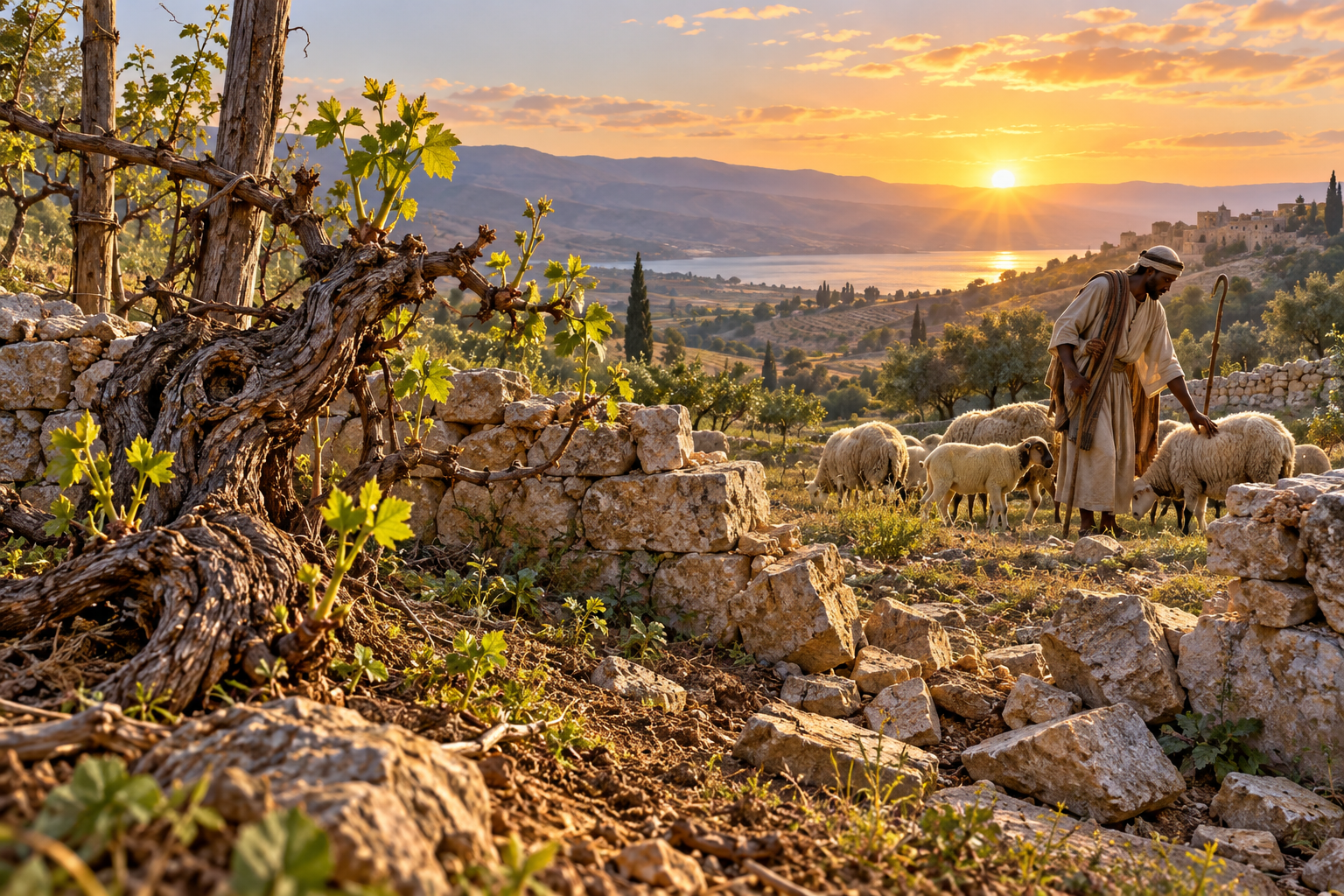
When the vine lies broken, what does praying “Restore us, O God” mean for our community?
01
Overview
“Restore us, O God”: A community asks the Shepherd of Israel to turn his face toward a devastated people
Key text — Psalm 80:3, 7, 19 (sense of the repeated refrain): Restore us, O God; let your face shine upon us, and we shall be saved. The plea is repeated three times with increasingly full titles for God.
A shepherd once led his flock through danger. A gardener carried a vine from one country to another, planted it, cleared the ground, and watched it spread. Yet the flock now cries as though its shepherd has gone silent, and the vine stands exposed, its protective wall broken, its branches stripped by strangers.
The people do not ask first for a stronger wall. They ask for the return of the One who planted and protected them: “Restore us.”
02
1.0 Introduction
What do people pray when everything God once helped them build seems to have fallen apart? Psalm 80 gives voice to a community confronting that question. The people remember a God who led them like a shepherd, planted them like a vine, and made them flourish. They now experience loss, public humiliation, and a frightening sense that the divine face has turned away.
This is not merely nostalgia for national success. The community wants to live again in a restored relationship with its God. That desire runs through the poem as a recurring prayer: “Restore us … let your face shine.” The plea returns in verses 3, 7, and 19, gathering force as the poem moves from a shepherd and throne to tears and enemies, then to a ravaged vineyard and a final appeal for renewed life.
Psalm 79 ends by calling the people God's flock. Psalm 80 begins by addressing the Shepherd of Israel. But the images of divine care in this psalm do not remove the anguish. They deepen it: If you have shepherded us and planted us, why are we being left to perish?
Central message: Restoration begins not with pretending that the vine is healthy, but with bringing its broken condition before the Shepherd who planted it. God's people may pray boldly for his return, ask honestly why they suffer, and commit themselves to renewed faithfulness—without claiming to know precisely when or how deliverance will come.
03
2.0 Historical and Literary Context
Psalm 80 is associated in its heading with Asaph. It is a communal lament, not a thanksgiving song spoken after the crisis has already ended. The heading's reference to “Lilies” or “The Lilies of the Covenant/Testimony” is probably a musical or liturgical direction; its precise significance is uncertain. An ancient Greek heading adds a reference to the Assyrian, though that addition by itself does not determine the original date.
The names Joseph, Ephraim, Benjamin, and Manasseh in verses 1–2 give the lament a pronounced interest in Israel's northern tribes. Ephraim and Manasseh descend from Joseph; Benjamin, Joseph's brother, completes the group of Rachel's sons. That family language matters. The poem is concerned with a wounded people, not merely with a contested piece of land.
One credible setting is the series of Assyrian invasions that weakened the northern kingdom and ended with Samaria's fall in 722/721 BCE (2 Kings 15:29; 17:1–23). Derek Kidner considers this the most likely context, suggesting that the prayer reflects grief in Judah over the loss suffered by northern Israel (Kidner 2014, 318–20). John Goldingay sees the northern perspective clearly but cautions against fixing the psalm to one event. It could also be a prayer by surviving northerners in Judah or a later community still longing for the restoration of Joseph's descendants (Goldingay 2007, 532–34). The psalm names the wounded tribes, but it does not name an invading army or give a date.
The literary shape is controlled by its refrain:
1. Verses 1–3: The Shepherd who sits enthroned above the cherubim is summoned to shine forth and save. 2. Verses 4–7: The community protests that its prayers seem to meet anger, while tears and mockery have become daily realities. 3. Verses 8–13: Israel's story is retold as a vine brought from Egypt, planted and allowed to flourish, then suddenly laid open to destruction. 4. Verses 14–19: God is urged to turn back to his vine, strengthen the one at his right hand, revive his people, and restore them.
Goldingay notes both the four-part movement and the increasing weight of the divine names in the refrain: God (v. 3), God of hosts (v. 7), and LORD God of hosts (v. 19). The words do not change because the first prayer was insufficiently sincere. Their intensification gives a suffering congregation a way to keep crying out (Goldingay 2007, 533–34).
04
3.0 Walking Through the Text
3.1 “Give ear, Shepherd of Israel”: the One who led the flock must speak again
Psalm 80:1–3
The opening address reaches back to an older identity: God is Israel's Shepherd, the One who led Joseph like a flock. The words recall Jacob's description of God as the shepherd of his life (Genesis 48:15; 49:24) and Psalm 78:52, where God guided Israel out of Egypt like sheep.
Yet this shepherd is also enthroned above the cherubim, a reference to God's royal presence symbolized in the sanctuary (Exodus 25:18–22; 1 Samuel 4:4). The psalm brings two images together: intimate guidance and sovereign majesty. The shepherd who knows the flock is also the King whose authority does not end at Israel's border.
The plea to “shine forth” flows into the refrain's request for God's face to shine. This recalls the priestly blessing of Numbers 6:24–26: the shining face signifies divine favor, peace, and relationship. The people are not asking for a theatrical display of light. They are asking that God's presence, which they now experience as obscured, become the source of life again.
The repeated word restore can include rescue from enemies, but the poem's ending shows that more is at stake: the people want to return to God and call on his name (v. 18). It is a prayer for outward deliverance and inward renewal.
3.2 A bitter table: tears instead of nourishment
Psalm 80:4–7
The lament asks how long the LORD God of hosts will remain angry with the prayers of his people. It is a startling question. Prayer should be the place where the wounded find help, but here even the act of praying seems unable to bridge the distance.
The shepherd's provision has become its terrible opposite. Rather than pasture and water, the people have tears for food and tears to drink. The image does not diagnose each worshiper's personal condition. It gives public language to prolonged collective grief. Sorrow has become as regular as eating and drinking.
Their neighbors quarrel over them, and their enemies laugh. Humiliation is not incidental to the suffering. The people have lost the ability to control how others speak about them. Again the refrain interrupts the pain: “Restore us, God of hosts.” It is prayer as perseverance, not prayer as a way to deny what has happened.
Kidner contrasts this meager diet with the abundant care of the Shepherd. Goldingay observes that the poem dares to address God as responsible for the people's present condition, even though it also acknowledges the action of hostile neighbors (Kidner 2014, 320–21; Goldingay 2007, 536–38).
3.3 The vine brought out of Egypt: grace has a history
Psalm 80:8–11
The psalm changes its governing picture. Now Israel is a vine. God brought it out of Egypt, displaced the nations before it, prepared ground for it, and planted it. It took root and spread until its shade reached mountains and its branches reached toward the sea and the River.
This is the Exodus and settlement story told through cultivation. In Psalm 78, God led the people from Egypt like a flock; here he transplants them like a vine. Both images emphasize God's initiative. The plant did not rescue itself, choose its own land, or clear its own soil. Its life depended from the beginning on another's care.
The sea and River probably refer to the Mediterranean and the Euphrates, the broad horizons associated with Israel's ideal reach (compare Psalm 72:8). The language is poetic, not a precise map of uninterrupted political control. It conveys the abundance and scale of what God had enabled.
The same metaphor appears elsewhere with sharper moral emphasis. Isaiah 5:1–7 portrays the vineyard as responsible for yielding injustice instead of the good fruit God sought. Psalm 80, however, directs attention primarily to the grower's past work and to the devastation now threatening the vine. Reading both passages keeps us from imagining either that Israel had no responsibility or that its suffering did not matter.
3.4 “Why have you broken down its walls?”: the exposed vineyard
Psalm 80:12–13
The song turns abruptly from flourishing to devastation. The hedge is gone. Passersby pluck the fruit. A wild boar tears up the vine, and creatures of the field feed on what remains. The protected garden is now open to any intruder.
Most difficult is the direction of the question: “Why have you broken down its walls?” The singers do not merely accuse their enemies. They take the crisis to the God who once established their home. The very God who planted the vine appears to have permitted its defenses to collapse.
The question is not proof that the invaders were innocent, or that God delights in devastation. Israel's prophetic tradition speaks both about its own covenant failures and about the guilt of violent empires (Isaiah 5; 10:5–19; Hosea 10). Psalm 80 gives sufferers permission to ask how divine judgment and divine faithfulness belong in the same story.
Nor does the boar need to be identified with certainty as a particular nation. The metaphor works by describing the vulnerability of a community once its security is removed. The enemies have their own actions; the lament refuses to pretend that those actions explain everything.
3.5 “Turn again”: the prayer asks God to look at what he planted
Psalm 80:14–16
Now the lament becomes an urgent appeal: “Turn again, O God of hosts. Look down from heaven and see.” In Hebrew, the verb used for God's turning back is closely connected to the verb used in the refrain for restoring the people. The prayer imagines renewal as a movement in both directions: God turning his attention toward his people, and his people being turned back toward him.
The community asks God to attend to the stock his right hand planted. The appeal is grounded in grace, not achievement: You began this work. Do not abandon what your own hand established. Moses appealed similarly to God's past commitments when he prayed after Israel's idolatry (Exodus 32:11–14).
Verse 15 includes a difficult reference to the “son” or “branch” whom God made strong. The wording belongs to the vine metaphor but also prepares for the human figure in verse 17. Interpreters differ about whether the son here is Israel collectively, a vigorous branch, or an emerging royal reference. The following verse's language of burning and cutting brings the devastation back into view before the prayer proceeds.
3.6 The one at God's right hand and the promise of renewed loyalty
Psalm 80:17–19
The community asks that God's hand be upon the man at his right hand, the son of man whom God has made strong for himself. This is a significant phrase, but it needs careful handling.
In its immediate setting, it may refer to Israel as God's son, using collective language associated with Exodus 4:22–23. It may also look toward a royal representative, in continuity with the Davidic king and the right-hand imagery of Psalm 110:1. Kidner stresses the corporate setting and its later messianic possibilities; Goldingay gives more weight to the prospect of a king who represents and restores the people (Kidner 2014, 322–23; Goldingay 2007, 541–43). The text does not specify Jesus by name or settle the debate simply by using the phrase “son of man.”
Whatever precise historical referent one adopts, the purpose is clear: God is asked to strengthen someone through whom renewed life and fidelity may come. The people answer with a vow: they will not turn away; if God gives them life, they will call on his name.
That promise matters because the history told in Psalm 78 included repeated turning away. Restoration is not merely the recovery of lost territory or reputation. It must include a repaired covenant relationship. “Revive us” means more than “make us impressive again.” It asks for life in which worship, obedience, and faithful dependence are renewed.
At the end comes the third refrain, now with the fullest invocation: “LORD God of hosts, restore us.” There is no report that the vine has already recovered. The prayer concludes with the unresolved request. That is not a literary failure; it is the form hope takes while the community is still waiting.
05
4.0 Theological Reflection
4.1 Restoration begins with God's initiative
God carried the vine from Egypt and planted it before it could produce a harvest. The people now return to that history because their deepest basis for hope is not their present strength. They ask the God who began the relationship to continue his work (Psalm 80:8–9, 14–15). Grace is not simply an introduction to the story; it remains the foundation of the community's appeal.
4.2 Lament can remain truthful about divine mystery
The psalm does not resolve all the questions created by suffering. It asks why the wall fell and why prayer seems to meet anger. Those are bold words. Yet their boldness is addressed to God, not offered as proof that God is absent. Biblical lament holds grief and trust together without reducing one to the other.
4.3 The shining face is relational language
To pray for God's face to shine is to ask for restored favor, communion, and peace (Numbers 6:24–26). The people desire material help, but they also long for the presence of their Shepherd. Prosperity without that relationship would not answer the refrain's deepest request.
4.4 The community's future includes repentance and renewal
Psalm 78 has recalled Israel's repeated failures. Psalm 80 does not erase them, even as it centers the pain of a damaged community. Its closing commitment not to turn back from God means that restored life ought to bear new fruit. The prayer invites both divine mercy and human responsiveness; it cannot be reduced to nostalgia for an earlier golden age.
4.5 God's people may pray for those beyond their own group
The northern tribal names deserve attention. A community in Judah could pray for its wounded kin in the north, even across a long history of rivalry. Likewise, religious communities should be capable of grieving the losses of believers and neighbors whose institutions, histories, or customs differ from their own. Solidarity is part of the image of God's one flock.
06
5.0 Canonical and Christological Horizon
The shepherd image joins Psalm 23, Psalm 78:52–53, and Ezekiel 34. In Ezekiel, God rebukes leaders who feed themselves while scattering the sheep and promises to search for the lost. The vine recalls Genesis 49:22, Isaiah 5:1–7, and Hosea 10:1, texts that ask whether a richly blessed people will produce justice and loyalty.
The repeated prayer for God's face to shine echoes Numbers 6:24–26. In Christian reading, this longing gains new depth in Jesus, who shows the Father's character and brings God's presence near (John 1:14–18; 14:9; 2 Corinthians 4:6). This is a canonical theological connection, not a claim that the psalm itself directly describes those later events.
Jesus calls himself the true vine in John 15:1–8. In that passage, fruitfulness depends on abiding in him, and his Father remains the gardener. Jesus also names himself the good shepherd who knows his sheep and lays down his life for them (John 10:11–18). These New Testament images deepen Psalm 80's basic concerns: the people need more than external protection; they need life, faithful leadership, and enduring communion with God.
The figure at God's right hand in Psalm 80:17 can therefore be read christologically, particularly in light of the Davidic and messianic hope and the New Testament's witness to Jesus' exaltation (Psalm 110:1; Acts 2:32–36; Hebrews 1:3). Yet the immediate psalmic referent remains disputed—Israel, its king, or a representative understood in both senses. A Christian reading should not erase that historical question.
The plea “Give us life” finds a wider horizon in Christ's resurrection (1 Corinthians 15:20–26) and in the promised renewal of creation (Revelation 21:1–5). The psalm's unhealed vine should also keep us from treating restoration as automatic or instantly visible. Christian hope depends on God's decisive action, even while communities still experience seasons of pruning, sorrow, and waiting.
07
6.0 Life Application
1. Name the broken wall honestly. Identify what has been damaged in your family, congregation, or community. Avoid both denial and the habit of blaming every loss on one convenient enemy. 2. Pray for restoration that includes changed lives. Ask not only for recovered resources, attendance, or reputation, but for renewed truthfulness, justice, care, and faithfulness. 3. Remember the history of grace without romanticizing the past. Thank God for what he has done, while also learning from mistakes and harm that accompanied earlier successes. 4. Care for the flock beyond familiar boundaries. Reach out to a person or congregation whose suffering is easy to ignore because they belong to another group, region, or generation. 5. Practice the prayer of the shining face. In a difficult season, return to Psalm 80:3, 7, and 19. Let the repeated request be a way of remaining in conversation with God, not a formula that guarantees a particular outcome.
08
7.0 Reflection Questions
1. Why might the description of God as Shepherd make the community's present suffering more painful, rather than less? 2. In what ways does the vine metaphor change how you understand Israel's history of blessing and crisis? 3. What is the difference between praying for the return of past success and praying for genuine spiritual restoration? 4. How might the phrase “let your face shine” reshape a community's understanding of what it most needs? 5. Who are the “Josephs” in our own setting—people whose suffering we should carry in prayer even though they live beyond our immediate circle?
09
8.0 Response Prayer
Shepherd of Israel, hear us. You know the places where our trust has been wounded, where relationships have broken, and where work once full of promise now lies exposed.
We remember that you planted what we could never establish by ourselves. Do not let gratitude for the past blind us to the truth of the present. Give us courage to confess our failures, to protect those who are vulnerable, and to repair what we have neglected.
Turn toward us in mercy; turn our hearts toward you. Let your face shine on people who have grown weary of tears. Revive us—not merely so that we may look strong, but so that we may bear the fruit of justice, love, and faithful worship.
Through Jesus Christ, our good Shepherd and true Vine, keep us close to your life while we wait for your renewal.
Amen.
10
9.0 Window into What Comes Next
Psalm 80 repeatedly pleads, “Restore us.” Psalm 81 turns to the question that a restored community must answer: Will you listen? Its opening sounds a festival trumpet and calls Israel to rejoice. But the celebration becomes a searching reminder of the Exodus and God's command to have no rival gods.
The movement is purposeful. In Psalm 80, the people ask the Shepherd to act. In Psalm 81, the Shepherd's people are confronted with the need to hear and obey. Restoration cannot mean returning to old patterns unchanged. The God who brings his flock home also calls them to listen to his voice.
11
10.0 Bibliography
The Bible. Psalm 80; Exodus 4:22–23; 25:18–22; Numbers 6:24–26; Genesis 48:15; 49:22–24; 2 Kings 15:29; 17:1–23; Isaiah 5:1–7; Ezekiel 34; John 10:11–18; 15:1–8; Acts 2:32–36; Revelation 21:1–5. The key-text statement is a summary of the refrain, not a quotation assigned to a particular translation.
BibleProject. The Book of Psalms: Study Notes. Project study resource, especially its overview of the Asaph collection and the shape of Book Three.
Goldingay, John. 2007. Psalms, Volume 2: Psalms 42–89. Baker Commentary on the Old Testament Wisdom and Psalms. Grand Rapids, MI: Baker Academic, 531–44.
Kidner, Derek. 2014. Psalms 73–150. Kidner Classic Commentaries. Downers Grove, IL: IVP Academic, 318–23. (Originally published 1975.)
Be the first to leave a comment.