

How can joyful worship change us when we listen to God’s voice?
01
Overview
The God who broke Israel’s chains invites his people to exchange empty celebration for attentive, trusting obedience
Key text — Psalm 81:8, 10, 13 (sense of the passage): God calls Israel to listen, identifies himself as the One who brought them out of Egypt, promises to supply their need, and longs for them to walk in his ways. This is a thematic summary, not a verbatim quotation from a particular Bible translation.
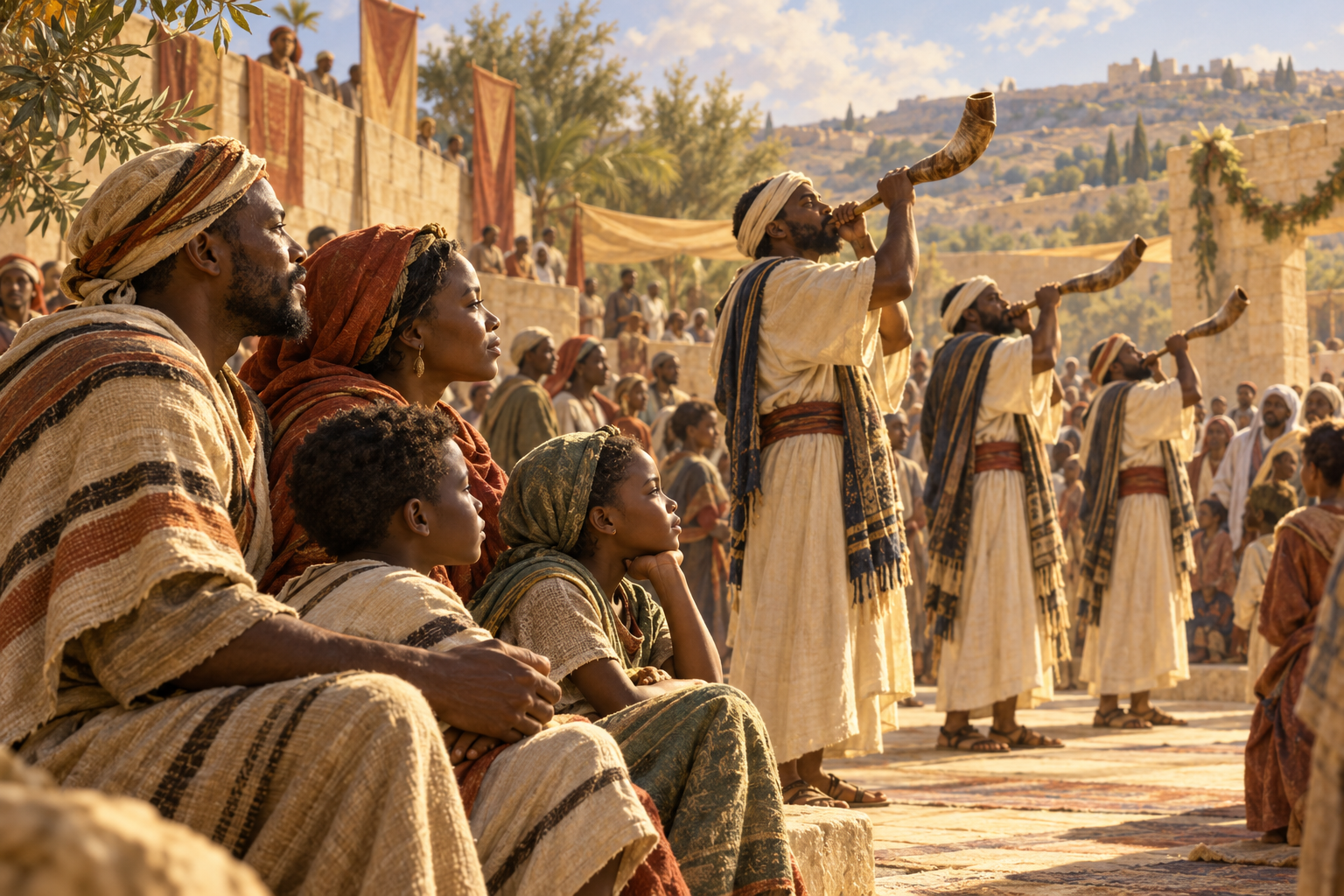
The trumpet sounds. The tambourine answers. Harps and voices fill the gathering with celebration. It is the kind of worship in which a community remembers that its story did not begin with its own strength. God brought it out of bondage.
Then the music gives way to a voice. The God they are celebrating begins to speak. And his question is disarmingly simple: Will you listen to me?
02
1.0 Introduction
Psalm 81 begins where many worship services seem happiest: in the freedom to sing, make music, and celebrate together. But the celebration suddenly becomes a searching conversation. God recalls his acts of deliverance, reminds his people of their responsibility to worship him alone, and describes the sorrow of being refused by those he rescued.
There is a poignant connection to the psalms immediately before it. Psalm 79 cries out from a devastated community. Psalm 80 repeatedly pleads, “Restore us.” Psalm 81 shifts the direction of the conversation. Instead of only asking whether God will hear the people’s prayers, it asks whether the people will hear God's voice. Restoration is not merely something to be received; it is a relationship in which God's people must learn to listen again.
The psalm's invitation is not harsh self-reliance. The God who calls for obedience is the very God who took burdens from enslaved shoulders and offers to fill hungry mouths. Obedience is not the purchase price of liberation. It is the fitting response to the Liberator who has already acted.
Central message: True worship joins joyful praise with attentive listening. The God who rescued Israel still longs for a people who trust him rather than rival sources of security, and who discover that his commands lead toward life rather than away from it.
03
2.0 Historical and Literary Context
The heading associates Psalm 81 with Asaph and includes the musical direction Gittith, also found in Psalms 8 and 84. Its precise meaning is uncertain; it may identify a tune or instrument. Psalm 81 belongs to the collection of Asaph psalms in Book Three (Psalms 73–83), where the community repeatedly reflects on worship, covenant failure, divine justice, and the memory of God's acts.
The trumpet sounded at the new moon and the full moon (v. 3), suggesting a sacred festival. Derek Kidner argues that the Feast of Booths, or Tabernacles, is the most likely occasion: the seventh month began with the sounding of a ram's horn and included the annual celebration recalling Israel's wilderness life (Leviticus 23:23–24, 33–43). Every seventh year, the law was to be read publicly during this festival (Deuteronomy 31:10–13). That setting fits the psalm's shift from celebration to covenant instruction (Kidner 2014, 323–25).
John Goldingay is more cautious about identifying one feast. The new-moon and full-moon wording may fit more than one observance, and Passover or Booths are both plausible contexts for worship shaped by memories of Egypt (Goldingay 2007, 547–50). The psalm itself gives us no reliable date of composition. Its use of Joseph may suggest an association with the northern tribes, but that cannot establish exactly where or when it was composed.
Literarily, Psalm 81 is built around a striking change of speaker and sound:
1. Verses 1–5b — The people are summoned to celebrate. Music and festival worship recall God's act of deliverance. 2. Verses 5c–7 — A voice is heard, and God remembers his rescue. Shoulders were freed from burdens; cries were answered; Israel was tested at Meribah. 3. Verses 8–10 — God invites exclusive loyalty. The people are called to listen, reject strange gods, and trust the One who brought them from Egypt. 4. Verses 11–12 — God names the refusal. Israel did not listen; God allowed the people to follow the choices they stubbornly preferred. 5. Verses 13–16 — God reveals what he still desires. His “if only” exposes divine grief and the possibility of a different future.
The repetition of the Hebrew verb shamaʿ, “hear” or “listen,” holds the poem together. It refers not merely to sound entering the ears but to receiving what is heard and responding faithfully. As Goldingay observes, the psalm is not against singing; it challenges the assumption that singing can replace listening (Goldingay 2007, 556–57).
04
3.0 Walking Through the Text
3.1 A trumpet sounds: worship remembers the God who rescued
Psalm 81:1–5b
The opening is exuberant. God is called our strength, and the assembly is urged to shout joyfully. Voices, tambourines, lyres, harps, and a ram's horn make this a communal event. Nobody is asked merely to observe worship from a safe distance. Israel is invited to rejoice together.
Yet the joy is not self-generated excitement. The psalm calls it a statute, an ordinance, and a testimony established for God's people. Music is joined to memory and covenant obligation. Israel is not celebrating its own cultural greatness. It is recalling a God who acted for people who could not free themselves.
The mention of Joseph and Egypt returns the assembly to the roots of the nation's identity. Joseph's name can stand for northern Israel, but it also belongs to the larger Exodus story. God's relationship with these people was forged amid exploitation and deliverance.
There is a subtle challenge here for every generation. Public worship can become familiar in its rhythms yet lose sight of the One it is meant to honor. A trumpet may gather a crowd, but only attentive hearts can receive the message that follows. The festival's music prepares the people to remember—and to hear.
3.2 From burdens to freedom: God's voice begins with remembered mercy
Psalm 81:5c–7
The second half of verse 5 is difficult. Many translations speak of hearing a language or voice that the speaker did not know. Some understand this as a recollection of an unfamiliar language in Egypt. Others hear an introduction to the divine speech that now interrupts the festival. Kidner favors the latter as fitting the transition into God's oracle; Goldingay also reads the phrase in terms of a voice previously unacknowledged (Kidner 2014, 324–25; Goldingay 2007, 550–51). The precise speaker at that point is debated, but the change to God's address is unmistakable by verse 6.
God speaks first of shoulders and hands. The oppressive load was taken away; the hands were released from carrying baskets. This concrete imagery points toward the forced labor of Egypt (Exodus 1:11–14; 5:6–18). Instead of speaking abstractly about salvation, God remembers what oppression did to human bodies—and what liberation changed.
He also remembers that the people cried out in distress and were answered. Then come thunder and the waters of Meribah, whose name evokes contention and testing (Exodus 17:1–7; Numbers 20:1–13). The thunder may recall Sinai or broader imagery of divine intervention in the Exodus tradition. The point is not that freedom brought an easy journey. The people who were freed still had to learn whether they would trust the God leading them through uncertainty.
Thus mercy and formation belong to the same story. God did not remove the burdens so that Israel could live without any relationship or responsibility. He freed them from slavery to make possible a different way of life.
3.3 “Listen, my people”: freedom is an invitation to covenant loyalty
Psalm 81:8–10
These verses bring the psalm's heart into focus. God asks his people to listen and commands them not to recognize or worship foreign gods. The language recalls the beginning of the Ten Commandments: the Lord who forbids rival gods first identifies himself as the One who brought Israel from Egypt (Exodus 20:2–3; Deuteronomy 5:6–7).
The order matters. Deliverance precedes the command. God does not say, “Make yourselves worthy, and I may set you free.” He speaks as the Liberator who has already acted. The commandments describe the faithfulness appropriate to a redeemed people.
Then, where we might expect another prohibition, comes an extraordinary promise: open your mouth wide, and I will fill it. The picture is of eager dependence and divine provision. It exposes the absurdity of turning to rival gods for life after the God of the Exodus has shown his power and generosity.
This is not a promise that every believer can obtain any desired possession simply by asking. The surrounding verses concern trust, worship, and a sustained relationship with Yahweh, not a technique for acquiring wealth. The invitation calls the people to bring their needs to the One who can truly sustain them (compare Deuteronomy 8:2–10).
The command to listen and the promise to provide belong together. When trust is misplaced, the community is tempted to worship whatever seems to guarantee safety, prosperity, or control. When it listens, it learns to receive provision as a gift rather than to treat other powers as gods.
3.4 The tragedy of refusing the voice that gives life
Psalm 81:11–12
The next words are painfully direct: God's people did not listen. Israel would not submit to his voice. The tragedy is not ignorance alone; it is persistent unwillingness. The people who had heard the story of redemption chose their own path instead.
God describes the consequence in unsettling terms: he allowed them to go their own stubborn way. Sometimes divine judgment takes the form of restraint, stopping people before they ruin themselves. Here the judgment is also the withdrawal of restraint: a community is permitted to experience where its chosen loyalties lead.
Kidner compares this with Paul's repeated statement that God “gave them over” to their desires in Romans 1:24, 26, and 28 (Kidner 2014, 326). Goldingay likewise sees a refusal to listen becoming its own judgment: Israel is allowed to seek security elsewhere and discover the cost of that decision (Goldingay 2007, 554–57).
This does not mean that every hardship is proof that the person suffering must have disobeyed God. The Psalter contains many prayers from faithful people who suffer unjustly—Psalms 44, 74, and 79 are close reminders. Psalm 81 diagnoses a particular covenant pattern, not every human tragedy. We must not weaponize it against the vulnerable.
Its searching question remains: Can people reject the voice that sustains them and still expect their chosen substitutes to provide what only God can give?
3.5 “If only”: divine grief and an invitation still open
Psalm 81:13–16
After the accusation comes a surprising sound. God does not conclude with cold dismissal. He speaks in the language of longing: If only my people would listen to me; if only Israel would walk in my ways.
This is the emotional center of the closing movement. God's command is not presented as a ruler's arbitrary test. The divine speaker grieves over a people who have turned from the life offered to them. Kidner compares the tone to Jesus' sorrow over Jerusalem (Matthew 23:37); Goldingay emphasizes the persistence of God's desire even after judgment has been announced (Kidner 2014, 326; Goldingay 2007, 555–57).
The images of enemies being subdued, good wheat, and honey from the rock speak of security and abundance associated with God's covenant care. They recall the Song of Moses in Deuteronomy 32:12–14. Honey from a place that seems unable to produce sweetness beautifully expresses the unexpected generosity of God.
But these lines should be read in their own historical and covenant setting. They do not teach that obedience guarantees every Christian freedom from illness, poverty, persecution, or loss. Their immediate argument is that abandoning God means abandoning the source of life and protection the people claim to celebrate.
There is also a grammatical wrinkle in verse 16: the Hebrew moves between speaking about what God has provided and God's own first-person promise to fill his people. Commentators differ over how the final line relates to past provision and future possibility (Goldingay 2007, 555–56). What remains clear is the ending's extraordinary openness. Even after stubborn refusal, God still addresses Israel as the people he desires to feed.
The psalm begins with loud music. It ends with the longing voice of God. The final question is not whether Israel can organize another festival. It is whether Israel will respond.
05
4.0 Theological Reflection
4.1 Worship is a conversation, not merely a performance
The joyful opening and the searching speech belong to one act of worship. Songs honor God; listening receives God's instruction. Neither should swallow the other. Beautiful music can express genuine loyalty, but a community can also sing with great energy while its habits remain unchanged. Psalm 81 refuses to separate the worship service from the life that follows it (vv. 1–4, 8, 11).
4.2 Grace comes before obedience
God's first claim upon Israel is grounded in what he has already done: he removed the burden and brought them out of Egypt (vv. 6, 10). The people are summoned to obey as those who have been rescued, not as slaves trying to earn release. This sequence keeps biblical faith from turning into a bargain in which human performance buys divine acceptance.
4.3 Idolatry is misplaced dependence
Foreign gods are not just another set of religious objects in the psalm. They represent alternative objects of ultimate trust. A person or community may claim allegiance to God while treating money, status, political power, personal control, or religious prestige as if these alone guarantee life. The test is not only what we sing about God but what we actually depend on when afraid (vv. 9–10).
4.4 Being left to our chosen ways can be a severe judgment
The words “I gave them over” reveal a frightening dimension of moral freedom. Not every consequence is an immediate punishment imposed from outside. Some follow from the habits a person insists on maintaining. Yet this does not justify blaming sufferers. Scripture distinguishes the effects of sin from the assumption that every wounded person deserves the wound (John 9:1–3).
4.5 God's “if only” keeps the possibility of response before us
The divine longing in verses 13–16 shows that God's covenant concern is not extinguished by Israel's refusal. The promise of life remains a genuine summons to return, listen, and walk in his ways. Grace is not indifference toward disobedience; grace invites people back to the relationship for which they were freed.
06
5.0 Canonical and Christological Horizon
Psalm 81 is saturated with the Exodus story. Its burdens and baskets recall Israel's slavery (Exodus 1–6); its thunder and testing recall the sea, Sinai, and the wilderness (Exodus 14–20); its exclusive-loyalty command echoes the Decalogue (Exodus 20:2–3); and its wheat and honey recall the Song of Moses (Deuteronomy 32:12–14). It is therefore not a stand-alone warning to be more religious. It retells the covenant relationship as a movement from rescue, to listening, to life.
Its call to hear recalls the Shema: “Hear, O Israel,” followed by the command to love the Lord with the whole person (Deuteronomy 6:4–5). The echo reaches forward to Psalm 95, where a joyful summons to worship becomes a warning not to harden the heart as Israel did in the wilderness (Psalm 95:1–11). The book of Hebrews applies that warning to its own hearers: “Today,” while God's voice can be heard, the community must not turn away (Hebrews 3:7–4:11).
In the Gospels, Jesus likewise treats listening as inseparable from belonging to him: his sheep recognize his voice and follow him (John 10:3–5, 27–28). His teaching about hearing and doing resists the idea that mere religious speech establishes faithfulness (Matthew 7:24–27). And his grief over Jerusalem echoes the divine lament of Psalm 81:13 in theological tone, even though the Gospel does not present it as a direct quotation (Matthew 23:37; Luke 19:41–44).
The promise to fill an open mouth also resonates with Jesus' description of himself as the bread of life (John 6:32–35). The connection is theological rather than a claim that Psalm 81 explicitly foretells this statement. The God who sustained his people in the wilderness is revealed in Christ as the One who gives life more deeply than food alone can provide. The Gospel transforms neither listening nor grace into a formula for guaranteed material prosperity.
Paul warns the Corinthian church not to presume that experiencing God's saving acts makes subsequent faithlessness harmless (1 Corinthians 10:1–13). Yet the risen Christ also makes possible a renewed people who live by the Spirit (Romans 8:1–4; Galatians 5:16–25). The biblical story moves toward a creation in which God's dwelling with humanity is secure and its life is healed (Revelation 21:1–5; 22:1–5).
Read in this wider horizon, Psalm 81 asks the church a question as urgent as the one first put to Israel: Will the people who celebrate redemption allow the Redeemer's voice to shape their actual life?
07
6.0 Life Application
- Make space to listen after the music. In personal and corporate worship, give Scripture, thoughtful silence, and honest response more room. Ask not only whether worship was moving but what truth it asked you to receive.
- Tell the story of liberation concretely. Remember ways God has sustained people through actual burdens. Avoid vague triumphalism; include the history of hardship, human help, and difficult learning.
- Identify an alternative source of ultimate security. What do you turn toward first when afraid—a person, bank balance, position, platform, or controlling habit? Ask whether a useful gift has become an object of misplaced trust.
- Take one step from hearing to doing. Choose one clear biblical teaching you already know but are postponing. Act on it this week, with appropriate accountability and without pretending that change is effortless.
- Hear God's longing as an invitation, not a weapon. When someone has wandered or is struggling, speak truthfully but leave room for repentance, recovery, and grace. Do not turn Psalm 81 into an accusation against someone simply because they are suffering.
08
7.0 Reflection Questions
- What is the difference between singing enthusiastically about God and actually listening to his voice?
- How does the Exodus-first order of Psalm 81 protect obedience from becoming an attempt to earn salvation?
- Which substitutes for God seem most convincing in our churches, families, or public life today?
- In what way can being allowed to follow our own stubborn choices become a form of judgment?
- What might God be inviting our community to change when he says, “If only my people would listen”?
09
8.0 Response Prayer
God of Jacob, our strength and our Liberator, we know how to raise a song, yet too often we are slow to hear your voice.
You know the burdens from which you have brought us, the prayers you answered, and the paths on which you patiently taught us to trust. Forgive us for celebrating your gifts while looking elsewhere for the life only you can give.
Open our ears before we ask you to fill our mouths. Unseat the little gods of fear, pride, and control. Where our stubborn choices have wounded others, give us courage to confess, repair, and begin again.
Teach us worship that becomes justice, thanksgiving that becomes generosity, and listening that becomes faithful action.
Through Jesus Christ, who calls his sheep by name, bring us back into the joy of your grace. Feed us with what truly sustains, and guide us in the ways of life.
Amen.
10
9.0 Window into What Comes Next
Psalm 81 ends with God's grieving appeal: If only my people would listen. The problem is not that Israel lacks ceremonies, songs, or memories of past deliverance. It is that the relationship celebrated in those forms can be contradicted by actual disloyalty.
Psalm 82 will take the question of hearing and obedience into the realm of justice and power. There God confronts those who are responsible for judging rightly but fail to defend the weak, the orphan, the poor, and the needy. Read together, the psalms insist that loyalty to God cannot remain safely inside the walls of worship. The voice heard at the feast also calls for justice in the world.
The trumpet of Psalm 81 invites the people to listen. The courtroom of Psalm 82 asks what happens when those entrusted with authority refuse to do so.
11
10.0 Bibliography
The Bible. Psalm 81; Exodus 1–6; 14–20; Leviticus 23:23–43; Deuteronomy 5–6; 8; 31:10–13; 32:12–14; Psalms 78; 80; 82; 95; Matthew 7:24–27; 23:37; John 6:32–35; 9:1–3; 10:3–5, 27–28; Romans 1:24–28; 8:1–4; 1 Corinthians 10:1–13; Hebrews 3:7–4:11; Revelation 21–22. The key-text statement above is a summary, not an attributed verbatim quotation.
BibleProject. The Book of Psalms: Study Notes. Project reference material, especially the discussion of Asaph's psalms and Book Three.
Goldingay, John. 2007. Psalms, Volume 2: Psalms 42–89. Baker Commentary on the Old Testament Wisdom and Psalms. Grand Rapids, MI: Baker Academic, 545–57.
Kidner, Derek. 2014. Psalms 73–150. Kidner Classic Commentaries. Downers Grove, IL: IVP Academic, 323–27. First published 1975.

Be the first to leave a comment.