

How does God judge authorities who abandon the vulnerable?
01
Overview
God confronts the powers that fail the vulnerable—and the earth waits for him to rise
Key text — Psalm 82:3–4, 8 (summary of the passage): The psalm commands those exercising authority to defend the poor, the orphan, the weak, and the needy, and concludes by asking God to rise and govern the earth, for all nations belong to him. This summarizes the passage rather than quoting a particular English Bible translation.
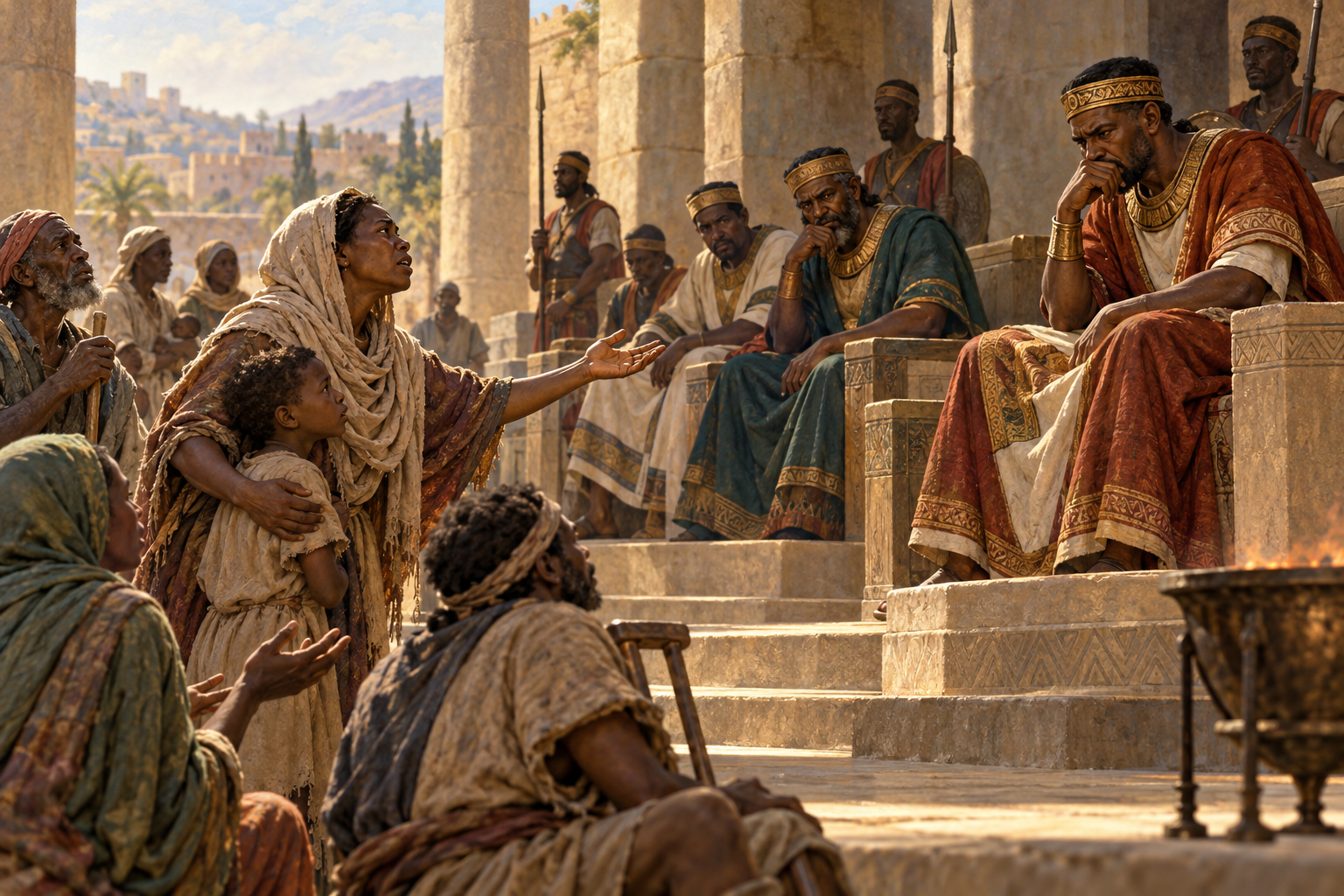
A courtroom falls silent. The accused are not the poor people waiting for a verdict. They are the authorities expected to deliver one. Their failure is written across the lives of those who cannot buy protection, command attention, or compel anyone to listen.
Then the astonishing charge is heard: those entrusted with upholding justice have been favoring the wicked. The case is not merely about corrupt decisions. The very foundations of the earth are shaking.
02
1.0 Introduction
Psalm 82 is only eight verses long, yet it asks a question that reaches from a village tribunal to the nations of the world: What happens when those responsible for justice use their authority to protect the powerful instead of the vulnerable?
In Psalm 80 the community repeatedly pleaded for the Shepherd of Israel to restore his people. Psalm 81 answered with God's call to listen rather than merely celebrate. Psalm 82 moves the question into the public realm. What does faithfulness to God mean where power is exercised, decisions are made, and people without influence wait for help? Listening to God cannot be separated from doing justice.
This psalm is unusual because its main scene is a heavenly assembly. God stands among beings called gods, and the failures of these figures are exposed. Readers disagree about their identity and about who delivers the central accusation. But no credible interpretation can avoid the psalm's repeated demand: protect the vulnerable, do what is right for them, and rescue them from wicked hands.
Central message: All authority is answerable to God, and its moral test is how it treats people least able to defend themselves. When those entrusted with justice abandon that responsibility, the faithful may call upon God to take up the cause of the whole earth.
03
2.0 Historical and Literary Context
The heading associates Psalm 82 with Asaph. It belongs to the Asaph collection in Book Three (Psalms 73–83), where questions of worship, abuse of power, national distress, and God's rule recur. The precise date and worship setting of this psalm cannot be established from its eight verses. Its dramatic language resembles scenes of a heavenly court elsewhere in Scripture (1 Kings 22:19–23; Job 1:6–12; Psalm 89:5–7), but it should not automatically be treated as a reporter's literal transcript of events in heaven.
The central challenge is the Hebrew word ʾelohim. In Psalm 82:1 it is used first of the one God, with a singular verb, and then of the plural figures among whom he stands. There are three influential approaches:
1. Human judges or rulers: Some interpreters understand the “gods” as human officials entrusted with exercising God's justice. This reading emphasizes passages such as Exodus 18:13–26 and the debated use of ʾelohim in Exodus 21:6 and 22:8–9. It gives the commands in verses 2–4 an immediately recognizable social setting. Yet the heavenly-assembly language and the warning that these figures will die like human beings raise difficulties for an exclusively human reading. 2. Subordinate heavenly beings: Other interpreters see a poetic representation of a divine court in which lesser heavenly powers have failed in responsibilities connected to the nations. Derek Kidner considers this reading more suitable to the language of the psalm, and John Goldingay also favors a heavenly setting (Kidner 2014, 327–30; Goldingay 2007, 558–62). Such beings, if intended, are not presented as Yahweh's equals: they stand under his authority and judgment. 3. A polemic against claims of divine power: Some readers see the poem as exposing the pretensions of other deities or systems that claim sacred authority. This approach illuminates the psalm's challenge to unjust power, but reconstructing a precise stage of Israel's religious history from the imagery alone goes beyond what the text proves.
There is a second question: Who speaks in verses 2–7? In the common dramatic reading, God himself indicts the powers and pronounces their sentence. Goldingay argues instead that a human petitioner or prophet speaks throughout the poem, confronting the heavenly figures and finally calling on God to act. The psalm does not identify a new speaker explicitly, so the latter proposal is worth considering, even though the traditional divine-speech reading remains natural (Goldingay 2007, 559–60, 563–68).
The poem moves through four tightly connected scenes:
1. Verse 1: God stands in the assembly and exercises authority among the gods. 2. Verses 2–4: Unjust judgment is challenged, and vulnerable people are named as the ones who must be defended. 3. Verses 5–7: Darkness, shaken foundations, and the downfall of the exalted expose the consequences of injustice. 4. Verse 8: The speaker turns to God: rise and govern the earth, for every nation belongs to you.
The repeated Hebrew verb shaphat, often rendered “judge,” is important. It can describe the exercise of authority; whether that authority is just depends on how it is used. Psalm 82 demands judgment that actively protects those whose rights are being denied (Goldingay 2007, 563–65).
04
3.0 Walking Through the Text
3.1 The highest court opens—but God is not on trial
Psalm 82:1
God stands in an assembly and exercises judgment among those called gods. The image is startling because we might expect the accused to be ordinary wrongdoers. Instead, the spotlight falls on figures associated with authority itself.
In an ancient royal court, a king might stand among officials who had received responsibilities on his behalf. A heavenly-assembly image carries that relationship into the language of poetry. Whatever the status of the subordinate figures, they cannot appeal to an authority above God. His sovereignty is the measure by which their conduct is assessed.
The singular and plural uses of ʾelohim in one verse do not imply that the psalmist regards all the figures as equally divine. They instead sharpen the contrast: the one God holds even the seemingly exalted accountable. If the other figures are understood as heavenly beings, they remain subordinate. If understood as human representatives, their public authority does not free them from judgment. The ethical conclusion survives either reading.
This opening also widens the horizon beyond one corrupt official. The psalm is asking what happens when structures of power—visible or unseen—fail in their responsibility to sustain justice.
3.2 “How long?”—justice is being bent toward the wicked
Psalm 82:2
The first words of the accusation carry both outrage and grief: How long? It is a familiar question from lament psalms, but here it is directed toward those who should be stopping injustice.
The charge has two sides. They are exercising authority in favor of the wicked, and they are showing partiality to people who do wrong. This is more than making an occasional mistaken judgment. It is turning the institution of justice into a means of protecting the very people it should restrain.
Scripture repeatedly forbids such favoritism (Exodus 23:2–3, 6–8; Leviticus 19:15; Deuteronomy 16:18–20). Justice is not the privilege of the highest bidder, the loudest voice, or the closest friend of an official. It is a responsibility exercised under God's regard for truth and human dignity.
Goldingay draws attention to the practical force of “showing favor”: in the image of a petitioner before an authority, someone who comes seeking help may leave able to lift their head. The tragedy in Psalm 82 is that it is the wicked, not the wronged, who are being vindicated (Goldingay 2007, 563–64).
The question “How long?” also refuses to normalize prolonged injustice. The passage gives sufferers language for naming wrongdoing without treating delay as proof that wrongdoing is acceptable.
3.3 Justice must become protection, not merely correct language
Psalm 82:3–4
Four groups now come into focus: the poor, the fatherless, the weak, and the needy. They are named because they have little leverage in systems where influence usually decides who receives help. An orphan in the ancient world might lack not only a parent but also the social protection and resources that made it possible to bring a grievance to court. The poor might have no powerful ally to secure a hearing (compare Deuteronomy 10:18; 24:17–22; Isaiah 1:17).
The commands build in force: uphold the rights of the vulnerable, treat them fairly, rescue them, and deliver them from the wicked. Justice moves from a verdict to an act of protection. A court or leader who knows that someone is being crushed but never acts has not finished the work of justice.
This does not mean that poor people are always right simply because they are poor. Leviticus 19:15 also warns against partiality toward the poor. The point is that those without power must receive the same truthful hearing, legal protection, and practical access to safety as anyone else. Where the vulnerable are being exploited, formal neutrality can become complicity if it protects the stronger party's continuing harm.
The commands apply beyond judges. Parents, pastors, employers, teachers, public servants, and community leaders make choices that can either strengthen the weak or expose them to harm. Psalm 82 asks not how impressive our offices are but who is safer because we exercise them responsibly.
3.4 The foundations shake when justice is abandoned
Psalm 82:5
The poem abruptly says that “they” do not know or understand, that “they” walk in darkness, and that all the foundations of the earth are shaken. The referent of “they” is debated.
Many readers understand it to refer to the unjust authorities: those entrusted with wisdom are themselves morally blind. Goldingay reads it more specifically as the wicked from whose hands the needy must be rescued in verse 4. Kidner offers another possibility: people misgoverned and misled are walking in darkness because those responsible for guiding them have failed (Goldingay 2007, 565–66; Kidner 2014, 329).
Each reading hears a serious consequence of corrupt rule. When right and wrong are confused by the very systems meant to clarify them, the damage spreads far beyond a single case. People stop trusting one another. The disadvantaged withdraw from places where they should find protection. Institutions continue functioning outwardly while their moral foundations erode.
The shaking foundations are poetic language with cosmic force. Justice is not an optional ornament added to an otherwise healthy society. It belongs to the conditions that make shared life possible (compare Psalm 11:3; Isaiah 24:5–6).
This is why injustice grieves God. It is not merely a procedural mistake; it threatens the world in which God's creatures must live together.
3.5 Exalted titles cannot shield anyone from accountability
Psalm 82:6–7
The charge now reaches its sharpest reversal. The figures have been called gods and sons of the Most High. Yet they are told that they will die like human beings and fall like rulers.
If the figures are heavenly powers, the shock lies in the withdrawal of their presumed permanence. Their status cannot protect them from God's judgment. If they are human officials, the sentence exposes the foolishness of regarding their authority as more than human: every officeholder is mortal, and no title makes wrongdoing sacred.
The words “sons of the Most High” should not be confused with the New Testament's teaching about believers becoming God's children through Christ. Here the designation concerns beings addressed within a judgment scene, and it intensifies their responsibility rather than granting them permission to rule without restraint.
Goldingay notes that verse 6 can be heard as the disillusioned psalmist's earlier assessment of the powers, now overturned by what he has seen. The more familiar dramatic reading hears God withdrawing their privileged position. Both lead to the same warning: delegated status is never a license for injustice (Goldingay 2007, 566–68).
There is also a pastoral warning here. A leader may begin with a genuine calling, respected credentials, or an honored title. None of these exempts that person from hearing complaints, admitting harm, or accepting correction. In the psalm, the lofty fall precisely because they have failed the lowly.
3.6 “Rise, O God”—the nations belong to him
Psalm 82:8
The closing line is a prayer: God is asked to rise and exercise justice over the earth because all nations belong to him.
The ending matters. The psalm does not resolve the suffering of the poor by inviting them merely to endure. It asks God to act where delegated responsibility has failed. Neither does it shrink divine concern to Israel alone. All nations stand within God's claim and God's responsibility.
Goldingay emphasizes that the final appeal asks God not simply to announce a verdict in the heavenly assembly but to exercise his authority effectively on earth (Goldingay 2007, 568–70). Kidner likewise sees the poem's dramatic focus turning at last from the mysterious powers to God himself and his saving rule (Kidner 2014, 330).
The verse also prevents despair. The world's brokenness is real, but no earthly or heavenly power can claim final ownership of the people it harms. The earth belongs to God, and the people crying out for justice have the freedom to address him as its rightful ruler.
05
4.0 Theological Reflection
4.1 God measures authority by its service to the vulnerable
Psalm 82 is not impressed by status. It does not ask first whether leaders have been recognized, praised, or feared. It asks what their authority does to those without influence. The orphan, the poor, and the needy are not marginal to God's evaluation of leadership; they are central to it.
This does not erase the need for truthful judgment. It establishes the conditions under which truth is heard: vulnerable people must not be ignored because they lack the means to defend themselves.
4.2 God's sovereignty is a reason to question power, not worship it
The heavenly-assembly imagery denies that authority is ultimate merely because it appears inaccessible. No government, institution, religious hierarchy, spiritual force, or charismatic personality can replace the Lord of the earth.
The more a leader claims sacred legitimacy, the more important the question becomes: does this authority reflect God's concern for righteousness and mercy?
4.3 Unjust systems harm more than their immediate victims
The shaking of the earth's foundations joins moral collapse to social disorder. Corruption teaches people that the rules are different for the powerful; favoritism teaches them that fairness is an illusion. Over time such habits damage families, institutions, and public trust. Psalm 82 treats this destruction as a theological problem, not only a political one.
4.4 Prayer and responsibility belong together
The final request for God to rise does not excuse human passivity. In verses 3–4, the psalm has already stated what justice requires. Those who pray for God to defend the vulnerable cannot consistently turn away when their own decisions could protect someone. Prayer does not replace the work of justice; it keeps that work answerable to a greater Judge.
06
5.0 Canonical and Christological Horizon
Psalm 82 belongs to a larger biblical pattern. Israel's law insists on justice for the orphan, widow, resident foreigner, and poor (Exodus 22:21–24; Deuteronomy 10:17–19; 24:17–22). The prophets rebuke communities whose public worship coexists with exploitation (Isaiah 1:10–17; Amos 5:21–24). Psalm 72 imagines a king whose greatness is shown in his care for the needy. Together these passages explain why the treatment of vulnerable people is not a secondary concern.
The New Testament places Psalm 82 directly in conversation with Jesus. In John 10:34–36, when opponents accuse him of blasphemy, Jesus cites the statement “you are gods.” His immediate purpose is to challenge the logic of their accusation and defend his claim to be the one the Father has consecrated and sent. Scholars differ on whether his quotation evokes human judges, heavenly beings, or the broader scriptural status of those who received God's word. The passage does not establish that every human being is literally a god, nor does it make Psalm 82 a straightforward prediction of Jesus' divinity. Rather, Jesus employs the wording of Scripture in an argument about his own identity and mission; the rest of John 10 turns attention to his works and relation to the Father (John 10:25–38).
Jesus' earthly ministry also makes the ethical demand of Psalm 82 visible. He announces good news to the poor and freedom for the oppressed (Luke 4:16–21), welcomes people pushed aside by respectable society, and judges the nations in a scene where treatment of the vulnerable matters (Matthew 25:31–46). His authority is exercised not by exploiting the weak but by serving and giving his life (Mark 10:42–45).
On the cross, apparent authorities condemn the innocent One. Yet the resurrection vindicates Jesus and announces that corrupt judgment cannot have the final word (Acts 2:22–24; 3:13–15). The New Testament also speaks of powers and authorities being confronted through Christ's victory (Colossians 2:13–15; 1 Corinthians 15:24–28). These are canonical connections, not claims that Psalm 82 explicitly describes the crucifixion.
The psalm's final prayer—God, rise and govern the earth—finds its ultimate Christian horizon in the hope of God's renewed creation. The nations belong to him; therefore the future of the world is not permanent exploitation but a creation in which justice, healing, and God's presence dwell together (Revelation 21:1–5; 22:1–5).
07
6.0 Life Application
- Examine whom your decisions protect. Think of one position of influence you hold—at home, in church, at work, or in the community. Ask whether the people least able to challenge your decisions are being heard and treated fairly.
- Move from sympathy to safe, practical protection. Where someone faces abuse, exploitation, or unfair treatment, consider an appropriate action: careful listening, documented reporting through responsible channels, connecting them with competent help, or ensuring their immediate safety. Do not put vulnerable people at greater risk in the name of helping them.
- Refuse favoritism. Do not alter the truth to favor either wealth or poverty. Ensure that the disadvantaged have a real opportunity to be heard and that powerful people cannot purchase silence.
- Create accountability in spiritual leadership. Churches should have clear ways for people to raise concerns, especially when leaders themselves are involved. Confidentiality, independent review where appropriate, and protection against retaliation matter more than preserving appearances.
- Pray beyond your own group. Psalm 82:8 includes every nation. Name situations of injustice beyond your community, and pray that God's rule will become visible in fair decisions, restraint of violence, and care for those without defenders.
08
7.0 Reflection Questions
- When Psalm 82 describes the world as having shaken foundations, what forms of injustice in our own communities come to mind?
- How does the responsibility to defend the vulnerable differ from giving favored treatment to someone merely because of their social status?
- Why might the language of a heavenly court be important for people who feel that ordinary systems of justice cannot be trusted?
- What changes in our understanding of spiritual authority when even those called “gods” are held accountable?
- What is one concrete step my family, church, or community could take so that vulnerable people can speak and be protected without fear?
09
8.0 Response Prayer
God of the whole earth, no title is higher than your justice, and no voice is too small for your attention.
Where the powerful have silenced the weak, let truth be heard. Where the poor have been denied protection, raise up those who will stand beside them. Where we have benefited from unfairness, show us what repentance must change.
Keep our worship from becoming a shelter for injustice. Give courage to those who must speak, wisdom to those who must decide, and safety to those who are afraid.
Rise, O God, and do what only you can do. Teach us to reflect your fairness and mercy while we wait for your kingdom to be revealed in fullness through Jesus Christ, our righteous Lord.
Amen.
10
9.0 Window into What Comes Next
Psalm 82 ends with a sweeping appeal: all nations belong to God. Psalm 83 then introduces a disturbing tension. Nations are not simply distant people who need good government; in the next psalm they appear as a coalition threatening to erase Israel's identity.
How can the God who claims all nations govern a world where nations turn against one another? How can prayer for justice remain faithful without becoming hatred? Psalm 83 brings those questions into the open. The movement from Psalm 82 to Psalm 83 invites readers to hold together God's universal rule, his concern for endangered people, and the hope that even hostile nations might finally acknowledge his name.
11
10.0 Bibliography
The Bible. Psalm 82; Exodus 18:13–26; 21–23; Deuteronomy 10:17–19; 16:18–20; 24:17–22; 1 Kings 22:19–23; Job 1:6–12; Psalms 11; 72; 81; 83; 89; Isaiah 1:10–17; 24:21; Amos 5:21–24; Daniel 10; Luke 4:16–21; Mark 10:42–45; John 10:25–38; Acts 2–3; Colossians 2:13–15; 1 Corinthians 15:24–28; Revelation 21–22. The key-text statement is an authored summary, not a verbatim Bible quotation.
BibleProject. The Book of Psalms: Study Notes. Project reference material, especially its account of Book Three and the Asaph psalms.
Goldingay, John. 2007. Psalms, Volume 2: Psalms 42–89. Baker Commentary on the Old Testament Wisdom and Psalms. Grand Rapids, MI: Baker Academic, 558–70.
Kidner, Derek. 2014. Psalms 73–150. Kidner Classic Commentaries. Downers Grove, IL: IVP Academic, 327–30. First published 1975.
Be the first to leave a comment.